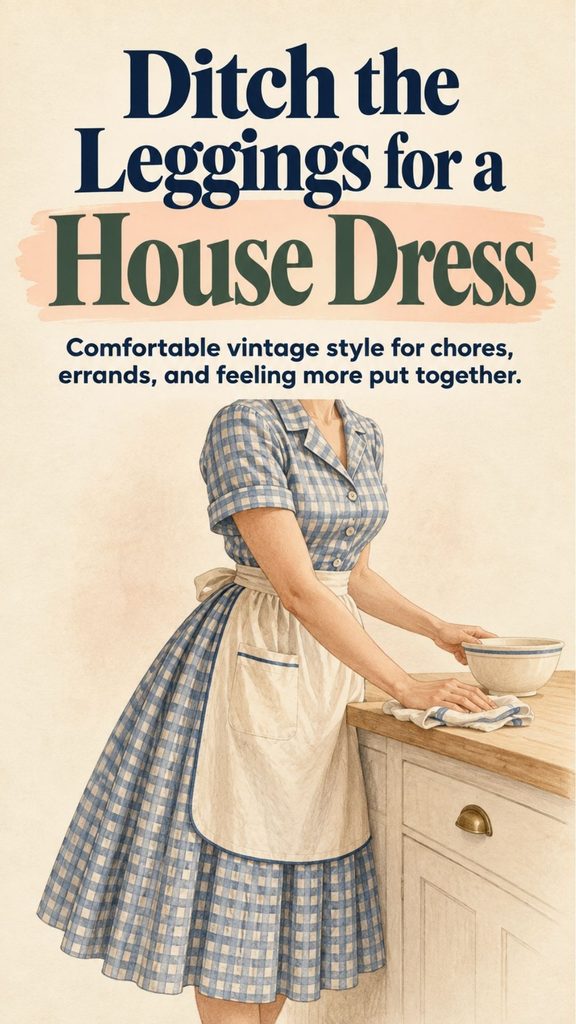
Leggings, sweatpants, and pajamas are comfortable for a reason. There is absolutely nothing wrong with wearing them at home.
But if you have ever noticed that getting properly dressed changes how you feel about the day, a simple house dress can be a surprisingly enjoyable alternative.
A house dress combines many of the things people love about lounge clothes—soft fabric, freedom of movement, easy washing—with the feeling of being a little more put together.
You Might Also Like:
- Loading posts...
You can cook in it.
Clean in it.
Work from home in it.
Answer the door without scrambling to change.
Add a cardigan or nicer shoes, and many styles are perfectly suitable for errands as well.
The idea is not to recreate an idealized 1950s housewife or suggest that women should look polished while doing housework. It is simply to borrow one practical piece of vintage homemaking: comfortable everyday clothing designed specifically for life at home.
What Is a House Dress?
Traditionally, a house dress was an everyday dress intended for household work.
It was not an evening dress or formal outfit.
It was practical clothing.
House dresses were often made from washable fabrics and designed to allow movement while cooking, cleaning, caring for children, gardening, or doing other everyday work.
Common styles included:
shirtwaist dresses,
button-front dresses,
wrap dresses,
loose A-line dresses,
simple cotton day dresses,
and roomy dresses worn with aprons.
The details varied considerably by decade and household.
The most useful modern definition is even simpler:
A house dress is a comfortable, washable dress you are happy to live and work in at home.
It does not have to be authentically vintage.
It does not need a full skirt.
It does not need lace, heels, pearls, or a perfectly tied apron.
If it is comfortable enough for ordinary work and makes you feel good wearing it, it qualifies.
Why Wear a Dress at Home?
For some people, getting dressed creates a clear transition between sleeping and starting the day.
That is probably one reason house dresses still appeal to people who spend a great deal of time at home.
Putting on real clothes can signal:
The day has started.
You may feel more prepared to tackle laundry, cooking, paperwork, homeschooling, gardening, or work.
That does not mean clothing magically creates productivity.
Nor should anyone feel guilty for needing a pajama day.
But routines affect how we approach the day, and clothing can be part of that routine.
If you already know that staying in sleepwear until afternoon makes you feel sluggish, changing into something comfortable may be a useful habit.
A house dress simply offers another option besides jeans or athletic wear.
Comfort Comes First
A practical house dress should feel easy.
If you cannot bend, reach, sit on the floor, carry a laundry basket, or move freely in it, it is probably not a very good house dress.
Look for room through the shoulders.
Make sure the waist does not dig in when you sit.
Check whether the skirt allows a normal walking stride.
Raise your arms.
Bend down.
Sit in a chair.
If possible, perform those movements before deciding whether a dress is truly suitable for everyday wear.
A beautiful dress that requires constant adjustment will end up hanging in the wardrobe.
The one you reach for repeatedly is usually the winner.
Choose Washable Fabric
House clothes get used.
They encounter flour, dishwater, cleaning splashes, garden soil, pet hair, children’s hands, and dinner.
That means easy care matters.
Cotton can be an excellent choice because it is comfortable and breathable, although different cotton fabrics vary considerably in weight and wrinkle resistance.
Cotton blends may require less ironing.
Jersey knit can feel almost as comfortable as a T-shirt while still looking like a dress.
Linen is breathable but often wrinkles readily.
Rayon or viscose can feel soft and cool, but some garments require gentler washing.
Always check the care label.
For an everyday house dress, a machine-washable fabric you already know how to care for is usually more useful than a delicate fabric requiring special treatment.
Pockets Make a House Dress Better
If there is one feature worth actively looking for, it may be pockets.
Housework somehow produces a constant stream of small objects.
A clothespin.
A tissue.
A grocery list.
Your phone.
A child’s toy.
A packet of seeds.
A screwdriver you were supposed to put away ten minutes ago.
Good pockets are extraordinarily useful.
Side-seam pockets can work beautifully if they are deep enough.
Patch pockets are even easier to access and add a charming vintage look.
Tiny decorative pockets that cannot hold anything are far less helpful.
When shopping or sewing, check whether the pockets are genuinely functional.
Shirtwaist Dresses Are a Classic Choice
The shirtwaist dress is closely associated with mid-century everyday fashion.
It usually has a structured or semi-structured bodice resembling a button-up shirt, a defined waist, and a skirt below.
Modern versions can range from fitted and polished to soft and casual.
For housework, look for one with enough ease through the arms and torso.
A very tight fitted bodice may look beautiful but become uncomfortable after several hours.
A softer cotton version with usable pockets can give you the vintage appearance without turning ordinary chores into a costume.
Wrap Dresses Are Easy and Adjustable
Wrap-style dresses can make excellent house dresses because the fit is somewhat adjustable.
They are particularly useful when your body fluctuates slightly in size.
Look carefully at the neckline, though.
A wrap dress intended for going out may be cut lower than you want for bending, cleaning, or working around children.
A camisole underneath can solve that problem, or you can choose a higher-cut faux-wrap style.
Also make sure the ties are secure and will not dangle into anything while you work.
A-Line and Loose Dresses Are Extremely Practical
You do not need a defined vintage waist.
A simple A-line dress can be one of the easiest styles to wear around the house.
It hangs away from the body, allows plenty of movement, and can often be pulled over the head in seconds.
A loose T-shirt dress can serve the same purpose.
These styles are particularly good for warm weather or anyone who dislikes waistbands.
If your idea of a house dress is essentially an extra-long comfortable shirt with pockets, that is perfectly valid.
Consider the Length
A very long skirt can be inconvenient during active housework.
You do not want fabric catching under your feet on stairs or dragging near wet floors.
At the other extreme, a very short dress may feel awkward when bending or sitting.
Around-knee, midi, and modestly below-knee lengths are popular for a reason: they generally offer a useful balance of coverage and mobility.
The best length depends on your height, preferences, and the kind of work you do.
Pay Attention to Sleeves
Sleeves matter more in a work dress than you might expect.
Long loose sleeves can dip into dishwater or food.
Very tight sleeves can restrict movement.
For cooking and cleaning, short sleeves, elbow-length sleeves, or sleeves that can easily be rolled and secured are often convenient.
If you love long sleeves, make sure they stay put when pushed up.
The most practical garment is one you do not have to constantly manage.
Add an Apron for Messy Work
One reason vintage house dresses were so often paired with aprons is simple: aprons protect clothes.
You do not need to change your entire dress because you spilled tomato sauce while cooking.
Put on an apron for:
baking,
frying,
washing dishes,
canning,
crafting,
painting,
gardening,
or especially messy cleaning jobs.
A full apron offers more protection than a waist apron.
Large pockets make it even more practical.
Aprons can also be one of the easiest ways to enjoy vintage style without committing to an entirely vintage wardrobe.
Think About Safety While Doing Chores
Vintage-looking clothing still needs modern common sense.
Avoid long flowing sleeves around open flames.
Keep loose scarves, ties, and dangling accessories away from stovetops and machinery.
If you are using power tools or garden equipment, wear clothing appropriate for the task rather than prioritizing appearance.
Wear closed, supportive footwear when moving heavy objects or doing work where dropped tools could injure your feet.
A house dress is everyday clothing, not protective equipment.
Change when the job requires something safer.
You Don’t Need Heels to Complete the Look
Vintage illustrations often show housewives doing chores in heels.
You do not need to recreate that detail.
Comfortable flats, supportive house shoes, sneakers, sandals, or bare feet where appropriate make much more sense for ordinary home life.
If you enjoy heels, save them for situations where you actually want to wear them.
The purpose of a house dress is to make home life comfortable, not to perform a historical stereotype.
Layer It Through the Seasons
A good house dress does not need to disappear when summer ends.
In cool weather, add:
a cardigan,
a fitted sweater,
tights or leggings underneath,
warm socks,
or a lightweight base layer.
Yes, you can even wear leggings underneath your house dress.
There are no rules.
A lightweight cotton dress that works alone in summer may become surprisingly useful in autumn with layers.
In very cold weather, heavier knit dresses may be more practical.
Build a Small House-Dress Rotation
You do not need a wardrobe full of dresses.
Three or four easy-to-wash options may be plenty.
For example:
one dark practical dress for messier days,
one light cotton dress for warm weather,
one comfortable knit dress,
and one slightly nicer house dress that can go directly from home to errands.
If you do laundry frequently, you might need even fewer.
Start with one.
See whether you actually enjoy wearing it.
There is no reason to buy ten dresses before discovering whether the lifestyle suits you.
Shop Your Closet First
You may already own a house dress without realizing it.
Look for dresses you rarely wear because they feel too casual for special occasions but are too comfortable to discard.
Try wearing one around the house.
Can you move easily?
Can it be washed normally?
Would you be upset if you splashed a little flour or coffee on it?
If the answers are favorable, you have probably found your first house dress.
Repurposing something you already own is far cheaper than shopping for an entirely new “vintage lifestyle.”
Secondhand Shops Can Be Excellent
House dresses do not need to be expensive.
Thrift shops, vintage stores, consignment shops, and online secondhand marketplaces can be good places to look.
Search beyond the phrase “house dress.”
Try terms such as:
shirt dress,
cotton day dress,
button-front dress,
A-line dress,
tea dress,
wrap dress,
or vintage-inspired dress.
Shopping by useful features often produces better results than shopping by label.
Look for washable fabric, comfortable cut, suitable length, and pockets.
Vintage Clothing and Vintage-Inspired Clothing Are Different
An authentic 1950s dress can be beautiful, but original vintage garments come with limitations.
Fabric may be fragile.
Sizing may differ substantially from modern sizing.
Seams, elastic, buttons, and zippers may need repair.
Some vintage fabrics cannot tolerate modern washing methods.
An original garment may therefore be better saved for occasional wear.
Vintage-inspired clothing gives you the silhouette or print while using newer fabric and construction.
For everyday household work, that may be far more practical.
You can appreciate vintage fashion without insisting that every garment be historically authentic.
Sewing Your Own House Dress Is Another Option
The house dress is a particularly good sewing project because the garment does not need to be formal.
Choose a pattern with comfortable ease and straightforward construction.
Useful features to add include:
deep pockets,
a washable fabric,
an easy closure,
a slightly generous seam allowance,
and enough skirt width to move freely.
If you already have a favorite dress, you can use its fit as inspiration when choosing a pattern.
Do not begin with an extremely complicated 1940s or 1950s reproduction pattern if you are new to sewing unless you genuinely want the challenge.
A simple modern pattern in a vintage-looking fabric may give you exactly the effect you want.
Novelty Prints Make Everyday Clothes Fun
One joyful feature of vintage-inspired clothing is the abundance of prints.
Florals.
Cherries.
Strawberries.
Checks.
Polka dots.
Kitchen motifs.
Books.
Cats.
Seasonal designs.
You are allowed to wear clothing simply because it makes ordinary Tuesday morning more cheerful.
A playful print can transform a very simple dress.
If you prefer a quieter wardrobe, solid colors and small florals can provide the same practical benefits.
Don’t Save All Your Favorite Clothes for “Best”
Many people own clothes they like but rarely wear because they are saving them.
For what?
If a washable cotton dress makes you happy, you can wear it while making soup.
Clothing is meant to be used.
Of course, some delicate or expensive garments deserve special care.
But everyday clothes become worthwhile precisely because they participate in everyday life.
You may remember baking with your children in that blue floral dress far longer than you remember keeping it perfectly preserved in the wardrobe.
Getting Dressed Can Become Part of Your Morning Routine
A simple morning rhythm might be:
get up,
wash and get ready,
make the bed,
put on a comfortable house dress,
open the curtains,
and begin the day.
There is no requirement to style your hair perfectly or put on makeup.
The act of changing from sleepwear into daytime clothing may be enough to create separation between rest and activity.
For people who work from home or spend most of the day caring for a household, that transition can be useful because there is no commute naturally creating it.
But Pajamas Are Sometimes Exactly What You Need
Not every day needs a dress.
If you are sick, recovering from childbirth, exhausted, dealing with a difficult season, or simply taking a quiet day off, comfortable pajamas may be exactly right.
A house dress should never become another standard you have to meet before considering yourself a successful homemaker.
Clothes should serve your life.
Your life should not revolve around maintaining an aesthetic.
Don’t Shame the Leggings
The phrase “ditch the leggings” is fun, but leggings are popular because they are genuinely practical.
They stretch.
They layer.
They wash easily.
They work for exercise.
They are comfortable while crawling around the floor with children or tackling physical tasks.
You do not have to choose one side.
Wear a dress Monday.
Leggings Tuesday.
Jeans Wednesday.
Pajamas Saturday morning.
There is no homemaking uniform.
The useful question is simply:
What helps me feel comfortable and ready for the kind of day I am having?
Sometimes the answer may be a vintage-inspired dress.
A House Dress Can Be Practical Without Becoming a Costume
There is a difference between enjoying vintage style and feeling as though you must reenact every detail of another era.
Keep the parts that improve your life.
The washable cotton.
The pockets.
The apron.
The comfortable silhouette.
The cheerful print.
The routine of getting dressed.
Leave behind anything that is uncomfortable, impractical, restrictive, or simply not you.
That is one of the nicest things about vintage-inspired homemaking.
You can borrow selectively.
The Best House Dress Is the One You Actually Wear
Forget the perfect 1950s silhouette for a moment.
Your ideal house dress might be a button-front floral dress with a full skirt.
It might be a stretchy black midi dress.
It might be a loose cotton shift.
It might be a jersey wrap dress.
It might be something handmade from a cheerful fabric.
The details matter less than the experience.
You should be able to move.
You should be able to wash it.
You should not spend the entire day adjusting it.
And ideally, when you catch your reflection halfway through an ordinary day, you should think:
I like wearing this.
That is enough.
House dresses were practical clothing long before they became part of modern vintage aesthetics. That practicality is still worth rediscovering.
So keep the leggings if you love them.
But if you are tired of feeling as though your only choices at home are pajamas, workout clothes, or stiff jeans, try one comfortable dress.
Add pockets.
Throw on an apron.
Wear practical shoes.
Then get on with your day.
You may find that an old-fashioned idea fits surprisingly well into modern home life.