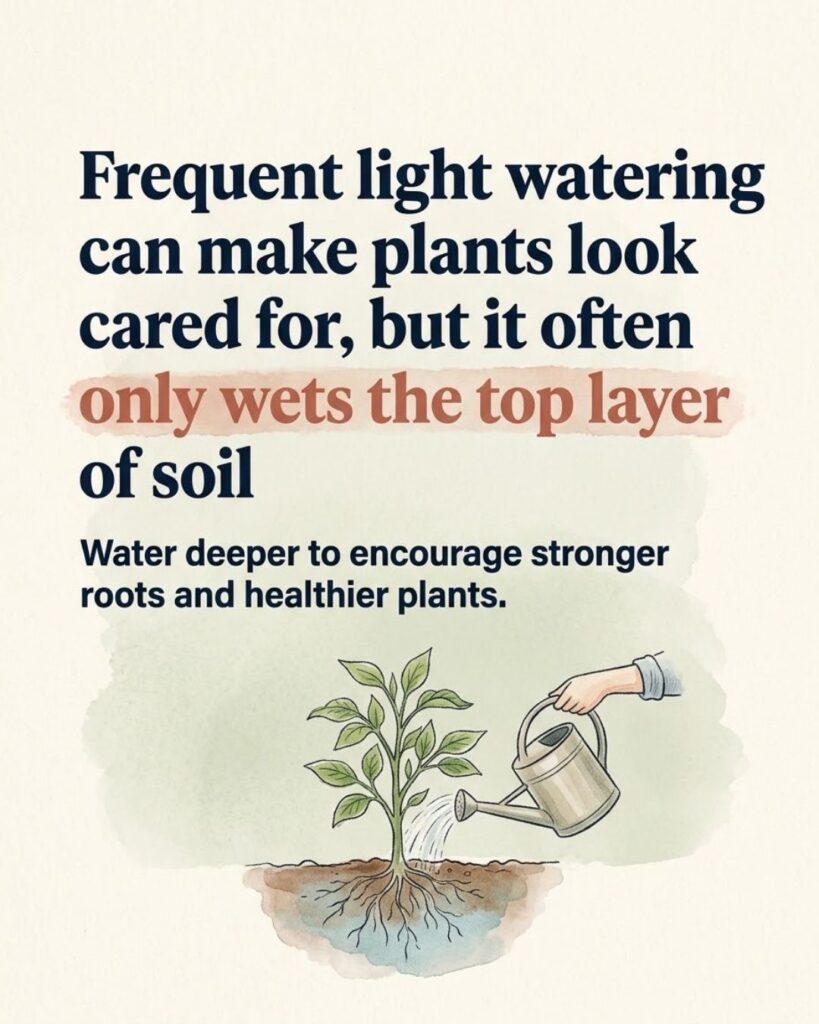
Watering every day can feel like good garden care, especially during hot weather. The soil surface looks dry, the leaves may appear thirsty, and a quick pass with the hose seems like the obvious answer. But repeatedly wetting only the top inch or two of soil may not give established plants the moisture they actually need.
For many vegetables, flowers, shrubs, and other established plants growing in the ground, a slower and deeper watering is generally more useful than frequent shallow sprinkling. The goal is to moisten the part of the soil where active roots are growing rather than simply making the surface look wet.
That does not mean every plant should be watered deeply on the same schedule. Seedlings, new transplants, containers, sandy soils, heavy clay soils, and established garden plants all behave differently. Good watering is less about following a fixed calendar and more about understanding what is happening below the soil surface.
You Might Also Like:
- Loading posts...
Why Shallow Watering Can Be a Problem
A short watering session may darken the soil and make the garden look thoroughly watered, while the soil only an inch or two below remains dry.
That creates a problem because roots need access to moisture throughout the soil profile.
If water repeatedly reaches only the surface, much of it may evaporate quickly during hot, dry, or windy weather. Plants can then experience moisture stress soon after watering because the deeper soil never received enough water.
Repeated shallow irrigation can also encourage a greater concentration of roots near the surface in some situations. Those shallow roots are exposed to faster temperature changes and quicker drying than roots growing farther down.
The better approach for many established plants is to apply enough water that moisture moves well below the surface.
What “Deep Watering” Actually Means
Deep watering does not mean flooding the garden.
It means applying water slowly enough, and in sufficient quantity, for moisture to move into the plant’s root zone instead of running away across the soil surface.
Imagine pouring a large amount of water onto dry ground all at once. If the soil cannot absorb it quickly enough, much of that water may pool or run away. Giving the same amount more slowly may allow significantly more of it to soak into the ground.
That is why watering duration alone does not tell you whether you have watered deeply.
Soil type, irrigation method, slope, mulch, weather, and how dry the soil was beforehand all affect how far water penetrates.
The real question is simple:
How deep is the soil actually moist after you finish watering?
Check the Soil Instead of Guessing
One of the easiest ways to improve watering is to stop judging moisture only by the appearance of the surface.
After watering, check below it.
For a quick test, push a finger several inches into loose soil. If the surface feels wet but the soil underneath is noticeably dry, the watering session probably did not penetrate very far.
For deeper-rooted plants, you can get a better idea by using a small garden trowel. Carefully dig beside the plant, away from the main stem, and examine the soil several inches down.
You do not need to do this every time you water. Checking periodically teaches you how your particular soil responds.
For example, you may discover that:
- Ten minutes with a sprinkler barely wets the surface.
- A slow drip reaches significantly deeper.
- One garden bed drains much faster than another.
- Mulched soil stays moist considerably longer than bare soil.
Those observations are more useful than blindly following a rule such as “water every two days.”
Soil Type Changes Everything
Two gardeners can apply the same amount of water and get completely different results because their soils behave differently.
Sandy Soil
Sandy soil contains relatively large particles and drains quickly.
Water can move through it rapidly, which means plants growing in sandy ground may require watering more often than plants in soils that hold moisture longer.
Trying to compensate by dumping a huge quantity of water on sandy soil at once is not necessarily helpful. Some of that moisture may simply move beyond the most active part of the root zone.
Slower watering and more frequent moisture checks are useful.
Clay Soil
Clay holds water much longer, but it usually absorbs it more slowly.
If you run a hose quickly over heavy clay, water may begin pooling or running across the surface before it has penetrated deeply.
Using a slower application rate can help.
In very compacted soil, improving soil structure over time with appropriate organic matter may also help water infiltrate more effectively.
Loamy Soil
Loam generally provides a useful balance between moisture retention and drainage, although real garden soils rarely fit perfectly into one category.
Even good soil still needs to be checked because weather and plant size continually change how quickly moisture is used.
Established Plants and Seedlings Need Different Treatment
Deep, less-frequent watering is useful advice for many established plants, but applying that rule indiscriminately can harm young plants.
A newly germinated seedling has a tiny root system close to the surface.
If you water deeply and then allow the top several inches of soil to become dry before watering again, that seedling may not be able to reach the moisture below.
Seeds and very young seedlings often need the upper soil layer kept more consistently moist during establishment.
Water them gently so you do not wash seeds away or damage tender stems.
As plants mature and their root systems expand, watering practices can gradually shift toward encouraging deeper moisture.
Fresh Transplants Need Extra Attention Too
A plant that has just been moved from a nursery pot into the garden may look large above ground while still having a relatively compact root ball.
Until roots begin growing into the surrounding soil, that plant cannot draw moisture from a large area.
Fresh transplants therefore often need closer monitoring than established plants.
Water the root ball thoroughly at planting and keep checking moisture around it during the establishment period.
As the roots spread, watering can generally become less frequent and cover a wider area around the plant.
Avoid assuming that because the surrounding garden soil feels damp, the original root ball must also be moist. Different soil mixes can dry at different rates.
Containers Are a Different Situation
The advice to “water less often” should be used cautiously with containers.
A pot contains a limited amount of soil. It cannot draw moisture from surrounding ground, and containers can dry rapidly during warm weather.
Several factors make pots particularly vulnerable to drying:
- Small soil volume
- Hot temperatures
- Wind
- Large mature plants
- Porous container materials
- Dark pots exposed to direct sunlight
- Containers placed on hot patios or pavement
A large vegetable growing in a container during midsummer may need water far more frequently than the same plant growing in a mulched garden bed.
When watering containers, apply enough water to moisten the potting mix thoroughly. Containers should also have functioning drainage holes so excess water can escape.
Then check the soil before the next watering rather than assuming every container needs the same schedule.
Water Slowly Enough for the Soil to Absorb It
Speed matters.
If your hose delivers water faster than the soil can absorb it, increasing the flow does not necessarily water the plant better.
A slow application gives water time to infiltrate.
Useful methods can include:
Soaker Hoses
A soaker hose releases water gradually along its length and can work well in vegetable beds and around rows of plants.
Drip Irrigation
Drip systems apply water directly near the root zone at a controlled rate. They can reduce unnecessary wetting between plants and make consistent watering easier.
A Hose at Low Flow
You do not need an irrigation system to water deeply.
A regular hose turned to a gentle flow and left near the root zone can work perfectly well. Move it around larger plants when necessary so moisture reaches more than one small spot.
Watering Cans
Watering cans are particularly useful for seedlings, containers, and smaller gardens because you can control where the water goes.
Whatever method you choose, periodically check how deeply the water has traveled.
Don’t Water Only at the Stem
Another common mistake is placing all the water directly against a mature plant’s stem.
Roots spread outward as plants grow.
For established plants, water should generally reach the soil around the root zone rather than concentrating permanently in one tiny circle against the stem.
The size of that zone depends on the plant.
A mature tomato, for example, occupies far more underground space than it did when first transplanted. As the plant grows, your watering area should reflect that expansion.
Trees and shrubs require their own watering practices and should not be treated exactly like annual vegetables.
Mulch Helps Soil Hold Moisture Longer
A layer of mulch can make deep watering more effective by reducing evaporation from the soil surface.
Suitable garden mulches may include materials such as:
- Straw
- Shredded leaves
- Wood chips in appropriate areas
- Other clean organic mulch materials
Mulch also moderates soil temperature and can reduce weed growth.
Avoid piling thick mulch directly against plant stems. Leave a little breathing space around the base.
Mulch does not mean the garden never needs watering. It simply slows moisture loss, which can extend the time between watering sessions.
Always check underneath the mulch rather than assuming the soil is moist because the surface is covered.
Morning Is Often a Convenient Time to Water
For many gardens, morning is a practical watering time.
Temperatures are usually cooler than they will be later in the day, so less water may be lost immediately to evaporation. Plants also begin the hotter part of the day with moisture available in the soil.
That said, a severely dry plant should not be left struggling simply because it is not morning.
If a plant genuinely needs water, water it.
The more important priorities are getting moisture into the soil and avoiding waste.
What About Wetting the Leaves?
Watering the soil directly is generally preferable to repeatedly soaking foliage when you have a choice.
Drip irrigation and soaker hoses are useful partly because they concentrate water near the roots.
If you use overhead irrigation, watering earlier in the day allows foliage more opportunity to dry than watering late in cool conditions.
Leaf wetness can contribute to some plant diseases, although disease development depends on the pathogen, plant, temperature, humidity, and duration of wetness. Simply getting a leaf wet does not automatically make a plant diseased.
The main goal is to put most of the water where the plant needs it: in the soil.
Signs You May Be Watering Too Shallowly
You may need to reconsider your watering method if:
- The surface becomes wet but dries again very quickly.
- Soil a few inches down remains dry immediately after watering.
- Watering sessions are extremely short.
- Plants repeatedly wilt soon after the surface dries.
- You are watering from habit rather than checking soil moisture.
Do not diagnose every wilting plant as underwatered, however.
Plants can wilt temporarily during extreme afternoon heat even when soil contains adequate moisture. Overwatering, damaged roots, disease, and other problems can also cause wilting.
Check the soil before reaching automatically for the hose.
Deep Watering Does Not Mean Keeping Soil Constantly Wet
There is an important difference between moist soil and waterlogged soil.
Plant roots need oxygen as well as water.
Soil that remains saturated for too long can create poor conditions for many garden plants and contribute to root problems.
Good watering should generally create a cycle in which soil becomes thoroughly moist and then gradually loses some moisture before irrigation is needed again.
Exactly how much drying is appropriate depends on the plant.
A vegetable garden, a drought-tolerant perennial bed, and a container of moisture-loving plants should not all be managed the same way.
Weather Should Change Your Watering Schedule
A rigid calendar rarely works for an entire growing season.
Your garden’s water use can change dramatically from one week to another.
Consider:
- Recent rainfall
- Temperature
- Wind
- Humidity
- Plant size
- Flowering and fruit production
- Soil type
- Mulch
- Sun exposure
A newly planted tomato in mild spring weather may use relatively little water. The same plant, much larger and carrying fruit during a hot spell, can draw substantially more moisture from the soil.
Instead of saying, “I water every Tuesday and Friday,” think, “I check the soil regularly and water thoroughly when the root zone needs moisture.”
That small change in thinking can prevent both unnecessary watering and drought stress.
A Better Watering Habit for Stronger Garden Plants
Frequent light sprinkling is tempting because it is quick and the garden immediately looks refreshed. But the appearance of wet soil is not proof that water has reached the roots.
For established plants growing in the ground, a slower, more thorough watering followed by an appropriate period between waterings is often more effective than wetting only the surface every day.
There are important exceptions. Seeds, young seedlings, fresh transplants, and container plants usually need more frequent attention because their accessible root zones are smaller or their soil dries more quickly.
The simplest improvement is also one of the most reliable: check the soil below the surface.
Water slowly. See how deeply the moisture travels. Adjust for your soil, weather, and the stage of plant growth. As roots expand, widen the area you water and allow moisture to reach farther into the ground.
The best watering schedule is not the one that keeps you holding a hose every day. It is the one that delivers enough water to the root zone when the plants actually need it.