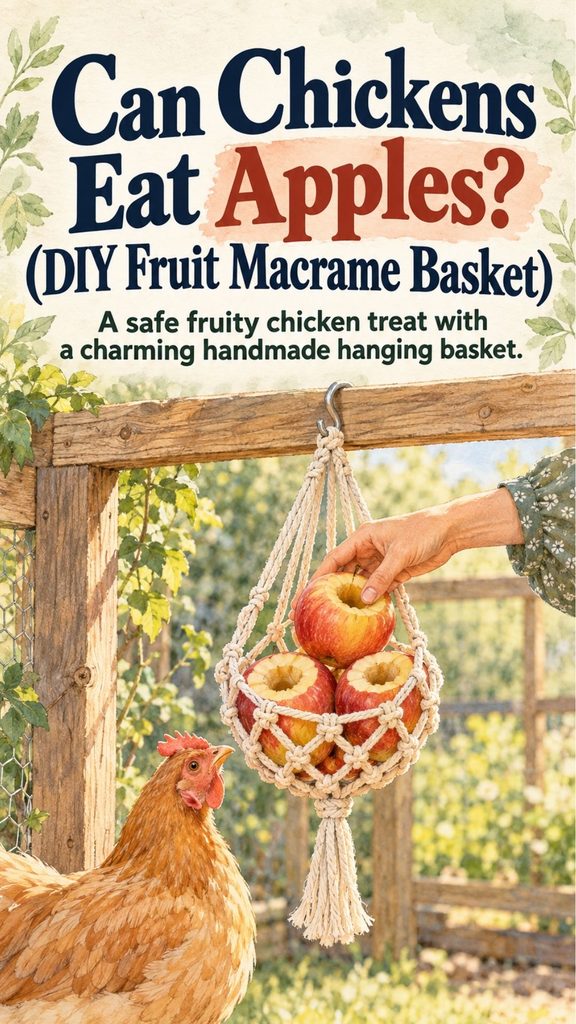
If you keep backyard chickens, you probably already know how quickly they gather whenever something interesting appears in their run. A handful of garden greens, a few vegetable scraps, or a piece of fresh fruit can turn an ordinary afternoon into a little flock-wide celebration.
Apples are one of the fruits chickens can enjoy, and they offer a useful way to share suitable kitchen scraps or make use of extra apples during harvest season.
But there are a few things worth knowing before tossing whole apples into the chicken coop.
You Might Also Like:
- Loading posts...
While the flesh and skin are generally safe for chickens, apple seeds should be removed as a precaution. Fruit should also be offered as an occasional treat rather than replacing the nutritionally balanced feed that chickens need every day.
One enjoyable way to serve apples is with a homemade hanging fruit basket. Using ordinary macrame cord, you can create a simple net-style holder that suspends apple pieces off the ground and gives your flock something interesting to peck at.
This project combines a little old-fashioned crafting with practical backyard chicken keeping.
Can Chickens Safely Eat Apples?
Yes, chickens can eat apples, including the flesh and properly washed skin.
Fresh apples contain water, natural carbohydrates, dietary fiber, and small amounts of vitamins and minerals. They can provide variety in a chicken’s diet, especially when offered alongside other suitable fruits and vegetables.
However, apples are not a substitute for complete poultry feed.
A laying hen has specific nutritional requirements, particularly for protein, calcium, energy, vitamins, and minerals. A properly formulated layer feed is designed to meet those needs more consistently than kitchen scraps.
Treats should therefore make up only a small portion of the overall diet. A commonly recommended guideline is to keep supplemental treats to approximately 10% or less of daily food intake.
Think of apples as something enjoyable to offer occasionally, not something your chickens need to eat every day.
Which Parts of an Apple Can Chickens Eat?
Not every part of an apple should automatically go into the chicken run.
Apple flesh: Safe to offer in appropriately sized pieces. Fresh, firm apples are preferable to fruit that has begun to rot.
Apple skin: Generally safe when washed. There is no need to peel every apple before sharing it with your flock.
Apple cores: Best removed before feeding, particularly because they contain the seeds and tougher central portions.
Apple seeds: Remove these as a precaution. Apple seeds contain amygdalin, a naturally occurring compound that can release cyanide when the seeds are crushed or digested.
Accidentally swallowing an occasional intact seed is not the same as consuming a toxic dose, but deliberately feeding apple seeds is unnecessary when they are so easy to remove.
Also remove produce stickers and any visibly spoiled sections.
Can Chickens Eat Apple Peels?
Apple peels are particularly convenient for households that frequently bake pies, prepare applesauce, or peel fruit for children.
Instead of immediately throwing the skins away, you can set aside clean, suitable peelings for your chickens.
Wash the apples before peeling them, remove stickers, and cut unusually long strips into shorter pieces if needed.
Offer peelings fresh rather than allowing them to sit in a damp pile for several days.
Do not feed moldy, fermented, or rotten apple scraps.
Why Use a Hanging Fruit Basket for Chickens?
You can certainly serve prepared apple pieces in an ordinary chicken feeder or clean dish.
However, a hanging basket offers a different way to present the treat.
A properly designed hanging feeder keeps the fruit in a designated location and allows chickens to investigate and peck at it.
It can also provide a form of environmental enrichment.
Chickens naturally spend much of their time exploring, scratching, and searching for food. Giving them appropriate opportunities to interact with their surroundings can encourage some of these normal behaviors.
A hanging fruit holder is especially appealing because it can be made with inexpensive materials.
The main consideration is safety. Loose string, oversized loops, exposed hooks, and fraying cord can create entanglement or ingestion hazards, so any homemade hanging feeder should be carefully constructed, inspected, and used under supervision.
Materials Needed for a DIY Chicken Fruit Basket
This macrame basket uses a simple knotted-net design.
You will need:
- Seven lengths of sturdy natural macrame cord, each approximately 7 feet long.
- Sharp scissors.
- One sturdy S-hook or preferably a secure, closable hanging hook.
- One temporary rubber band.
- A measuring tape.
- Fresh apples with their cores and seeds removed.
Six lengths of cord will form the basket, while the seventh will be reserved for securing the gathered ends at the top.
Choose strong cord that is suitable for the project and inspect it for loose fibers. Avoid chemically treated or heavily fraying rope.
Remember that natural cord is still not edible. Replace the basket if your chickens begin pulling apart or swallowing the fibers.
How to Make a DIY Macrame Fruit Basket
The basket is built by joining folded cords into a circular base and then creating several rows of alternating knots.
The result is a flexible net that can hold a small quantity of prepared fruit.
Step 1: Cut the Macrame Cord
Measure and cut seven equal lengths of cord, approximately 7 feet each.
Set one entire length aside.
You will use this final piece later to wrap and secure the gathered strands near the hanging hook.
Keep the remaining six lengths together for the basket construction.
Step 2: Create the Base Cord
Take one of the six working cords and fold it exactly in half.
Bring the ends together so both sides are approximately equal in length.
This folded piece will act as the central base cord to which the additional cords are attached.
Lay it on a clean, flat working surface.
Step 3: Attach the Remaining Working Cords
Take another length of cord and fold it in half.
Position the folded loop underneath the base cord.
Bring the two loose ends over the base and pass them through the folded loop, creating a lark’s head knot.
Pull gently to secure it.
Repeat this process with the remaining four working cords.
You should now have five folded cords attached to the original base cord.
Step 4: Form the Circular Bottom
Bring the two loose ends of the original base cord through its folded loop.
Carefully tighten the arrangement so the attached cords gather together to create a circular center.
Adjust the strands until they are reasonably evenly distributed around the circle.
Tie the base cord securely near the center to prevent the arrangement from loosening.
This central section will form the bottom of your hanging fruit basket.
Step 5: Make the First Row of Netting
Spread the loose strands outward so you can clearly see the individual groups of cord.
Take one strand from a neighboring pair of cords and join it with the closest strand from the next group.
Tie the two strands together approximately 1½ inches away from the circular base.
Move around the basket, repeating the same method with neighboring strands.
Keep the spacing as consistent as possible.
By connecting strands from adjacent groups rather than simply tying the original pairs together, you begin creating a net-like pattern.
Step 6: Add the Second Row
Move approximately another 1½ inches away from the previous row of knots.
Take one cord from one knotted section and join it to the nearest cord from the neighboring section.
Repeat around the entire basket.
These alternating connections gradually form diamond-shaped openings.
As the net develops, the macrame will begin curving naturally instead of lying flat.
That is exactly what you want.
Step 7: Continue Building the Basket
Repeat the alternating knotting process until you have approximately five complete rows.
Keep checking that the openings are reasonably uniform and that the knots remain secure.
Five rows can create a basket suitable for holding a few medium-sized apples, depending on the cord thickness, knot spacing, and fruit size.
Before using the basket, test it with prepared fruit to make sure the pieces cannot fall through the openings.
If the fruit slips out, adjust the mesh or use a different feeder.
Step 8: Gather the Loose Ends
Once the final row is complete, bring all the remaining loose strands together above the basket.
Pass them around a sturdy hanging hook.
Temporarily secure the gathered cords with a rubber band.
Trim the ends evenly if necessary, leaving sufficient material to create a strong finishing wrap.
Avoid leaving long loose strands where chickens could become entangled.
Step 9: Secure the Top With the Remaining Cord
Take the seventh length of macrame cord that you reserved earlier.
Create a small loop approximately 5 inches long near one end.
Hold this loop against the gathered strands, positioning the short end toward the hook and the loop downward.
Using the long end, wrap the cord tightly around the gathered strands several times.
Continue wrapping until the short ends are covered and the bundle feels secure.
Pass the working end through the small loop.
Carefully pull the opposite short end to draw the loop beneath the wrapped section, locking the finishing cord in place.
Trim the excess cord and remove the temporary rubber band.
Check that no loose strands can be easily pulled free.
Step 10: Test the Basket Before Hanging It
Before putting fruit inside, gently pull on the basket and inspect the knots.
Add the prepared apples and lift the basket to confirm that it supports their weight.
Check for oversized openings, loose strands, or any section that could trap a chicken’s foot, beak, or head.
Secure the hook so it cannot accidentally detach.
The basket should hang at an accessible height for pecking without creating long dangling ropes or large loops that chickens could become caught in.
Use the feeder only while you can supervise the flock, and remove it if the birds begin pecking apart the cord.
How to Fill the Hanging Apple Basket
Choose clean, fresh apples.
Wash the fruit, remove the stems, cut away the cores, and discard the seeds.
Prepare the apples in pieces large enough to remain securely inside the basket but suitable for your chickens to peck at comfortably.
Place the pieces in the net without overfilling it.
For a small flock, one prepared apple may be plenty for an occasional treat. A larger flock may require additional feeding locations so dominant birds cannot monopolize the food.
Avoid using the basket to hold rotten fruit or scraps that have already started fermenting.
Where Should You Hang the Fruit Basket?
Choose a location within the chicken run that is easy to reach and observe.
Secure the hook to a strong overhead support, making sure the attachment cannot fall or come loose.
Avoid placing the basket directly over drinking water, nesting boxes, or areas where dropped fruit will be difficult to remove.
The height should allow chickens to peck comfortably without needing to jump aggressively or become entangled in the hanging materials.
Watch the flock during its first introduction to the basket.
Some chickens may investigate immediately, while others may take longer to approach an unfamiliar object.
Remove uneaten fruit before it spoils, and take down the basket after the feeding session rather than leaving accessible cord unattended in the run.
Other Fruits Chickens Can Enjoy
Apples are not the only fruit that can be offered occasionally.
Depending on preparation and suitability, chickens can also enjoy small amounts of:
- Seedless watermelon flesh.
- Blueberries.
- Strawberries.
- Raspberries.
- Banana flesh.
- Cantaloupe.
- Seedless grapes cut appropriately.
- Pear flesh with the core and seeds removed.
Always research unfamiliar foods before introducing them to your flock.
Avoid offering moldy produce, excessively salty foods, heavily processed snacks, or foods known to be toxic to poultry.
Variety can make treats interesting, but nutritional balance should remain the priority.
What About Apple Cider Vinegar for Chickens?
Apple cider vinegar is another popular subject among backyard chicken keepers.
It is frequently promoted online as a digestive supplement, a solution for sour crop, or a way to prevent various poultry diseases.
However, those claims should not be accepted without considering the quality of the evidence.
Apple cider vinegar is not a substitute for veterinary care, complete poultry nutrition, appropriate sanitation, or established disease-prevention practices.
In particular, it should not be relied upon to prevent or treat coccidiosis or other potentially serious flock health problems.
Healthy chickens need dependable access to fresh, clean drinking water. If you are considering any regular dietary supplement, seek guidance from a poultry veterinarian or qualified poultry nutrition professional.
Tips for Keeping Your Chickens Healthy While Offering Treats
Providing fruit can be enjoyable, but it is only one small part of keeping a healthy backyard flock.
Make sure your chickens have continuous access to appropriate feed and clean water.
Remove spoiled food from the run promptly.
Inspect homemade feeders regularly for damage.
Keep feeding areas reasonably clean to discourage pests and prevent the accumulation of decaying scraps.
Pay attention to how your flock behaves around treats. If a particular setup creates aggressive competition, provide additional feeding stations or switch to a simpler serving method.
And remember that younger birds have different nutritional requirements from mature laying hens, so treats should be especially limited and age-appropriate.
A Simple DIY Project for Backyard Chicken Keepers
A hanging macrame apple basket is a creative way to combine a traditional craft with a practical homesteading activity.
It provides an opportunity to reuse suitable seasonal fruit, create an interesting feeding experience, and make something useful with your hands.
The project requires only a small collection of materials and a little patience with the knotting process.
Just remember that the basket itself needs careful supervision and regular inspection, and apples should remain occasional additions to a balanced poultry diet.
Remove the seeds, offer fresh fruit in sensible amounts, and keep the hanging structure secure.
Sometimes the simplest backyard projects are the most enjoyable—not because they replace good poultry care, but because they add a little variety to the everyday routine of looking after your flock.