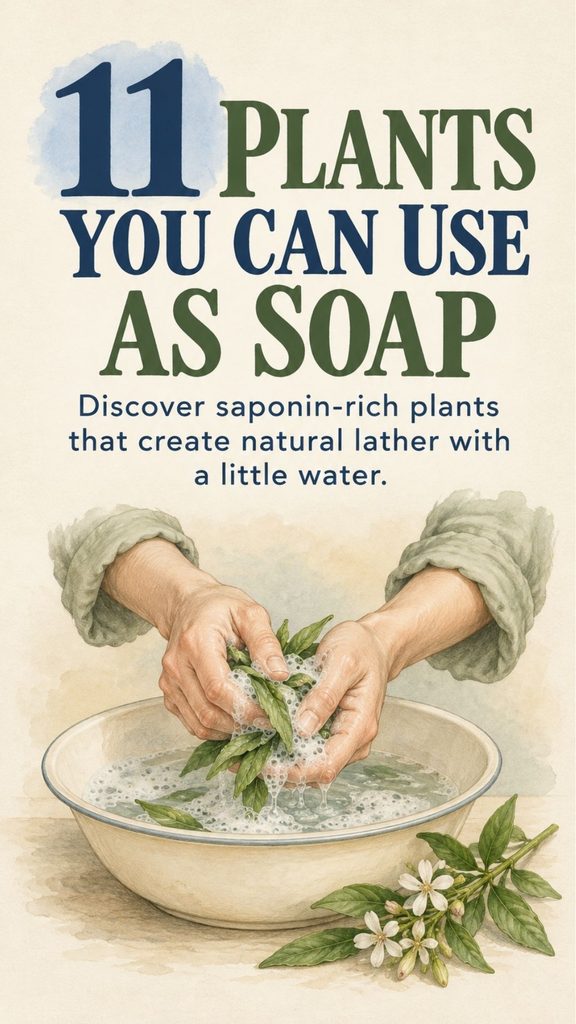
What if you could walk into your garden, pick a handful of leaves, add a little water, and watch them produce a gentle, soap-like lather?
It sounds surprising, but certain plants contain natural compounds that can create foam when mixed with water.
Long before modern liquid soaps, shampoos, and laundry detergents became everyday household products, people experimented with plants, roots, berries, and other natural materials for washing.
You Might Also Like:
- Loading posts...
Some of these plants became important parts of traditional household routines. Others were used for washing fabrics, cleaning personal belongings, or preparing mild cleansing solutions.
Today, they’re especially interesting to gardeners, homesteaders, and anyone curious about traditional self-sufficiency skills.
The secret behind many of these plants is a group of naturally occurring compounds called saponins.
These compounds can interact with water and oils, giving certain plant extracts soap-like properties.
But there’s something important to understand before heading outside with a pair of garden scissors.
Not every saponin-containing plant is appropriate for washing your hands, hair, or body.
Some can cause skin irritation. Others contain toxic compounds, and a few are best appreciated for their botanical history rather than used in homemade cleaning preparations.
Here are 11 fascinating plants traditionally associated with natural soap, how their cleansing properties work, and which precautions matter most.
What Makes Some Plants Work Like Soap?
Before exploring the individual plants, it helps to understand the science behind their natural lather.
Many plants contain compounds called saponins.
Saponins are naturally occurring substances that have both water-attracting and fat-interacting properties.
This is why some saponin-rich plant material can create foam when crushed, soaked, or agitated in water.
How Natural Plant Lather Works
Imagine adding a few pieces of a suitable saponin-containing plant to water.
When the plant material is gently crushed or stirred, some of the saponins may enter the water.
Agitating the mixture can create bubbles.
The resulting liquid may help lift certain types of dirt or oily residue.
A simplified version looks like this:
SAPONIN-RICH PLANT
        +
   CLEAN WATER
        ↓
 RELEASE OF SAPONINS
        ↓
    AGITATION
        ↓
   FOAM OR LATHER
However, different plants contain different concentrations and types of saponins.
Some produce noticeable foam.
Others produce very little.
And a foamy mixture isn’t automatically an effective or safe cleaning product.
Is Plant Soap the Same as Regular Soap?
Not exactly.
Traditional soap is generally produced through a chemical reaction involving fats or oils and an alkali.
Plant-based saponin washes work differently.
They may behave like mild surfactants, but their composition, concentration, cleaning performance, and safety can vary considerably.
For routine hygiene, properly formulated soap remains the more dependable choice.
Still, understanding how plants create natural lather is a fascinating part of traditional household knowledge.
1. Soapwort (Saponaria officinalis)
Soapwort is probably one of the best-known plants historically used for soap-like washing.
Its name comes from its long association with natural cleansing preparations.
This herbaceous perennial originally comes from Europe and has become established in many parts of North America.
How to Recognize Soapwort
Soapwort typically has:
- Upright green stems
- Opposite leaves
- Clusters of pale pink or white flowers
- Five-petaled blooms
- A spreading perennial growth habit
It commonly flowers during summer.
The plant can spread vigorously, so gardeners should check whether it’s invasive or otherwise unsuitable for cultivation in their region.
Why Soapwort Produces Lather
Soapwort contains saponins in several parts of the plant, including its roots and aboveground growth.
Historically, these compounds made it useful for preparing washing liquids.
Traditional Uses
Soapwort has been associated with:
- Washing delicate textiles
- Cleaning certain woolen fabrics
- Traditional household washing
- Preparing plant-based cleansing solutions
Its historical use in textile care is particularly interesting.
Some traditional methods involved extracting the saponins into water rather than making a hard bar of soap.
A Simple Educational Lather Demonstration
If you have correctly identified, cultivated soapwort and want to observe its foaming properties:
- Wear gloves while handling the plant.
- Collect a small amount of healthy material from your own plant.
- Place it in a clean container.
- Add a little lukewarm water.
- Gently agitate the mixture.
- Observe whether a light foam develops.
- Dispose of the liquid responsibly.
This demonstrates how naturally occurring plant compounds interact with water.
It isn’t a validated formula for personal hygiene or delicate fabric restoration.
Important Precautions
Soapwort can be harmful if swallowed.
Its saponins may also irritate sensitive skin or eyes.
Avoid using homemade soapwort preparations on broken skin, near the eyes, or as a substitute for reliable handwashing.
Best takeaway: Soapwort is an excellent plant for learning about the history of natural cleaning, but traditional use doesn’t guarantee that a homemade preparation is safe for everyone.
2. Buffaloberry (Shepherdia Species)
Buffaloberry is a group of shrubs found in parts of North America.
Certain species produce small berries containing naturally occurring saponins.
One of the best-known examples is Shepherdia canadensis, sometimes called Canada buffaloberry or soapberry.
What Does Buffaloberry Look Like?
Depending on the species, buffaloberry shrubs may have:
- Small oval leaves
- Silvery or grayish foliage
- Woody stems
- Small reddish or yellowish fruits
- A spreading shrub-like appearance
Different species look somewhat different, so proper identification is essential.
Why the Berries Are Interesting
The berries of certain Shepherdia species contain compounds that can create foam when mixed with water.
In some Indigenous North American food traditions, correctly identified soapberries have been whipped into a distinctive foamy preparation.
These traditions are specific to particular plants and established preparation methods.
They should not be confused with consuming any unfamiliar berry found outdoors.
Traditional Soap-Like Uses
The foaming properties of buffaloberry have also attracted interest for natural cleansing.
The source article describes using berries and stems to create a mild soapy liquid.
However, the strength and safety of homemade mixtures can vary.
Important Precautions
Some saponins can cause gastrointestinal irritation when consumed in excessive amounts.
Certain berries may also have poisonous look-alikes.
Do not taste unknown berries or use unidentified plants for personal washing.
Best takeaway: Buffaloberry is a fascinating example of naturally foaming fruit, but correct identification and knowledge of the specific species matter.
3. Soapweed Yucca (Yucca glauca)
Soapweed yucca is a hardy plant associated with the Great Plains and western regions of North America.
Unlike many soft-leaved garden plants, yucca has a distinctive appearance.
How to Recognize Soapweed Yucca
Common characteristics include:
- Narrow, stiff leaves
- Sharp leaf tips
- Fibrous leaf margins
- A clumping growth habit
- Tall flower stalks
- Pale, bell-shaped flowers
Yucca is often well adapted to dry landscapes.
Why Yucca Has Been Used for Washing
Several yucca species contain saponins.
Historically, different yucca plants were used in traditional washing preparations, including preparations for the hair and body.
The specific plant part and method varied among communities and species.
Traditional Preparation
The original article describes removing the sharp tip from a yucca leaf, separating the fibers, and rubbing the material with water to produce foam.
This reflects a traditional method of mechanically releasing plant compounds.
However, it should not be assumed that every yucca species is appropriate for direct skin contact.
Important Safety Considerations
Yucca leaves can have sharp edges and pointed tips.
These can cause punctures or scratches.
Plant extracts can also irritate skin or eyes.
When working with yucca:
- Wear sturdy gardening gloves.
- Use appropriate cutting tools.
- Avoid direct contact with sharp tips.
- Keep plant liquids away from the eyes.
- Don’t use unidentified yucca species in homemade personal-care products.
A Gardening Advantage
Yucca can be an attractive plant for appropriately designed dry gardens.
It may provide architectural interest while requiring relatively little supplemental watering once established.
Best takeaway: Soapweed yucca has a genuine history as a natural washing plant, but its sharp leaves and variable plant chemistry make careful handling important.
4. Soaproot Plant (Chlorogalum pomeridianum)
Soaproot, also called wavyleaf soap plant, is another important traditional cleansing plant.
It is native to western North America, particularly California and parts of Oregon.
The plant is especially interesting because its bulb contains substantial amounts of saponins.
How to Recognize Soaproot
Soaproot may produce:
- Long, narrow leaves
- Wavy leaf edges
- Tall flowering stalks
- Small pale flowers
- A large underground bulb
- Fibrous material surrounding the bulb
Its growth cycle is adapted to seasonal conditions.
Traditional Uses of Soaproot
The underground bulb has been used historically for several purposes.
Traditional applications included:
- Preparing cleansing lather
- Washing certain fabrics
- Hair and body washing
- Making brushes from bulb fibers
- Other household and craft uses
Some Indigenous Californian communities developed extensive knowledge of this plant and its practical applications.
How the Natural Lather Was Produced
Traditional preparations involved processing the bulb to release saponin-rich material into water.
The resulting liquid could produce a soap-like foam.
Why Harvesting Requires Caution
Unlike collecting a few leaves, digging up a bulb can damage or kill a plant.
Wild harvesting may also be restricted or inappropriate in protected habitats.
If you want to learn about soaproot, consider visiting a botanical garden, studying traditional plant-use resources, or growing legally sourced plants where suitable.
Avoid digging up wild plants simply to experiment with soap.
Best takeaway: Soaproot is one of the most historically significant natural soap plants, but conservation and responsible harvesting should come first.
5. Clematis (Clematis Species)
Clematis is a popular ornamental climbing plant.
Gardeners often grow it for its attractive flowers, which may be purple, white, pink, blue, or other shades.
Some traditional plant lists mention clematis among plants associated with saponins.
However, this is one example where a historical cleansing claim shouldn’t be treated as a practical DIY recommendation.
What Does Clematis Look Like?
Depending on the species, clematis may have:
- Climbing stems
- Opposite leaves
- Showy flowers
- Twining or scrambling growth
- Decorative seed heads
Clematis is commonly grown on trellises, fences, and other garden supports.
Why It Appears on Natural Soap Lists
The original article suggests that clematis foliage and flowers can produce a soap-like liquid when processed with water.
But the presence of plant compounds capable of foaming doesn’t establish that a preparation is safe for skin.
Important Safety Warning
Clematis plants can contain irritating substances.
Handling certain species may cause redness, rashes, or blistering.
Because of this, clematis should not be used as a homemade body soap or hand cleanser.
Do not crush the plant and rub it directly onto your skin.
A Better Use for Clematis
Enjoy it as an ornamental flowering vine.
Choose a variety appropriate for your climate and growing conditions.
Wear gloves when pruning if your skin is sensitive.
Best takeaway: Clematis belongs in the garden rather than in an experimental homemade skincare routine.
6. Ceanothus (Ceanothus Species)
Ceanothus is a genus of shrubs that includes plants sometimes called California lilac, mountain lilac, soap bush, or New Jersey tea.
Some species have a history of soap-like uses.
What Does Ceanothus Look Like?
Characteristics vary by species, but many produce:
- Small leaves
- Clusters of tiny flowers
- White, blue, or purple blooms
- Dense, branching shrub growth
Some ceanothus species are evergreen.
Others are deciduous.
For example, Ceanothus americanus, commonly called New Jersey tea, is a deciduous shrub native to eastern and central North America.
Why It Can Produce Foam
Certain ceanothus species contain saponins that may form a light lather when their plant material is agitated with water.
Traditional Uses
Historically, selected ceanothus plants have been associated with:
- Mild washing preparations
- Botanical cleansing experiments
- Traditional plant-based household uses
The source article describes rubbing leaves and flowers together with water to produce foam.
Important Precautions
Not every ceanothus species should be assumed to have identical chemistry.
A shrub’s common name also isn’t enough to establish that it is safe for personal use.
Avoid using unfamiliar plant extracts on sensitive skin or near your eyes.
Growing Ceanothus
Many species are valued for their attractive flowers and usefulness in native planting designs.
Choose a species suited to your local climate and soil.
Best takeaway: Ceanothus is an interesting example of a flowering shrub with traditional cleansing associations, but species identification is essential.
7. Horse Chestnut (Aesculus hippocastanum)
Horse chestnut trees produce large, shiny brown seeds enclosed in distinctive green husks.
These seeds are sometimes called conkers.
They contain compounds capable of producing foam, which explains their appearance in traditional washing lists.
How to Recognize Horse Chestnut
Horse chestnut trees commonly have:
- Large, palmately compound leaves
- Showy flower clusters
- Round green seed husks
- Smooth, shiny brown seeds
- A pale patch on each seed
Horse chestnuts are not the same as edible sweet chestnuts.
Why Horse Chestnuts Foam
Horse chestnut seeds contain saponins.
Historically, crushed horse chestnut material has been associated with household washing preparations.
Why Caution Is Necessary
Raw horse chestnut seeds and other parts of the tree contain toxic substances.
Swallowing them can cause serious gastrointestinal symptoms and other poisoning effects.
The seeds may also be confused with edible chestnuts.
Should You Use Them as Hand Soap?
For a beginner, horse chestnut is not a recommended choice for personal cleansing.
Homemade seed extracts vary in concentration and may irritate skin or eyes.
The risk is particularly concerning in households with young children or pets.
Can They Be Used for Laundry?
Historical and experimental laundry uses exist, but that doesn’t guarantee compatibility with modern fabrics or washing machines.
Homemade preparations can leave residue, stain certain materials, or create disposal concerns.
It’s better to use a laundry product designed for the fabric and appliance.
Best takeaway: Horse chestnuts demonstrate the connection between plant saponins and foam, but raw seeds are poisonous and aren’t suitable for casual experimentation.
8. Bracken Fern (Pteridium aquilinum)
Bracken is a widespread fern found in many woodland, grassland, and open habitats.
Its large fronds and extensive underground rhizomes help it spread over broad areas.
The original article identifies its underground structures as a historical source of soap-like material.
However, this plant raises especially significant safety concerns.
How to Recognize Bracken
Bracken typically has:
- Large, divided fronds
- Triangular leaf structure
- Long underground rhizomes
- Extensive spreading colonies
It is found in many parts of the world.
Why It Appears on Traditional Soap Lists
Certain historical accounts describe processing bracken rhizomes for washing or other household purposes.
But traditional use alone doesn’t establish safety.
The Serious Safety Concern
Bracken contains toxic compounds, including ptaquiloside.
Research has established carcinogenic effects of bracken and its constituents in experimental animals.
Bracken is classified as possibly carcinogenic to humans.
Its compounds may also pose risks to livestock and the surrounding environment.
Should You Make Soap From Bracken?
No. Bracken fern is not recommended for homemade skin cleansers or household washing experiments.
Boiling or soaking plant material isn’t a reliable way to establish that an extract is safe.
Avoid preparing bracken wash solutions or using the plant as a substitute for soap.
A Better Way to Appreciate Bracken
Learn about its role in woodland ecosystems, botanical history, and traditional land use.
There’s no need to turn every historically useful plant into a modern DIY project.
Best takeaway: Bracken is a particularly important example of why natural foaming properties should never be confused with safety.
9. Baby’s Breath (Gypsophila Species)
Baby’s breath is well known for its clouds of small, delicate flowers.
It often appears in bouquets and cottage-style gardens.
But certain Gypsophila species also contain saponins, particularly in their roots.
What Does Baby’s Breath Look Like?
Depending on the species, it may have:
- Small white or pink flowers
- Fine, branching stems
- Narrow leaves
- A light, airy appearance
- A substantial root system
Traditional Cleansing Connection
The original article describes boiling baby’s breath roots in water to produce a foaming liquid.
Some Gypsophila species have indeed been used historically as sources of saponins.
However, this isn’t an appropriate reason to boil ornamental florist flowers or unidentified garden roots for personal care.
Why You Should Be Careful
Some baby’s breath plants can cause contact dermatitis or irritation.
Commercial florist stems may also have been treated with substances not intended for skin contact.
Species and preparation methods matter.
What to Do Instead
Enjoy baby’s breath as an ornamental plant or cut flower.
If you’re interested in its chemistry, explore how botanical saponins are extracted and studied rather than making an untested skin cleanser.
Best takeaway: Baby’s breath has an interesting connection to saponin chemistry, but homemade skin-washing preparations aren’t recommended.
10. Wild Mock Orange (Philadelphus lewisii)
Wild mock orange is a flowering shrub native to western North America.
Its beautiful white flowers have a fragrance often compared to citrus blossoms.
This attractive shrub has also been associated with traditional household uses.
How to Recognize Wild Mock Orange
Common characteristics include:
- Woody, branching stems
- Opposite leaves
- White, fragrant flowers
- A deciduous growth habit
- A rounded or upright shrub form
It can be an attractive addition to suitable native and wildlife-friendly gardens.
Why It Appears on Natural Soap Lists
Historical plant-use sources describe using parts of Lewis’ mock orange, particularly leaves and bark, in mild washing preparations.
Some accounts mention the production of a light lather when suitable plant material is mixed with water.
How It Was Traditionally Used
The original article suggests placing plant material in water and agitating the mixture until foam appears.
These accounts are interesting, but they don’t provide standardized concentrations or modern safety testing for use as a body cleanser.
What to Remember
Do not assume that every ornamental shrub sold as mock orange is the same species.
Different plants can share similar common names.
Avoid applying homemade preparations to your face, broken skin, or sensitive areas.
Best takeaway: Wild mock orange offers an interesting combination of ornamental beauty and traditional botanical uses, but homemade cleansing products require more caution than a simple foaming demonstration suggests.
11. Buffalo Gourd (Cucurbita foetidissima)
Buffalo gourd is a sprawling plant native to parts of North America, especially drier regions.
It is related to pumpkins and squashes.
The plant is sometimes called coyote melon or calabazilla.
How to Recognize Buffalo Gourd
Buffalo gourd commonly has:
- Sprawling vines
- Large leaves
- Yellow flowers
- Small, round gourds
- Rough or hairy foliage
- A strong plant odor
Its growth habit makes it noticeable in open, dry landscapes.
Traditional Uses
Buffalo gourd has appeared in traditional accounts involving household uses, including soap-like washing.
The original source describes crushing or rubbing leaves with water to create foam.
Important Precautions
Buffalo gourd foliage can be rough and irritating to handle.
The plant also contains biologically active compounds, and its fruits should not be assumed to be edible simply because the plant belongs to the squash family.
Avoid rubbing freshly crushed leaves directly onto your skin.
Do not use the plant for cleansing your face, hair, or broken skin.
A More Suitable Use
Buffalo gourd is an interesting subject for studying native plant adaptations, traditional material uses, and dry-climate gardening.
It is better treated as a botanical learning opportunity than a dependable homemade soap substitute.
Best takeaway: Buffalo gourd has historical interest, but direct skin-cleansing experiments aren’t a good choice for beginners.
Which Natural Soap Plants Are Worth Exploring?
After reading about all 11 plants, you may be wondering which are the most practical.
The answer depends on what you want to accomplish.
If your goal is learning about traditional plant-based cleansing, soapwort, soaproot, and selected yucca species are particularly interesting.
If your goal is everyday handwashing, regular soap is still the better option.
Here’s a quick comparison.
| Plant | Soap-Like Property | Practical Recommendation |
|---|---|---|
| Soapwort | Well-known source of saponins | Suitable for learning about traditional cleansing; avoid ingesting |
| Buffaloberry | Certain berries create foam | Interesting botanical and cultural history; identify species carefully |
| Soapweed yucca | Contains natural saponins | Traditional use documented; sharp leaves require caution |
| Soaproot | Saponin-rich bulb | Important historical plant; avoid destructive wild harvesting |
| Clematis | Claimed soap-like properties | Avoid DIY skin use because of irritation risks |
| Ceanothus | Some species produce lather | Interesting for botanical study; species matter |
| Horse chestnut | Foaming saponins in seeds | Raw seeds are poisonous; avoid personal-care experiments |
| Bracken fern | Historical washing claims | Not recommended because of toxicity concerns |
| Baby’s breath | Saponins in certain species | Avoid homemade skin cleansers because of irritation concerns |
| Wild mock orange | Traditional mild washing uses | Interesting historical use; avoid untested personal-care preparations |
| Buffalo gourd | Traditional soap-like use | Avoid direct skin use; rough foliage and safety concerns |
How to Explore Natural Plant Lather Safely
If you’re interested in traditional plant-based cleaning, the safest way to begin is with observation rather than immediately using plant extracts on your body.
A simple demonstration can help you understand the difference between a plant that produces foam and one that doesn’t.
A Basic Botanical Demonstration
Choose a correctly identified, cultivated plant known to contain saponins, such as soapwort.
You’ll Need
- A small amount of verified plant material
- A clear container
- Clean water
- Gardening gloves
- A spoon or stirring stick
Step 1: Prepare the Container
Choose a clean jar or bowl.
Add a small amount of water.
Step 2: Add the Plant Material
Using gloves, add the small amount of plant material.
Avoid collecting plants from roadsides or areas treated with pesticides.
Step 3: Agitate the Water
Stir or gently shake the mixture.
Depending on the plant material, temperature, and concentration, a light foam may form.
Step 4: Observe the Foam
Notice how long the bubbles last.
Compare the appearance with plain water.
Step 5: Finish Safely
Do not taste the mixture or apply it to your eyes or skin.
Keep the container away from children and pets.
Dispose of the mixture responsibly, avoiding ponds, streams, and other natural waterways.
This activity demonstrates the foaming properties of plants.
It does not establish the safety or effectiveness of the liquid for bathing, laundry, or disinfection.
Why Homemade Plant Soap Isn’t Always Better for the Environment
Natural products are often assumed to be automatically environmentally friendly.
But the full picture is more complicated.
A plant-based preparation can still have environmental consequences.
Harvesting Wild Plants
Removing roots or bulbs may destroy the plant.
Repeated harvesting can damage native populations.
Effects on Aquatic Life
Some saponins can be harmful to fish and other aquatic organisms.
Traditional uses of certain saponin-rich plants even included stunning fish.
For this reason, natural plant extracts should not be poured directly into streams, lakes, or ponds.
Water and Energy Use
Boiling roots or other plant material consumes water and energy.
That needs to be considered when comparing homemade methods with commercially produced products.
Inconsistent Cleaning
If a homemade wash doesn’t remove dirt effectively, repeated washing can consume additional water.
A Better Approach
Choose appropriate, biodegradable commercial cleaning products when practical.
Use the recommended amount.
Avoid unnecessary packaging.
Maintain reusable cloths and cleaning equipment.
Protect native plants and local waterways.
Environmental responsibility involves more than whether an ingredient came from nature.
Can Natural Plant Soap Kill Germs?
This is one of the most important questions.
A plant producing foam doesn’t mean the liquid has been proven to remove harmful microorganisms as effectively as regular soap.
Saponins can behave like surfactants, but the concentration and performance of a homemade plant wash can vary.
Traditional cleansing and modern infection prevention are not automatically the same.
For Everyday Hand Hygiene
Use ordinary soap and clean running water.
Wash thoroughly for at least 20 seconds, including the backs of the hands, between fingers, and around fingernails.
Rinse and dry properly.
When Soap Isn’t Available
An alcohol-based hand sanitizer containing at least 60% alcohol is often an appropriate alternative when hands aren’t visibly dirty.
If neither soap nor sanitizer is available, rubbing hands under clean running water can still remove some contamination, although it’s less effective than washing with soap.
For Food Preparation
Do not rely on homemade plant extracts to clean hands after handling raw meat or poultry.
Use established food-safety practices.
For Cleaning Household Surfaces
Use an appropriate household cleaning product.
If sanitizing or disinfecting is required, choose a product designed and tested for that purpose.
Foam is not proof of disinfection.
7 Safety Rules for Using or Studying Soap Plants
Before experimenting with botanical washing traditions, keep these precautions in mind.
1. Identify Every Plant Correctly
Common names can describe several unrelated plants.
Use the scientific name and reliable botanical identification resources.
Never experiment with an unknown species.
2. Avoid Toxic Plants
Some plants contain substances that may cause poisoning or serious irritation.
Do not assume that soaking or boiling removes those risks.
3. Protect Your Eyes
Saponin-rich liquids and plant extracts may irritate the eyes.
Avoid splashing and wash exposed areas with clean water if irritation occurs.
4. Be Careful With Sensitive Skin
People with eczema, dermatitis, allergies, or sensitive skin may react to homemade plant extracts.
Avoid using untested mixtures for personal care.
5. Never Drink Plant Soap
Many saponins can irritate the digestive tract.
Keep experimental extracts clearly labeled and away from children and pets.
6. Harvest Responsibly
Do not dig up protected plants or collect wild material without permission.
Avoid damaging native habitats.
7. Don’t Replace Reliable Hygiene Products
Plant-based soap substitutes are interesting from a historical and botanical perspective.
But routine handwashing, wound cleaning, and food-related hygiene should rely on appropriate products and established methods.
Other Traditional Homemaking Skills Worth Learning
If natural soap plants interest you, there are many other practical old-fashioned skills worth exploring.
These skills can be useful without requiring risky plant experiments.
Growing Culinary Herbs
Learn to grow thyme, rosemary, mint, parsley, and other edible herbs.
Making Homemade Cleaning Cloths
Repurpose suitable old cotton towels or T-shirts into reusable cleaning cloths.
Learning Laundry Care
Understand how to wash wool, cotton, linen, and delicate fabrics properly.
Making Traditional Bar Soap
If you’re interested in soapmaking, consider learning from a thoroughly tested soap recipe and proper safety instruction.
Traditional lye-based soapmaking requires careful handling of caustic ingredients and isn’t appropriate as an unsupervised beginner experiment.
Growing a Useful Garden
Create a garden that includes herbs, vegetables, pollinator-friendly flowers, and locally appropriate native plants.
Reducing Household Waste
Reuse suitable containers, maintain cleaning equipment, repair belongings, and avoid unnecessary purchases.
Traditional homemaking isn’t just about making everything from scratch.
It’s also about learning to use resources thoughtfully.
Frequently Asked Questions About Plants That Make Soap
What Plant Is Most Famous for Making Natural Soap?
Soapwort, Saponaria officinalis, is one of the best-known examples.
Its name reflects its long history as a plant used in soap-like washing preparations.
Can You Really Wash Your Hands With Leaves?
Certain plants can release saponins that produce foam.
However, homemade plant lather isn’t necessarily a safe or reliable replacement for properly formulated hand soap.
What Is Saponin?
Saponins are naturally occurring plant compounds that can interact with water and oils.
Some produce foam when mixed or agitated with water.
Their concentrations and biological effects vary widely.
Are All Saponin-Rich Plants Safe?
No.
Some saponins can irritate skin, eyes, or the digestive tract.
Other toxic compounds may also be present in the same plant.
Can You Use Soapwort as Shampoo?
Soapwort has a history of use in traditional washing, including hair-care preparations.
However, homemade extracts are not standardized for concentration, skin compatibility, or eye safety.
A properly formulated shampoo is the more predictable choice.
Can Horse Chestnuts Be Used for Laundry?
Horse chestnuts contain foaming saponins and have been used in historical laundry experiments.
However, raw horse chestnuts are poisonous when swallowed, and homemade preparations aren’t validated for modern washing machines or delicate fabrics.
Is Bracken Fern Safe for Homemade Soap?
No.
Bracken contains toxic compounds, including the carcinogenic substance ptaquiloside.
It should not be used in homemade cleansing experiments.
Are Plant-Based Soap Substitutes Biodegradable?
Some plant-derived compounds may break down naturally, but that doesn’t automatically make every homemade extract environmentally safe.
Certain saponins can harm aquatic organisms.
Avoid disposing of concentrated plant extracts in natural waterways.
Can I Grow My Own Soap Plants?
Some historically used soap plants can be cultivated under appropriate conditions.
However, check local restrictions, invasive-plant concerns, and the growing requirements of each species.
Choose responsibly sourced plants from reputable nurseries.
Does More Foam Mean Better Cleaning?
Not necessarily.
Foam volume alone doesn’t determine cleaning performance.
A product can create lots of bubbles without effectively removing a particular type of dirt or contamination.
Final Thoughts: The Fascinating History of Plants That Make Soap
The natural world contains an extraordinary variety of useful materials.
Some plants provide food.
Others supply fibers for baskets, ropes, and textiles.
And certain species contain compounds that can create a soap-like lather.
Soapwort, yucca, soaproot, ceanothus, buffaloberry, and other plants reveal how people historically used local resources for household tasks.
These traditions are an interesting part of gardening, homesteading, and botanical history.
But traditional use doesn’t mean every plant should become a homemade cleanser.
Some plants contain toxic substances.
Others may irritate the skin.
Certain species need protection from overharvesting.
And homemade plant extracts don’t automatically provide the dependable hygiene performance of properly formulated soap.
The most useful approach is to learn which plants contain saponins, understand how their foaming properties work, and appreciate the traditional knowledge behind their uses.
For beginners, studying a well-identified plant such as soapwort is a more sensible starting point than experimenting with unfamiliar roots, poisonous seeds, or irritating foliage.
You don’t need to replace every modern product with a homemade alternative to appreciate the value of traditional self-sufficiency skills.
Sometimes the most rewarding lesson is simply discovering how people once used the plants growing around them—and learning how to approach those traditions thoughtfully today.