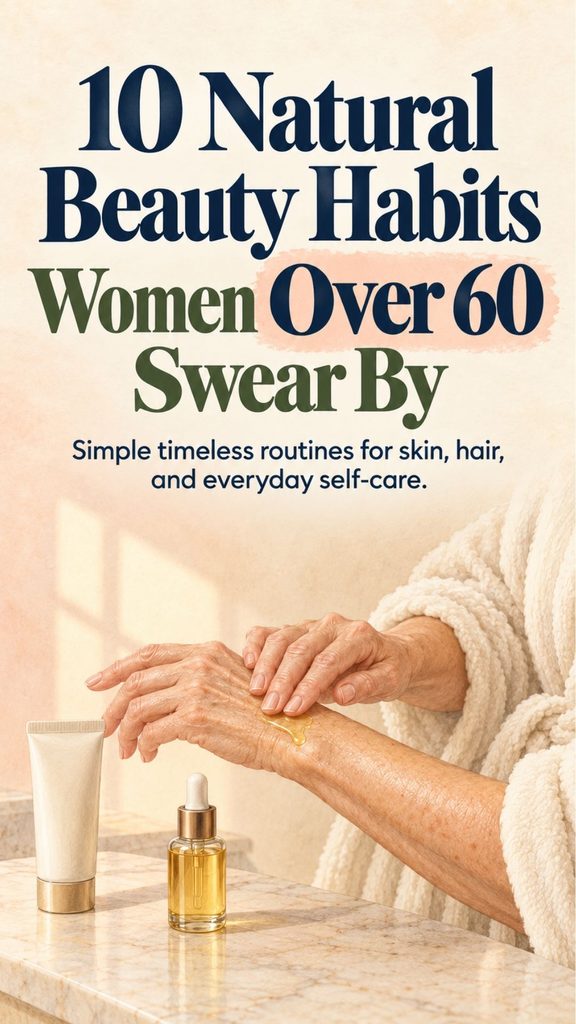
Beauty routines often seem to get more complicated with age.
There is always another serum, device, acid, mask, supplement, or “anti-aging” treatment promising smoother, younger-looking skin. Yet the source article noticed something different in discussions among women over 60: many of their favorite habits were simple, familiar, and inexpensive enough to repeat for years.
That emphasis on consistency makes sense.
You Might Also Like:
- Loading posts...
Skin generally becomes drier with age, hair may change in density and texture, and sun exposure accumulated over decades becomes more visible. But caring for mature skin does not require trying to erase every wrinkle or pretending aging is a problem to solve.
A few dependable habits usually matter more than an overflowing bathroom cabinet.
Some of the original tips are genuinely useful. Others need a little perspective because popular beauty claims about silk, gua sha, rosemary oil, castor oil, and humidifiers can easily become exaggerated.
Here are ten habits worth understanding—what they can realistically do, what they cannot do, and how to make them safer and simpler.
1. Sleep on a Smooth, Clean Pillowcase
Silk and satin pillowcases have become popular because their smooth surface creates less friction against the hair and face than rougher fabrics.
That can be particularly appealing if your hair is:
dry,
curly,
fragile,
chemically treated,
or prone to tangling.
A smoother pillowcase may reduce friction and make hair feel less mussed in the morning.
It may also leave fewer temporary sleep creases on the face.
What it probably cannot do is meaningfully reverse skin aging.
Claims that an expensive silk pillowcase prevents wrinkles or preserves large amounts of skin moisture overnight are much stronger than the evidence available.
So if you enjoy silk, use it.
But you do not need an expensive 22-momme pillowcase to have healthy skin.
A clean satin pillowcase can provide a similar low-friction feel at a much lower cost.
Whatever material you choose, wash it regularly—especially if you use heavy moisturizers, hair oils, or overnight skin products.
2. Wash With Lukewarm Water and a Gentle Cleanser
This is one of the strongest habits on the list.
The source recommends lukewarm water and a mild, non-foaming cleanser because mature skin can feel dry and tight after harsh washing.
Dermatologists give similar advice.
The American Academy of Dermatology recommends washing with warm rather than hot water and using a mild cleanser instead of aggressively scrubbing the skin. Moisturizing is also particularly helpful because skin tends to become drier with age.
A simple routine may be all you need:
gentle cleanser,
moisturizer,
and daytime sun protection.
If your skin is very dry or sensitive, cleansing once in the evening may sometimes be sufficient rather than washing aggressively twice a day.
Your face should not feel squeaky, tight, or stripped after cleansing.
That sensation is not proof that your skin is exceptionally clean.
It can be a sign that your routine is too harsh.
3. Use Facial Massage for Relaxation and Temporary Puffiness
A gentle facial massage can feel wonderful.
It may temporarily reduce the appearance of morning puffiness, increase superficial blood flow, and help facial muscles feel relaxed.
You do not need a jade roller or expensive stone.
Clean fingertips work.
If you prefer a tool, use enough moisturizer or facial oil to allow it to glide without pulling the skin.
Keep the pressure light.
The source correctly notes that gua sha and facial massage should not be expected to produce dramatic permanent changes in facial structure.
Research into facial rollers and gua sha is still limited. One small randomized trial published in 2025 found changes in certain facial-contour, muscle-tone, and elasticity measurements after repeated massage, but it involved only 34 women and does not establish gua sha as a substitute for established skin treatments.
Most importantly, facial massage does not “detox” your face or permanently sculpt your bones.
Use it because it feels pleasant.
Two quiet minutes of self-care may be valuable even without a dramatic before-and-after photo.
4. Be Cautious With Scalp Oiling—and With Rosemary Claims
Scalp oiling has long traditions in many cultures and can be enjoyable for people with dry hair or scalp.
But oiling and treating hair loss are not the same thing.
The source discusses rosemary oil because a 2015 randomized trial compared it with 2% minoxidil in 100 people with androgenetic alopecia.
The study found no significant increase in hair count at three months. At six months, both the rosemary-oil and minoxidil groups had increased hair counts, with no significant difference between the two groups.
That is interesting.
It is not proof that rosemary oil universally regrows thinning hair.
It was one relatively small study involving a particular type of hair loss and a six-month treatment period.
Hair thinning in women over 60 can have many causes, including genetic pattern hair loss, hormonal changes, nutritional problems, thyroid disease, medication effects, illness, and other conditions.
If hair loss is sudden, severe, patchy, or rapidly progressing, it is better to investigate the cause than to assume an oil will fix it.
If you want to try rosemary essential oil, do not pour undiluted essential oil directly over your scalp. Concentrated essential oils can irritate skin. A properly formulated scalp product is easier to use consistently and safely.
And ordinary carrier oils can still be useful simply because they make dry hair feel softer.
They do not need to regrow hair to have value.
5. Make Sunscreen the Non-Negotiable Step
Of all the habits on this list, sun protection has some of the strongest evidence behind it.
Ultraviolet radiation contributes to skin cancer and accelerates visible signs of photoaging such as wrinkles, uneven pigmentation, and loss of elasticity.
The American Academy of Dermatology recommends broad-spectrum, water-resistant sunscreen with SPF 30 or higher on exposed skin when going outdoors, along with shade and protective clothing when appropriate.
The source specifically favors mineral sunscreen and recommends daily use.
Mineral sunscreens containing zinc oxide or titanium dioxide can be excellent, particularly for people who tolerate them well.
But mineral is not automatically better for everyone.
Chemical or hybrid sunscreens can also provide excellent broad-spectrum protection.
The best sunscreen is one that:
protects adequately,
works with your skin,
does not irritate you,
and is comfortable enough that you will actually use the right amount.
If a mineral formula leaves a heavy white cast and you hate wearing it, a different formulation may be a better choice.
What about sunscreen indoors?
UVA can pass through ordinary window glass, so people who spend significant time directly beside sunny windows may still receive meaningful exposure.
But someone spending an entire day well away from windows does not need to treat their living room like a beach.
Use common sense based on your actual UV exposure.
6. Wear Less Foundation If You Prefer—But It Is Not a Rule
The source suggests that some women over 60 prefer spot concealer instead of full foundation because heavier products can settle into lines or emphasize texture.
That can be an excellent technique.
Apply concealer only where you want it:
around the nose,
under the eyes,
on a blemish,
or over an area of redness.
Then leave the rest of the skin visible.
But there is no age at which a woman needs to “graduate” from foundation.
If you love foundation, wear it.
The trick is often preparation and application.
Moisturize first.
Use thin layers.
Apply only as much as you need.
Avoid piling powder over areas that are already dry.
A sheer or luminous base may feel more comfortable than thick matte coverage, but individual skin types vary.
Makeup is personal style, not medical care.
The best mature-skin makeup is whatever makes you enjoy your reflection.
7. Moisturize Damp Skin After Bathing
The source recommends applying body oil immediately after showering while the skin is still damp.
The principle is useful.
Applying moisturizer soon after bathing helps trap water in the outer layer of the skin.
Dermatologists generally recommend regular moisturizing for dry and mature skin, and thicker creams or ointments tend to be more effective for significant dryness than very light lotions.
Body oil can feel lovely and may help reduce water loss.
But oil itself contains little or no water.
If your skin is very dry, you may get better results from a fragrance-free cream applied to slightly damp skin, with oil added afterward if you enjoy it.
You do not need a particular branded body oil.
A basic moisturizer that your skin tolerates can work beautifully.
Pay particular attention to areas that often become dry:
shins,
elbows,
arms,
feet,
and hands.
8. Treat Your Hands With More Moisturizer and Less Scrubbing
Hands often show dryness and cumulative sun exposure because they are repeatedly washed and frequently exposed during everyday life.
The source correctly emphasizes caring for hands, but it also recommends a weekly salt-and-oil scrub.
You can safely skip the aggressive scrub.
Mature, dry skin generally does not need more friction.
Repeated scrubbing can worsen irritation and dryness.
A simpler routine is better:
apply hand cream after washing when needed,
use a thicker moisturizer before bed,
wear gloves for cleaning or gardening,
and apply sun protection to the backs of your hands when they will be exposed.
AAD specifically recommends sunscreen and protective clothing as major ways to reduce photoaging, including visible signs on the hands.
If your hands are cracked or extremely dry, look for a fragrance-free cream or ointment rather than another exfoliator.
Softness usually comes from restoring moisture, not scrubbing harder.
9. Don’t Expect Castor Oil to Grow New Brows or Lashes
Castor oil has become one of the internet’s favorite eyebrow and eyelash remedies.
The source is more cautious than many beauty posts: it acknowledges that castor oil does not create new follicles and describes it mainly as a conditioner for existing hairs.
That distinction is important.
There is not strong clinical evidence showing that ordinary castor oil reliably causes eyelashes or eyebrows to grow thicker.
Research involving castor oil around the eyes has investigated conditions such as blepharitis and tear-film function—not cosmetic eyelash growth.
If you like castor oil on your brows, use a very small amount and stop if it causes irritation or clogged pores.
I would be much more cautious about deliberately brushing ordinary cosmetic oil directly along the eyelid margin or into the eyes.
Eye-area products need to be used carefully because irritation there can be particularly uncomfortable.
If your eyebrows or lashes are suddenly becoming much thinner, consider asking a clinician or dermatologist about the cause rather than automatically reaching for oil.
10. Use a Humidifier When the Air Is Actually Dry
A humidifier can genuinely make dry winter air feel more comfortable.
The source recommends one particularly during cold months when heated indoor air becomes dry.
That can help people who notice:
dry skin,
chapped lips,
dry nasal passages,
or static electricity.
But humidity is another situation where more is not better.
The EPA recommends maintaining indoor relative humidity around 30% to 50%. Excess humidity can encourage mold and dust mites.
So before buying a humidifier, consider a small hygrometer.
If your room is already at 50% humidity, adding more moisture is unlikely to help.
And humidifiers need maintenance.
Dirty tanks can grow microorganisms, while some ultrasonic models can disperse minerals or microbes into the air if they are not cared for properly. Follow the manufacturer’s instructions for filling, cleaning, and maintaining your specific machine.
If you notice condensation collecting on windows or walls, reduce the humidity.
What About the Products Women Over 60 Don’t Use?
One of the more valuable ideas behind the source article is not any particular product.
It is restraint.
A complicated routine is not automatically a better one.
Using several acids, scrubs, serums, retinoids, essential oils, devices, and masks simultaneously can make irritation more likely.
AAD advises that using too many anti-aging products can irritate the skin and make signs of aging look more noticeable.
If you have mature or sensitive skin, introduce products slowly.
Give them time.
Do not change five things at once.
That way, if irritation develops, you have a much better chance of identifying the cause.
“Natural” Doesn’t Automatically Mean Gentler
This is especially important in beauty routines aimed at mature skin.
Salt is natural.
Essential oils are natural.
Castor oil is natural.
Rosemary is natural.
That tells you where an ingredient came from.
It does not tell you whether it will be effective, irritating, allergenic, or appropriate for your skin.
Likewise, laboratory-made ingredients are not automatically harsh.
Glycerin, ceramides, petrolatum, and many other ordinary skincare ingredients can be extremely helpful for dry skin.
Judge products by what they do and how your skin responds rather than whether the marketing calls them clean, natural, botanical, or chemical-free.
A Much Simpler Beauty Routine After 60
You could turn all ten habits into a long beauty schedule.
You do not need to.
A practical morning might be:
Gentle cleanse or rinse if needed.
Moisturizer.
Broad-spectrum SPF 30+ when appropriate for your daytime exposure.
Makeup if you enjoy it.
At night:
Remove makeup and cleanse gently.
Apply any treatment you genuinely use.
Moisturize.
For the rest of the body:
Use moisturizer after bathing.
Apply hand cream after washing when your hands feel dry.
Care for your scalp according to its actual needs.
Run a humidifier only when the indoor air is dry.
Everything else is optional.
What Actually Matters Most Over the Years
Beauty habits become powerful through repetition.
Not because a pillowcase transforms the skin overnight.
Not because gua sha permanently lifts the jaw.
Not because castor oil suddenly creates eyelashes.
And not because expensive products can stop aging.
The habits with the strongest long-term rationale are wonderfully ordinary:
protect your skin from excessive UV exposure,
cleanse without stripping it,
moisturize consistently,
avoid smoking,
eat reasonably well,
sleep adequately when possible,
and treat skin problems rather than repeatedly irritating them.
The source ends with a similar theme: the attraction of these routines is that many can be repeated for years because they are small enough to become part of ordinary life.
That may be the best beauty lesson at any age.
You do not need to wage war against wrinkles.
You do not need twenty products.
You do not need to look 40 when you are 60, or 50 when you are 70.
Care for your skin.
Protect it.
Keep it comfortable.
Choose the rituals you genuinely enjoy.
And let consistency—not fear of aging—decide what earns a permanent place in your routine.