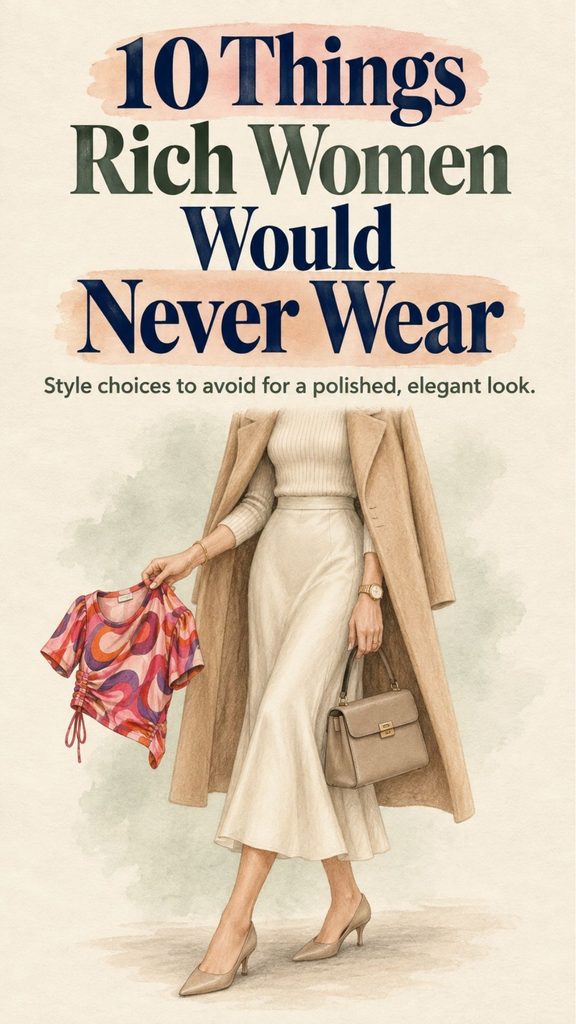
There is no secret dress code that every wealthy woman follows.
Some rich women adore bright colors. Others wear oversized coats, crop tops, stacked jewelry, dramatic nails, or outfits covered in designer logos. Personal style does not disappear when someone becomes wealthy.
But there is a recognizable aesthetic often described as old money, quiet luxury, or understated elegance. That look tends to favor restraint, good fit, quality fabrics, thoughtful grooming, and clothing that does not depend on obvious branding to appear expensive.
You Might Also Like:
- Loading posts...
The useful lesson is not to copy what supposedly “rich women” wear.
It is to understand why certain outfits tend to look polished while others can feel visually busy, trend-driven, or less refined.
And the best part is that none of these principles requires an enormous clothing budget.
Here are ten things women aiming for an understated, elegant style often avoid—and what to wear instead.
1. Too Many Visible Logos
A logo is not automatically tacky.
A discreet monogram on a handbag, a small embroidered symbol on a polo shirt, or a recognizable buckle can work beautifully.
The problem begins when the outfit becomes a collection of advertisements.
A logo-covered handbag paired with a large-logo belt, monogrammed shoes, branded sunglasses, and an oversized designer name across a shirt can make the labels more noticeable than the woman wearing them.
Understated style usually allows the quality of the garment to speak first.
Look instead for:
beautiful fabric,
clean construction,
good buttons,
neat stitching,
flattering proportions,
and a good fit.
A simple wool coat with no visible branding can look more expensive than a heavily branded coat costing several times as much.
The same is true for handbags.
A structured leather bag in a classic shape does not need a giant logo to look elegant.
The budget lesson
Do not assume expensive-looking means designer.
A well-maintained secondhand leather handbag or a beautifully fitting unbranded blazer can create a more polished appearance than a trendy item purchased solely for its recognizable label.
2. Makeup That Competes With the Entire Outfit
Bold makeup can be beautiful.
Blue eyeshadow, graphic eyeliner, glitter, dramatic lashes, and brightly colored lipstick all have a place in personal style.
But the quiet-luxury aesthetic generally treats makeup as part of the overall composition rather than the main event.
That usually means:
natural-looking skin,
defined brows,
subtle eye makeup,
mascara,
soft blush,
and either a neutral or classic lip color.
The goal is not to appear as though you are wearing nothing.
It is to avoid having the makeup, jewelry, clothing, and accessories all competing for attention simultaneously.
If you love a dramatic lip, keep the eyes simpler.
If you want a stronger eye look, a softer lip can balance it.
Elegance is often about editing
A useful question before leaving the house is:
Where do I want the eye to go first?
If every element is demanding attention, removing one or two things may improve the entire outfit.
3. Too Much Jewelry at Once
Stacking jewelry is fashionable and can look wonderful.
But a refined, traditional style often uses fewer pieces with more visual breathing room.
Instead of:
five bracelets,
three necklaces,
large earrings,
multiple statement rings,
and a watch,
you might choose a watch, earrings, and one ring.
Or a necklace and a simple bracelet.
Or one dramatic piece with almost nothing else.
The idea is not that wealthy women own less jewelry.
They may own extraordinary jewelry.
They simply do not necessarily wear the entire jewelry box at once.
Choose a focal point
If your necklace is large and decorative, let it have the spotlight.
If you are wearing statement earrings, consider skipping the necklace.
If you love several rings, perhaps keep the wrist simpler.
This makes each piece look more intentional.
4. Poorly Proportioned Oversized Coats
Oversized clothing is not inherently inelegant.
In fact, some of the most sophisticated coats are intentionally roomy.
The difference lies in proportion.
A coat that is designed to be oversized can still have structured shoulders, deliberate length, quality fabric, and a silhouette that works with the wearer.
A coat that is simply several sizes too large may overwhelm the body.
Classic wardrobes often favor coats with some structure:
a tailored wool coat,
a trench coat,
a belted wrap coat,
a pea coat,
or a clean longline silhouette.
You do not need a skin-tight coat.
You simply want one that looks intentional rather than accidental.
Fit matters more than the size on the label
Ignore whether the garment says small, medium, or large.
Look at:
where the shoulder seam falls,
whether the sleeves are the right length,
whether the coat closes comfortably,
and whether the overall shape works with the clothes underneath.
A modest alteration can sometimes make an inexpensive coat look considerably more polished.
5. Crop Tops That Fight the Rest of the Outfit
Crop tops can absolutely look sophisticated.
The problem is not exposed skin itself.
It is proportion and context.
A very short, tight crop top paired with a low-rise bottom may create a distinctly casual or trend-focused look.
Someone aiming for traditional understated elegance may instead choose:
a full-length silk blouse,
a fitted knit top,
a crisp cotton shirt,
a fine-gauge sweater,
or a shorter top paired with a high-waisted skirt or trousers so only a small amount of skin is visible.
That creates a very different effect.
Think in terms of balance
If the top is short, the bottom can provide more coverage.
If the skirt is short, a higher neckline or structured jacket may balance it.
If the neckline is dramatic, the rest of the outfit can remain quieter.
There is no universal rule requiring women to cover themselves.
The principle is simply that deliberate proportions tend to look more polished than several revealing elements competing simultaneously.
6. Sheer Clothing Without Intentional Styling
Sheer fabrics can be elegant.
Chiffon sleeves, lace panels, organza, and translucent overlays have appeared in high fashion for generations.
The issue is when sheer fabric looks accidental rather than intentional.
For example, a thin white blouse that unexpectedly reveals an entire bra because the fabric becomes transparent under bright lighting may look less polished than a blouse designed specifically to incorporate sheer elements.
If you enjoy sheer clothing, consider:
a camisole underneath,
a tonal underlayer,
strategically sheer sleeves,
a lined bodice,
or a sheer overlay over a simple base.
This creates dimension without making the outfit feel unfinished.
Check clothes in real lighting
Something that appears opaque in a dim bedroom can become completely transparent outdoors.
Stand near a window or check the garment under bright light before wearing it out.
That small habit prevents many wardrobe surprises.
7. Several Statement Necklaces at the Same Time
Layered necklaces can look stylish, but traditional quiet-luxury dressing usually keeps necklines relatively uncluttered.
A simple chain.
A strand of pearls.
A pendant.
A fine necklace with a small charm.
Or one larger statement necklace.
Each can work beautifully.
The problem begins when several large decorative pieces fight with the neckline, buttons, print, scarf, and earrings.
Let the neckline guide the jewelry
A crewneck sweater may look wonderful with a short necklace.
An open shirt may suit a delicate pendant.
A high-neck blouse may need no necklace at all.
A patterned dress can often stand alone.
Jewelry is not mandatory simply because the outfit feels “too simple.”
Sometimes simplicity is exactly what makes an outfit look expensive.
8. Very Short Skirts in Situations Calling for Polish
There is nothing inherently wrong with a short skirt.
But if your goal is a timeless, conservative, or old-money-inspired wardrobe, midi and knee-length skirts are usually easier to style.
They work with:
loafers,
ballet flats,
boots,
heels,
sweaters,
button-down shirts,
and structured jackets.
They also transition easily between casual and dressier settings.
Popular elegant silhouettes include:
A-line skirts,
pleated skirts,
pencil skirts,
slip skirts,
and straight midi skirts.
A modest slit can add movement without changing the overall sophistication of the outfit.
The important part is comfort
A skirt cannot look effortless if you spend the entire day pulling it down.
Choose a length that allows you to sit, walk, climb stairs, and move naturally.
Comfort and elegance are much closer relatives than fashion advice sometimes admits.
9. Too Many Competing Colors and Prints
You do not need to wear beige from head to toe to look sophisticated.
Rich colors can be incredibly elegant:
burgundy,
forest green,
navy,
chocolate brown,
deep red,
camel,
cream,
and cobalt blue.
Prints can work beautifully too.
The trick is usually cohesion.
An outfit containing seven unrelated colors, several prints, dramatic shoes, and a statement handbag can become visually chaotic.
A simpler approach is to build the outfit around two or three main colors.
For example:
cream trousers,
a navy sweater,
and brown leather accessories.
Or:
a burgundy dress,
black shoes,
and a camel coat.
If you wear a patterned blouse containing several colors, repeat one or two of those shades elsewhere.
That makes the outfit look connected.
The three-color rule is a guideline, not a law
You can absolutely wear more than three colors.
A floral dress may contain ten.
A patterned scarf may introduce several more.
What matters is whether the colors relate to one another.
Use restraint when it helps, but do not turn personal style into arithmetic.
10. Nail Color That Fights Everything Else
Neutral nails are popular in understated wardrobes because they work with almost anything.
Think:
sheer pink,
soft beige,
milky white,
pale taupe,
classic red,
or simply clean natural nails.
These colors do not demand much attention and generally coordinate easily with jewelry and clothing.
But wealthy women certainly wear dark burgundy, black, coral, red, and other strong colors too.
The more useful lesson is grooming.
A simple manicure looks polished when the nails are:
clean,
evenly shaped,
and reasonably maintained.
Chipped polish often looks less intentional than bare nails.
If you do not enjoy maintaining polish, there is no reason to wear it.
Well-cared-for natural nails are perfectly elegant.
What Actually Makes an Outfit Look Expensive?
Avoiding certain clothes will not automatically create elegance.
The strongest visual signals usually come from much simpler things.
Proper fit
One of the most expensive-looking things you can do is wear clothing that fits your body correctly.
A $40 pair of trousers that fits beautifully may look far better than $500 trousers that bunch at the waist and drag on the floor.
Learn what good fit looks like on your own body.
Do not become obsessed with the number on the label.
Clothing maintenance
Remove lint.
Shave pilling from sweaters.
Replace loose buttons.
Repair hems.
Clean shoes.
Steam wrinkled garments.
Store coats properly.
These small details often matter more than the brand.
Fabric
Natural fibers are not automatically superior, and synthetic fabrics are not automatically cheap-looking.
But fabric quality matters.
Look at how the material hangs.
Does it feel substantial enough for the garment?
Does it wrinkle badly?
Is it already pilling in the store?
Can you see through areas that should be opaque?
A good fabric usually makes even a simple design look better.
Shoes
Shoes receive enormous visual attention.
They do not need to be designer.
They should simply suit the outfit and be reasonably maintained.
Classic options include:
loafers,
ballet flats,
simple leather sneakers,
ankle boots,
riding boots,
pumps,
and minimal sandals.
Replace worn heel tips and clean obvious marks.
A coherent handbag
A structured handbag in a versatile color can make simple clothes look more finished.
Black, tan, cognac, navy, burgundy, and chocolate brown are particularly easy to combine with a wardrobe.
A bag does not need an enormous designer logo.
Good proportions and a clean shape often matter more.
You Don’t Need to Be Rich to Dress With Restraint
Perhaps the most useful lesson from “old money” style is that buying more is not necessarily the answer.
A small wardrobe can look extremely polished.
Imagine having:
two good trousers,
one flattering pair of jeans,
several shirts,
a few fine-knit sweaters,
one blazer,
a trench coat,
a winter coat,
two skirts,
a few dresses,
and several dependable pairs of shoes.
If everything coordinates, you may have far more useful outfits than someone with a wardrobe packed with random purchases.
That principle has nothing to do with wealth.
It is simply thoughtful shopping.
Build Around Neutrals, Then Add Personality
If you are attracted to understated style, start with a neutral foundation.
Common wardrobe neutrals include:
black,
navy,
cream,
white,
camel,
brown,
grey,
and denim.
Then add whatever makes the wardrobe feel like yours.
Maybe that is burgundy lipstick.
A silk scarf.
Gold earrings.
Red shoes.
Florals.
A vintage handbag.
A colorful coat.
A woman can dress elegantly without disappearing into beige.
Tailoring Can Matter More Than Labels
One reason genuinely expensive clothing often looks better is not necessarily the logo.
It is the fit.
People who spend more on clothing may also have garments altered.
That creates an important budget-friendly lesson.
Consider spending modestly on tailoring instead of continually replacing clothes.
A tailor may be able to:
shorten sleeves,
hem trousers,
adjust a waist,
improve skirt length,
or refine the fit of a jacket.
Not every cheap garment deserves expensive alterations, but a well-made piece you love may become dramatically more useful after a small adjustment.
Quiet Luxury Is Really About Restraint
The aesthetic becomes much easier to understand when you stop thinking about specific prohibited garments.
It is less about:
Never wear crop tops.
and more about:
Choose your focal points deliberately.
Less about:
Rich women never wear bright colors.
and more about:
Make colors work together.
Less about:
Never show a logo.
and more about:
Do not rely on branding to provide style.
Less about:
Own expensive clothes.
and more about:
Buy fewer pieces you genuinely like and maintain them well.
That is a philosophy almost anyone can use.
Don’t Turn Elegance Into Another Set of Rules
Fashion should still be enjoyable.
If you love six bracelets, wear them.
If emerald-green eyeshadow makes you happy, use it.
If oversized coats are your favorite silhouette, keep them.
If you feel wonderful in a crop top, there is no universal wealthy-woman committee waiting to confiscate it.
Style advice becomes useful when it helps you understand the effect an outfit creates.
It becomes unhelpful when it convinces you that there is only one acceptable way for a woman to dress.
Old-money style is simply one aesthetic.
A woman can look confident, elegant, creative, glamorous, rebellious, minimalist, romantic, or dramatic.
All of those can be done beautifully.
The Real Secret Is Looking Intentional
The most expensive-looking woman in a room may not be wearing the most expensive outfit.
She may simply be wearing clothes that fit.
Her shoes are clean.
Her coat hangs properly.
Her handbag suits the outfit.
Her colors work together.
Her jewelry has been chosen rather than piled on automatically.
Her grooming is neat.
And most importantly, she seems comfortable in what she is wearing.
That combination creates polish.
So instead of asking:
“Would a rich woman wear this?”
try asking:
“Does this outfit look intentional, balanced, well cared for, and like me?”
That question is far more useful.
And it costs absolutely nothing.