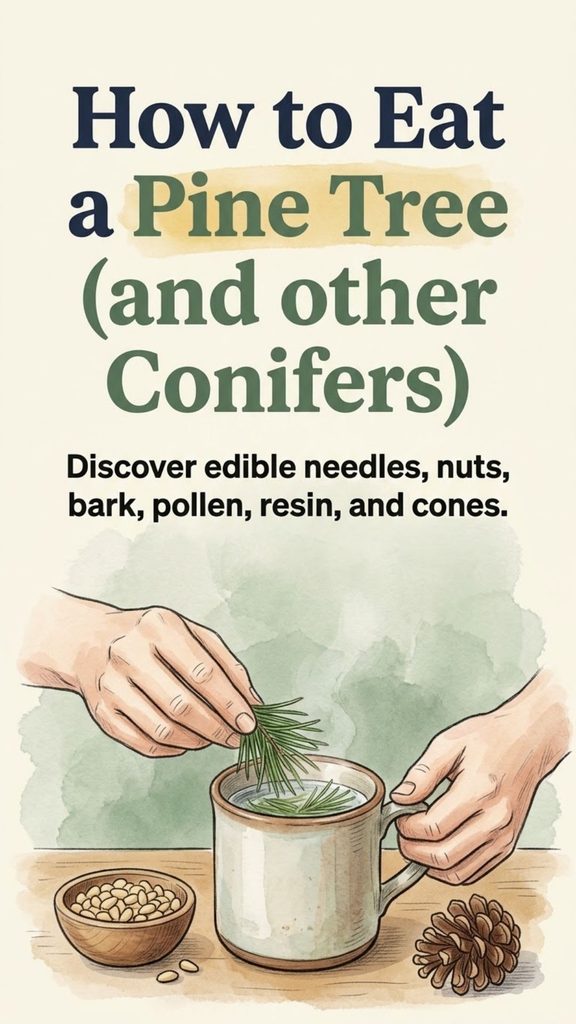
A pine tree may not look like food, but several parts of properly identified pine species have a long history of culinary use. Pine nuts are the obvious example, yet people have also prepared certain pine needles, inner bark, young growth, and other parts of the tree.
Other conifers have culinary uses too. Spruce, fir, and Douglas-fir have all been used traditionally in different regions.
There is one rule that matters more than every recipe or foraging trick, however: never eat an evergreen tree simply because it looks like a pine.
You Might Also Like:
- Loading posts...
Conifers are not interchangeable. Yews (Taxus species), for example, are highly poisonous. Their foliage, bark, and seeds contain toxic compounds, and ingestion can be fatal.
Successful conifer foraging therefore begins with identification, not tasting.
Once you know exactly what species you have and have confirmed that the particular part is edible, conifers can provide some surprisingly interesting wild foods.
First: Know Exactly Which Tree You Are Harvesting
“Pine tree” is often used casually for almost any evergreen with needles, but botanically that is inaccurate.
True pines belong to the genus Pinus. One useful identifying characteristic is that their needles grow in bundles, usually containing two, three, or five needles depending on the species. Eastern white pine (Pinus strobus), for example, has five needles in each bundle.
Spruces, firs, Douglas-firs, hemlocks, yews, cedars, and junipers are different trees.
Some have edible parts. Some are unsuitable for casual culinary use. Some are dangerous.
Do not rely on a single characteristic such as needle color, smell, or tree shape. Use several identifying features, including needles, cones, bark, branching pattern, and geographic range. A reputable regional field guide or experienced local forager is far more useful than trying to identify a tree from one photograph.
This is especially important in gardens and landscaped areas, where different evergreen species are often planted close together.
Also avoid harvesting from trees that may have been treated with pesticides or other chemicals, and obtain permission before collecting from private property.
1. Pine Nuts Are the Most Familiar Edible Part
Pine nuts are actually seeds found inside pine cones.
Many pine species produce seeds, but only certain species make seeds large enough to be worthwhile as food. Pinyon pines are among the best-known North American examples.
Colorado pinyon (Pinus edulis) and singleleaf pinyon (Pinus monophylla) produce edible seeds that have long been important foods in parts of western North America. They can be eaten raw or roasted and have traditionally been ground into flour and incorporated into other foods.
Once shelled, pine nuts are wonderfully versatile. Their rich, mild flavor works in both savory and sweet dishes.
Try them in:
- Pesto and herb sauces
- Salads
- Pasta dishes
- Rice and grain bowls
- Cookies
- Cakes
- Stuffings
- Roasted vegetable dishes
- Nut-based spreads
Wild pine nuts require more patience than a package from the grocery store. Cones must mature, seeds have to be extracted, and shells may need to be removed.
That is one reason commercial pine nuts feel expensive: there is quite a bit of work hidden inside that little seed.
2. Certain Pine Needles Can Be Used for Tea
Needles are probably the most accessible part of an edible pine, but this is also where correct species identification becomes especially important.
Eastern white pine is one well-documented example. Its needles have traditionally been prepared as an infusion, and educational resources from the University of Maine and Harvard’s Arnold Arboretum describe white pine needles being brewed as tea.
Pine needles contain vitamin C, although the exact amount varies with species, season, growing conditions, storage, and preparation.
The flavor is usually more interesting than people expect. Depending on the tree and age of the needles, the infusion can have resinous, citrus-like, woodsy, or slightly spicy notes.
A Simple Pine Needle Infusion
After positively identifying an edible pine species, collect a small amount of healthy, clean foliage.
Rinse the needles, remove woody debris, and cut or crush them into shorter pieces. Place them in a mug or heatproof container and add hot water.
Allow the needles to steep until the water becomes aromatic, then strain.
Honey can soften the stronger resinous notes, though a good pine infusion does not necessarily need sweetening.
Start mild. Adding more needles will not automatically make a better drink.
3. Young Conifer Tips Can Be a Seasonal Ingredient
One of the most interesting times to forage some edible conifers is spring, when fresh growth appears at the ends of the branches.
These new tips are softer and milder than mature needles. Spruce tips in particular have become a popular seasonal ingredient among chefs, brewers, and wild-food enthusiasts.
Their flavor can range from citrusy and fruity to strongly resinous.
Depending on the species and recipe, young conifer tips can be used to flavor:
- Sugar
- Syrups
- Vinegars
- Salt
- Baked goods
- Drinks
- Sauces
- Desserts
Harvesting should be restrained.
The tip of a branch contains new growth. Removing too many tips can alter the way the tree grows, especially on small trees. Never strip every new shoot from one branch or one tree.
Take only a small amount from healthy, abundant trees and leave the majority untouched.
Again, “spruce-like” is not an identification. Confirm the exact species before tasting anything.
4. Pine Pollen Is Another Foraged Ingredient
In spring, some pine trees release enormous quantities of yellow pollen. On a heavy pollen day, it can coat cars, porches, windows, and almost everything nearby.
Foragers sometimes collect that pollen directly from the male pollen cones before it blows away.
Pine pollen can be used in small amounts in cooking and baking. Its flavor is mild compared with the needles, so it can disappear easily into other ingredients.
It may be stirred into batters, sprinkled into flour mixtures, or used as a novelty wild-food ingredient.
However, the often-repeated suggestion that pine pollen should simply replace a large portion of the flour in ordinary recipes is not especially practical. Pollen does not behave like wheat flour and does not provide gluten, so large substitutions can dramatically change the structure of baked goods.
People with pollen allergies should also be cautious around concentrated pollen.
5. Pine Inner Bark Has a Real History as Food
Eating tree bark sounds like something reserved for desperate survival situations, but the history is more complicated.
The rough outer bark is not the part traditionally valued as food. The useful portion is the softer living tissue beneath it, often referred to broadly as inner bark or phloem.
Historical and ethnobotanical research documents the use of Scots pine (Pinus sylvestris) inner bark by Sámi communities in northern Scandinavia. It was eaten fresh, dried, roasted, and prepared for storage. Research on culturally modified trees shows that this practice continued for centuries.
It therefore should not automatically be dismissed as nothing more than “famine food.” In some places, pine inner bark was part of an established food tradition.
North American Indigenous communities also made use of the inner bark of various forest trees, including pines. Utah State University documents traditional food uses of inner bark among Indigenous peoples of the region.
But Don’t Peel Bark From Healthy Trees
Knowing that inner bark is edible does not mean stripping bark from a living tree is responsible.
Removing a wide ring of bark around the trunk can interrupt the movement of sugars and nutrients through the tree and eventually kill it. Even smaller wounds can expose wood to insects, fungi, and physical damage.
For modern foraging, bark is better collected from an appropriately identified tree that has already been cut for another reason, when doing so is legal and you have permission.
There is rarely a good reason to injure a healthy tree just to experiment with pine-bark flour.
6. Inner Bark Can Be Dried and Ground
Historically, pine inner bark was processed in several ways rather than simply chewed straight from the tree.
Once separated from the rough outer bark, it could be dried and ground. The resulting material was sometimes incorporated into breads or other foods.
The flavor and texture are very different from ordinary grain flour. Pine inner bark contains fibrous plant material and should not be expected to behave like wheat flour in baking.
Think of it as a traditional specialty ingredient rather than a one-for-one flour substitute.
The history is fascinating, but for the average modern forager, pine nuts, needles, or young tips are much easier places to begin.
7. What About Pine Cones?
A common claim is that “pine cones are edible,” but that statement needs context.
The mature brown cone you pick up from the forest floor is woody, fibrous, and not something most people would reasonably consider food.
What usually matters is what the cone contains: the seeds.
Those are the pine nuts discussed earlier.
There are also traditional and modern preparations involving very young, immature cones from certain identified species. But young-cone recipes are species- and preparation-specific and should not be taken as evidence that any random pine cone can be eaten.
If you are new to conifer foraging, start with better-established foods instead.
8. Pine Resin Is Useful, but Don’t Treat It Like an Everyday Food
Resin is another part of pine trees surrounded by a huge amount of folklore.
Humans have used pine resin for practical purposes for centuries. Sticky resin has served as a component of adhesives, waterproofing materials, fire-starting materials, and traditional preparations.
Utah State University’s ethnobotanical records document a wide variety of historic uses of pine pitch among Indigenous communities.
That historical use does not make resin an ordinary culinary ingredient.
Eating concentrated resin or experimenting with homemade medicinal doses is very different from brewing a correctly identified edible needle as tea.
For casual wild-food use, there is little reason to consume pine resin.
If you find resin on a tree, there is also no need to cut into the trunk to obtain more. The resin is part of the tree’s response to injury.
9. Don’t Assume “Natural” Means Medicinal
Pine and other conifers have long histories in traditional medicine, but traditional use and proven medical treatment are not the same thing.
Claims that pine needles, bark, or resin can cure infections, arthritis, coughs, eczema, wrinkles, or other health conditions are often repeated online without enough information about species, dose, preparation, or quality of evidence.
That does not make traditional knowledge meaningless. It simply means culinary use should not be turned into medical advice.
Enjoy an edible conifer as food or flavoring because you have correctly identified it and understand its preparation—not because a social-media post promises it will treat a disease.
10. Yew Is the Conifer Every Forager Should Know to Avoid
If you remember only one safety lesson, remember yew.
Yews belong to the genus Taxus. Many are planted as ornamental shrubs and hedges, so they can appear in gardens, parks, cemeteries, and landscaped areas as well as natural settings.
They are not pines.
Several Taxus species contain taxines that can seriously disrupt heart function. Extension references classify common and Japanese yews as plants with high-severity poisoning characteristics. Foliage, bark, and seeds are poisonous, and serious poisoning may be fatal.
Never use an unknown evergreen for tea.
Never assume that a tree with green needles is edible.
And never rely on smell alone to distinguish one conifer from another.
How to Forage Conifers Responsibly
Wild foods remain available only when people harvest them carefully.
Take small quantities rather than filling bags simply because something is abundant. Spread your harvest among several mature plants when possible. Avoid damaging trunks and major branches.
Do not harvest rare trees or plants in protected areas where gathering is prohibited.
For tips and needles, remove only a small portion of growth.
For bark, avoid damaging living trees.
For nuts, remember that you are sharing the crop with squirrels, birds, and other wildlife that may rely on those seeds.
And before collecting anything, make sure you have permission to be there.
Responsible foraging is not simply about leaving enough for the next human visitor. It means recognizing that the tree is part of an entire living system.
The Best Pine Foods for Beginners
If you are interested in eating from the conifer forest, there is no need to begin with bark flour or obscure survival foods.
Start with something simple and well documented.
Pine nuts from an edible nut-producing species are familiar, nutritious, and easy to understand. Eastern white pine needles are an established example of foliage used for tea. Once you are confident identifying local trees, seasonal young tips can open up another range of flavors.
The deeper lesson is that a pine tree can be much more than timber, shade, or winter greenery. Humans have developed relationships with these trees as sources of food and useful materials for generations.
But those traditions were built on detailed knowledge of individual species.
That knowledge still matters.
Learn the tree first. Confirm the species from more than one reliable source. Harvest lightly. Respect the tree and the land. Then the forest starts to look very different—not as a place where “everything green is edible,” but as a landscape filled with specific plants, each with its own uses, limitations, and history.