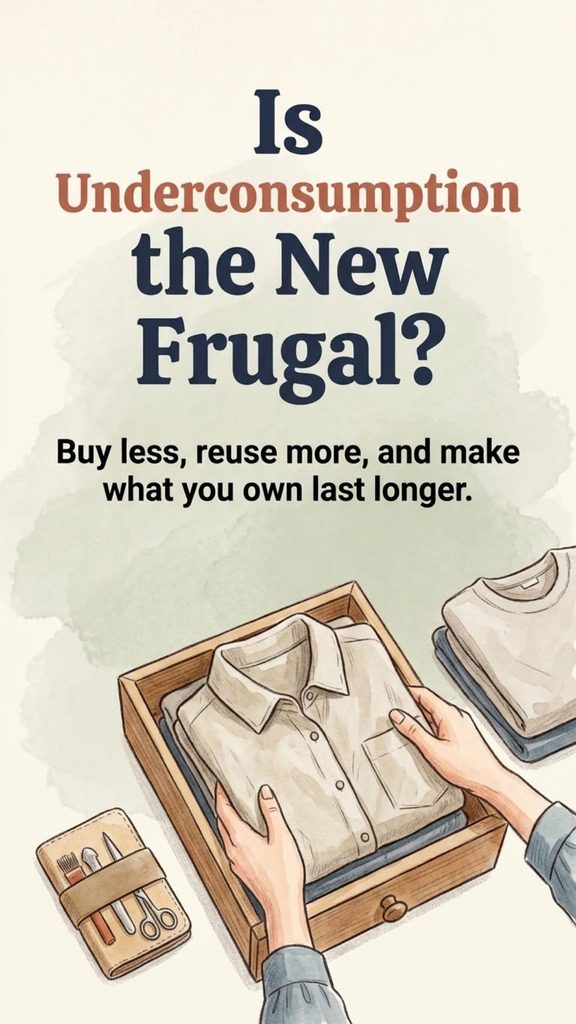
For years, social media made consumption highly visible. Clothing hauls, overflowing beauty drawers, elaborate home restocks, seasonal decor refreshes, and endless lists of “must-have” products turned ordinary shopping into entertainment.
Then a very different kind of content started gaining attention: people showing worn-out makeup pans, old phones that still worked, repaired clothing, half-empty bottles they intended to finish, and household items they had owned for years.
The trend became known online as “underconsumption core.” It gained significant attention on social media in 2024, particularly among younger users, as a response to the constant pressure to upgrade and buy more.
You Might Also Like:
- Loading posts...
For anyone who has practiced frugal living for years, however, much of this may sound surprisingly familiar.
Use what you own. Repair what you can. Avoid unnecessary purchases. Shop secondhand. Don’t replace something merely because a newer version exists.
So is underconsumption genuinely different from frugality, or has an old idea simply received a new name?
The answer is somewhere in the middle.
What Does Underconsumption Actually Mean?
In its modern lifestyle sense, underconsumption means deliberately consuming less than the level encouraged by mainstream consumer culture.
Rather than constantly upgrading possessions, the emphasis is on using things completely, keeping them for longer, and buying replacements only when they are actually needed.
That could mean finishing every bottle of shampoo before buying another, wearing the same winter coat for several years, keeping a perfectly functional phone instead of upgrading annually, or making dinner from ingredients already in the pantry before going grocery shopping.
It isn’t necessarily extreme minimalism.
Someone practicing underconsumption might still own plenty of books, kitchen equipment, gardening supplies, clothing, or decorations. The important difference is that purchasing is intentional rather than automatic.
The modern social-media movement is also separate from the older economic meaning of underconsumption, which has been used in economic discussions to describe insufficient consumer demand. The online lifestyle trend is concerned instead with personal purchasing habits and resistance to excessive consumption.
Underconsumption and Frugality Have a Lot in Common
The overlap between underconsumption and traditional frugal living is considerable.
Both approaches encourage people to get more usefulness from what they already own.
A frugal household might mend a torn shirt because replacing it would cost money. Someone interested in underconsumption might repair the same shirt because it is still useful and replacing it feels unnecessary.
Either way, the shirt gets repaired instead of thrown away.
Both approaches commonly encourage habits such as:
- Cooking at home more often
- Buying secondhand
- Repairing rather than automatically replacing
- Borrowing items that are rarely needed
- Using leftovers
- Avoiding waste
- Keeping useful possessions for many years
- Thinking before making nonessential purchases
The practical results can look almost identical.
The difference is often found in why someone is doing these things.
Frugality Usually Starts With Value
Traditional frugal living is strongly connected to money management.
The basic question is often:
How can I meet this need while spending less?
That might involve comparing prices, using coupons, waiting for a sale, buying store brands, cooking inexpensive meals, repairing something yourself, or purchasing a used version instead of a new one.
A frugal person does not necessarily want to own fewer things. The goal may simply be to obtain those things at the lowest reasonable cost.
Imagine someone needs a winter coat.
A frugal shopper might compare retailers, search clearance racks, use a discount code, and buy a good coat for $60 instead of paying $150.
That is a successful frugal purchase.
Someone focused primarily on underconsumption might first ask a different question:
Do I need another coat at all?
If the one in the closet is still warm and wearable, the purchase may never happen.
That small distinction explains much of the difference between the two ideas.
Underconsumption Starts Before the Price Tag
Underconsumption challenges the purchase itself rather than simply looking for a cheaper way to make it.
The questions become:
Do I already have something that works?
Can I repair what I own?
Could I borrow this?
Will I genuinely use it?
Where will I store it?
Would I still want it if I had not seen it advertised?
The goal is not necessarily to spend the least amount possible. It is to reduce unnecessary consumption.
That means an underconsumption mindset can occasionally lead to spending more on an individual purchase.
Someone might pay more for a durable pair of boots that can be repaired and worn for years instead of repeatedly purchasing inexpensive pairs that wear out quickly.
That is where thoughtful frugality and underconsumption can work particularly well together: buy fewer things, but consider durability and total value rather than price alone.
Why Underconsumption Became So Appealing
The popularity of underconsumption did not develop in isolation.
For years, social platforms encouraged highly visible forms of consumption. Influencers posted enormous clothing hauls, beauty collections, kitchen restocks, Amazon finds, and frequent product recommendations. TikTok even became closely associated with the phrase “TikTok made me buy it.”
At the same time, another movement known as de-influencing began encouraging people to question viral products instead of automatically buying them.
Underconsumption took that idea further.
Instead of merely saying, “Don’t buy this particular product,” people began showing what it looked like to simply keep using what they already owned.
Financial pressure has also played a role. Higher living costs have encouraged many households to scrutinize discretionary spending more closely, while no-buy challenges have attracted people trying to reduce debt, save money, or change impulsive shopping habits.
Environmental concerns add another motivation. Keeping products in use longer can reduce the demand for replacement items and the waste created when usable belongings are discarded.
But underconsumption does not need to become a moral competition. Sometimes people consume less because they are concerned about waste. Sometimes they are saving for a house. Sometimes money is tight. Sometimes they are simply tired of clutter.
All are legitimate reasons to reconsider buying habits.
What Underconsumption Looks Like in an Ordinary Home
The most useful version of underconsumption is surprisingly ordinary.
It rarely requires dramatic lifestyle changes.
Use Products Completely
Before opening another bottle, container, candle, notebook, cleaning product, or cosmetic, finish the one already in use whenever practical.
This prevents half-used items from multiplying in cupboards and drawers.
Wear Clothes Repeatedly
A healthy wardrobe does not require constant novelty.
Repeating outfits, repairing minor damage, caring for shoes properly, and wearing clothes until they genuinely need replacing are simple forms of underconsumption.
A capsule wardrobe can help some people, but there is no magic number of garments everyone should own.
Repair Before Replacing
A loose button does not require a new shirt. A scratched wooden table may not need replacing. A lamp might only need a new cord or bulb.
Of course, safety matters. Electrical appliances, damaged structural items, and certain products should be repaired professionally or replaced when they become unsafe.
The goal is not to keep everything forever. It is to avoid throwing things away merely because repair requires a little effort.
Shop Secondhand When It Makes Sense
Furniture, tools, books, dishes, clothing, garden supplies, and many children’s items can often be found used.
Secondhand buying is not automatically the best option for every product, but it can extend an item’s useful life while reducing the cost of purchasing something you genuinely need.
Borrow Rarely Used Items
Some objects spend almost their entire lives sitting in storage.
A specialty baking pan needed once a year, a carpet cleaner needed for one weekend, or a tool required for a single project may be better borrowed or rented.
Ownership is useful when something is frequently needed. It is less valuable when storage becomes the bigger responsibility.
Try a No-Buy or Low-Buy Period
One practical way to explore underconsumption is to temporarily restrict nonessential purchases.
A no-buy period does not have to mean spending nothing.
Groceries, medication, transportation, household necessities, bills, and genuine replacements can remain normal expenses. Instead, you create personal rules around categories where unnecessary buying tends to happen.
For example:
Allowed: groceries, toiletries when something runs out, necessary repairs, planned gifts.
Paused: new clothing, decor, beauty products, hobby supplies, kitchen gadgets, impulse online purchases.
A month is long enough to reveal surprisingly useful information.
You may discover that certain purchases were triggered by boredom rather than need. You may find unopened duplicates at home. You may also discover categories where buying something genuinely improves daily life.
The purpose is awareness, not punishment.
Reduce the Advertising Coming Into Your Life
Buying less is much harder when you are constantly being encouraged to buy.
Removing some of those triggers can be more effective than repeatedly relying on willpower.
Unsubscribe from promotional emails you never wanted. Turn off retailer notifications. Remove shopping apps you habitually browse. Unfollow accounts whose main purpose is convincing you that your wardrobe, kitchen, home, or appearance constantly needs updating.
This is a kind of digital decluttering.
You are not only reducing screen clutter. You are reducing the number of purchasing decisions competing for your attention.
Underconsumption Can Still Become Another Trend to Buy Into
There is an irony worth watching.
Once a lifestyle becomes popular online, companies quickly find ways to sell products associated with it.
Suddenly, someone trying to simplify may feel that they need the perfect neutral capsule wardrobe, matching glass pantry jars, expensive reusable containers, a minimalist water bottle, or a beautifully designed planner to track their no-buy year.
That misses the point.
You do not need to replace your possessions with more aesthetically appropriate versions of the same possessions.
The most authentic form of underconsumption is usually far less photogenic: an old mixing bowl, a scratched phone case, a repaired sweater, mismatched storage containers, and a perfectly serviceable appliance that will remain in the kitchen until it stops working.
Usefulness matters more than creating a particular aesthetic.
Frugality and Underconsumption Work Better Together
There is little reason to choose between the two philosophies.
Frugality teaches you to use money carefully.
Underconsumption reminds you that sometimes the cheapest purchase is the one you realize you do not need.
Put them together and you get a practical approach to household spending:
First, ask whether the purchase is necessary.
If it is, check whether you already own something that can do the job.
If not, consider borrowing, repairing, or buying secondhand.
If buying new makes the most sense, compare quality, usefulness, expected lifespan, and price.
Then buy the item without guilt and use it well.
That is far more useful than trying to follow either lifestyle perfectly.
Buying Less Isn’t About Deprivation
The strongest idea behind underconsumption is not that possessions are bad.
Homes need things. People need clothes, furniture, cookware, tools, appliances, school supplies, toiletries, and countless other products that make ordinary life possible.
Intentional consumption simply removes the assumption that every improvement requires another purchase.
Sometimes you really do need the new shoes.
Sometimes the washing machine genuinely needs replacing.
Sometimes buying a tool saves enough time to justify owning it.
And sometimes the mug you have used for ten years is still completely fine.
Learning to recognize the difference is where the real value lies.
Is Underconsumption Really the New Frugal?
Underconsumption is not a replacement for frugal living, and it certainly did not invent the idea of using what you have.
Generations of households have repaired clothes, preserved food, reused containers, bought secondhand goods, passed belongings between family members, and avoided unnecessary purchases long before those habits had a social-media label.
What the newer movement has done is place those ordinary habits in a modern context.
Frugality often asks, “How can I spend my money wisely?”
Underconsumption adds another useful question: “Do I need to spend it at all?”
Neither approach requires deprivation, extreme minimalism, or refusing every pleasure. Used sensibly, they simply encourage a little more space between wanting something and buying it.
And in a culture where purchasing can happen with a single tap, that pause may be one of the most valuable frugal habits of all.