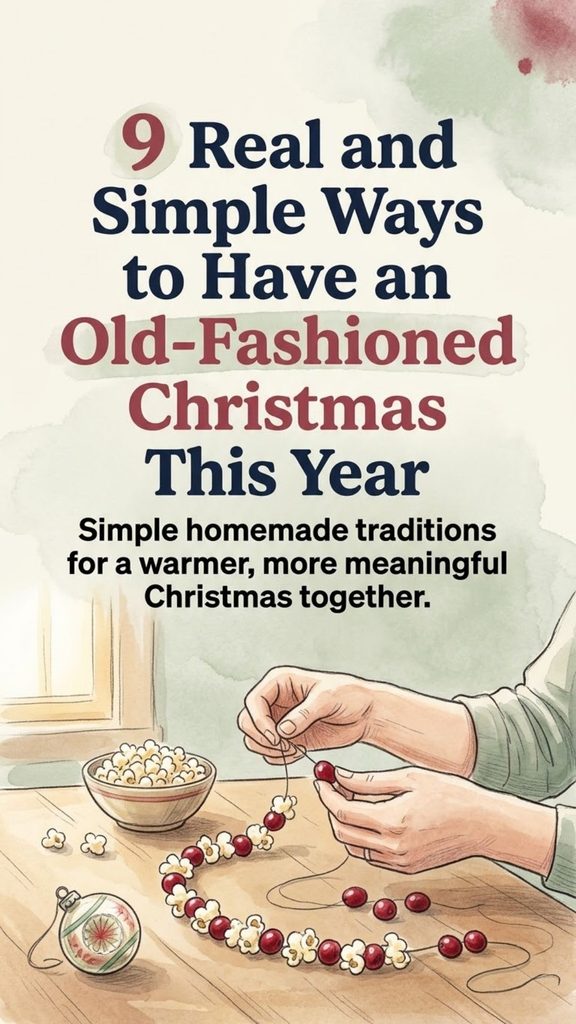
An old-fashioned Christmas does not require a perfectly decorated farmhouse, expensive vintage ornaments, or weeks of complicated preparation. At its heart, it is simply a Christmas that feels slower, warmer, and more personal.
Instead of filling December with endless shopping and pressure to create a picture-perfect holiday, an old-fashioned approach puts the emphasis back on homemade food, simple decorations, meaningful gifts, familiar traditions, family time, and kindness toward others.
You do not have to recreate Christmas from a particular decade or give up every modern convenience. The goal is to choose a few traditions that make the season feel less commercial and more connected.
You Might Also Like:
- Loading posts...
Here are nine realistic ways to bring that feeling into your home this year without turning Christmas into another exhausting project.
1. Make Simple Christmas Food at Home
Homemade food is one of the easiest ways to give Christmas an old-fashioned feeling.
That does not mean preparing an enormous holiday spread or spending three days decorating elaborate cookies. In fact, keeping the food simple often makes the experience more enjoyable.
Choose a few recipes your family genuinely likes and make them part of the season every year.
Classic choices might include:
- Sugar cookies
- Gingerbread
- Jam thumbprint cookies
- Fudge
- Homemade bread
- Hot cocoa
- A favorite family cake or pie
The value is often in the making rather than in how impressive the final result looks.
Children can cut cookie shapes, stir ingredients, sprinkle sugar, or help wrap treats. Cookies do not need identical icing. Bread does not need to look professionally baked. A slightly uneven batch made together can become much more memorable than something purchased simply because it looked perfect.
Try choosing one or two baking days instead of feeling obligated to make every traditional recipe you come across.
That keeps homemade food enjoyable rather than turning it into another Christmas obligation.
2. Share Homemade Treats Without Fancy Packaging
Giving food is one of the simplest traditional ways to show appreciation during the holidays.
Bake an extra loaf of bread, make another dozen cookies, prepare a batch of fudge, or put together homemade cocoa mix and share it with someone nearby.
You might give treats to:
- Neighbors
- Friends
- Teachers
- Coworkers
- Delivery drivers
- Elderly relatives
- Someone who has helped your family during the year
There is no need to spend more on the container than you spent making what is inside it.
Use a clean jar, reusable tin, simple paper bag, plate, or container you already have. Add a handwritten note if you want to make the gift more personal.
The point is generosity, not presentation.
One of the quickest ways to turn simple holiday giving into unnecessary stress is believing that every cookie box needs coordinated ribbon, custom labels, and elaborate wrapping. A plate of homemade cookies delivered with genuine warmth already accomplishes what matters.
3. Make a Few Gifts Instead of Buying Everything
Homemade gifts can feel especially appropriate at Christmas because they represent time and thought rather than simply another purchase.
You do not have to be an experienced crafter.
Start with skills you already have.
Someone who enjoys baking might give bread, cookies, or granola. Someone who sews could make a simple apron, fabric napkins, or reusable kitchen cloths. A knitter might make a scarf or dishcloth. Children can create drawings, ornaments, decorated frames, or handmade cards.
The best homemade gifts are usually practical or personal rather than complicated.
Consider gifts such as:
- A family recipe written neatly on a card
- Homemade baked goods
- A simple sewn apron
- Knitted dishcloths
- A framed photograph
- Homemade ornaments
- A jar of dry cookie ingredients
- A handwritten collection of favorite recipes
Do not create twenty difficult handmade gifts just because homemade sounds more traditional. That defeats the purpose.
Choose a few people for whom a handmade gift would be meaningful and keep the project manageable.
4. Decorate With Natural and Homemade Materials
Christmas decorations once relied much more heavily on what families could make, gather, reuse, or preserve from year to year.
That same approach still creates a warm holiday atmosphere.
Instead of replacing your decorations whenever trends change, begin with what you already own. Bring out familiar ornaments, ribbons, candles, baskets, greenery, or textiles and rearrange them in a fresh way.
Natural materials can add plenty of character without requiring much spending.
Depending on what is available where you live, you might use:
- Pinecones
- Evergreen branches
- Dried orange slices
- Cinnamon sticks
- Bare branches
- Nuts in their shells
- Apples
- Cranberries
- Paper decorations
- Fabric scraps and ribbon
A bowl filled with oranges and greenery can look festive on a kitchen table. A few evergreen cuttings in a jug can brighten a hallway. Pinecones placed around candles or tucked into a garland bring in texture without requiring a new box of decorations.
Keep natural materials away from open flames and other heat sources, and use only plants you can identify safely if children or pets may handle them.
The goal is not to cover every surface. A few thoughtful decorations often create more atmosphere than a house filled with seasonal clutter.
5. Bring Back Easy Handmade Christmas Decorations
Some of the most charming Christmas decorations are also among the simplest.
Paper snowflakes are a good example. They require only paper, scissors, and a little patience, yet a collection of them across a window can make a room feel immediately festive.
Paper chains are another inexpensive option. Children can cut strips from colored paper, old craft paper, or other suitable scraps and connect them into long garlands.
Popcorn garlands are also associated with traditional Christmas decorating. If you make one, use plain popcorn and strong thread, and treat it as decoration rather than food once it has been handled and displayed.
Homemade ornaments can be created from salt dough, paper, fabric scraps, pinecones, or other simple materials.
You do not need an entire tree filled with handmade decorations. Adding just a few each year can slowly create a collection with real family history behind it.
Write the year on the back of children’s ornaments when possible. Ten or twenty years later, those imperfect little decorations may be the ones everyone looks forward to seeing most.
6. Use Old Decorations and Secondhand Finds
An old-fashioned Christmas should not require buying brand-new items designed to look old.
Use the real things you already have.
Family ornaments, inherited decorations, old serving dishes, worn Christmas books, faded ribbons, and decorations collected over many years often give a home much more character than a completely coordinated collection.
If you want to add a few pieces, thrift stores, flea markets, secondhand shops, and estate sales can be good places to look.
You might find:
- Glass ornaments
- Brass candlesticks
- Vintage-style serving trays
- Old Christmas books
- Table linens
- Baskets
- Wooden decorations
- Holiday dishes
Buy only what you genuinely like. A simple Christmas can become cluttered surprisingly quickly when “vintage” becomes another excuse to collect.
The most meaningful decorations are often those connected to stories.
Tell children where an old ornament came from. Mention who made the quilt on the chair. Use a dish that belonged to a grandparent if it is still safe and practical to use.
These small stories are how ordinary objects become family traditions.
7. Repeat the Same Simple Traditions Every Year
Traditions do not need to be elaborate.
In fact, repetition is what makes them traditions.
A family might bake the same cookies on the weekend before Christmas, read the same story on Christmas Eve, take an evening drive to see neighborhood lights, or have pancakes every Christmas morning.
The activity itself can be very ordinary.
What makes it special is that everyone knows, “This is what we do at Christmas.”
Consider choosing a few traditions such as:
- Reading a favorite Christmas story aloud
- Making cookies together
- Watching one favorite Christmas film
- Driving or walking around to see lights
- Playing board games after dinner
- Making ornaments
- Drinking cocoa while decorating the tree
- Taking a winter walk
- Leaving cookies for Santa if that is part of your family’s celebration
- Taking the same family photograph each year
Try not to introduce so many traditions that December becomes a checklist.
Two or three reliable family rituals can feel far more meaningful than fifteen activities everyone is rushing to complete.
8. Spend More Time in Your Community
An old-fashioned Christmas feeling often comes from participating in the season rather than only consuming it.
Local events can provide some of the most memorable experiences of December, and many are inexpensive or free.
Look for events such as:
- Christmas parades
- Community tree lightings
- Local craft markets
- School concerts
- Winter festivals
- Neighborhood light displays
- Library activities
- Charity collections
- Local performances
Bring a thermos of cocoa to a tree lighting. Bundle up for a parade. Walk through a small holiday market and talk with local makers instead of rushing through a crowded shopping center.
Community traditions can become family traditions too.
Checking local event calendars early is useful because some popular activities require reservations or have limited dates.
You also do not need snow or a picturesque small town to create this experience. A neighborhood walk, outdoor market, city light display, or community gathering can provide the same sense of shared celebration.
9. Make Generosity Part of Christmas
One of the easiest ways to make Christmas feel more meaningful is to turn some attention outward.
Generosity does not always require a large donation.
It can mean bringing cookies to a neighbor, checking on someone who lives alone, helping with a community collection, donating useful items, leaving a generous tip when appropriate, or giving your time to a local organization.
Families with children can involve them in choosing something manageable.
Perhaps they select a new toy to donate. Maybe everyone helps bake bread for a neighbor. Older children can help sort donations, write cards, or participate in an appropriate community volunteer activity.
Keep generosity thoughtful rather than performative. The goal is not to create another holiday accomplishment to photograph and share. It is simply to notice other people.
Sometimes the most meaningful gesture is also the smallest: delivering a warm meal, shoveling a walkway, sending a handwritten card, or remembering someone who might otherwise be overlooked.
Put Family Time Ahead of Holiday Productivity
Christmas can become surprisingly busy even when the activities themselves are pleasant.
There are gifts to buy, food to prepare, decorations to put up, events to attend, and countless little details competing for attention.
An old-fashioned Christmas works best when family time is treated as part of the celebration rather than something squeezed in after everything else is finished.
Have an evening when phones are put aside and everyone plays cards or a board game.
Watch an old Christmas movie together with popcorn and cocoa.
Take a walk after dinner.
Sit around the table longer than usual.
Let children help decorate without worrying that every ornament is perfectly placed.
These experiences may not produce an impressive photograph, but they often become the memories people keep.
Keep Christmas Spending Under Control
A simpler Christmas can also be gentler on the household budget.
Decide what you are comfortable spending before holiday shopping begins. Consider separate amounts for gifts, food, decorations, activities, and travel if those apply to your family.
Then look for areas where tradition can replace spending.
Instead of buying new decorations, use what you already own.
Instead of purchasing dozens of gifts, exchange fewer meaningful ones.
Instead of attending an expensive attraction every weekend, choose a free community event.
Instead of purchasing elaborate neighbor gifts, bake something simple.
Secondhand items can also be useful, particularly for decorations, serving pieces, books, and certain gifts when appropriate.
Simple does not have to mean cheap, and inexpensive does not automatically mean meaningful. The idea is to spend deliberately instead of allowing holiday pressure to make every decision.
What If Your Family Loves Lots of Presents?
A simpler Christmas does not require suddenly eliminating gifts.
Changing family expectations too abruptly can create unnecessary disappointment, especially for children who are accustomed to a particular tradition.
Instead, simplify gradually.
You might reduce the number of gifts while choosing them more carefully. Families can also shift some of the focus toward experiences, books, useful items, handmade gifts, or activities done together.
Talk about changes before Christmas morning rather than surprising everyone.
Children can still experience excitement and abundance without an enormous mountain of presents. What matters is finding a balance that feels joyful and realistic for your household.
What If You Are Not Crafty?
You do not need advanced craft skills to have an old-fashioned Christmas.
Choose projects with a very low chance of frustration.
Cut paper snowflakes. Bake cookies. Tie ribbon around an ornament. Arrange greenery in a jar. Write cards. Frame a photograph. Make a paper chain.
A homemade Christmas should feel warmer, not harder.
If making something causes more stress than buying it, purchase the item and move on. Simplicity includes knowing what is not worth your time.
The Best Old-Fashioned Christmas Is the One You Actually Enjoy
Having an old-fashioned Christmas is not about pretending modern life does not exist. You do not need to make every gift, cook every food from scratch, cover your house in homemade garlands, or recreate an idealized Christmas from the past.
Choose the parts that make your family slow down and enjoy being together.
Bake one favorite cookie. Make paper snowflakes. Use the ornaments you already own. Attend the local parade. Deliver something homemade to a neighbor. Read the same story every Christmas Eve.
Then allow those ordinary things to be enough.
The warmth people associate with an old-fashioned Christmas rarely came from perfection. It came from repetition, familiarity, generosity, handmade touches, shared meals, and people making time for one another.
Those things do not require an enormous budget.
They simply require making room for them.