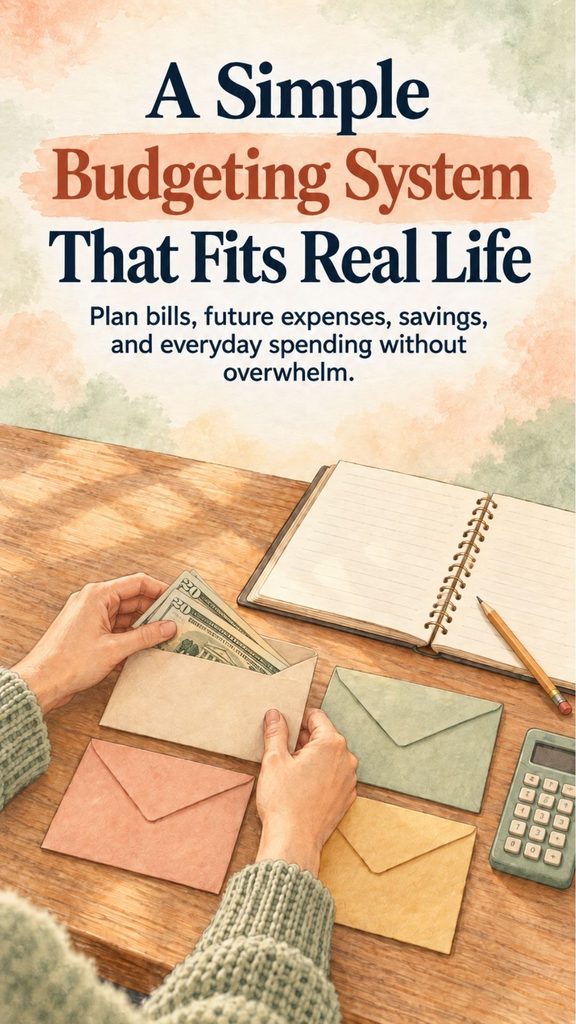
A budget works best when it feels like a plan for your real life rather than a punishment for spending money.
That means accounting for rent or mortgage payments, groceries, fuel, bills, debt, savings, birthdays, car repairs, the occasional takeaway, and all the other expenses that tend to appear throughout the year.
Many budgets fail because they are built around an ideal month.
You Might Also Like:
- Loading posts...
The ideal month has no unexpected bills. No one needs new shoes. The car behaves perfectly. There are no school expenses, medical costs, family celebrations, home repairs, or tempting purchases.
Real life is different.
A useful budget needs enough structure to guide your money and enough flexibility to survive an imperfect month.
Instead of starting with a long list of spending restrictions, use a simpler approach: decide what your money must do first, prepare for expenses you know will eventually happen, and give yourself a realistic amount for everything else.
Start With Your Monthly Take-Home Income
Before deciding how much you can spend, determine how much money is actually available.
Use the amount that reaches your bank account after taxes and other automatic deductions.
If your income is consistent, this may be easy.
Write down all regular take-home income, including:
- Wages
- Salary
- Regular freelance income
- Pension income
- Reliable benefits
- Other predictable household income
If two people contribute to the household, decide whether you are budgeting jointly or separately.
For a shared household budget, looking at the total amount coming in usually makes planning easier.
What If Your Income Changes Every Month?
Budgeting on irregular income requires a slightly different method.
Do not build your household around your best month.
Look back at several months of income and identify a conservative amount you can reasonably expect.
Another option is to base the current month’s spending on money already earned rather than money you hope to receive.
When income is higher than expected, use the extra strategically.
You might:
- Build an emergency fund
- Prepare for upcoming annual bills
- Pay down debt
- Save for a major goal
- Create a buffer for slower months
This prevents one unusually good month from permanently increasing your everyday spending.
Build Your Budget Around Four Main Categories
Instead of creating dozens of categories immediately, begin with four broad groups.
They are:
- Essentials
- Future expenses
- Financial goals
- Flexible spending
This method gives every major type of expense a place without making the budget unnecessarily complicated.
1. Essentials: Cover the Bills That Keep Life Running
Essentials are the expenses you need to maintain your household.
These may include:
- Rent or mortgage
- Electricity
- Water
- Gas
- Groceries
- Transportation
- Insurance
- Basic phone service
- Internet when needed for work or school
- Minimum debt payments
- Necessary medications
- Childcare
- Basic household supplies
Write down the actual amounts rather than what you think you should be spending.
If your electricity bill averages $140, budgeting $80 because you wish it were lower will only create a shortage later.
Use recent bills and bank statements to estimate realistic amounts.
Some expenses will vary each month. For those, use an average and leave a little room for fluctuations.
2. Future Expenses: Budget for Bills Before They Become Emergencies
This category is where many household budgets go wrong.
People remember their monthly bills but forget expenses that arrive only occasionally.
A yearly insurance payment may feel unexpected, but it is not actually unpredictable.
Neither is Christmas.
Neither is an annual car registration.
Neither is routine vehicle maintenance.
These are often called sinking funds.
A sinking fund simply means setting aside a small amount each month for an expense you know is coming.
Examples include:
- Car repairs
- Home maintenance
- Annual insurance
- Property taxes
- School expenses
- Clothing
- Birthdays
- Holidays
- Medical deductibles
- Pet expenses
- Appliance replacement
- Travel
Suppose you normally spend about $600 on holiday gifts and celebrations.
Instead of trying to find $600 in December, setting aside $50 each month spreads the expense across the year.
This simple habit can make a budget much more stable.
3. Financial Goals: Decide What You Are Building Toward
After essential expenses are covered, decide what you want your money to accomplish.
Common goals include:
- Building an emergency fund
- Paying off debt
- Saving for a home
- Increasing retirement savings
- Building a home-repair fund
- Saving for a car
- Preparing for travel
- Starting a business
Avoid trying to fund every goal aggressively at the same time.
Choose one or two priorities.
If you have no emergency savings, creating a modest cash buffer may deserve attention before making very aggressive extra debt payments.
Once your basic emergency reserve is established, you can increase contributions toward debt or other goals.
The important part is making savings intentional.
If you wait to save whatever happens to remain at the end of the month, there may rarely be much left.
4. Flexible Spending: Leave Room for Everyday Life
A budget that removes every enjoyable purchase is difficult to maintain.
Flexible spending might include:
- Restaurants
- Coffee
- Entertainment
- Hobbies
- Personal care
- Small home purchases
- Clothing beyond essentials
- Treats
- Streaming services
These categories are often the first place to adjust when money is tight.
But they do not necessarily need to disappear entirely.
A realistic entertainment budget of $50 is usually more useful than budgeting $0 and then spending $100 because the original plan was impossible to follow.
You want limits you can actually live with.
Track Spending Before You Start Cutting
If you have never budgeted before, do not immediately try to change everything.
Spend a few weeks learning where your money currently goes.
Review:
- Bank statements
- Credit-card statements
- Digital wallet transactions
- Cash purchases
Sort the spending into basic categories.
You may notice patterns you did not expect.
Perhaps groceries are reasonable but takeout is high.
Maybe small online purchases add up faster than expected.
You might discover several subscriptions you barely use.
This stage is about information, not guilt.
You cannot make a useful plan until you know what the current reality looks like.
Find the Expenses That Actually Matter
Not every spending cut is worth the effort.
Driving across town to save a tiny amount on groceries may cost more in fuel and time than it saves.
Focus first on recurring expenses and large categories.
Ask:
- Is the housing cost manageable?
- Are we paying for subscriptions we rarely use?
- Is there a cheaper phone plan that still meets our needs?
- Are we wasting food?
- Are we paying interest because bills are being carried on credit cards?
- Can we reduce restaurant spending without eliminating it completely?
- Are we buying things because they are needed or because shopping has become automatic?
Ten small savings can help.
One major recurring saving can help much more.
Use a Weekly Money Check-In
You do not need to look at your budget every day.
A short weekly check is usually enough for many households.
Set aside 10 to 20 minutes.
During the check-in:
- Review recent transactions.
- Update spending totals.
- Check upcoming bills.
- Look at grocery spending.
- Move money to savings if needed.
- Correct any category that is drifting off track.
If you share finances with a partner, do this together.
The purpose should not be to criticize each other’s purchases.
It is simply to make sure both people understand what is happening.
Regular check-ins prevent small overspending from turning into a surprise at the end of the month.
Create a Small Buffer Category
One of the easiest ways to make a budget more realistic is to include a small miscellaneous amount.
Life rarely follows neat categories.
Maybe you need to replace a phone charger.
A child needs money for a school activity.
You forgot about a small annual fee.
A household item breaks.
A modest buffer gives those expenses somewhere to go.
Without one, every tiny surprise can make the budget appear to have failed.
Build an Emergency Fund Separately
A sinking fund prepares for expenses you expect.
An emergency fund is for expenses you cannot reasonably predict.
Examples might include:
- Unexpected medical costs
- Urgent home repairs
- Loss of income
- Major car repairs
- Emergency travel
The ideal emergency fund varies according to income stability, household size, insurance, and expenses.
Do not become discouraged if saving several months of expenses feels impossible.
Start with a smaller target.
Even a modest reserve can prevent a surprise bill from immediately going onto a credit card.
Build from there over time.
Choose a Debt Payoff Strategy
If you are paying off consumer debt, a budget helps identify how much extra money is available each month.
Two common approaches are the debt avalanche and debt snowball.
Debt Avalanche
Make minimum payments on every debt and direct extra money toward the debt with the highest interest rate.
Once it is paid off, move that payment to the next-highest rate.
Mathematically, this approach generally minimizes interest cost when all other factors are equal.
Debt Snowball
Make minimum payments on every debt and direct extra money toward the smallest balance first.
Once it is eliminated, move the payment to the next-smallest debt.
This can provide quicker psychological wins because individual balances disappear sooner.
The best system is the one you can follow consistently.
Regardless of the method, avoid ignoring minimum payments on other debts while concentrating on one balance.
Do Not Forget Irregular Income
Bonuses, gifts, tax refunds, overtime, and side income can disappear quickly when there is no plan for them.
Before the money arrives, decide how it will be divided.
For example, extra income might go toward:
- 40% savings
- 30% debt
- 20% future expenses
- 10% fun
Those percentages are only an example.
Your priorities may be completely different.
The key is making the decision intentionally instead of spending the money simply because it feels extra.
Make Grocery Spending Easier to Control
Food is one of the most adjustable parts of many household budgets.
Begin with simple habits:
- Plan several dinners before shopping.
- Check the pantry and freezer first.
- Use a grocery list.
- Compare unit prices.
- Plan meals around food that needs to be used.
- Freeze leftovers before they spoil.
- Keep inexpensive backup meals available.
Do not assume that cooking everything from scratch is always the cheapest use of your time.
Choose the homemade foods that provide a meaningful saving or that you genuinely enjoy making.
Put Friction Between You and Impulse Purchases
You do not have to eliminate every unnecessary purchase.
But adding a pause can reduce purchases you do not really want.
Try:
- Waiting 24 hours before small discretionary purchases
- Waiting several days for larger purchases
- Removing saved payment details from shopping websites
- Unsubscribing from promotional emails
- Keeping a wish list instead of immediately buying
- Avoiding shopping when bored
Often the desire for an item disappears once the initial excitement passes.
Create a Budget for Fun
Fun should be planned too.
Giving yourself a specific amount for restaurants, entertainment, hobbies, or personal spending makes it easier to enjoy those purchases without wondering whether the money was supposed to pay a bill.
Some couples find it useful for each person to have a personal spending amount.
That money can be spent without needing approval for every small purchase.
It reduces arguments and keeps the larger household plan intact.
What to Do When You Overspend
One expensive week does not mean the entire budget is ruined.
Suppose you spend $60 more than planned on groceries.
You have several options:
- Reduce another flexible category.
- Use some of your monthly buffer.
- Accept the overage and adjust next month’s estimate.
- Investigate why the spending was higher.
Maybe grocery prices increased.
Maybe you hosted guests.
Maybe the original grocery budget was simply unrealistic.
A budget should provide information.
It should not become a reason to give up after one mistake.
Review Your Budget Every Few Months
A budget created today may not work six months from now.
Expenses change.
Income changes.
Goals change.
Families grow.
Children start school.
Insurance increases.
Debts disappear.
Every few months, review the entire plan.
Ask:
- Which categories are consistently too low?
- Which categories have more money than necessary?
- Have any bills increased?
- Are we still working toward the same goals?
- Is there a new expense coming?
- Can savings increase?
- Is any subscription or service no longer useful?
A budget should evolve with your household.
What a Good Budget Should Feel Like
A successful budget should not make you feel as though every purchase is a failure.
It should answer basic questions clearly:
Can I afford this?
Are the bills covered?
Am I saving for future expenses?
Am I moving toward my goals?
Do I still have some money for things I enjoy?
When those questions have answers, money becomes easier to manage.
Start With a Budget You Can Maintain
You do not need a complicated spreadsheet, an expensive budgeting app, or dozens of categories.
A notebook can work.
A basic spreadsheet can work.
A free budgeting app can work.
The tool matters far less than the habit of reviewing your money regularly.
Begin with four areas:
Pay the essentials.
Prepare for future expenses.
Fund your most important financial goals.
Give yourself a realistic amount for flexible spending.
Then review the plan weekly and adjust it as your life changes.
The goal is not to predict every dollar perfectly.
It is to make sure your money has a direction before it disappears into a month of ordinary spending.
When a budget reflects the way you actually live, it becomes much easier to stick with—and much more useful for building the life you want.