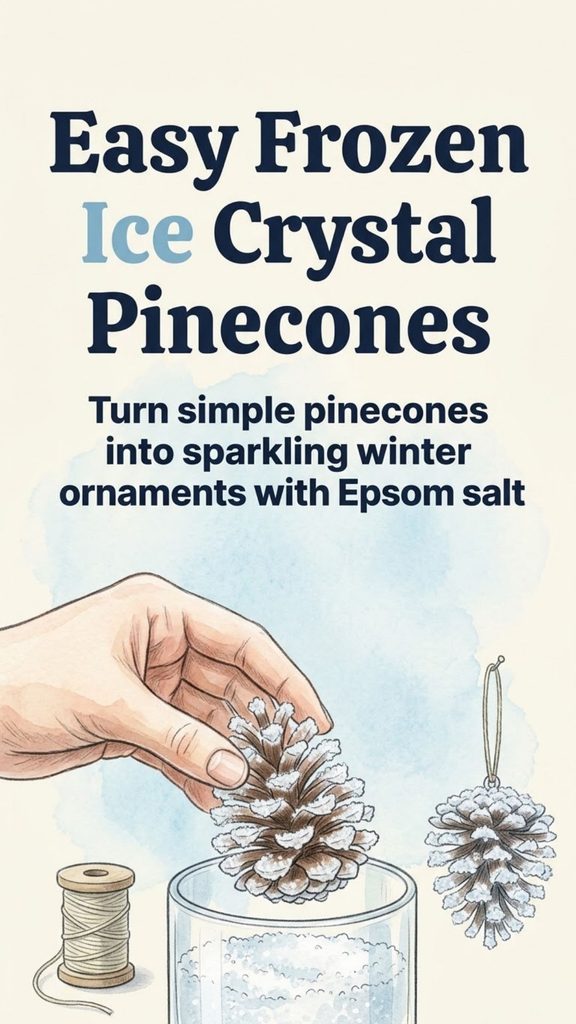
Winter crafts do not need complicated supplies to look beautiful. A few ordinary pinecones, Epsom salt, warm water, and a little patience can create sparkling decorations that look as though they have been touched by frost.
These crystal-covered pinecones are especially pretty on a mantel, tucked into a winter centerpiece, displayed in a bowl, or hung as simple seasonal ornaments. They also make an interesting family science activity because the frosty coating is created by real salt crystals forming on the surface of the pinecone.
Despite the popular name “frozen ice crystal pinecones,” there is no need to freeze them. The white sparkle comes from crystallized Epsom salt rather than ice. As water leaves a concentrated Epsom salt solution, dissolved magnesium sulfate can reform into visible crystals. The American Chemical Society uses the same basic principle in educational crystal-growing activities.
You Might Also Like:
- Loading posts...
The result is a simple nature craft that combines a little chemistry with old-fashioned winter decorating.
Why Make Crystal Pinecones?
One of the nicest things about this project is how little it requires. You do not need specialty craft supplies or an elaborate setup. Pinecones provide all the texture, while the crystals do most of the decorating.
It is also an easy way to bring natural materials indoors during winter. Instead of buying another seasonal decoration, you can transform something as ordinary as a pinecone into something that looks snowy and delicate.
Crystal pinecones work well for:
- Winter mantel displays
- Table centerpieces
- Christmas tree ornaments
- Bowl and basket fillers
- Nature-themed decorations
- Family craft afternoons
- Simple science activities with children
The finished pinecones can be left completely natural or dressed up with string, ribbon, or a very small amount of glitter.
What You’ll Need
Gather your materials before preparing the crystal solution.
You will need:
- Clean, dry pinecones
- Epsom salt
- Very warm or hot tap water
- A heat-safe bowl, jar, or wide container
- Spoon for stirring
- String or twine
- Optional glitter
- Tray, parchment paper, or another protected surface for drying
Epsom salt is magnesium sulfate, a salt that dissolves in water and can form visible crystals as conditions change and water evaporates.
You do not need an exact amount of salt for every batch. The size of your container and the number of pinecones will determine how much solution you need.
Prepare the Pinecones First
If you gathered pinecones outdoors, inspect them before bringing them into your craft area.
Brush away loose dirt, leaves, pine needles, and other debris. A dry paintbrush or soft cleaning brush works well for getting between the scales.
Make sure the pinecones are fully dry before beginning.
If you plan to hang the finished pinecones, tie the string on now. Secure a loop of twine or string around the upper scales or stem. Doing this before the crystals form prevents you from having to handle the finished pinecone more than necessary.
Choose a container wide enough for your pinecones to sit comfortably without being tightly packed together.
Make a Concentrated Epsom Salt Solution
The crystal solution is the most important part of the project.
Pour very warm water into your container or a separate heat-safe mixing bowl. Begin adding Epsom salt a little at a time while stirring.
Continue adding and stirring until the water has dissolved a large amount of salt. For a strongly saturated solution, keep adding small amounts until additional salt becomes difficult to dissolve or a little remains at the bottom even after thorough stirring.
This approach is more reliable than relying on a single fixed salt-to-water ratio because the amount that dissolves can vary with temperature and conditions.
A saturated solution contains about as much dissolved substance as the water can hold under those conditions. As the water later evaporates, dissolved material is left behind and forms crystals.
There is no need to boil the mixture. Very warm water is sufficient for a simple household crystal-growing project, and it is easier and safer to work with.
Children should have adult supervision whenever hot water is being handled.
How to Make Epsom Salt Crystal Pinecones
Step 1: Attach the Hanging String
Tie string or twine securely around the top of each pinecone if you want to use the finished pieces as ornaments.
Leave enough string to make hanging and removing the pinecones easy.
Step 2: Prepare the Salt Solution
Add Epsom salt gradually to very warm water, stirring after each addition.
Continue until you have a concentrated solution and most of the salt has dissolved.
Step 3: Add the Pinecones
Place the pinecones into the solution.
Try to get the solution into the spaces between the scales so that crystals have many textured surfaces on which to form.
Depending on the container and pinecone, it may float rather than stay completely underwater. That is not necessarily a problem. You can carefully turn it so more of the surface becomes coated.
Avoid squeezing or damaging the scales.
Step 4: Leave the Pinecones Undisturbed
Allow the pinecones to sit in the solution for several hours or overnight.
Disturbing the container repeatedly can interfere with the developing crystal coating, so place it somewhere it can remain still.
As the solution cools and water gradually evaporates, crystals can begin appearing on the pinecone and around the container.
Step 5: Remove Carefully
Lift each pinecone using its string if possible.
Allow excess liquid to drip back into the container rather than shaking the pinecone aggressively.
At this point, the crystals can be delicate.
Step 6: Let Them Dry Completely
Place or hang the pinecones over a protected surface and leave them until completely dry.
As remaining water evaporates, more salt may become visible on the surface.
Once dry, the pinecone should have a pale, crystalline coating that resembles frost or snow.
Why Do the Crystals Form?
This craft provides a simple demonstration of crystallization.
When Epsom salt is stirred into water, the magnesium sulfate separates into dissolved ions. Warm water makes it easier to prepare a highly concentrated solution.
As water evaporates, there is less liquid available to keep all that material dissolved. The dissolved salt begins returning to a solid state, arranging itself into crystal structures.
The American Chemical Society describes the same process in its Epsom salt experiments: once water from a saturated solution evaporates, Epsom salt reforms into visible crystals.
The pinecone’s rough, layered surface gives the forming crystals plenty of places to collect, which helps create the snowy appearance.
The exact crystal shapes and coverage will not be identical from one pinecone to another. Temperature, concentration, evaporation, and the pinecone’s surface can all affect the finished appearance.
That unpredictability is part of what makes the craft attractive.
Should You Add Glitter?
Glitter is completely optional.
Epsom salt already develops a sparkly crystalline appearance, particularly when light catches the finished pinecone. If you prefer a natural winter look, leave the glitter out.
For something more decorative, a very small amount of fine glitter can be added.
Do not use so much that it covers the crystals. The texture of the salt should remain the main feature.
For a rustic arrangement, plain crystallized pinecones with natural twine usually need nothing else.
Easy Ways to Decorate With Crystal Pinecones
Once they are completely dry, there are plenty of ways to use them.
Make Simple Winter Ornaments
Use the string attached earlier to hang individual pinecones from a tree, branch arrangement, garland, or decorative hooks.
Natural jute twine creates a rustic look, while ribbon makes them more festive.
Fill a Decorative Bowl
Place several crystal pinecones together in a wooden or ceramic bowl.
Mixing different pinecone sizes makes the arrangement feel more natural without requiring additional decorations.
Add Them to a Winter Centerpiece
Arrange crystal pinecones around candles, greenery, or winter branches.
If using real candles, keep dry pinecones and other combustible decorations well away from flames.
Decorate a Mantel
Scatter a few crystal pinecones among greenery or other seasonal decorations. Their pale crystalline coating stands out particularly well against darker evergreen branches.
Create a Nature Display
Children can combine the pinecones with stones, branches, leaves, and other collected natural objects for a seasonal nature table.
Can You Color the Crystals?
You can experiment with adding a small amount of water-based coloring to the solution, but colored results may vary.
For the most realistic frosted appearance, plain Epsom salt is usually the better choice. Its white-to-clear crystals naturally create the icy look that makes this project appealing.
If experimenting with color, make one test pinecone before treating an entire batch.
Some pinecones may absorb colored water unevenly, which can change the natural appearance of the wood.
What About Essential Oils?
Adding fragrance may sound appealing, but it is not necessary for crystal formation.
If you want scented decorations, it is generally simpler to add fragrance separately after considering how the particular oil may affect surfaces or decorations nearby. Essential oils can stain some porous materials and finishes.
For a straightforward crystal-growing activity, Epsom salt and water are all that is needed.
Common Problems and How to Fix Them
Very Few Crystals Formed
The solution may not have contained enough dissolved Epsom salt.
Try preparing a more concentrated solution by adding salt gradually to warm water until little additional salt will dissolve.
Giving the project more drying time can also help make the remaining salt more visible.
The Pinecone Looks White Instead of Sparkly
Crystal size and appearance can vary considerably. Fast evaporation can leave a finer white coating, while different conditions can produce more noticeable crystals.
It does not mean the project failed.
Crystals Fall Off
Some shedding is normal because the crystals are attached to an irregular natural surface.
Handle finished pinecones by the string whenever possible rather than repeatedly touching the scales.
The Pinecone Closed Up
Pinecones respond to moisture. Scales may close when the cone becomes wet and reopen as it dries.
Give the pinecone plenty of time to dry before deciding what the final shape will look like.
How to Store Crystal Pinecones
The finished decorations should be kept dry.
Epsom salt is water-soluble, so moisture and high humidity can affect the crystal coating. Store the pinecones in a dry container or box rather than somewhere damp.
Layering them loosely with tissue paper can help reduce rubbing and crystal loss.
Do not pack them tightly beneath heavy decorations.
Even with careful storage, homemade salt crystal decorations may change somewhat over time. That is normal for a craft made with water-soluble crystals and natural materials.
If a pinecone loses much of its coating, you can simply repeat the crystallization process.
A Few Safety Tips
Although this is a simple household craft, it should still be treated as a science activity rather than something edible.
Do not taste or drink the crystal solution.
Wash hands after handling the materials and clean the work surface when finished. Keep the solution away from eyes and supervise children, particularly while warm water is being prepared. The American Chemical Society gives similar precautions for children’s Epsom salt crystal activities.
Glitter should also be kept away from young children who may put craft materials in their mouths.
A Simple Winter Craft Worth Making
Epsom salt crystal pinecones are beautiful precisely because they are uncomplicated. The pinecone supplies the shape, the salt creates the frost, and the crystallization process makes every finished piece slightly different.
They can become ornaments, mantel decorations, centerpiece accents, or simply a small winter science project to watch develop overnight.
Best of all, there is no need for artificial snow or an elaborate list of craft supplies. A concentrated solution of Epsom salt and water can transform an ordinary pinecone into something that looks as though it was collected on a sparkling frosty morning.
Sometimes the loveliest seasonal decorations really do begin with the simplest materials.