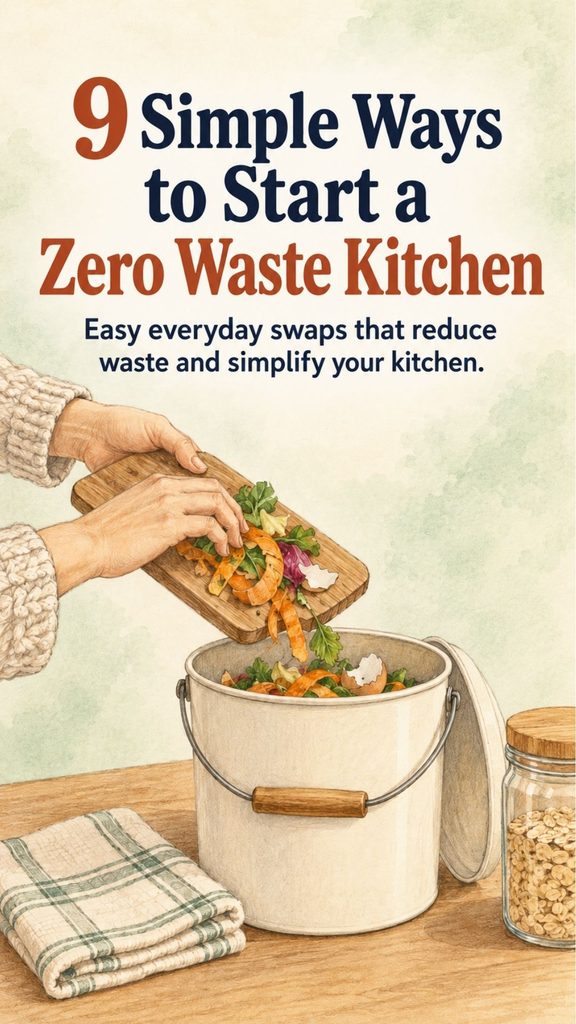
A zero-waste kitchen sounds appealing, but the phrase can also make the goal seem impossible. Food arrives in packaging, jars eventually break, cleaning supplies run out, and not every item can be composted or recycled.
A more realistic goal is to create a lower-waste kitchen—one where you buy thoughtfully, use food before it spoils, reuse durable items, compost what makes sense, and throw away less over time.
You do not need to replace everything you own with bamboo, glass, linen, or stainless steel. In fact, throwing away perfectly usable kitchen items simply to purchase more environmentally styled replacements can create unnecessary waste of its own.
You Might Also Like:
- Loading posts...
Start with what you already have. Replace disposable habits gradually, and buy new reusable products only when they solve a genuine problem.
Here are nine practical ways to begin.
1. Compost Suitable Kitchen Scraps
Composting is one of the most useful ways to keep certain food scraps and yard materials out of household trash.
A healthy backyard compost pile needs a balance of nitrogen-rich materials, often called greens, and carbon-rich materials, commonly called browns.
Useful green materials include:
- Fruit and vegetable scraps
- Coffee grounds and paper coffee filters
- Crushed eggshells
- Grass clippings
- Fresh plant trimmings
Useful brown materials include:
- Dry leaves
- Small twigs
- Shredded plain cardboard
- Uncoated paper
- Untreated wood chips
The U.S. Environmental Protection Agency recommends using roughly two to three times as much brown material by volume as green material in a home compost pile, while also maintaining moisture and airflow.
For a typical backyard pile, it is usually better to avoid meat, fish, bones, dairy products, fats, and greasy foods. They can attract pests, create odors, and may not break down properly in a small home system. Commercial composting programs can sometimes accept foods that backyard systems cannot, so check your local rules rather than assuming every composting system works the same way.
A Countertop Bin Is Only the First Step
A small countertop container is useful for collecting scraps, but simply placing food in a kitchen bin does not turn it into compost.
The scraps still need to go into:
- A backyard compost pile
- A compost tumbler
- A properly managed worm bin
- A community compost program
- A municipal food-scrap collection system
Some countertop machines dehydrate and grind scraps, but the EPA notes that the resulting material is not necessarily finished compost and may still require further treatment.
If you are new to composting, begin with fruit and vegetable scraps, coffee grounds, dry leaves, and shredded cardboard. A simple system is much easier to maintain than one filled with materials you are unsure how to manage.
2. Buy in Larger Quantities Only When It Makes Sense
Buying in bulk can reduce packaging, but it is not automatically cheaper or less wasteful.
The useful question is not, “Can I buy a huge package?”
It is:
Will my household actually use this before it spoils?
Good bulk purchases are often shelf-stable foods you use frequently, such as:
- Rice
- Oats
- Flour
- Pasta
- Dried beans
- Lentils
- Nuts
- Baking staples
- Frequently used spices
Compare the unit price rather than assuming a larger package is the better deal.
A 10-pound bag of food saves nothing if half of it becomes stale, infested, or forgotten.
Bulk shopping is most effective when you combine it with good storage. Transfer appropriate dry ingredients to clean, dry containers and label them so you know what you have.
If a store offers package-free bulk bins and allows reusable containers, that can reduce packaging further. But buying an enormous plastic-wrapped package simply because it is labeled “bulk” may offer a different kind of benefit—usually fewer shopping trips or a lower unit price rather than eliminating packaging.
Buy quantities that match your household’s real consumption.
3. Use and Maintain Durable Kitchen Tools
A lower-waste kitchen depends more on durability than on any particular material.
Wooden spoons, stainless-steel utensils, silicone spatulas, glass dishes, and other reusable tools can all serve a kitchen well when properly maintained.
If you already own a functional set of plastic cooking utensils, there is usually little benefit in throwing them all away just to replace them immediately with wooden versions.
Use what remains safe and functional.
Then, when something eventually needs replacing, consider a durable alternative that fits the job.
Wooden spoons and spatulas can last many years when cared for correctly:
- Wash them after use.
- Avoid leaving them soaking in water.
- Let them dry completely.
- Follow appropriate care instructions for the type of wood.
- Replace them if they develop deep cracks, splinters, or other damage that makes them difficult to clean.
Do not choose wooden utensils simply because of broad claims that all wood or bamboo is naturally “antibacterial.” What matters in a working kitchen is using sound utensils and cleaning and drying them properly.
Longevity is one of the simplest forms of waste reduction.
4. Take Care of Your Cookware Instead of Replacing It Unnecessarily
Cast iron can be an excellent long-lasting choice, but you do not need to throw away every nonstick pan simply because it contains PTFE, commonly known by the brand name Teflon.
Modern nonstick cookware should be used according to its manufacturer’s instructions.
Health Canada advises against preheating empty nonstick cookware and recommends avoiding very high heat—around or above 500°F (260°C)—because overheated nonstick coatings can release irritating or harmful fumes. It also recommends proper ventilation while cooking.
So the more practical approach is:
- Do not leave an empty nonstick pan heating on a burner.
- Use the heat range recommended by the manufacturer.
- Use utensils that will not unnecessarily damage the coating.
- Follow the manufacturer’s cleaning instructions.
- Replace cookware that is badly damaged or no longer suitable for safe use.
If you eventually need a new pan, cast iron, stainless steel, carbon steel, and other cookware all have useful applications.
Cast iron is particularly appealing from a low-waste perspective because a well-maintained pan can remain useful for a very long time.
But the most sustainable pan is often the safe, functional one you already own.
5. Replace Some Paper Towels With Washable Cloths
Many ordinary kitchen spills can be handled with washable cloths instead of disposable paper towels.
Old towels, worn cotton T-shirts, washcloths, and tea towels can all be repurposed into cleaning rags.
Keep a basket or drawer of clean cloths somewhere convenient.
Use them for jobs such as:
- Wiping counters
- Drying clean dishes
- Cleaning cabinet fronts
- Wiping up water
- Dusting
- Cleaning the dining table
Have a separate container for used cloths and wash them regularly.
There are situations where disposable towels can still be useful. Food-safety guidance emphasizes avoiding cross-contamination from cloths exposed to raw meat, poultry, fish, or seafood. Health Canada recommends frequent laundering of kitchen cloths and notes that paper towels can be useful for wiping kitchen surfaces.
If a reusable cloth touches raw meat juices, do not continue wiping other surfaces with it. Put it directly into the laundry and clean the contaminated surface appropriately.
A lower-waste household does not need to eliminate paper towels completely. Simply reducing routine use can make a meaningful difference.
6. Simplify Your Cleaning Products
A kitchen cabinet full of specialized sprays is not always necessary.
For routine household cleaning, soap or detergent and water can handle many jobs. The CDC notes that ordinary cleaning removes dirt and most germs from surfaces and that routine disinfection is often unnecessary unless someone is ill or there is another specific reason to disinfect.
This creates an opportunity to simplify.
Instead of purchasing a separate product for every small cleaning task, identify a few products that safely work on the surfaces in your home.
Homemade cleaners can sometimes be useful, but avoid a common mistake: treating vinegar as a universal disinfectant.
Vinegar can be useful for certain cleaning jobs and mineral deposits, but the EPA does not verify ordinary household vinegar as a registered surface disinfectant. When true disinfection is needed, use an appropriate registered product or properly prepared disinfecting solution according to current guidance.
Also remember that vinegar is acidic and can damage some materials.
Avoid assuming it is safe for:
- Natural stone
- Certain grout
- Some wood finishes
- Specialty coatings
- Appliances whose manufacturers advise against acids
Always check the care instructions for the surface.
The lower-waste goal is not necessarily to manufacture every cleaning product at home. It is to own fewer products, use them correctly, and avoid buying unnecessary duplicates.
7. Keep Reusable Shopping Bags Where You Will Remember Them
Reusable bags only reduce disposable bag use when you actually remember to bring them.
Keep some in places that make sense:
- In the car
- Near the front door
- Inside your everyday bag
- With your grocery-shopping supplies
If you already own reusable bags, continue using them rather than buying a new collection simply because another material looks more sustainable.
Wash them too.
Reusable grocery bags can become contaminated by leaking food or residues. Health Canada recommends washing cloth bags frequently, especially after carrying fresh produce, meat, poultry, fish, or seafood, and keeping raw animal products separated from other groceries.
Assigning different bags to different purposes can help.
For example, you might keep one washable bag specifically for raw meat packages and others for packaged pantry foods and produce.
Dry bags completely after washing before putting them away.
The same principle works beyond grocery bags. Reusable produce bags, lunch containers, water bottles, jars, and storage boxes are most effective when they fit naturally into your routine rather than becoming another collection of products taking up space.
8. Plan Meals Around Food You Already Have
One of the biggest opportunities for reducing kitchen waste has nothing to do with buying reusable products.
It is simply eating the food you purchase.
Before planning meals, look through:
- The refrigerator
- The freezer
- The pantry
- The fruit bowl
- The garden, if you grow food
Identify what needs to be used first.
Then build several meals around those ingredients.
The EPA recommends checking food already on hand, making shopping lists, and planning meals as practical ways to prevent food waste. Preventing food from becoming waste in the first place is environmentally preferable to dealing with it after it has spoiled.
Try keeping an eat-first area in the refrigerator.
Put foods that need to be used soon in one obvious place so they do not disappear behind newer groceries.
Plan a flexible meal once a week for leftovers.
That meal could become:
- Soup
- Fried rice
- Frittata
- Pasta
- Tacos
- Sandwiches
- Grain bowls
Freeze suitable leftovers if you know you will not eat them in time.
And resist buying produce based entirely on good intentions. If your household never eats five heads of lettuce in a week, purchasing them because they are healthy or discounted will not reduce waste.
Buy for the way you actually cook.
9. Reduce and Reuse Before Relying on Recycling
Recycling matters, but it should not be the first strategy for every purchase.
The EPA’s waste-management hierarchy places source reduction and reuse ahead of recycling. Avoiding unnecessary material in the first place generally prevents more waste than creating an item, using it once, and then trying to recover the material afterward.
That means asking a few questions before buying:
Do I need this?
Can I buy it with less packaging?
Can I choose a reusable version?
Can I use something I already own?
Can this container be reused safely?
After reducing and reusing, recycle what your local system actually accepts.
Do not “wish-cycle” by tossing questionable items into the recycling bin and hoping they can be processed. Contaminated or unacceptable materials can create problems for recycling facilities.
Local rules vary significantly, so check which types of glass, paper, cardboard, metal, and plastic your program accepts.
Recycling is useful, but preventing unnecessary waste is usually better.
Do Not Turn Zero Waste Into a Shopping Project
One of the easiest mistakes is trying to purchase your way into a lower-waste lifestyle.
You see glass pantry jars, matching bamboo utensils, cloth produce bags, stainless-steel containers, beeswax wraps, wooden brushes, and reusable paper towels—and suddenly reducing consumption requires a large shopping trip.
Start in the opposite direction.
Use the glass jars already in your cupboard.
Turn an old towel into cleaning cloths.
Finish the cleaning products you already own.
Carry the reusable bags you already have.
Eat what is in the freezer.
Use the cookware that still works.
Repair rather than replace when practical.
The environmental value of an item does not begin with how rustic, natural, or eco-friendly it looks. It begins with whether it actually prevents additional consumption and remains useful for a long time.
Focus on Food Waste First
If you want one place to concentrate your efforts, begin with food.
The EPA’s current Wasted Food Scale places preventing food waste among the most environmentally preferable actions because discarded food also represents wasted land, water, energy, transportation, and labor.
Small kitchen habits can help:
Store food where you can see it.
Label freezer containers.
Learn how to use leftovers.
Plan meals before shopping.
Freeze ingredients before they spoil.
Buy realistic amounts.
Compost unavoidable scraps when possible.
These habits usually save money at the same time, which makes them easier to maintain than an expensive sustainability makeover.
Build a Lower-Waste Kitchen Gradually
There is no point at which a normal household suddenly becomes perfectly zero waste.
Packaging will still enter the kitchen. Something will occasionally spoil. A disposable product will sometimes be the most practical or hygienic option. Recycling systems will remain imperfect.
That does not make the effort pointless.
Choose one habit first.
Start composting vegetable scraps.
Replace some paper towels with old cloths.
Plan meals around the refrigerator.
Remember your shopping bags.
Learn your local recycling rules.
When that change becomes ordinary, add another.
Over time, the kitchen begins to operate differently. You buy with more intention, use more of what comes through the door, and throw away less without having to think about every decision.
That is a far more realistic goal than producing absolutely no waste—and it is one you can continue improving for years.