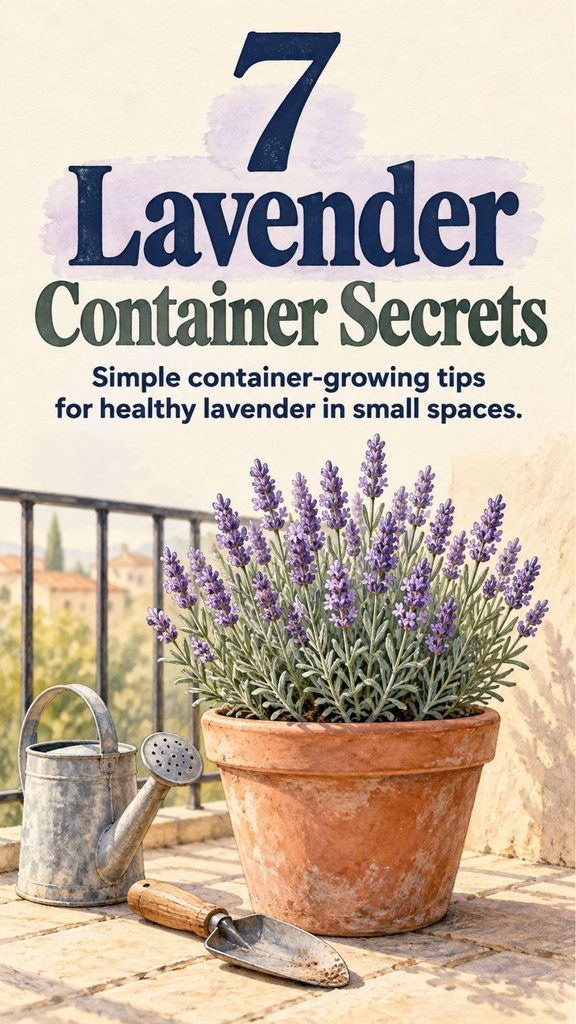
Lavender looks like the perfect container plant: compact, fragrant, beautiful, and seemingly tough enough to handle anything.
Then many people bring one home, place it in a pretty pot, water it generously, and watch it slowly turn brown.
The problem usually is not that lavender is difficult. It is that lavender wants very different conditions from many common container plants.
You Might Also Like:
- Loading posts...
Most culinary and ornamental lavenders prefer plenty of sun, excellent drainage, modest fertility, and soil that is allowed to dry somewhat between waterings. A container can provide all of those conditions—even on a patio, balcony, deck, doorstep, or sunny courtyard.
You do not need a traditional garden bed.
What you do need is to stop treating lavender like a moisture-loving flowering annual.
These seven container-growing habits make the biggest difference.
1. Give Lavender More Sun Than You Think It Needs
Lavender is a sun-loving plant.
For strong, compact growth and good flowering, give it the brightest location you have, ideally around six or more hours of direct sun each day.
A sunny south- or west-facing patio can be excellent, depending on your climate.
A balcony can work beautifully if neighboring buildings do not block too much light.
The important thing is actual direct sunlight.
A location can appear bright to us while still being too dim for lavender.
Insufficient light can produce weak, stretched growth, fewer flowers, and slower drying of the potting mix. That last problem matters because lavender roots are much more vulnerable when they remain wet for long periods.
If your lavender begins leaning strongly toward one direction, rotate the pot occasionally, but remember that rotation cannot replace adequate overall light.
In extremely hot climates, some protection from the most intense afternoon heat may be helpful for certain varieties, especially in containers where roots heat more quickly than they would in the ground.
But in general, lavender prefers too much light to too little.
2. Use a Pot With Real Drainage
The prettiest container in the store is useless for lavender if water cannot escape from it.
A drainage hole is essential.
Several drainage holes are even better for a large container.
Lavender does not want its roots sitting in a reservoir of wet soil.
Avoid planting it directly into a decorative container with no drainage unless the lavender remains inside a separate nursery pot that can be removed for watering.
A terracotta pot can be particularly useful because unglazed clay allows some moisture to evaporate through the sides.
It is not mandatory, though.
Plastic, ceramic, metal, and other containers can work as long as drainage is good and you adjust watering accordingly.
Choose a pot that gives the roots room without being dramatically oversized.
Putting a tiny lavender plant into an enormous pot creates a large volume of soil that may remain wet long after the roots have taken up what they need.
Move up gradually as the plant grows.
And do not rely on a layer of rocks in the bottom of a pot to fix poor drainage.
The container itself needs an open drainage route.
3. Make the Potting Mix Fast-Draining
Ordinary garden soil is usually a poor choice for container lavender.
In a pot, native soil can compact and drain very differently than it does in the ground.
Instead, start with a quality container potting mix and improve its drainage if needed with a coarse mineral ingredient suitable for horticultural use, such as perlite, pumice, or fine horticultural grit.
The goal is not to create a pot full of stones.
You still need a growing medium that holds enough moisture for roots.
You simply want water to move through the mix rather than leaving the root zone saturated for days.
A good lavender container mix should feel open and crumbly rather than heavy, sticky, and dense.
If water sits on top for a long time before disappearing, the mix may be too compacted.
If the pot remains noticeably wet for many days despite warm sunny weather, the soil, pot size, or watering routine may need adjusting.
Drainage is one of the most important parts of successful lavender growing.
4. Stop Watering on a Calendar
This is where many container lavenders fail.
Someone is told:
“Water it twice a week.”
So they water every Tuesday and Friday whether the plant needs it or not.
Lavender does not read the calendar.
How fast a container dries depends on temperature, wind, humidity, sunlight, pot material, plant size, soil composition, and container size.
A lavender in a small terracotta pot on a sunny windy balcony may need water much sooner than one in a large glazed pot during cool weather.
Check the soil instead.
Let the upper portion of the potting mix dry before watering again.
Then water thoroughly enough that moisture reaches the root zone and excess water drains from the bottom.
Discard water collected in a saucer rather than leaving the pot sitting in it.
A newly planted lavender may need more frequent attention while its roots become established.
An established plant can often tolerate the mix becoming moderately dry between waterings.
The mistake to avoid is keeping the soil constantly damp.
Lavender generally handles a short dry spell better than prolonged waterlogging.
5. Feed Lightly—Lavender Does Not Need Rich Soil
Many container gardeners assume that more fertilizer produces more flowers.
With lavender, excessive feeding can work against you.
Lavender naturally grows well in relatively lean conditions.
Heavy applications of nitrogen-rich fertilizer can encourage lots of soft leafy growth without necessarily producing the compact, fragrant plant you wanted.
Start with fresh potting mix.
That may already contain enough nutrients for the early part of the growing season.
If additional feeding becomes necessary, use a light hand and follow the fertilizer label rather than doubling the dose in hopes of getting faster growth.
More fertilizer is not better fertilizer.
The same applies to homemade amendments.
Do not continuously add coffee grounds, banana water, eggshell mixtures, or other kitchen-scrap “fertilizers” simply because lavender is flowering.
Container soil is a limited environment, and adding unmeasured materials can affect drainage, salts, and nutrient balance.
Simple care usually works better.
6. Prune for a Compact Plant—But Don’t Cut Into Old Bare Wood
Lavender benefits from regular trimming.
Harvesting flower stems during bloom already removes some growth.
After flowering, a light shaping can help prevent the plant from becoming long, loose, and woody.
The key is knowing where to cut.
Trim green leafy growth while leaving foliage below your cuts.
Avoid cutting deeply into old, bare woody stems unless you know the particular lavender will reliably regenerate from that wood.
Many lavenders do not respond well when heavily cut back into sections with no green growth.
A simple approach is to remove spent flower stems and lightly shape the green growth into a rounded plant.
Do not try to turn it into a perfect ball.
You are simply encouraging branching and preventing it from becoming excessively leggy.
Good airflow matters too.
Avoid cramming several large lavender plants tightly together in a small container.
Their silvery foliage may look attractive when crowded initially, but densely packed growth stays damp longer and receives less air movement.
One healthy plant often looks better than three struggling ones.
7. Choose the Right Lavender for Your Climate
This secret is often overlooked.
Not every lavender behaves the same way.
English lavender (Lavandula angustifolia) is widely grown and is generally among the more cold-tolerant lavenders.
Lavandin (Lavandula × intermedia) includes vigorous hybrids often grown for fragrance and flowers, but many become fairly large.
Spanish lavender (Lavandula stoechas) has distinctive flower heads topped with showy bracts and can perform well in warm conditions, but it is generally less cold-hardy than many English lavenders.
French lavender can refer to different species depending on region and labeling, so checking the botanical name is useful.
This matters even more in pots.
Roots growing above ground in containers are exposed to temperature swings more strongly than roots insulated by garden soil.
A lavender considered hardy in your general climate may still need winter protection when grown in a container.
If winters are severe, options may include moving the pot to a protected unheated location appropriate for the cultivar, insulating the container, or choosing a variety known to tolerate local conditions.
If summers are extremely hot and humid, selecting a cultivar suited to those conditions matters just as much.
Buy the lavender that fits your climate rather than choosing entirely by flower color.
Bonus Secret: Don’t Plant Lavender With Plants That Want Constant Moisture
Lavender looks beautiful in mixed planters.
But plant compatibility matters.
Putting lavender beside a plant that needs constantly moist, rich soil creates a watering conflict.
Someone will lose.
Lavender combines more easily with plants that appreciate similar sunny, relatively dry conditions.
If you want a mixed container purely for appearance, research the water requirements of every plant before putting them together.
Sometimes the easiest design is simply one lavender plant in one attractive pot.
Its flowers and silvery foliage already provide plenty of interest.
What About Lavender Indoors?
Lavender can be more challenging as a permanent indoor houseplant because providing enough direct light and airflow is difficult.
A very sunny window may work for a period, but many homes are much darker than outdoor conditions even when a room appears bright.
If possible, grow container lavender outdoors during its active growing season.
Balconies, patios, terraces, and sunny doorsteps are usually better than an interior table.
If you must grow it indoors, give it the brightest suitable location available, keep it away from constantly wet soil, and pay close attention to airflow.
A grow light may help where natural light is inadequate.
Why Is My Potted Lavender Turning Brown?
Brown lavender can have several causes.
If the soil remains wet and stems begin declining, excessive moisture and root problems are possibilities.
If the plant is extremely dry and crisp, lack of water may be the issue.
A sudden move into intense sun can scorch foliage that was previously grown under lower light.
Cold injury can damage tender varieties.
Poor drainage, root crowding, disease, and unsuitable growing conditions can also cause decline.
Do not automatically respond to brown leaves by adding more water.
Check the soil first.
Look at the stems.
Think about recent weather and how frequently the pot has been watered.
Correcting the actual cause is much more effective than treating every symptom as drought.
Can Lavender Stay in the Same Pot for Years?
Eventually, container lavender may become root-bound or the potting mix may deteriorate.
If growth slows significantly and roots have filled the container, move the plant into a slightly larger pot.
Spring is often a convenient time to inspect it.
Do not automatically jump from a small container to a giant one.
Move up gradually and use fresh, well-draining potting mix.
Very old lavender plants can also become increasingly woody with age.
Sometimes propagation and replacement are more practical than trying to maintain an aging plant indefinitely.
Harvest the Flowers
One of the pleasures of growing lavender in containers is having flowers close at hand.
Cut stems when they are suitable for the way you intend to use them.
Fresh lavender can be arranged in small bouquets.
Stems can also be dried by bundling modest amounts and hanging them somewhere dry with good airflow.
If you plan to use lavender in food, make sure you are growing a culinary-suitable lavender and that it has not been treated with pesticides or other products unsuitable for edible use.
Not every ornamental lavender sold in a garden center is intended for culinary use.
You Really Don’t Need a Garden
A sunny balcony can hold lavender.
So can a patio.
A deck.
A front step.
A courtyard.
A rooftop growing space.
Even a small outdoor area may be enough for one good container.
The secret is not giving lavender a huge amount of space.
It is giving it the conditions it actually likes:
Plenty of light.
A pot that drains.
Loose, well-draining soil.
Deep but not constant watering.
Modest feeding.
Careful pruning.
A variety suited to your climate.
Get those seven things right and lavender becomes much easier to grow.
You may not have room for a traditional lavender border stretching along a garden path, but one healthy plant in a sunny pot can still provide beautiful flowers, fragrance, and that unmistakable silvery foliage all season long.