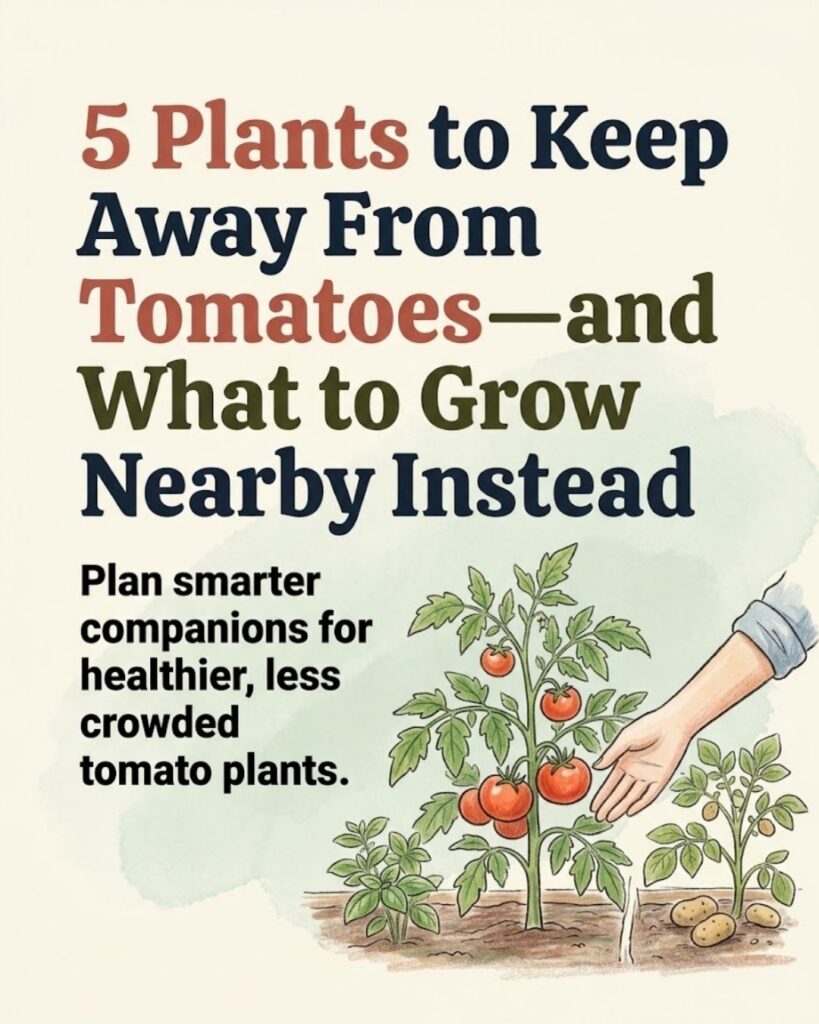
Tomatoes can share a garden successfully with many vegetables, herbs, and flowers, but plant placement still matters. A crowded bed can leave tomato plants fighting for light, water, nutrients, and airflow, while certain neighboring crops may share the same diseases or insect pests.
That does not mean every traditional “bad companion” warning is scientifically proven. Companion-planting advice often mixes practical horticulture with gardening folklore. University of Minnesota Extension notes that while some companion combinations have research behind them, many popular charts and recommendations do not.
For tomatoes, the best approach is to think beyond simple lists of “good” and “bad” plants. Consider disease families, mature plant size, sunlight, irrigation needs, pest pressure, and how much room each crop needs.
You Might Also Like:
- Loading posts...
With those factors in mind, here are five plants worth separating from tomatoes—or at least planting thoughtfully.
1. Potatoes
Of all the plants commonly listed as poor tomato companions, potatoes deserve the most caution.
Tomatoes and potatoes belong to the same plant family, Solanaceae. This close relationship means they can be affected by several of the same pests and diseases. University of Minnesota Extension recommends rotating tomatoes away from areas where tomatoes, potatoes, peppers, eggplants, and tomatillos have been grown during the previous three or four years.
One particularly serious shared disease is late blight, caused by Phytophthora infestans. It can infect tomato leaves, stems, and fruit as well as potato foliage and tubers. Under cool, wet conditions, the disease can spread rapidly.
Growing potatoes directly beside tomatoes does not automatically cause blight, but putting susceptible hosts together makes disease management more difficult if a problem does appear.
Potatoes also require considerable garden space below ground. Hilling soil around developing potato plants and eventually digging the crop can disturb nearby tomato roots.
For a small vegetable garden, it is usually simpler to place potatoes in a separate bed or section and rotate both crops carefully from year to year.
Better approach
Keep potatoes and tomatoes in different parts of the garden when space allows. At the end of the season, remove diseased plant debris and avoid leaving volunteer potato tubers in the soil, since infected tubers can serve as a source of late blight in suitable climates.
2. Sweet Corn
Tomatoes and sweet corn are not inherently incompatible, but they can become awkward neighbors.
The first issue is sunlight.
Tomatoes perform best in full sun. Mature sweet corn creates a tall, dense stand that can shade shorter crops planted on the wrong side of the corn patch. Tomatoes receiving insufficient light may become more stretched and produce less vigorously than plants growing in an open, sunny location.
Garden orientation matters here. A tomato planted south of a corn patch may receive plenty of light, while one planted where the corn casts afternoon shade may struggle.
There is another reason to consider some separation: corn earworm.
Corn earworm (Helicoverpa zea) is also known as tomato fruitworm because the caterpillars can attack tomatoes as well as corn. On tomatoes, they chew into developing fruit, leaving holes and damaged flesh.
Sweet corn is an important host for this insect, although planting tomatoes beside corn does not guarantee an infestation. Local pest populations, timing, weather, and other host plants all influence pressure.
Better approach
Give tomatoes an unobstructed sunny location and put tall corn where it will not shade them during the strongest part of the day.
If corn earworm is common in your region, inspect tomato fruit regularly once caterpillars become active rather than relying solely on plant separation.
3. Cabbage
Cabbage is frequently described as a plant that should “never” grow beside tomatoes because it supposedly steals nutrients from them. That claim is stronger than the evidence supports.
There is no universal rule saying cabbage and tomatoes cannot share a garden.
The real concern is competition.
A mature cabbage develops a broad canopy and needs adequate soil moisture and fertility. Tomatoes also grow into large plants with substantial root systems. Pack the two crops closely together and both can compete for available water, nutrients, and physical space.
This is especially important in raised beds and small gardens, where gardeners sometimes try to fit far more plants into the soil than the bed can support.
Plants crowded together can also reduce air movement. Good spacing is particularly valuable for tomatoes because keeping foliage dry and allowing air to circulate helps reduce conditions favorable to many plant diseases.
There is one useful advantage, however: cabbage is generally a cool-season crop, while tomatoes thrive during warmer weather. With careful timing, gardeners may harvest spring cabbage before tomato plants reach their full summer size.
Better approach
Rather than declaring cabbage forbidden, give both crops adequate spacing.
If you are gardening in a tight area, use cabbage as an early-season crop and remove it after harvest. That frees space, moisture, and sunlight as the tomatoes become larger.
4. Broccoli
Broccoli presents many of the same practical challenges as cabbage because both are brassicas.
Broccoli plants need room to develop, and healthy plants can form a substantial spread of leaves. When tomatoes and broccoli are squeezed tightly together, their leaves may overlap while their roots draw moisture and nutrients from the same limited patch of soil.
Again, the problem is not that broccoli releases a mysterious substance that poisons tomatoes. It is largely a matter of garden design.
Nutrient competition can occur whenever vigorously growing crops are packed into inadequate soil. Instead of assuming one crop will “steal” a particular nutrient, use soil testing and proper fertility management to determine what your garden actually needs. Extension guidance recommends basing fertilizer decisions on soil conditions and plant requirements rather than applying nutrients blindly.
Broccoli can also be useful in seasonal succession. In many climates it grows best during cooler parts of the gardening year, while tomatoes occupy the bed during warmer months.
Better approach
If you want both crops in the same garden, either provide generous spacing or grow them at different times.
For example, broccoli can occupy a bed during spring, followed later by warm-season plants once the broccoli is harvested. The exact timing depends on your climate and growing season.
5. Dill
Dill is perhaps the most misunderstood plant on this list.
A commonly repeated companion-planting claim says that young dill benefits tomatoes but mature dill suddenly becomes harmful, stealing nutrients or inhibiting tomato growth once it flowers.
There is little solid evidence supporting the idea that mature dill becomes uniquely harmful to tomatoes simply because it reaches the flowering or seed-producing stage.
All plants use water, nutrients, light, and space as they grow. A large dill plant growing directly against a tomato can create ordinary competition, but that is very different from saying mature dill should never be allowed near tomatoes.
In fact, flowering dill can be useful in a diverse garden. Utah State University Extension notes that dill attracts numerous insects, including bees, lady beetles, lacewings, hoverflies, wasps, and tachinid flies. Some of these are beneficial predators or parasitoids of garden pests.
Allowing some dill to flower can therefore provide nectar and habitat for useful insects.
The bigger practical problem is that dill can become tall and may reseed readily if mature seed heads are left in place. Too many volunteer dill plants could crowd neighboring vegetables the following season.
Better approach
You do not need to ban dill from the tomato bed.
Give it enough room that it does not shade or crowd the tomatoes. Harvest some plants for foliage and allow a few to flower if you want to support beneficial insects or collect seed.
What Actually Makes a Bad Tomato Neighbor?
The most useful lesson is not memorizing a long companion-planting chart. Instead, watch for a few specific problems.
Shared diseases
Closely related crops often share pathogens. This is why potatoes deserve particular attention around tomatoes and why crop rotation is more valuable than simply moving two plants a few inches apart.
Too much shade
Tomatoes are sun-loving crops. Tall corn, sunflowers, trellised vines, or even another row of tomatoes can become a problem if they block too much light.
Plan the garden based on the mature height of each crop, not its size on planting day.
Poor airflow
Tiny tomato seedlings can make a newly planted bed look empty, tempting gardeners to fill every gap.
A few months later, those seedlings may be large, sprawling plants.
Adequate spacing allows better airflow and makes it easier to inspect foliage, harvest fruit, and remove diseased leaves. Extension recommendations for tomato disease management include staking or caging plants and spacing them so air can move between them.
Competition for water and nutrients
Competition is real, but it is rarely as simple as “Plant A steals nutrients from Plant B.”
Problems are more likely when several large crops share a small volume of soil, particularly during hot or dry weather.
Maintain consistent soil moisture, add organic matter where appropriate, mulch to reduce moisture fluctuations, and fertilize according to actual soil needs.
Two Good Companion Choices for Tomatoes
Some plants can earn space near tomatoes for more convincing reasons.
Basil
Basil is convenient because it enjoys warm growing conditions similar to tomatoes and does not need to dominate the bed.
There is also some research supporting its value as a companion plant. University of Minnesota Extension reports that studies have found basil intercropping can reduce thrips on tomatoes, and some research has even shown improved tomato growth when basil was included.
That is a much more defensible benefit than the popular claim that basil somehow makes nearby tomatoes taste sweeter or more flavorful. Flavor is affected by many factors, and planting basil nearby should not be expected to transform the taste of the fruit.
Give both plants enough room rather than packing basil directly against the tomato stem.
Marigolds
Marigolds are another classic choice, but their benefits are often exaggerated.
They are not a magical shield that repels every insect, deer, rabbit, nematode, and tomato disease.
Research does support some specific effects. University of Minnesota Extension reports that marigolds have reduced thrip populations around tomatoes in some studies. Research cited by the university has also found that French marigolds can interfere with whiteflies in certain tomato-growing situations.
Marigolds also provide flowers that contribute to a more diverse garden ecosystem.
That makes them worthwhile neighbors, even without promising that they will eliminate tomato pests.
Build a Better Tomato Bed With Spacing, Not Superstition
Potatoes are the strongest candidate for separation from tomatoes because the two crops share important diseases and belong to the same plant family. Corn deserves thoughtful placement because of shade and its connection with corn earworm.
Cabbage and broccoli are better described as potential space competitors than dangerous companions, while the warning that mature dill suddenly harms tomatoes is poorly supported.
That distinction makes garden planning much easier.
Instead of treating companion planting as a list of mysterious plant friendships and rivalries, concentrate on conditions you can actually manage: full sun, adequate spacing, consistent moisture, healthy soil, crop rotation, good airflow, and regular pest inspection.
Then use companion plants such as basil, marigolds, dill, and other flowering species where they provide a clear benefit without crowding the tomatoes.
A tomato plant does not need a perfectly choreographed collection of neighbors. It needs enough light, root space, water, nutrients, and airflow to grow vigorously. Give it those things first, and companion planting becomes a useful extra rather than the foundation of your harvest.