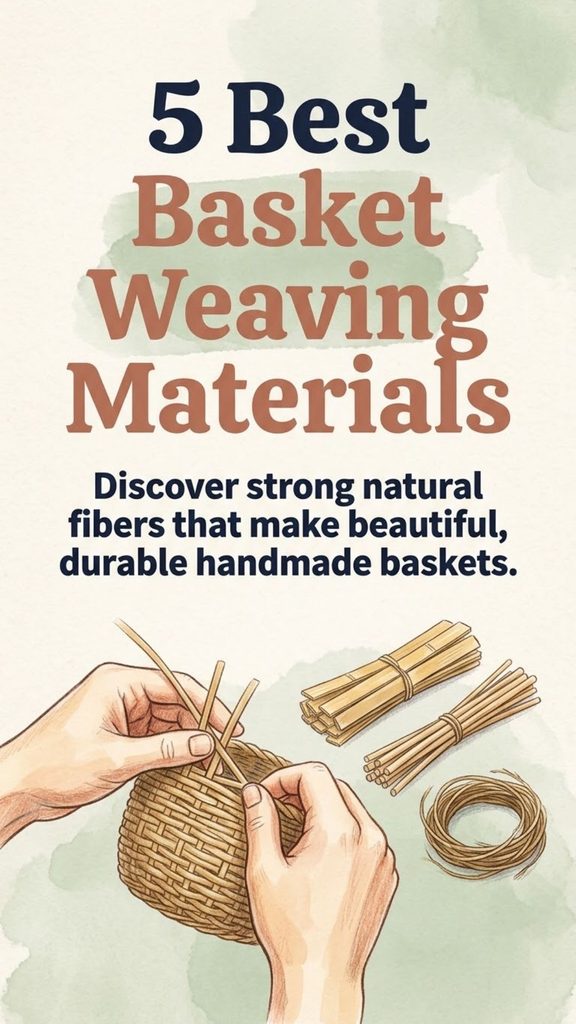
Basket weaving is one of those crafts where the material matters just as much as the technique. A beautiful weave will not hold its shape for long if the fibers are too brittle, while a strong but inflexible material can turn a simple project into a frustrating struggle.
The good news is that basketry can be made from an enormous range of natural materials. Grasses, vines, reeds, bamboo, bark, roots, willow, rattan, and split wood have all been used in different basket-making traditions. Smithsonian collections include baskets made from materials as varied as sweetgrass, willow, white oak, pine needles, grapevine, reed, and bamboo.
For a home basket maker, the best material is usually one that combines three qualities: flexibility while you are weaving, enough strength to hold the finished shape, and availability in the size required for your project.
You Might Also Like:
- Loading posts...
Five materials stand out as especially useful: grasses, bamboo, vines, reeds, and honeysuckle. Each behaves differently, so understanding how to prepare and use them will save you a great deal of trial and error.
1. Grasses and Seagrass
Grass is one of the most approachable natural basketry materials because many types can be bundled, twisted, braided, or coiled.
Traditional grass basketry is found in many cultures, although the exact species and weaving method vary considerably. Some baskets use bundles of grass as a foundation that is stitched or wrapped with another material rather than woven strand by strand. The Smithsonian, for example, documents coiled baskets made with grass foundations as well as sweetgrass baskets combined with bulrush, palmetto, pine needles, and other fibers.
Why Grass Works Well
Long grasses are lightweight and naturally flexible. Several blades can be bundled together to create a thicker cord, while finer grasses can be used for decorative details.
Grass is especially useful for:
- Coiled baskets
- Small storage baskets
- Decorative bowls
- Mats and trays
- Lightweight containers
The biggest advantage is accessibility. Depending on where you live, suitable grasses may be available locally or purchased already cleaned and prepared.
Preparing Grass for Basketry
One common mistake is assuming grass must always be completely dry while you weave it.
Drying is useful for storing plant material, but very dry grass can become brittle. Traditional preparation varies by species and technique. Some fibers are dried for storage and then slightly dampened before use so they regain enough flexibility to bend without cracking.
Choose long, clean stems or blades without mold, rot, or insect damage. Remove unnecessary leaves and seed heads if the project calls for a smooth finish.
If you are gathering wild grasses, identify the plant correctly and harvest only where you have permission.
2. Bamboo
Bamboo can produce remarkably strong and lightweight basketry.
Rather than weaving thick bamboo canes whole, basket makers typically split suitable bamboo into narrow strips. Those strips can then be trimmed and smoothed into more manageable weaving material.
Historically, bamboo has been used for baskets, mats, containers, and many other woven objects. Smithsonian documentation describes bamboo stems and their finely prepared outer portions being used extensively in basketry traditions.
Why Bamboo Is a Good Choice
Properly prepared bamboo offers an excellent combination of strength and flexibility.
It works especially well for:
- Market baskets
- Utility baskets
- Trays
- Larger containers
- Structural basket frames
- Decorative woven patterns
Thin bamboo strips can create detailed weaving, while thicker pieces can provide structure around the base or rim.
The Difficult Part: Preparing It
Bamboo is not necessarily the easiest beginner material if you are starting with an intact cane.
Splitting bamboo evenly takes practice, and sharp cutting tools must be handled carefully. Irregular strips can cause uneven tension in the finished basket.
If you want the appearance and strength of bamboo without spending time preparing raw culms, buying ready-made bamboo splints is often the simpler option.
Bamboo also varies greatly by species, age, and thickness, so there is no single preparation method appropriate for every type.
3. Grapevine and Other Flexible Vines
Vines are excellent for rustic baskets because they naturally create organic curves and irregular shapes.
Grapevine is one of the best-known examples. Smithsonian collections include woven grapevine baskets whose naturally uneven vines give them a distinct texture and shape.
Unlike perfectly uniform commercial reed, grapevine rarely produces a mathematically neat basket. That is part of its appeal.
What Vines Are Best For
Vines are particularly suitable for:
- Rustic garden baskets
- Decorative baskets
- Wreath-style containers
- Ribbed baskets
- Free-form basketry
- Handles and rims
Thicker vines can create the framework, while thinner flexible pieces can become the weavers.
Fresh Vine vs. Dried Vine
Freshly harvested vine may already be flexible enough to work. Once it dries, however, woody vine can become stiff.
Dried vines are commonly rehydrated or heated before weaving so they bend without snapping. The exact soaking or heating time depends on the species and thickness. Natural-material basket makers often judge readiness by bending a sample rather than relying on one fixed soaking time.
The vine should bend smoothly without breaking, but it should not become soft or degraded.
Let the Material Influence the Basket
One advantage of vine basketry is that you do not have to force every strand into perfect alignment.
A crooked or branching vine can become part of the design. Instead of trying to make natural vine behave exactly like commercial reed, allow some of its curves and variations to remain visible.
That usually produces a basket with much more character.
4. Reed and Rattan
For someone learning traditional woven basket construction, commercial basket reed is one of the most practical places to start.
Basket-making suppliers sell round reed, flat reed, flat-oval reed, and other forms in different widths. This gives beginners much more consistency than they would get from gathering random plant stems outdoors.
Why Reed Is Beginner-Friendly
Commercial reed is:
- Fairly uniform
- Easy to measure
- Available in several sizes
- Flexible after wetting
- Suitable for many basket patterns
- Easy to trim with ordinary basketry tools
This predictability makes it easier to learn how spokes, stakes, weavers, rims, and tension work.
Reed Should Usually Be Damp While You Work
This is another area where beginners sometimes receive confusing advice.
Basket reed is commonly soaked briefly before weaving to make it flexible. Instructions from The Basket Maker’s Catalog, for example, recommend wetting reed and re-wetting it during the project when necessary, while cautioning against over-soaking. Reed should then be allowed to dry thoroughly before storage.
That means the basic pattern is:
Dry for storage → dampen for weaving → allow the finished work to dry.
Do not leave bundles of natural reed damp in storage, where moisture can encourage mold or deterioration.
Round vs. Flat Reed
Round reed is useful for stakes, spokes, twining, and finer weaving.
Flat reed provides a broader surface and is popular for traditional utility baskets and many beginner projects.
Flat-oval reed sits somewhere between the two and is frequently used for rims or decorative weaving.
If this is your first basket, purchasing a pattern that specifies the exact reed sizes is much easier than trying to guess the correct thickness.
5. Honeysuckle Vine
Honeysuckle may be less familiar to new basket makers, but it has an established place in basketry.
Honeysuckle vine is flexible and fibrous, and Cherokee basket makers have used prepared honeysuckle in woven baskets, often over a stronger framework such as white oak.
It creates a naturally textured basket with a warm woodland appearance.
Preparing Honeysuckle Takes More Work
You generally cannot cut a tangled honeysuckle vine and immediately expect it to behave like commercial reed.
Traditional preparation can involve coiling the harvested vine, heating or boiling it, removing the outer bark, and drying the prepared material. The precise process depends on the vine and weaving tradition. The Center for Craft describes honeysuckle as a durable, flexible basket material and documents boiling and bark removal as part of its preparation.
Because of that extra preparation, honeysuckle is often better suited to someone who has already woven a simple reed basket and understands basic basket construction.
Be Certain Which Honeysuckle You Have
“Honeysuckle” includes many species. Some are native to particular regions, while others can be invasive.
Do not harvest a plant simply because it appears to be honeysuckle. Identify it first, check local rules, obtain permission if the plant is not on your property, and avoid damaging native vegetation.
How to Choose the Right Basket Weaving Material
There is no single best fiber for every basket.
Instead, match the material to the project.
Consider the Basket’s Purpose
A decorative bowl does not need the same structural strength as a harvest basket.
If the basket will regularly carry weight, use stronger stakes, ribs, or a sturdy framework. Decorative baskets give you more freedom to use delicate grasses and irregular vines.
Consider the Size
Small baskets usually look better with finer materials.
A miniature basket woven from very thick grapevine will feel bulky, while extremely fine fibers can make a large utility basket unnecessarily time-consuming.
The proportions of the material should suit the finished basket.
Consider the Shape
Some materials naturally cooperate with certain designs.
Commercial reed is excellent for controlled, symmetrical baskets.
Grapevine is better suited to rustic and free-form work.
Grass works beautifully with coiling.
Split bamboo is well suited to structured woven forms.
Honeysuckle is useful where a flexible natural vine is desired.
Trying to force the wrong material into a particular technique can make basket weaving much harder than it needs to be.
Can You Grow Basket-Making Materials at Home?
In the right climate and with enough space, some basketry materials can be grown in a home landscape.
Willow is one of the classic examples because selected willow varieties can produce long, flexible rods useful for basket making. Certain grasses and suitable bamboo species can also provide weaving material.
Growing your own material, however, requires more than planting it and waiting. Harvest timing, pruning, drying, storage, and preparation all influence the quality of the fiber.
Bamboo and vigorous vines also need careful management because some plants spread aggressively. Always choose species appropriate to your climate and property.
You do not need to grow your own material to be a traditional or skilled basket maker. Purchased reed is often the most practical way to learn.
Other Natural Basket Materials Worth Exploring
Once you become comfortable with the basics, the list of possibilities expands considerably.
Basket makers have worked with:
- Willow
- Rattan
- Pine needles
- Sweetgrass
- Cattails
- Bulrushes
- White oak splints
- Black ash splints
- Cedar bark
- Spruce roots
- Palm fibers
- Sisal
Traditional baskets frequently combine multiple materials rather than using only one. A basket might have rigid wooden ribs, flexible vine weavers, and a completely different material for lashing the rim. Smithsonian collections demonstrate just how varied these combinations can be.
Basic Tools for Beginning Basket Makers
Natural basketry does not require an enormous collection of equipment.
For many simple projects, a basic kit can include:
- Strong scissors or basket shears
- Pruning shears for collected vines
- Measuring tape
- Awl
- Spray bottle
- Bucket or basin for soaking material
- Towels for removing excess water
- Clothespins or small clips
- Gloves for rough or thorny material
More specialized knives and splitting tools become useful if you begin preparing bamboo, wood splints, bark, or other raw materials yourself.
Sharp tools deserve particular care. Always cut away from your body and stabilize round materials before attempting to split them.
Common Basket-Weaving Material Mistakes
Many early basket problems start before the weaving begins.
Weaving Brittle Material
If a strand cracks each time it bends, stop. Continuing will usually result in a weak basket.
Rehydrate materials that are meant to be dampened, or replace damaged strands.
Over-Soaking Reed
More soaking is not necessarily better. Commercial reed can become overly soft if left in water too long. Wet it only enough to regain flexibility.
Choosing Material That Is Too Short
Every new joint adds work and can create a weak or bulky area.
Whenever possible, collect or purchase pieces long enough to cross several stakes before another strand must be joined.
Ignoring Thickness
Sort natural material before weaving.
Keep similar sizes together so you can use heavier pieces for structural areas and thinner ones for detailed weaving.
Storing Plant Material While Damp
Allow natural basketry materials to dry thoroughly before long-term storage. Good airflow helps reduce the chance of mold.
Start With the Material That Makes Learning Easier
The best basket weaving material is not necessarily the rarest, strongest, or most traditional one. It is the material that suits the basket you want to make and lets you practice the technique successfully.
For a first woven basket, prepared reed is difficult to beat because it is consistent and forgiving. Grass is excellent for exploring coiling. Grapevine creates relaxed, rustic shapes. Bamboo offers impressive strength once you learn how to prepare it, while honeysuckle provides another beautiful option for natural-vine basketry.
Once you understand how natural fibers respond to moisture, tension, bending, and drying, basketry becomes much easier to explore. Then even an ordinary vine, strip of bamboo, or bundle of grass can begin to look less like yard material and more like the start of something useful and beautiful.