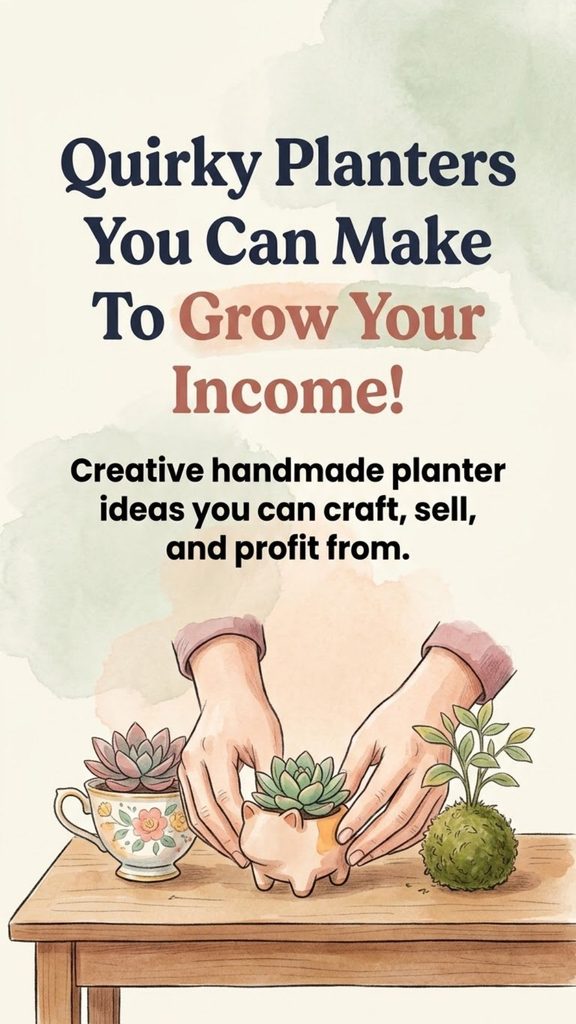
A handmade planter does not have to be complicated to stand out. In fact, some of the most memorable plant displays begin with ordinary materials—a thrifted cup, a piece of driftwood, a handful of polymer clay, an old tin can, or a simple concrete mold.
For anyone interested in turning a love of plants and crafts into extra income, quirky planters are an appealing place to start. They are relatively small, easy to photograph, highly customizable, and suitable for occasions such as housewarmings, birthdays, teacher gifts, and seasonal markets.
That does not mean every cute planter will automatically be profitable. Material costs, working time, packaging, marketplace fees, shipping weight, and breakage all affect what you actually earn. A good product should be attractive, practical, repeatable, and reasonably efficient to make.
You Might Also Like:
- Loading posts...
Plant health matters too. A decorative container should normally provide drainage or hold a removable nursery pot. Container plants generally need excess water to escape because prolonged waterlogging reduces the air available to roots and can contribute to root problems.
With that in mind, here are 20 unusual planter ideas that combine personality with practical selling potential.
1. Polymer Clay Mini Animal Planters
Tiny animal planters can turn an ordinary succulent display into an irresistible little character.
Cats, bears, frogs, rabbits, foxes, and sleepy dogs are simple themes that can be adapted into a recognizable collection. Rather than making every planter completely different, create several repeatable body shapes and change details such as ears, expressions, and colors.
For very small polymer clay creations, it is often more practical to make them as decorative cachepots that hold a miniature nursery pot or faux plant rather than relying on the clay itself as the growing container.
This also makes customization easier. Buyers could choose an animal, facial expression, or color combination.
2. Hand-Painted Face Mug Planters
Old mugs and teacups are inexpensive materials for playful plant displays.
Paint simple faces on the outside using a paint suitable for the cup’s surface. Minimal designs often work especially well: closed eyes, rosy cheeks, freckles, mustaches, or surprised expressions.
The main challenge is drainage. Many ceramic mugs do not have holes in the bottom, and drilling glazed ceramic requires appropriate tools and care.
An easier alternative is to leave the mug intact and place a smaller nursery pot inside. The plant can then be removed for watering and allowed to drain before being returned to the decorative cup.
Vintage cups, floral mugs, and unusual thrift-store finds make every batch slightly different.
3. Crochet Animal Pot Covers
Instead of making the planter itself, make a removable cover.
Crochet pot cozies shaped like bears, sheep, mushrooms, cats, flowers, or cottages can transform inexpensive nursery pots into gift-worthy decorations.
Because yarn and wet soil are not a good combination, the crochet cover should remain decorative and removable. Place it around a waterproof pot or cachepot rather than directly around damp growing medium.
Matching sets can make this idea particularly charming. Imagine three small pots styled as a fox, rabbit, and bear, or a group of woodland mushrooms in coordinating colors.
4. Terrazzo-Style Mushroom Planters
Mushroom decor works especially well with small plants because the playful shape already resembles something from a miniature woodland.
Cast the basic form using an appropriate concrete or craft-casting mold, then add colorful terrazzo-style chips or painted speckles.
If the planter will hold a living plant directly, include adequate drainage. Another option is to design the piece around a removable insert.
Concrete items can become surprisingly heavy, so keep shipping costs in mind when deciding how large to make them.
Small mushroom planters are often more practical than oversized versions and can be sold individually or grouped as a miniature collection.
5. Kokedama Moss Ball Hangers
Kokedama offers something completely different from a traditional flowerpot.
The basic method involves creating a compact growing-medium ball around a plant’s roots, covering the ball with moss, and securing everything with string or twine. The finished ball can sit on a dish or hang from a cord.
Proper watering is essential. One common approach is to judge moisture by feeling the growing medium and the weight of the moss ball, then soak it when needed and allow excess water to drain before putting it back on display.
Because different plants have different moisture and light requirements, include simple plant-specific care instructions when selling living kokedama.
6. Pressed-Flower Resin Cachepots
Pressed flowers suspended in clear resin can produce beautiful decorative pieces.
Instead of treating resin as the growing medium itself, design the project as an outer cachepot with a removable plant container inside. This helps keep water, soil, and roots separate from the decorative resin shell.
Dry flowers thoroughly before casting them, because trapped moisture can affect the appearance of clear resin.
Daisies, ferns, tiny leaves, forget-me-not-style flowers, and delicate petals can create very different collections. Customers may also appreciate custom pieces featuring specific flower colors.
Always follow the resin manufacturer’s handling, curing, ventilation, and protective-equipment instructions.
7. Driftwood Air-Plant Displays
Air plants provide an opportunity to design plant decor without filling a traditional pot with soil.
Start with an interesting piece of clean, dry driftwood and attach small handmade holders made from suitable clay, wire, or another stable material.
The holder should support the plant without crushing it and should allow the plant to be removed for care.
Because every piece of driftwood is naturally different, these displays have an individual quality that is difficult to reproduce with mass-produced decor.
They also photograph beautifully against simple backgrounds.
8. Upcycled Teacup Mini Gardens
Vintage teacups can become miniature scenes rather than simple planters.
Use a cup and saucer as the foundation, then add miniature plants, moss-like decorative materials, stones, tiny fences, mushrooms, or other small-scale accessories.
For easier maintenance, use a tiny removable plant pot hidden inside the arrangement.
You can create different themes such as:
- Woodland cottage
- Tiny herb garden
- Fairy garden
- Mushroom forest
- Miniature country garden
- Secret reading garden
The saucer can become part of the scene rather than simply sitting underneath the cup.
9. Mini Glass Cloche Terrariums
Small glass domes can turn mosses and miniature plants into tiny landscapes.
The important part is matching the plants to the conditions inside the display. A humid enclosed terrarium should not be treated the same way as an open succulent container.
Keep the design restrained. One focal plant, moss, a few stones, and one small decorative object will often look more polished than filling every available space.
Because glass is fragile, these may be better suited to local markets or carefully packaged premium orders than inexpensive long-distance shipping.
10. Crescent Moon Wall Planters
A crescent-shaped wall planter combines greenery with celestial decor.
The moon can be made from wood, ceramic, lightweight casting material, or another sturdy material, with a small planting vessel incorporated into the lower part of the design.
Pay particular attention to mounting. A planter becomes considerably heavier after soil and water are added, so the hanging hardware needs to be suitable for the finished weight.
For a lighter version, create the moon as a decorative frame and use a removable mini pot or air plant.
Stars, clouds, suns, and phases of the moon could expand this idea into a full collection.
11. Macramé Owl Plant Hangers
Ordinary macramé plant hangers are already decorative, but shaping the knots into an owl gives the design considerably more personality.
The owl’s eyes can be made with wooden rings, while knots form the body and wings around a small plant pot.
Natural cotton cord creates a softer cottage or bohemian appearance, while darker cord can produce a more dramatic look.
Before selling one, test it with a pot containing damp soil rather than an empty container. This gives you a much better idea of whether the finished hanger can support the actual weight it will carry.
12. Polymer Clay Micro Planter Ring Dishes
Rather than attempting to grow a real plant on a wearable ring, turn the miniature planter idea into something more useful: a ring holder or jewelry dish.
Sculpt a tiny pot, cactus, mushroom, or succulent arrangement from polymer clay and attach it to a small dish. Rings can rest around the central stem or decorative plant.
This preserves the whimsical miniature-garden idea while creating a practical product that does not require watering.
These pieces are especially suitable for gifts because they combine decor with a specific everyday use.
13. Painted Stone Succulent Cottages
Smooth stones can become miniature cottages with a little paint.
Add tiny doors, windows, vines, bricks, flowers, or shutters, then arrange the cottage beside a small succulent pot to create a miniature landscape.
Instead of drilling a planting cavity into a random stone—which may crack or provide inadequate root space—use the painted stone as a decorative feature beside a proper planting container.
A group of cottages can also become a miniature village display.
Seasonal variations could include snowy winter cottages, spring flower houses, autumn cottages, or mushroom-themed homes.
14. Ceramic Hedgehog Planter Bowls
A shallow ceramic planter with a hedgehog face and textured back is a playful way to display compact plants.
The plant itself can visually become part of the hedgehog’s “spines,” especially when using compact trailing or textured plants.
If making ceramics yourself, the project requires appropriate clay, firing, glazing, and drainage planning. If you do not have access to a kiln, you can achieve a similar look by decorating a commercially made planter rather than attempting functional ceramics with unsuitable air-dry materials.
Keep the facial features simple. A small nose and tiny eyes often look more charming than excessive detail.
15. Hanging Propagation Jars
Glass jars and bottles can be turned into compact propagation stations.
A simple wooden frame, macramé cord, or metal holder can suspend the jar while plant cuttings root in water.
This project is particularly attractive because buyers can actually watch roots develop.
Make the glass easy to remove for cleaning and water changes. Avoid permanently enclosing the jar in a complicated holder that makes basic maintenance frustrating.
Small sets of three matching jars can be more visually impressive than a single one.
16. Terrazzo-Painted Concrete Planters
If casting real terrazzo feels too involved, create the appearance using paint.
Cast a simple concrete planter, allow it to cure as directed for the material, smooth rough areas, and add irregular painted flecks in several sizes.
A little asymmetry makes the pattern more convincing.
You can create collections in muted earth tones, bright retro colors, pastel combinations, or monochrome speckles.
Include a drainage opening when the plant will grow directly in the container, or size the planter to accept a removable nursery pot.
17. Mushroom-Themed Tiered Plant Shelf
This idea is larger than a planter but can become an attractive display product.
Build a compact tiered stand that holds several mini pots, then incorporate mushroom details through painted patterns, cut wooden shapes, knobs, or miniature pot decorations.
The structure should be stable enough to hold the full weight of watered plants.
For selling, consider offering the shelf separately from the plants. This reduces shipping complications and allows customers to use pots they already own.
A small tabletop version will also be easier to package than a full-size plant stand.
18. Animal-Face Air-Plant Pods
Air-plant pods are one of the simplest ways to combine sculpting with plant decor.
Create hollow animal heads or rounded creatures from polymer clay or an appropriate ceramic material, leaving an opening where the air plant can sit.
The leaves can become part of the character. A spiky air plant might resemble wild hair, hedgehog spines, a lion’s mane, or a bird’s crest.
Make sure the plant can be removed easily. Air plants should not be permanently glued into their holders.
Creating sets of matching animals can also encourage buyers to purchase more than one.
19. Upcycled Tin Can Planters and Lanterns
Used food cans can make inexpensive craft materials, but it is best to separate the planter idea from the lantern idea rather than trying to put soil, plants, and an open flame in the same small container.
For a planter, clean the can thoroughly, smooth or cover sharp edges, provide drainage, and decorate the exterior with suitable paint, punched patterns, decoupage, or wrapped natural cord.
For a lantern-style design, use a separate can and choose a battery-powered LED light rather than combining a flame with dry plant material.
A coordinated planter-and-lantern pair can still create the fairy-garden appearance without forcing both functions into one container.
20. Matchbox-Style Seed Starter Gifts
Actual cardboard matchboxes are too small and moisture-sensitive for most seedlings to grow in for long, but the charming miniature concept can still become a useful product.
Create matchbox-inspired seed kits containing a small packet of seeds, compressed growing-medium pellet, biodegradable starter pot, and simple planting instructions.
The decorative outer box can carry illustrations of herbs, flowers, vegetables, or cottage-garden plants.
Collections could include:
- Kitchen herb starters
- Pollinator flowers
- Salad greens
- Children’s first garden
- Cottage flowers
- Mini windowsill garden
This turns the original tiny-planter concept into a product that is much more practical for real plants.
What Makes a Handmade Planter Easier to Sell?
A creative idea is only the beginning. If you hope to make money from handmade plant decor, consider how efficiently you can reproduce each design.
A product that takes three hours to make but can only command a low selling price may be difficult to turn into worthwhile income. Keep track of the cost of clay, paint, cord, plants, containers, packaging, marketplace fees, and your working time.
Shipping deserves particular attention. Concrete, ceramic, resin, soil, and glass can make a small item surprisingly heavy or fragile. Lightweight products such as crochet covers, macramé hangers, air-plant holders, and miniature clay accessories may be easier to sell online.
Personalization can also add value without requiring a completely new product. Offering several colors, animal choices, names, or small design variations allows customers to feel they are purchasing something individual while you continue working from a repeatable basic pattern.
Finally, photograph every piece clearly. Natural light, an uncluttered background, and one or two lifestyle photographs showing the planter in a real room usually communicate the design better than a crowded collection of props.
Start With One Idea and Make It Better
You do not need to make all 20 projects.
Choose one or two that fit the tools and materials you already understand. Make several prototypes. Check whether they are easy to use, stable, reasonably durable, and simple enough to reproduce. If they hold living plants, pay special attention to drainage, watering access, and whether the plant can be removed when necessary.
Then improve the design instead of constantly jumping to another project.
A quirky planter becomes much more than an unusual flowerpot when it combines personality with good craftsmanship and practical plant care. That combination—something useful, recognizable, and a little unexpected—is what can turn a simple handmade project into a product people are happy to bring into their homes.