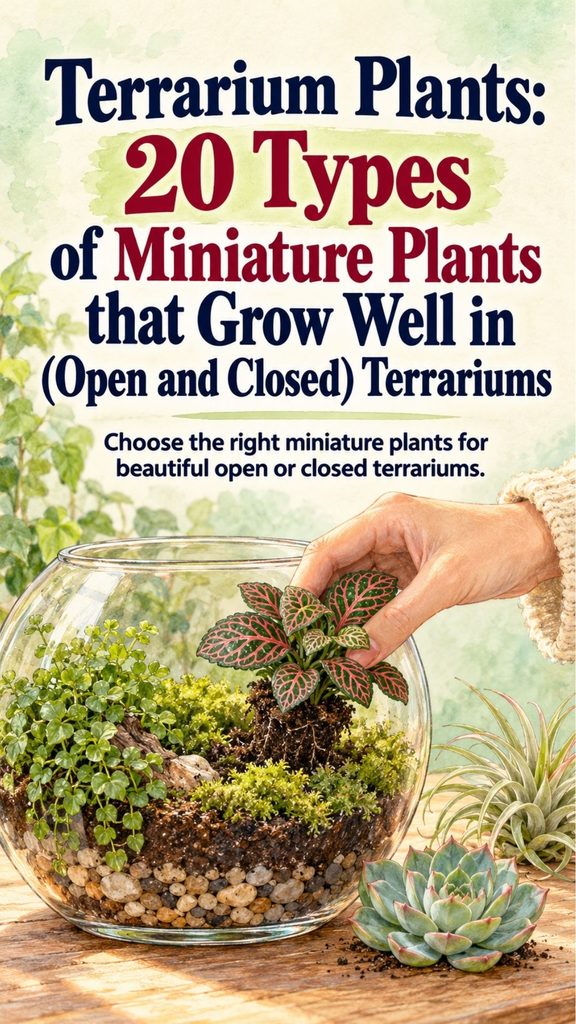
A terrarium is one of the easiest ways to bring a miniature garden indoors. A simple glass vessel can become a tiny woodland, a humid tropical scene, or a dry landscape filled with sculptural succulents.
The secret is not simply choosing plants that look attractive together. You need plants that want the same growing conditions.
A closed terrarium traps moisture and maintains high humidity, making it best suited to small tropical and woodland plants. An open terrarium allows much more air circulation and dries faster, making it a better home for succulents and other plants that dislike constantly humid conditions.
You Might Also Like:
- Loading posts...
That one distinction can determine whether your miniature garden thrives or slowly declines.
The original collection includes everything from tiny Fittonia and baby’s tears to Echeveria, Lithops, air plants, pitcher plants, and ferns. The plants are visually diverse, but they should not all be grown in the same type of terrarium.
Here are 20 beautiful choices, along with a more practical way to decide where each one belongs.
Before Choosing Plants, Decide Which Terrarium You Are Making
There are two basic styles.
Closed Terrariums
A closed terrarium has a lid or relatively enclosed top.
Moisture evaporates from the soil and plants, condenses on the glass, and eventually returns to the growing medium. A properly balanced closed terrarium therefore needs very little additional watering.
Penn State Extension recommends choosing small, slow-growing plants that tolerate high humidity and moist conditions. Ferns, mosses, Peperomia, and baby’s tears are examples of plants suited to this environment. Succulents and cacti, on the other hand, are poor choices for closed containers.
Open Terrariums
An open terrarium has no lid and allows moisture to escape more freely.
These containers are easier to ventilate and are much better suited to plants that prefer their growing medium to dry between waterings.
Succulents such as Echeveria, Haworthia, Crassula, and Lithops belong here rather than in a humid sealed jar.
Open terrariums generally require more frequent watering than closed ones because moisture can escape.
How to Build a Healthy Terrarium
Start with a clean glass container.
Then choose a growing medium suited to the plants rather than using the same soil for every terrarium.
One traditional method places decorative gravel at the bottom, followed by charcoal and potting mix. The supplied guide describes this layered approach with pebbles, moss, charcoal, soil, plants, and decorative top dressing.
However, a gravel layer does not actually create drainage in a container without drainage holes. Current Penn State guidance notes that rocks at the bottom are optional for appearance rather than necessary for drainage. The more important step is controlling how much water goes into the container in the first place.
For a closed terrarium, use a clean, relatively low-fertility potting mix and begin with it only slightly damp.
For a succulent terrarium, use a fast-draining cactus or succulent medium.
Most importantly, group plants according to similar moisture and light needs.
1. Nerve Plant
Fittonia spp.
Fittonia is one of the classic closed-terrarium plants.
Its compact leaves are covered with dramatic veins that may be white, pink, red, or silvery depending on the cultivar. The colorful foliage provides contrast even when nothing is flowering.
The supplied guide describes Fittonia as a compact plant that prefers filtered light and consistently moist rather than waterlogged soil.
Best terrarium:
Closed or humid terrarium
Fittonia appreciates humidity, which helps prevent its thin leaves from drying rapidly.
Give it bright indirect light rather than strong sun through glass.
If the terrarium receives enough light and is not overwatered, Fittonia can form a dense carpet of colorful foliage.
Prune the tips occasionally if the plant becomes too large for the container.
2. Baby’s Tears
Soleirolia soleirolii
Baby’s tears creates a soft carpet of tiny round green leaves.
It works especially well near the edge of a terrarium, where the foliage can gently spread across the soil and around stones.
The source describes it as a low plant that spreads rapidly and prefers bright indirect light with consistently moist soil.
Best terrarium:
Closed terrarium
Because it enjoys moisture and humidity, baby’s tears fits naturally into woodland-style glass gardens.
Be prepared to trim it. Under good conditions, it can spread faster than many of the other plants around it.
3. False Shamrock
Oxalis triangularis
False shamrock brings dramatic purple foliage to a glass planting.
Its triangular leaves resemble butterflies and often fold in response to changing light.
The plant is beautiful, but it can become considerably larger than the tiny plants usually chosen for a tabletop terrarium. The source notes that it can reach around 20 inches in height under favorable conditions.
Best terrarium:
Large open terrarium or dish garden
Instead of sealing it into a tiny bottle, give it enough space to grow.
Its strong color makes it an excellent centerpiece plant surrounded by smaller green foliage.
4. Venus Flytrap
Dionaea muscipula
Few plants create as much curiosity as a Venus flytrap.
Its modified leaves form hinged traps that close when properly triggered by prey.
The source includes Venus flytrap among humid terrarium plants and notes its preference for acidic, nutrient-poor growing medium and mineral-poor water.
But a Venus flytrap should not simply be treated like an ordinary tropical closed-terrarium plant.
Best setup:
Specialized carnivorous-plant container rather than a decorative sealed terrarium
Venus flytraps have particular requirements for light, water quality, growing medium, and seasonal growth.
Do not fertilize them like ordinary houseplants, and do not plant them in standard rich potting soil.
For most beginners, they are better grown as a dedicated carnivorous-plant project than mixed with tropical foliage plants.
5. Spike Moss
Selaginella kraussiana
Despite common names that sometimes include the word “fern,” Selaginella is a different group of primitive vascular plants.
Its tiny leaves create soft, fern-like sprays of green.
The source describes it as a moisture-loving plant suitable for shady, humid conditions.
Best terrarium:
Closed terrarium
It is excellent for creating a miniature forest-floor appearance.
Use it where you want dense green texture rather than a prominent flowering feature.
6. Indian Holly Fern
Arachnoides simplicior
A small fern can make a terrarium feel like a miniature woodland.
Indian holly fern has darker, more structured foliage than many delicate terrarium ferns.
The source lists it as a shade-tolerant fern that prefers moist but well-drained growing conditions.
Best terrarium:
Large humid terrarium
The main limitation is size.
A mature fern can quickly overwhelm a tiny jar, so it makes more sense in a large glass case or oversized container where it has room to expand.
For a very small terrarium, choose a naturally miniature fern instead.
7. Australian Pitcher Plant
Cephalotus follicularis
The Australian pitcher plant produces unusual pitcher-shaped traps that make it one of the most distinctive carnivorous plants available.
Its pitchers can develop striking green, burgundy, and reddish tones.
The source recommends acidic, low-nutrient media and consistently moist conditions.
Best setup:
Specialized carnivorous-plant terrarium
Do not combine it casually with plants that require rich potting soil or regular fertilizer.
Its specialized needs make it a better choice for growers who specifically want to maintain carnivorous plants.
8. Spiderwort
Tradescantia spp.
Tradescantias offer fast growth and colorful foliage or flowers, depending on the species.
The plant included in the source can grow one to several feet tall and wide.
That makes it an awkward choice for a genuinely miniature terrarium unless it is pruned frequently.
Best terrarium:
Large open glass garden
Compact Tradescantia cultivars are usually more practical than full-size forms.
If you use one, be prepared to pinch back the stems regularly.
9. Strawberry Begonia
Saxifraga stolonifera
Strawberry begonia is not a true begonia, despite its common name.
It produces rounded patterned leaves and runners that create small plantlets.
The source describes attractive foliage and delicate flowers held above the leaves, while noting that the plant can spread substantially.
Best terrarium:
Large open or moderately humid terrarium
Its decorative foliage works particularly well in a woodland arrangement.
Allow room for its runners, or trim them when they begin crowding neighboring plants.
10. Tropical Pitcher Plant
Nepenthes spp.
Nepenthes are famous for their hanging pitchers, which range dramatically in shape and color.
Some species grow into large vines, while more compact types remain manageable for longer.
The source highlights the enormous variation within the genus and recommends bright indirect light, acidic growing conditions, and consistent moisture without waterlogging.
Best setup:
Large specialized humid terrarium
A tiny decorative jar is generally too restrictive.
Choose a compact species or hybrid and give the pitchers room to hang freely.
As with other carnivorous plants, avoid ordinary rich potting soil and routine houseplant fertilization unless specific care instructions call for it.
11. Echeveria
Echeveria spp.
Now we move into plants that prefer much drier conditions.
Echeverias grow as sculptural rosettes and come in shades ranging from green and blue-gray to pink, purple, and red.
The source includes Echeveria secunda among the recommended dry terrarium plants.
Best terrarium:
Open terrarium
Echeverias need excellent drainage, strong light, and time for the growing medium to dry.
Do not place one in a sealed humid jar.
Penn State specifically recommends open terrariums for drought-tolerant succulents such as Echeveria.
Use a gritty succulent mix and water sparingly.
12. Red Pagoda
Crassula capitella
Red Pagoda is a colorful succulent with geometric leaves arranged tightly along its stems.
With sufficient light, the foliage can develop vivid reddish tones.
The source describes it as a plant that prefers very well-drained soil and drying between waterings.
Best terrarium:
Open succulent terrarium
Combine it with other drought-tolerant plants rather than ferns or mosses.
Its angular form provides an excellent contrast to round Echeveria rosettes.
13. Polka Dot Plant
Hypoestes phyllostachya
Polka dot plants are grown for their beautifully spotted leaves.
Depending on the cultivar, foliage may combine green with pink, red, white, or burgundy.
The source notes that the plant enjoys moist growing conditions during active growth.
Best terrarium:
Closed or humid terrarium
Compact cultivars work best.
Regular pinching encourages bushier growth and prevents the plant from becoming tall and sparse.
Pair it with green plants such as moss, Fittonia, or small ferns for strong contrast.
14. Zebra Haworthia
Haworthiopsis attenuata
Zebra haworthia produces narrow dark green succulent leaves marked with raised white bands.
It is compact, architectural, and much more tolerant of indoor conditions than some extremely sun-hungry succulents.
The source recommends very free-draining soil and allowing the growing medium to dry before watering again.
Best terrarium:
Open terrarium
Never seal it in a constantly damp container.
Use a gritty succulent medium and give it bright light.
Its striped leaves make it particularly attractive in simple arrangements with gravel and stone.
15. Earth Star
Cryptanthus spp.
Often called earth stars, Cryptanthus are small bromeliads that grow in colorful low rosettes.
Their foliage may be green, cream, pink, red, or striped.
The source highlights Cryptanthus bivittatus for its small size and decorative star-shaped form.
Best terrarium:
Humid open or loosely covered terrarium
Earth stars enjoy more humidity than desert succulents but should not sit in stagnant saturated soil.
They work beautifully as focal plants in tropical displays.
16. Air Plants
Tillandsia spp.
Air plants are unusual because they do not need traditional potting soil.
Instead, they absorb moisture and nutrients primarily through specialized structures on their leaves.
The source recommends them for open displays and notes their ability to grow without soil.
Best terrarium:
Open glass display
Air circulation is important.
Do not permanently trap Tillandsia in a wet, sealed jar.
They can be placed on decorative stones, wood, shells, or other supports without burying them in soil.
After watering, allow them to dry properly rather than leaving water trapped between leaves.
17. Button Fern
Pellaea rotundifolia
Button fern has arching stems lined with small round leaflets.
Its compact shape makes it attractive in glass containers, especially when you want something softer than a succulent but less delicate-looking than many traditional ferns.
The source describes it as preferring loose, well-drained growing medium with regular but controlled watering.
Best terrarium:
Open or moderately humid terrarium
Do not assume that because it is a fern it needs permanently saturated soil.
Keep the medium lightly moist when appropriate, but avoid waterlogging.
18. Living Stones
Lithops spp.
Lithops are among the strangest plants you can grow.
Each plant resembles a pair of small colored stones emerging from the ground.
Their unusual appearance makes them perfect for a miniature desert scene.
The source correctly emphasizes their preference for extremely free-draining soil and very restrained watering.
Best terrarium:
Very open, dry succulent display
Lithops are poor candidates for a traditional humid terrarium.
They need abundant light and a specialized watering schedule tied to their growth cycle.
Overwatering is one of the easiest ways to lose them.
For beginners, it may be easier to grow Lithops in an ordinary pot placed inside a decorative glass arrangement rather than planting them permanently into a drainage-free vessel.
19. Pies From Heaven
Kalanchoe rhombopilosa
This compact succulent has unusual gray-green leaves marked with darker spots and irregular edges.
It looks almost like a miniature sculptural tree.
The source identifies it as a drought-tolerant plant requiring loose, well-drained soil and drying between waterings.
Best terrarium:
Open terrarium
Use it as a focal plant among smaller succulents and stones.
Because its coloration is subtle, a simple neutral background often shows it off better than a very busy arrangement.
20. Pregnant Onion
Albuca bracteata
Pregnant onion is visually unusual because much of its bulb remains exposed above the soil.
It eventually produces long arching leaves and can develop a tall flower stalk.
The source notes that the plant may reach several feet in flower.
Best terrarium:
Large open dish garden rather than a miniature terrarium
Its eventual size makes it impractical for most enclosed glass containers.
If you want the same bulbous sculptural effect in a small terrarium, choose a genuinely miniature species instead.
The Best Plants for a Small Closed Terrarium
If you want a classic sealed glass garden, keep the selection simple.
Some of the easiest choices from this list are:
- Fittonia
- Baby’s tears
- Spike moss
- Compact polka dot plants
- Small ferns
- Small humidity-loving tropical plants
Penn State recommends choosing plants with similar light and moisture requirements and avoiding direct sunlight on closed terrariums because the enclosed glass can heat dangerously.
Bright indirect light is generally much safer.
The Best Plants for an Open Succulent Terrarium
For a dry open display, good choices include:
- Echeveria
- Red Pagoda
- Zebra Haworthia
- Lithops
- Kalanchoe
- Air plants
Do not mix these with Fittonia, baby’s tears, and moisture-loving ferns.
Trying to keep both groups happy in the same small container almost guarantees that one side will receive the wrong amount of water.
Do Terrariums Need Pebbles at the Bottom?
Pebbles can look beautiful through clear glass.
They can also help separate decorative layers visually.
But they do not transform a glass bowl without holes into a properly drained flowerpot.
Modern terrarium guidance notes that a bottom rock layer is optional rather than a true drainage solution.
The safest strategy is to:
- Use an appropriate growing medium.
- Add very little water at a time.
- Choose plants with compatible moisture requirements.
- Remove excess moisture if the container becomes saturated.
This matters especially in closed terrariums, where very little water escapes.
How Much Should You Water a Closed Terrarium?
Very little.
A properly functioning closed terrarium recycles much of its own moisture.
After planting, light condensation on the glass is normal.
Heavy condensation all day or water running continuously down the glass can indicate excess moisture. Penn State recommends temporarily removing the lid if the terrarium becomes too wet.
If everything is balanced, you may go weeks or even months without adding water.
Do not water on a calendar.
Watch the plants and soil instead.
Avoid Direct Sun on a Closed Terrarium
Glass can trap considerable heat.
A sealed terrarium placed in strong direct sunlight may become much hotter than the surrounding room.
Penn State specifically recommends a bright location without direct sun for closed terrariums.
Open succulent terrariums can tolerate brighter conditions, but indoor lighting should still be adjusted to the requirements of the individual species.
Keep Plants Small Through Pruning
Even plants sold as “miniature” may continue growing.
Do not wait until foliage is pressed against every wall of the container.
Trim:
- Long stems
- Crowded foliage
- Yellow leaves
- Dead plant material
- Runners that invade neighboring plants
Remove diseased material quickly, especially in a closed terrarium where high humidity can favor problems.
If a plant simply becomes too large, transplant it into a normal pot and replace it with something smaller.
Do Not Overfertilize
A terrarium is not a place where you want explosive plant growth.
Too much fertilizer encourages plants to outgrow the container quickly and may contribute to salt buildup or other problems.
Closed terrariums generally need very little feeding.
Penn State suggests that an established closed terrarium may eventually be fertilized only lightly, at a fraction of ordinary strength, rather than being fed like a conventional houseplant.
For many newly planted terrariums, fertilizer is unnecessary.
Choose Plants for the Environment, Not Just Their Appearance
A beautiful terrarium begins with plant compatibility.
Fittonia and moss may look wonderful beside an Echeveria, but their watering needs are fundamentally different.
A Venus flytrap may look dramatic next to an ordinary tropical plant, but its growing medium and nutrient requirements are specialized.
Lithops may be tiny enough for a jar, yet the humidity of a sealed terrarium can be exactly what they do not want.
Use the basic right plant, right place principle.
High-humidity plants belong together.
Dry succulents belong together.
Specialized carnivorous plants deserve their own setup.
And plants that naturally become large should be given a container large enough to accommodate them.
With those principles in place, a glass vessel can become more than decoration. It can function as a genuine miniature garden—one that continues looking healthy long after the initial planting day.