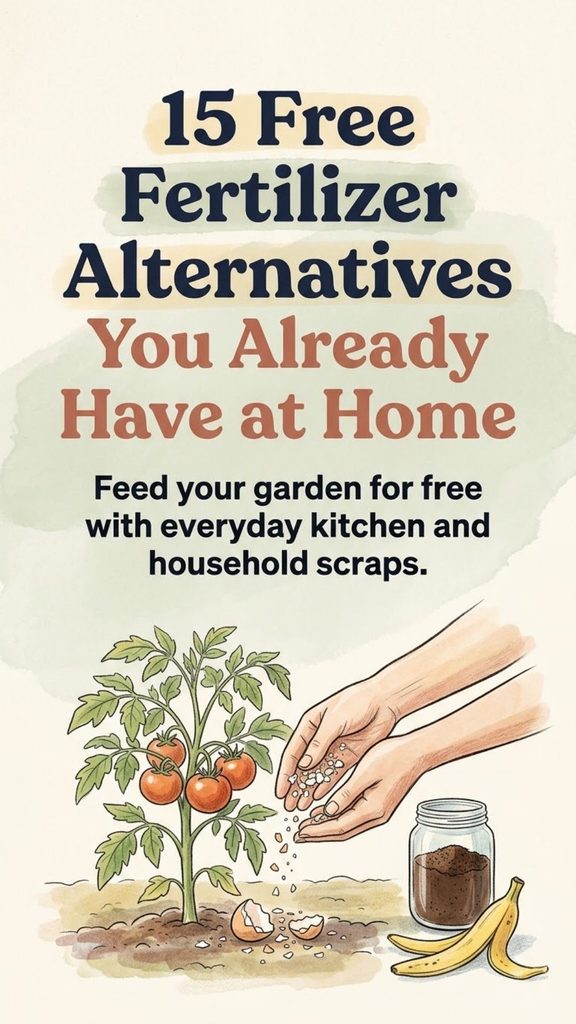
Before buying another bag of fertilizer, take a look at what your household already throws away. Coffee grounds, grass clippings, eggshells, vegetable scraps, and even water from a freshwater aquarium can return useful nutrients or organic matter to the garden.
There is one important distinction, though: not everything commonly called a “homemade fertilizer” actually works like fertilizer from a bag. Some household materials contain plant nutrients but release them slowly. Others are more useful for improving soil, feeding compost, or recycling nutrients that would otherwise go to waste.
That is not a disadvantage. Healthy garden soil depends on much more than a quick dose of nitrogen, phosphorus, and potassium. Organic matter, soil structure, moisture, microorganisms, pH, and nutrient balance all influence how well plants grow.
You Might Also Like:
- Loading posts...
The safest approach is to use household materials as part of a broader soil-care routine rather than assuming that every kitchen scrap can replace a balanced fertilizer.
A Quick Guide to Free Garden Fertilizers and Soil Boosters
| Household Material | Main Benefit | Best Use |
|---|---|---|
| Finished compost | Organic matter and multiple nutrients | Vegetable beds, flowers, containers |
| Grass clippings | Nitrogen and potassium | Lawns, mulch, compost |
| Coffee grounds | Organic matter and some nitrogen | Compost and garden soil |
| Banana peels | Potassium and organic matter | Compost |
| Eggshells | Calcium carbonate | Compost and long-term soil amendment |
| Wood ash | Potassium and raises soil pH | Acidic soils when appropriate |
| Aquarium water | Recycled nutrients | Houseplants and garden beds |
| Vegetable cooking water | Small amounts of dissolved nutrients | Supplemental watering |
| Rice or pasta water | Small amounts of dissolved material | Occasional watering |
| Used tea leaves | Organic matter | Compost |
| Hair | Nitrogen-rich organic material | Compost |
| Citrus peels | Organic matter | Compost |
| Milk | Limited specialty garden use | Mainly researched for powdery mildew |
| Molasses | Carbon source for microorganisms | Compost-related uses |
| Epsom salt | Magnesium and sulfur | Only where magnesium is deficient |
1. Finished Compost: The Most Useful Place to Start
If you want one homemade soil amendment that deserves a permanent place in the garden, make it compost.
Vegetable peelings, fruit scraps, coffee grounds, grass clippings, dried leaves, shredded paper, and other suitable organic materials can be turned into finished compost. During decomposition, microorganisms transform those materials into a stable amendment that contributes organic matter and slowly available nutrients.
A productive compost pile needs a mixture of nitrogen-rich “greens,” such as kitchen scraps and fresh grass, and carbon-rich “browns,” such as dried leaves, straw, or shredded paper. Moisture and air are important as well.
Finished compost can be spread over garden beds, incorporated into soil before planting, or used as a light top-dressing around established plants.
Its biggest advantage is not simply fertilizer value. Compost can also improve the soil’s ability to hold water and nutrients while supporting better structure.
Do not assume that more compost is always better. Repeated heavy applications can lead to excessive phosphorus or other nutrient imbalances, which is another reason occasional soil testing is worthwhile.
2. Grass Clippings: Free Nutrients From the Lawn
Grass clippings are one of the easiest nutrient sources to recycle because they require almost no preparation.
The simplest method is to leave short clippings on the lawn after mowing. As they break down, nutrients are returned to the soil. University of Minnesota Extension notes that decomposed clippings can return roughly the equivalent of one fertilizer application to a lawn each year.
Clippings can also be useful in vegetable gardens.
Allow them to dry slightly and spread them in thin layers around established plants. Thick piles of fresh grass may become slimy, mat together, restrict airflow, and interfere with water movement.
Grass clippings are also valuable additions to compost because they are considered a nitrogen-rich green material.
One precaution matters: do not transfer clippings from lawns recently treated with herbicides into vegetable beds or compost unless the product label confirms that doing so is safe.
3. Used Coffee Grounds: Better for Soil Than Many Garden Myths Suggest
Used coffee grounds contain some nitrogen and small amounts of other nutrients, but they should not be treated as a powerful fertilizer.
Their more useful role is as an organic soil amendment or compost ingredient.
Contrary to a widespread gardening claim, spent coffee grounds are not strongly acidic. After brewing, they are generally close to neutral, so sprinkling them around blueberries or hydrangeas is not a reliable way to acidify the soil.
Add coffee grounds to compost along with a good mixture of other materials, or incorporate moderate amounts into garden soil.
Avoid creating a thick mat of grounds around plants. Large quantities can interfere with water movement and may temporarily affect nitrogen availability while microorganisms decompose them.
Coffee grounds are useful. They simply work better when treated as one ingredient in a healthy soil system rather than a miracle plant food.
4. Banana Peels: Compost Them Instead of Making “Banana Tea”
Banana peels contain potassium and other mineral nutrients because those nutrients were part of the banana plant. However, that does not mean soaking a peel in a jar of water creates a balanced liquid fertilizer.
Most of the peel’s material remains in the peel after soaking.
A more dependable way to recover its nutrients is to compost it.
Cut banana peels into smaller pieces and mix them with the rest of your compost ingredients. As microorganisms break down the material, nutrients are gradually returned to the finished compost.
You can also bury small amounts deeply in an active garden bed, but composting is generally neater and less likely to attract insects or animals.
Tomatoes and peppers do need potassium, but adding random amounts of banana peel does not guarantee that a potassium deficiency will be corrected. If plants consistently perform poorly, testing the soil is more useful than guessing.
5. Eggshells: Useful Calcium, but Very Slow
Eggshells are rich in calcium carbonate, which makes them an interesting garden amendment. The problem is speed.
Large eggshell pieces break down very slowly. Even crushed shells may remain visible in soil or compost for a long time. Grinding clean, dry shells into a fine powder increases their surface area and can help them break down more quickly.
Eggshells are therefore better viewed as a long-term calcium-containing amendment than an emergency calcium fertilizer.
This distinction is particularly important with tomatoes. Adding eggshells to a planting hole is often recommended as a cure for blossom-end rot, but the disorder frequently occurs even when soil already contains adequate calcium. Irregular soil moisture and problems moving calcium into rapidly developing fruit are common factors.
Maintaining even soil moisture is generally more useful than piling eggshells around an affected tomato.
Adding finely crushed shells to compost is one of the simplest ways to reuse them.
6. Wood Ash: Valuable in the Right Soil and Harmful in the Wrong One
Clean wood ash can be one of the more powerful household garden amendments on this list.
It contains potassium, calcium, magnesium, and other minerals. More importantly, wood ash is alkaline and acts as a liming material, meaning it can raise soil pH.
That makes it potentially useful in acidic soil that also needs potassium.
It also makes careless use risky.
Do not routinely scatter fireplace ash around the garden simply because it is free. Test the soil first. Avoid using it around acid-loving plants such as blueberries, rhododendrons, and azaleas, and do not use it where soil is already alkaline.
Only use ash from clean, untreated wood. Ash from painted or pressure-treated lumber, trash, coal, or other questionable materials does not belong in food gardens.
Wood ash is a good example of why homemade does not automatically mean harmless. Used correctly, it can be useful. Used excessively, it can raise soil pH enough to create serious nutrient problems.
7. Freshwater Aquarium Water: Turn Water Changes Into Plant Watering
If you keep a freshwater aquarium, routine water changes can provide another opportunity to reuse water instead of pouring it down the drain.
Aquarium water may contain nitrogen and other dissolved nutrients originating from fish waste and uneaten food. In modest amounts, that water can be used on many garden and houseplants.
Apply it to the soil rather than storing it for long periods.
There are important exceptions.
Never pour saltwater aquarium water onto ordinary garden plants. Salt can damage roots and accumulate in soil. Water containing medications or other aquarium treatments should also be handled according to the product instructions rather than automatically being poured into the garden.
Think of ordinary freshwater aquarium water as a useful recycled input, not as a precisely balanced fertilizer.
8. Unsalted Vegetable Cooking Water
Water used to boil vegetables may contain small amounts of minerals and other soluble compounds released during cooking.
If you would otherwise pour that water away, it can sometimes be reused for watering plants.
Two rules matter: let it cool completely and make sure it is unsalted.
Hot water can injure roots, while repeated applications of salty cooking water can create harmful salt buildup in soil.
Do not expect dramatic growth from vegetable water. The concentration of useful plant nutrients is unpredictable and generally too low to replace normal fertility management.
Its value is mostly in sensible reuse. You are conserving water while returning a small amount of material to the soil instead of sending it down the drain.
9. Unsalted Rice and Pasta Water
Rice and pasta water are promoted online as powerful homemade fertilizers, but the reality is less dramatic.
The cloudy water left after rinsing rice or cooking starchy foods contains starch and small amounts of dissolved material. That can become food for microorganisms, but it is not equivalent to a complete plant fertilizer.
If the water contains no salt, oil, sauce, or seasoning, you can let it cool and occasionally use it to water garden plants.
Avoid leaving starchy water sitting around for days. Organic material can ferment, develop odors, and support unwanted microbial growth.
For houseplants, use it sparingly rather than making it the plant’s only source of water.
This is best considered a water-reuse habit, not a replacement for compost or a genuine nutrient deficiency correction.
10. Used Tea Leaves
Used loose tea leaves can go straight into the compost pile once they have cooled.
Tea leaves contribute organic material and become part of the composting process much like other kitchen plant scraps.
Be more careful with the bag itself. Not every tea bag is made entirely from compostable paper. Some contain plastic fibers or other synthetic materials. If you are uncertain, cut the bag open, compost the tea leaves, and discard the packaging separately.
Another common claim deserves caution: used tea leaves should not be relied upon to make soil acidic enough for blueberries, azaleas, or other plants with specific pH requirements.
If soil pH needs changing, test it and use an amendment appropriate for that purpose.
11. Human Hair and Pet Hair
Hair contains nitrogen because it is largely made of the protein keratin, but that does not mean plants can immediately use that nitrogen.
Hair decomposes slowly.
Instead of spreading handfuls around plants, chop or break it apart and add small quantities to a compost pile. Mixing it thoroughly with other ingredients helps prevent dense clumps.
Pet hair can also be composted in limited amounts, but avoid hair contaminated with pesticides, flea treatments, cleaning products, or other chemicals you would not want in your compost.
Hair is a good example of slow nutrient recycling: what looks like waste can eventually contribute to soil fertility, but patience is required.
12. Citrus Peels
Orange, lemon, grapefruit, and lime peels do not need to go in the trash.
Cut them into smaller pieces and add them to a well-managed compost pile.
Citrus peels are tougher than many vegetable scraps, so chopping them increases their exposed surface area and helps decomposition proceed faster.
They should not, however, be treated as a quick fertilizer for acid-loving plants. Burying orange peels around a blueberry bush is not a controlled or dependable way to change soil pH.
If you have large quantities of citrus waste, mix it with plenty of other compost materials instead of creating a pile dominated by citrus.
Variety generally produces better compost than relying heavily on a single kitchen ingredient.
13. Leftover Milk: A Specialized Use, Not Everyday Fertilizer
Milk contains calcium and other nutrients, but pouring large quantities into garden soil is not an efficient fertilization strategy. Decomposing dairy products can create unpleasant odors and attract animals.
Milk has received more serious attention for a completely different gardening use: diluted milk sprays have been studied as a possible treatment for powdery mildew on some plants, although results have varied. Oregon State University Extension notes that results have ranged from impressive to less successful, while standard disease-management practices still emphasize resistant varieties, spacing, airflow, and appropriate fungicides when needed.
So if a small amount of milk is nearing its use-by date, do not assume that pouring it around tomato roots will prevent blossom-end rot.
Calcium in milk does not correct the moisture-related calcium transport problems that commonly cause the disorder.
14. Unsulphured Molasses
Molasses is sometimes promoted as a fertilizer because it contains small quantities of minerals. Its more notable characteristic in soil is its high sugar content.
Those sugars provide an easily available carbon source for microorganisms.
That sounds automatically beneficial, but soil biology is complicated. Healthy garden soil already contains enormous microbial communities, and giving them large doses of sugar does not necessarily improve plant nutrition.
Too much molasses can also encourage unwanted microbial activity or attract insects.
If you use molasses at all, treat it as an occasional compost or soil-microbe supplement rather than a source of the nitrogen, phosphorus, and potassium required by hungry crops.
Good compost and appropriate soil fertility management offer much more predictable benefits.
15. Epsom Salt: Only When the Garden Actually Needs Magnesium
Epsom salt is magnesium sulfate. Both magnesium and sulfur are plant nutrients, so it sounds like an obvious homemade fertilizer.
That has led to recommendations for adding Epsom salt automatically to tomatoes, peppers, roses, and practically every other garden plant.
The problem is that a plant does not benefit from receiving a nutrient it already has in sufficient quantity.
Oregon State University Extension specifically advises that Epsom salt be used only when a soil test shows a magnesium deficiency. Excessive magnesium can create nutrient imbalances rather than healthier plants.
If your plants appear deficient, do not diagnose the problem from a single symptom alone. Yellow leaves, for example, can have many causes.
A soil test offers a much better basis for deciding whether magnesium is actually needed.
The Most Important Free Garden Tool Is Knowing Your Soil
Homemade fertilizers become much safer and more effective when you stop guessing about what the garden needs.
A soil test can reveal pH, organic matter, phosphorus, potassium, and other important characteristics depending on the laboratory and test package. That information makes it easier to determine whether your soil actually needs additional nutrients.
This matters because nutrient problems can come from both deficiency and excess.
Adding more potassium to soil already rich in potassium does not make tomatoes better. Adding magnesium when magnesium is already adequate can interfere with nutrient balance. Adding alkaline wood ash to soil with a high pH can make several nutrients less available.
Free fertilizer is only a bargain when the soil can use it.
A Better Way to Use Kitchen Scraps in the Garden
Rather than making separate jars of banana water, eggshell tea, citrus water, coffee mixtures, and other homemade concoctions, consider simplifying the process.
Keep a small compost container in the kitchen for suitable scraps. Add coffee grounds, fruit and vegetable scraps, crushed eggshells, tea leaves, and other compostable materials. Combine them with dried leaves, shredded paper, or other carbon-rich material in your compost system.
Leave grass clippings on the lawn when practical. Save appropriate freshwater aquarium water for plants. Reuse unsalted cooking water after it cools. Test the soil before reaching for powerful amendments such as wood ash or Epsom salt.
Those few habits accomplish more than a collection of complicated fertilizer recipes.
Free Does Not Mean You Should Use Everything
The best lesson from household fertilizer alternatives is not that every scrap belongs directly around plant roots.
Some materials are genuine nutrient sources. Others work best after composting. Some mainly improve soil structure. A few, such as wood ash and Epsom salt, should only be used under the right soil conditions.
That distinction can prevent many garden problems.
Start with the safest and most useful options: make compost, recycle grass clippings, return moderate amounts of organic material to the soil, conserve usable water, and learn what your soil actually needs.
Your kitchen and yard really can reduce how much fertilizer you buy. The secret is not turning every leftover into a miracle plant food. It is recycling nutrients intelligently and building soil that can support healthy plants year after year.