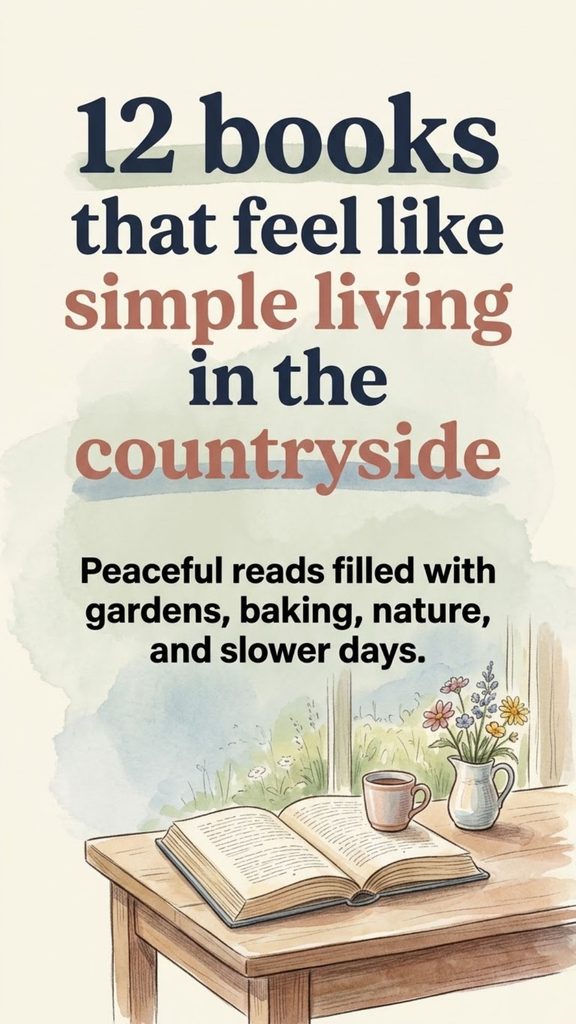
There is a particular kind of book that makes you want to put the kettle on, open a window, and spend the rest of the afternoon doing something slow.
These are books filled with gardens that change with the seasons, country kitchens, weathered houses, long walks, home-grown food, small communities, and people whose lives are shaped more by the land than by a crowded calendar. Some are novels and others are memoirs or practical reflections on simpler living, but they share the same appealing quality: they make ordinary life feel worth noticing.
You do not need to own a cottage or leave the city to enjoy that feeling. A book can offer a temporary retreat of its own. Even from an apartment, a busy commute, or a noisy neighborhood, you can spend a few hours among orchards, islands, vegetable gardens, farms, and quiet country rooms.
You Might Also Like:
- Loading posts...
If you are drawn to slow living, gardening, simple pleasures, seasonal food, and homes that feel genuinely lived in, these twelve books are especially good companions.
1. Old Herbaceous by Reginald Arkell
Read it for: English gardens, old-fashioned horticulture, dry humor, and the comforting rhythm of a life built around plants.
Old Herbaceous follows Bert Pinnegar, an awkward boy with a fascination for wildflowers who eventually becomes an accomplished head gardener at a British country house. Gardening is not simply scenery here; it provides the structure of Bert’s life.
The novel is warm and funny without becoming overly sentimental. Readers who love pottering in the garden may particularly enjoy the little details about flowers, greenhouse work, planting, and the peculiar personalities that gather around a large country garden.
It is also relatively short, making it a lovely choice when you want something gentle rather than a sprawling novel. The pleasure comes from watching a person find belonging through useful work, changing seasons, and years spent tending the same patch of ground.
2. The Rural Diaries by Hilarie Burton Morgan
Read it for: farm renovation, animals, family life, small-town community, and a realistic look at choosing a different pace of life.
This memoir follows Hilarie Burton Morgan’s move away from a Hollywood-centered lifestyle after she and her husband, Jeffrey Dean Morgan, bought a working farm in Rhinebeck, New York.
The countryside in The Rural Diaries is not presented as one endless cozy afternoon. There is work involved: chopping wood, keeping animals, building chicken coops, repairing a property, raising children, and becoming part of a community.
That makes the book especially appealing if you enjoy the dream of country living but also want to see some of the labor underneath the aesthetic.
At its heart, it is about creating a home intentionally and discovering that a meaningful life can be built through family, neighbors, physical work, and attachment to a place.
3. The Art of Frugal Hedonism by Annie Raser-Rowland and Adam Grubb
Read it for: spending less, escaping consumer pressure, appreciating free pleasures, and making simple living feel enjoyable rather than restrictive.
Not every book about a simpler life needs to involve moving to a farm. The Art of Frugal Hedonism approaches simplicity from another direction: learning how to enjoy life deeply without constantly spending money.
The authors question habits that encourage people to consume automatically and suggest finding pleasure in activities that cost little or nothing. Walking with friends, enjoying nature, cooking, slowing down, and paying closer attention to everyday experiences all fit into this philosophy.
What makes the idea particularly useful is that frugality is not presented purely as sacrifice. The emphasis is on becoming less dependent on purchased entertainment and possessions while making more room for time, freedom, and pleasure.
The original book appeared in 2016, and a revised edition was released in 2024.
4. Prodigal Summer by Barbara Kingsolver
Read it for: Appalachian forests, small farms, wildlife, summer abundance, and a novel in which human life is inseparable from the natural world.
For readers who want countryside fiction with more complexity and emotional depth, Prodigal Summer is an excellent choice.
Set during a humid summer in southern Appalachia, the novel intertwines three stories involving people living among forests and farms. Among them are Deanna Wolfe, a wildlife biologist living largely alone in a mountain cabin; Lusa Maluf Landowski, who must reconsider her relationship with a farm after a major personal loss; and elderly neighbors whose disagreements include farming, pesticides, and the natural world.
Ecology is woven deeply into the story. Coyotes, insects, crops, trees, predators, and human relationships all form part of the same living system.
This is not a cozy countryside novel in the lightest sense. It deals with grief, desire, conflict, and difficult decisions. But it also captures the astonishing fullness of a rural summer: plants growing, animals moving through the landscape, storms arriving, and life continuing in countless forms.
5. The Lady Farmer Guide to Slow Living by Mary E. Kingsley
Read it for: practical slow living, sustainability, food, clothing, home life, and thoughtful questions about how much we really need.
The Lady Farmer Guide to Slow Living is more practical than many of the books on this list. Mary E. Kingsley combines stories, recipes, resources, ideas, and reflections around living more simply and sustainably close to home.
The book looks at everyday choices, including our relationships with what we eat, what we wear, and what we consume. It also includes a 21-day slow-living challenge designed around daily reflection.
That makes it a useful choice for anyone who loves the countryside ideal but wants to translate some of that feeling into ordinary life.
You do not need acreage, livestock, or a perfect cottage. Slow living can start with how you shop, cook, dress, use what you own, and structure your days.
6. The Summer Book by Tove Jansson
Read it for: tiny islands, long summer days, quiet observation, family, nature, and one of the gentlest settings in modern fiction.
Tove Jansson’s The Summer Book takes place on a small island in the Gulf of Finland, where a six-year-old girl and her grandmother spend the summer together.
Very little of its appeal depends on a dramatic plot. Instead, the book is made from small episodes: exploring the island, talking, playing, observing weather and wildlife, arguing, imagining things, and simply sharing a place.
The relationship between the grandmother and granddaughter is affectionate without becoming sugary. Both characters are stubborn and independent, and their conversations move easily between everyday concerns and much larger questions.
Jansson’s island setting makes the book particularly suitable for readers who want the literary equivalent of turning off their phone and disappearing somewhere remote for a while.
It is a story about attention: to another person, to a landscape, and to the brief season unfolding around you.
7. Recipe for a Kinder Life by Annie Smithers
Read it for: seasonal cooking, productive gardens, country life, sustainability, and the connection between caring for land and caring for yourself.
Australian chef Annie Smithers combines memoir, practical experience, recipes, gardening, and reflections on sustainability in Recipe for a Kinder Life.
The book draws on decades spent working with food and productive gardens in country Victoria. Smithers writes about subjects including land, water, weather, buildings, growing food, and the realities of creating a more sustainable life.
That last point is important. This is not simply countryside escapism. The book acknowledges that producing food and caring for land involve mistakes, physical work, unpredictable conditions, and constant learning.
Recipes appear alongside those experiences, strengthening the connection between what is grown and what eventually reaches the table.
For readers attracted to the practical side of simple living—vegetable gardens, local food, cooking from the seasons, and using resources carefully—this is one of the most grounded choices on the list.
8. A Circle of Quiet by Madeleine L’Engle
Read it for: a country farmhouse, creativity, family life, solitude, reflection, and finding a quieter mental space.
First published in 1972, A Circle of Quiet is the first of Madeleine L’Engle’s Crosswicks Journals.
The memoir is rooted in Crosswicks, her family’s farmhouse in rural Connecticut. From there, L’Engle reflects on creativity, writing, family responsibilities, faith, identity, and the search for meaning.
This is less a book about adopting a simple-living lifestyle and more a book about creating enough quiet to hear yourself think.
That distinction makes it valuable. A simpler life is not only about vegetable patches, homemade bread, or living outside a city. Sometimes it means protecting enough mental space to read, create, reflect, and understand what matters.
A Circle of Quiet suits readers who like books they can read slowly rather than race through.
9. The Shell Seekers by Rosamunde Pilcher
Read it for: English homes, gardens, family history, art, meals, memory, and the comforting atmosphere of a long family saga.
At first glance, The Shell Seekers may seem less obviously connected to simple living than a book about gardening or homesteading. Its appeal lies instead in atmosphere.
The novel centers on Penelope Keeling and gradually explores her life, her family relationships, her past, and the importance of a painting created by her father. The story moves across generations and memories, with homes, gardens, food, art, and English landscapes providing much of its texture.
There are family disagreements and complicated emotions, so this is not a conflict-free comfort read. Yet Rosamunde Pilcher is particularly good at making domestic spaces feel substantial. Rooms, meals, gardens, and ordinary days matter.
It is a longer book than many on this list, making it ideal for a rainy weekend or for readers who want to settle into another family’s life rather than visit briefly.
10. Beatrix Potter’s Gardening Life by Marta McDowell
Read it for: cottage gardens, the Lake District, seasonal flowers, literary history, and the real landscapes behind Beatrix Potter’s illustrations.
Anyone who has looked closely at a Beatrix Potter illustration knows how important plants and gardens are to her fictional world.
Marta McDowell explores that connection in Beatrix Potter’s Gardening Life, tracing Potter’s interest in plants from childhood through her later years as a gardener, farmer, naturalist, and landowner.
The book begins with a gardening-focused biography, then follows the garden through the seasons, examining plants and landscapes connected with Potter’s life and artwork. It also includes information for readers interested in visiting places associated with her gardens.
This is a particularly lovely choice for anyone whose idea of country life includes stone walls, cottage gardens, vegetable patches, muddy paths, old farm buildings, and flowers spilling into unexpected places.
It reminds us that the landscapes in beloved books often grew from an author’s close observation of real places.
11. Braiding Sweetgrass by Robin Wall Kimmerer
Read it for: plants, ecology, Indigenous knowledge, scientific observation, gratitude, reciprocity, and a deeper way of thinking about our relationship with the natural world.
Braiding Sweetgrass reaches beyond the aesthetics of simple living.
Robin Wall Kimmerer is a botanist and an enrolled member of the Citizen Potawatomi Nation. In this collection, she brings scientific knowledge into conversation with Indigenous knowledge and teachings about the relationships between humans and other living beings.
Plants including strawberries, asters, goldenrod, squash, and sweetgrass become part of wider discussions about attention, gifts, responsibility, gratitude, and reciprocity.
For someone drawn to gardening or rural life, the book can deepen the conversation from “How can I live closer to nature?” to “What responsibilities come with being part of a living landscape?”
It is a thoughtful book rather than a quick lifestyle manual, and many chapters reward being read slowly.
12. Elizabeth and Her German Garden by Elizabeth von Arnim
Read it for: garden solitude, changing seasons, books, flowers, humor, and the wonderfully satisfying idea of escaping household demands by going outside.
First published in 1898, Elizabeth and Her German Garden is structured as a diary covering a year in the life of its narrator.
Elizabeth finds refuge in the garden of her country home in Pomerania, where gardening becomes both a pleasure and a form of escape from social expectations and domestic frustrations.
The novel is semi-autobiographical and mixes descriptions of nature and gardening with humor and social observation. Although it comes from another era and reflects the attitudes and circumstances of its time, the central pleasure remains surprisingly recognizable: having a private outdoor place where the demands of the world seem less urgent.
Readers who love seasonal writing will find plenty to enjoy as the garden changes through the year.
It is also in the public domain in the United States, so readers who do not mind reading digitally can legally find free editions through sources such as Project Gutenberg.
Which Countryside Book Should You Start With?
Although all twelve books share some connection with quieter living, they offer very different experiences.
Start with The Summer Book if you want something short, peaceful, and beautifully observant. Choose Old Herbaceous if gardens and classic British humor are more your style. Pick The Rural Diaries or Recipe for a Kinder Life when you want real-life stories about creating a life closer to the land.
For practical ideas about consuming less, The Art of Frugal Hedonism and The Lady Farmer Guide to Slow Living are useful places to begin.
If you want nature writing with greater ecological depth, reach for Braiding Sweetgrass. For richer fiction, Prodigal Summer brings together farming, wildlife, relationships, and ecology, while The Shell Seekers offers the pleasures of a long domestic family saga.
And when what you really want is simply an old garden, a chair in the shade, a stack of books, and nowhere urgent to be, Elizabeth and Her German Garden is difficult to beat.
The Quiet Appeal of Books About Simple Living
The best books about country life are not appealing because they pretend rural living is effortless. Farms need work. Gardens fail. Weather changes plans. Families remain complicated no matter how beautiful the view outside the window may be.
What these books offer instead is a different sense of scale.
They bring attention back to things that modern life can make easy to overlook: what is growing outside, what is cooking for dinner, how a familiar landscape changes through the seasons, what can be repaired instead of replaced, and how much pleasure can be found in an ordinary day.
Perhaps that is why books about simple living can feel restorative even if you have no intention of moving to the countryside.
You can close the book and carry part of that atmosphere back into your own life—water the plants, bake something slowly, take a walk without a destination, sit outside with tea, or simply leave a little more empty space in the day.
Sometimes the countryside we are looking for begins with paying closer attention to the life we already have.