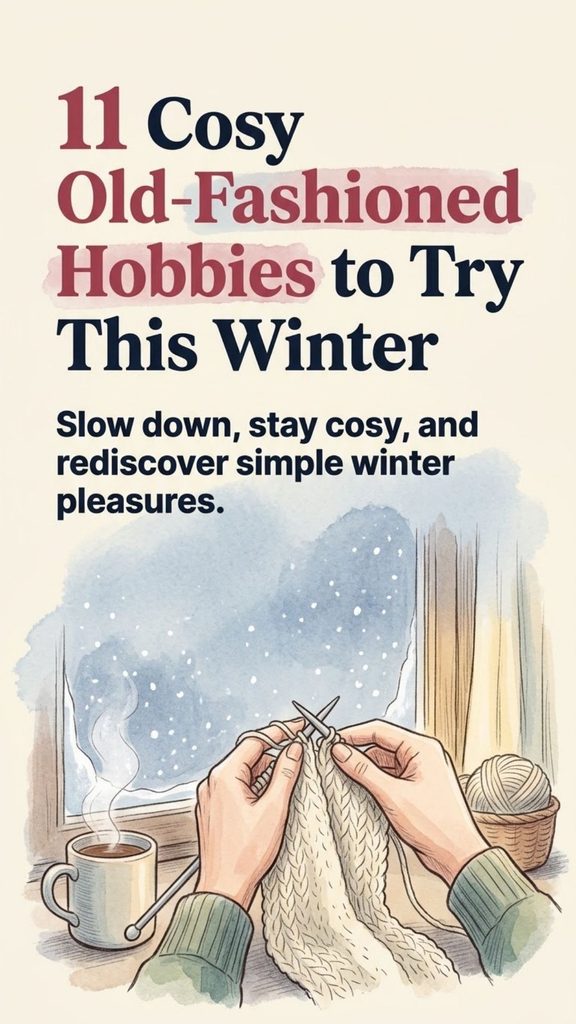
Winter naturally changes the pace of home life. Shorter days, cold evenings, and long stretches indoors make the season feel quieter than the rest of the year. Instead of treating that slower rhythm as something to endure, it can be an invitation to rediscover hobbies that generations before us enjoyed during the colder months.
Old-fashioned hobbies have a special appeal in winter because many of them are simple, inexpensive, and satisfying. They give your hands something useful to do, encourage creativity, and can replace some of the time normally spent scrolling on a phone or watching another evening of television.
You certainly do not need to recreate life from a hundred years ago. The charm comes from borrowing the parts that still make sense: making things by hand, reading slowly, cooking from basic ingredients, spending time outdoors, writing letters, repairing what you own, and gathering around a table with people you love.
You Might Also Like:
- Loading posts...
Here are 11 cosy old-fashioned hobbies worth trying this winter.
1. Learn to Knit or Crochet
Few hobbies suit a cold evening as naturally as knitting or crocheting. Yarn crafts have been practical household skills for generations, allowing people to make and repair clothing, blankets, socks, scarves, and other useful items.
They are also much more approachable than they first appear.
A beginner does not need to start with a complicated sweater. A simple scarf, dishcloth, headband, or set of granny squares gives you a chance to learn basic movements without worrying about shaping a complicated garment.
For knitting, learning the knit stitch and purl stitch gives you the foundation for many patterns. Crochet beginners can start with a chain and basic stitches such as single crochet.
Choose a smooth, medium-to-chunky yarn in a light color so you can see your stitches clearly. Very fuzzy yarn and very dark colors can make learning harder.
One of the nicest things about yarn crafts is that they can become social. Invite a friend over, join a local craft group, or work on a project while listening to an audiobook. By the end of winter, you may have something genuinely useful rather than simply wondering where the evenings went.
2. Bake Bread From Scratch
Bread baking turns an ordinary winter day into something memorable. There is a particular comfort in working with dough while the kitchen is warm and the weather outside is cold.
Homemade bread can also teach several useful kitchen skills: measuring ingredients accurately, understanding yeast, developing gluten, judging dough texture, and learning how fermentation affects flavor and structure.
You do not have to begin with sourdough.
A straightforward yeast loaf or no-knead bread is usually a friendlier place for a beginner to start. Once you are comfortable handling dough, you can experiment with rolls, whole-grain loaves, enriched breads, or sourdough if that interests you.
Pay attention to the dough rather than relying only on the clock. Rising times vary with room temperature, dough composition, and the amount of yeast used.
Bread also freezes well. Once a loaf has cooled completely, you can slice it, wrap it carefully, and freeze it so individual pieces are easy to take out when needed.
Even if homemade bread never replaces every loaf you buy, learning how to make one reliably is a satisfying winter skill.
3. Try Embroidery, Mending, or Hand Sewing
Hand sewing once belonged to ordinary household life rather than the craft aisle. Clothing was repaired, linens were mended, quilts were pieced together, and decorative stitching was added to useful household items.
Winter is an excellent time to bring some of that handwork back.
Embroidery beginners can learn a handful of simple stitches such as running stitch, backstitch, chain stitch, and satin stitch. A small sampler, tea towel, or simple floral design gives you something manageable to finish.
You can also make your hobby practical by starting a small mending basket. Add garments with missing buttons, loose hems, small tears, or worn patches and work through them during quiet evenings.
Visible mending is another option. Instead of trying to disguise every repair, contrasting thread or fabric can turn a patch into a deliberate decorative feature.
You do not have to sew everything by hand, either. A sewing machine can be useful for larger jobs while hand sewing remains perfect for small repairs.
The real pleasure is in learning that a damaged item does not always need to be thrown away.
4. Go Ice Skating
Not every traditional winter hobby has to happen indoors. Ice skating is one of the most enjoyable ways to make cold weather part of the fun.
A maintained public ice rink is the safest and easiest choice for most people. Beginners can start slowly near the edge, practice balance, and learn how to stop before trying to move quickly.
Natural ponds, lakes, and rivers require much more caution. Ice conditions can vary dramatically from one area to another and even across the same body of water. Appearance alone cannot tell you whether ice is safe.
Never assume frozen water is suitable for skating simply because other people have walked on it. Follow local safety guidance, posted warnings, and recommendations from the authority responsible for the area. When there is any uncertainty, choose a maintained rink instead.
Dress in warm layers that still allow movement, wear gloves, and bring dry socks if needed.
A thermos of cocoa afterward is optional, but highly recommended.
5. Spend an Evening Reading by Lamplight
Reading is one of the simplest winter hobbies because it requires almost no preparation.
Set aside one corner of the house as a comfortable reading place. You need little more than a supportive chair, a blanket, and good lighting. A warm drink can make the ritual feel even more inviting.
If you want an especially old-fashioned mood, winter is a wonderful time to explore classic fiction, memoirs, folklore, nature writing, or old cookbooks. You might revisit a childhood favorite or finally read a novel that has been sitting untouched on your shelf.
Do not feel that you must read something serious simply because it is a classic hobby. The best reading habit is one you actually enjoy.
Try keeping your phone in another room and reading for thirty minutes before bed. Even that small change can transform a winter evening from distracted to restful.
Libraries make this hobby especially affordable. Borrowing books, swapping them with friends, or rereading what you already own keeps reading from becoming another reason to accumulate more possessions.
6. Learn Simple Candle Making
Candles once provided essential household lighting. Today, candle making is mostly a craft, but it still has the satisfying combination of usefulness and creativity that makes many traditional hobbies appealing.
Beginners can start with simple container candles rather than complicated molded or hand-dipped designs.
Wax type matters. Beeswax, soy-based candle wax, and other candle-making waxes behave differently, so follow instructions designed for the material you choose. Wick size must also suit the candle’s diameter and wax type for the candle to burn properly.
If you add fragrance, use fragrance materials intended for candle making and follow the supplier’s recommended usage rates. More fragrance is not automatically better and can affect how a candle burns.
Because melted wax can cause serious burns and overheating wax creates a fire risk, work carefully. Keep children and pets away from the work area, use heat-safe equipment, and never leave heating wax unattended.
Once you understand the basics, you can explore dipped tapers, beeswax candles, seasonal scents, and simple handmade gifts.
7. Write Letters or Keep a Winter Journal
Handwriting asks you to slow down in a way that typing rarely does.
A winter journal does not need to become a detailed diary. You might write a few lines about the weather, what you cooked, books you are reading, plans for the garden, family memories, or things you want to remember.
Keeping a seasonal record can become surprisingly meaningful over time. A brief note about the year’s first frost or an ordinary family dinner may feel far more valuable when you read it several years later.
Letter writing offers a different pleasure.
Instead of sending another short message, write a real letter to a relative, an old friend, or someone who lives far away. Tell them about everyday life. Ask questions. Include a recipe, pressed leaf, photograph, or small drawing if you like.
You do not need expensive stationery. A notebook and a comfortable pen are enough.
The point is not to imitate another era perfectly. It is to create a slower form of communication that receives your full attention.
8. Go Sledding or Tobogganing
Some winter pleasures never become too old-fashioned.
If you have safe snow-covered hills nearby, sledding is an inexpensive way to get outside, move your body, and enjoy winter rather than simply waiting for spring.
Choosing the hill carefully matters more than choosing the fanciest sled.
Look for a wide slope with a clear runout area. Avoid hills that lead toward roads, parking lots, fences, trees, rocks, ponds, or other hazards. Daylight makes obstacles easier to see.
Young children should be supervised, and riders should use equipment designed for sledding rather than improvised objects that may be difficult to steer or stop.
Waterproof gloves, warm socks, and insulated boots make the outing far more enjoyable.
Then come home and warm up with soup, tea, or cocoa. Sometimes the simplest winter memories are the ones people remember longest.
9. Learn Whittling or Basic Woodworking
Woodworking is another traditional cold-weather pursuit with both creative and practical possibilities.
You do not need a full workshop to begin. Small projects such as simple wooden ornaments, carved figures, basic shelves, tool handles, or spoons can teach valuable skills without requiring a large amount of material.
Whittling, however, deserves respect. Carving knives are extremely sharp, and poor technique can lead to serious cuts.
Beginners should use a purpose-made carving knife, learn safe cutting techniques, and cut away from the body and hands. A cut-resistant glove can provide additional protection, particularly for the hand holding the workpiece. Children should only carve with appropriate instruction and close adult supervision.
Basswood is popular among beginner carvers because it is relatively soft and has an even grain. Whatever wood you choose, make sure it is suitable for the project.
If you would rather avoid carving tools, begin with simple woodworking that uses pre-cut pieces, sanding, drilling, or assembly.
The satisfaction comes from gradually turning an ordinary piece of wood into something you can actually use.
10. Bring Back Family Game Night
Long before every person in a household had a separate screen, winter evenings often centered around shared entertainment.
A deck of cards is one of the cheapest ways to revive that tradition.
Learn familiar games such as rummy, hearts, cribbage, or simple matching and trick-taking games. Board games such as chess, checkers, and backgammon have survived for generations because they remain enjoyable without requiring electricity, subscriptions, or updates.
Make one winter evening a regular game night.
Clear the table, prepare a simple snack, put phones away, and let different family members choose the game each week. Children can learn simpler games first and gradually move on to games that require more strategy.
You may discover that the real attraction is not the game itself. It is having everyone around the same table, concentrating on the same thing and talking to one another.
That can feel refreshingly old-fashioned in the best possible way.
11. Watch and Feed Winter Birds
Winter can make a garden appear quiet, but bird activity often continues all around us.
Birdwatching requires very little equipment. Start by looking closely from a window, porch, local park, or garden. Learn to notice size, shape, color patterns, behavior, and calls rather than trying to identify everything immediately.
A notebook makes the hobby more interesting. Record which birds you see, where they appear, what they are eating, and how sightings change through the season.
If you put out feeders, choose foods appropriate for the birds in your region rather than relying on kitchen scraps. Keep feeding areas clean because dirty feeders can contribute to the spread of disease among birds. Fresh water can also be valuable where natural sources are limited, provided it can be offered safely and kept clean.
Place feeders where you can enjoy watching them while also considering local predators and window-collision risks.
You do not need to identify every species. Simply learning to recognize a handful of regular visitors can make you much more aware of the life continuing outside during winter.
Make Winter a Season for Making, Not Just Waiting
There is something deeply satisfying about ending a winter evening with evidence of how you spent it: several knitted rows, a repaired shirt, a loaf cooling on the counter, a handwritten page, a finished chapter, or a new bird recorded in a notebook.
Old-fashioned hobbies remind us that entertainment does not always have to be fast, expensive, or passive.
Choose one activity rather than trying all eleven at once. Keep the first project small, use materials you already have where possible, and give yourself permission to be a beginner.
Winter will still be dark and cold. But instead of counting down the weeks until spring, you may find yourself enjoying the quieter season for exactly what it offers: time to make, read, learn, gather, and slow down.