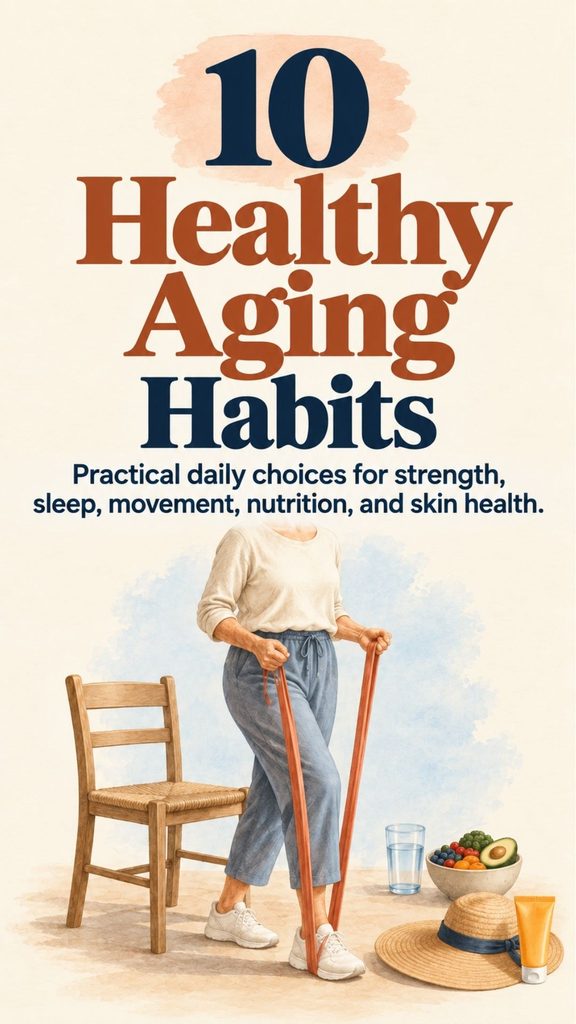
There is no routine that can stop aging, and no food, drink, bedtime, or exercise can literally keep someone young forever.
But the way you live can influence how well you age.
Sleep, regular movement, muscle strength, a nutritious diet, and protection from excessive ultraviolet exposure are all associated with better long-term health. The useful goal is not trying to freeze your appearance at a certain age. It is preserving energy, mobility, strength, cardiovascular health, skin health, and independence for as long as possible.
You Might Also Like:
- Loading posts...
Popular “stay young” lists often mix genuinely useful habits with rules that sound scientific but are too absolute. For example, you do not have to fall asleep before exactly 11:00 p.m., lemon water has no special anti-aging power, and deliberately spending 20–30 minutes in unprotected sun every day is not a universally safe recommendation.
Here are ten habits worth understanding properly.
1. Prioritize Enough Sleep, Not an Exact 11:00 p.m. Bedtime
Going to bed before 11:00 p.m. is not a universal anti-aging rule.
What matters more is getting enough good-quality sleep and maintaining a schedule that works with your life and body clock.
CDC guidance says adults ages 18–60 generally need at least seven hours of sleep per day, while sleep needs vary somewhat with age. Keeping fairly consistent sleeping and waking times can also support healthy sleep.
For one person, that might mean sleeping from 10:30 p.m. to 6:30 a.m.
For another, it may be midnight to 8:00 a.m.
The clock time alone does not determine whether the sleep is healthy.
A more useful evening routine is to give yourself enough opportunity for sleep, keep the bedroom comfortable, reduce unnecessary late-night stimulation, and seek medical advice if persistent insomnia, loud snoring, breathing pauses, or excessive daytime sleepiness are interfering with daily life.
You do not need a magical bedtime.
You need enough restorative sleep consistently.
2. Drink Water—But Lemon Is Optional
Staying hydrated is important, but adding lemon does not transform water into an anti-aging treatment.
If a slice of lemon makes water more enjoyable and encourages you to drink it, that is perfectly reasonable.
But plain water hydrates you too.
Lemon water does not detoxify the body, erase wrinkles, or reverse aging.
Your liver and kidneys already perform the body’s main waste-processing functions.
The amount of fluid each person needs varies with body size, activity, climate, diet, pregnancy, illness, medications, and other factors, so rigid internet rules such as “everyone must drink exactly eight glasses” are not appropriate for everyone.
A practical approach is to drink regularly throughout the day, increase fluids during heat and exercise, and pay attention to thirst and individual medical guidance.
People who have been told to restrict fluids because of kidney, heart, or other medical conditions should follow their clinician’s advice rather than generic hydration recommendations.
Lemon is flavor.
Water is the important part.
3. Walk Regularly—but Think Beyond 20 Minutes
Walking for 20 minutes a day is an excellent habit, especially if you are currently inactive.
But it is better understood as a starting point than as a special anti-aging dose.
Current U.S. physical activity guidance recommends that adults work toward 150–300 minutes of moderate-intensity aerobic activity per week, plus muscle-strengthening activity on at least two days each week. People who are inactive are encouraged to begin with smaller amounts and build gradually.
Brisk walking can count toward that aerobic activity.
You can accumulate movement in ways that fit your life:
walk after dinner,
take stairs when practical,
garden,
cycle,
swim,
dance,
or take several short walks during the day.
Twenty minutes is worthwhile.
Thirty minutes is not automatically better if it makes the routine impossible to maintain.
Consistency matters more than creating an elaborate exercise schedule that lasts two weeks.
4. Include Strength Training at Least Twice a Week
This is one of the strongest ideas in the original list—and it was accidentally listed twice.
Strength training becomes especially valuable as we get older because maintaining muscle and physical function helps support everyday activities.
Federal physical activity guidelines recommend muscle-strengthening activity involving the major muscle groups on at least two days per week for adults.
Strength training does not have to mean bodybuilding.
Depending on your ability and experience, it might include:
lifting weights,
resistance bands,
body-weight squats,
wall push-ups,
step-ups,
or appropriately supervised resistance machines.
Older adults, beginners, and people with medical conditions can start at a level appropriate for them and progress gradually.
The goal is not to look 25 forever.
It is to preserve the strength needed to carry groceries, climb stairs, get up from a chair, work around the house, travel, and remain independent.
5. Build Most Meals Around Minimally Processed Foods
“Never eat processed food” is unnecessarily rigid.
Processing describes an enormous range of foods.
Frozen vegetables are processed.
Plain yogurt is processed.
Canned beans are processed.
Whole-grain bread is processed.
Those foods can easily fit into a nutritious diet.
The more useful distinction is between a diet built mainly around nutrient-dense foods and one dominated by foods high in free sugars, sodium, and less-healthful fats.
WHO’s 2026 healthy-diet guidance emphasizes variety, balance, moderation, and a foundation of minimally processed or unprocessed foods such as vegetables, fruits, whole grains, legumes, nuts, seeds, and appropriate protein sources.
You do not need to panic because you ate a packaged snack.
Look at your overall pattern.
A simple plate might contain vegetables, a source of protein, a whole grain or other starchy food, and some healthy fat.
What you do repeatedly matters far more than one cookie or one convenience meal.
6. Eat Leafy Greens—but Also Eat Other Vegetables
Leafy greens deserve their healthy reputation.
Spinach, kale, collards, chard, lettuce, and similar vegetables can provide fiber and a variety of vitamins, minerals, and plant compounds.
But you do not need to build every meal around spinach.
Different fruits and vegetables provide different nutrients, which is why variety is more useful than treating one vegetable as a superfood.
WHO recommends a diet containing a wide variety of vegetables and fruits and advises people older than 10 to aim for at least 400 grams of fruits and vegetables per day.
Think in colors and variety:
dark leafy greens,
carrots,
tomatoes,
peppers,
broccoli,
berries,
citrus,
beans,
squash,
and whatever nutritious produce is affordable and available where you live.
Fresh is not the only option.
Frozen and appropriately canned vegetables can be practical choices too.
Healthy aging is supported by the whole dietary pattern, not by eating one particular leaf every day.
7. Enjoy Ginger and Turmeric, but Don’t Treat Them as Anti-Aging Medicine
Ginger and turmeric can be excellent additions to food.
They add flavor, can help make nutritious meals more interesting, and contain biologically active compounds that have attracted considerable scientific research.
What they should not be treated as is a requirement for staying young.
Sprinkling turmeric onto dinner does not cancel out smoking, chronic sleep deprivation, inactivity, or an otherwise poor diet.
Likewise, ginger does not function as a fountain-of-youth ingredient.
Use them because you enjoy them.
Add ginger to soups, stir-fries, tea, or curries.
Use turmeric in rice, lentils, vegetables, soups, or spice blends.
But keep the emphasis on the larger dietary pattern. WHO guidance supports variety across nutritious foods rather than relying on individual “superfoods” to protect health.
Food works best as food—not as a promise of immortality.
8. You Don’t Have to Stop Eating Exactly 2–3 Hours Before Bed
The claim that everybody must avoid food for two or three hours before sleep needs context.
For people with nighttime acid reflux or GERD, avoiding meals for about three hours before lying down can help reduce symptoms. NIDDK specifically recommends this strategy for people who experience GERD symptoms at night or while lying down.
That does not make it a universal anti-aging law.
If you eat dinner at 8:30 p.m., go to bed at 10:00 p.m., sleep comfortably, and have no relevant digestive problem, the clock alone does not prove that your routine is unhealthy.
What may be worth avoiding is making very large late-night meals a regular habit if they interfere with your sleep or trigger reflux.
Meal timing should fit your health, schedule, appetite, and medical needs.
Someone managing diabetes, taking certain medications, working night shifts, training athletically, or following another medically directed eating schedule may have different needs.
9. Protect Your Skin From Excessive UV Exposure
If the goal is reducing premature skin aging, this is one of the clearest habits on the list.
Ultraviolet radiation contributes to premature skin aging and also increases skin-cancer risk.
The American Academy of Dermatology recommends a combination of sun-protection strategies, including shade, protective clothing, and a broad-spectrum, water-resistant sunscreen with SPF 30 or higher on exposed skin. Sunscreen should be reapplied as directed, particularly during extended outdoor exposure, swimming, or sweating.
Sun protection does not mean you must become afraid of going outdoors.
Walk.
Garden.
Exercise.
Enjoy parks and beaches.
Just protect your skin appropriately for the conditions.
A hat, sunglasses, clothing, shade, and sunscreen can all be part of the strategy.
For visible signs of premature aging, sun protection is far more evidence-based than most expensive products advertised as “anti-aging.” The AAD specifically identifies sunscreen as a cornerstone of preventing premature skin aging.
10. Don’t Use “20–30 Minutes of Unprotected Sun” as a Universal Rule
This is where the popular graphic becomes contradictory.
It correctly says to protect your skin from the sun, but then tells everyone to get 20–30 minutes of sun every day.
There is no single amount of unprotected sun exposure that is appropriate for everyone.
Vitamin D production from sunlight varies with season, latitude, time of day, cloud cover, age, skin pigmentation, clothing, and many other factors. The NIH Office of Dietary Supplements notes that these differences make it difficult to establish a universal amount of sun exposure needed to maintain adequate vitamin D. It also emphasizes that UV radiation is carcinogenic and that limiting excessive UV exposure is prudent.
That does not mean sunlight itself is bad.
Daylight can be useful for circadian rhythms, outdoor activity, and daily life.
But you do not need to deliberately expose unprotected skin for exactly 20 or 30 minutes as an anti-aging treatment.
If vitamin D deficiency is a concern, discuss appropriate testing, food sources, or supplementation with a healthcare professional rather than trying to estimate a therapeutic UV dose yourself.
What Actually Matters Most for Healthy Aging?
Healthy aging is rarely about one unusual trick.
It is mostly about ordinary habits repeated for years.
Sleep enough.
Move frequently.
Keep your muscles strong.
Eat a varied, nutrient-dense diet.
Avoid smoking.
Manage medical conditions.
Stay socially connected.
Protect your skin from excessive UV.
Keep up with recommended preventive healthcare.
And choose habits you can actually maintain.
That last part matters.
Walking four days every week for years is more useful than an extreme exercise challenge you abandon after ten days.
Eating vegetables most days is more realistic than declaring that you will never touch processed food again.
Going to bed at a consistent time that gives you enough sleep is more meaningful than forcing yourself into bed before 11:00 simply because an infographic told you to.
You Cannot Stop Aging—and That Isn’t the Goal
Gray hair, changes in skin, and getting older are not failures that need to be defeated.
The better goal is healthspan: maintaining physical and mental function for as much of life as possible.
Some factors affecting aging are outside our control.
Genetics matter.
Disease can occur even in people with excellent habits.
Circumstances, environment, healthcare access, and simple chance matter too.
Healthy habits reduce certain risks; they do not guarantee a particular appearance or lifespan.
That is why “stay young” is better understood as shorthand for something much more realistic:
sleep well, stay active, maintain strength, eat nourishing food, protect your skin, and take care of the body you have as it changes over time.
Those habits will not stop birthdays.
They can, however, help make the years ahead healthier, stronger, and more active—and that is far more valuable than trying to stay permanently young.