Few experiences in home horticulture match the frustration of inspecting a strawberry patch at dawn, only to find the season’s first ripe, fragrant berries hollowed out by birds. Gardeners frequently cycle through a barrage of reactive measures—tangled monofilament netting, holographic flash tape, and plastic owl decoys—often with mediocre results or collateral harm to beneficial wildlife.
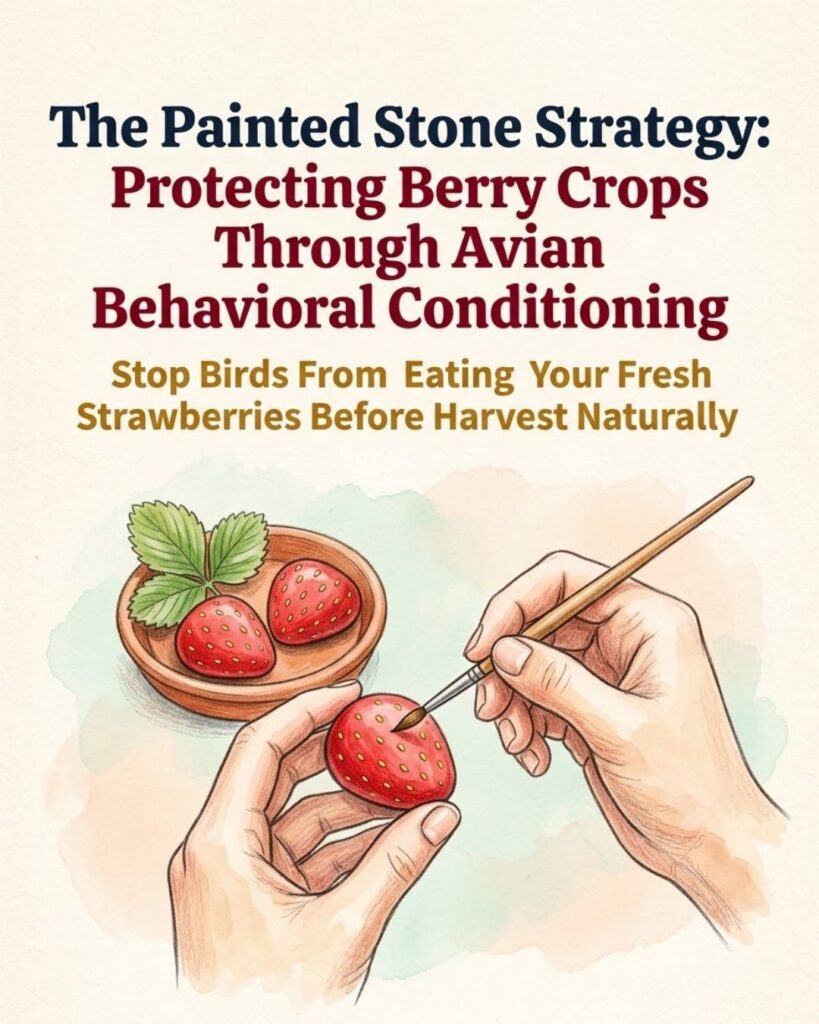
A surprisingly effective, non-lethal defense relies on a simple behavioral exploit: deploying hand-painted red stones throughout the patch weeks before the actual fruit sets.
While the technique resembles a lighthearted craft project, its success rests squarely on established principles of avian cognitive psychology, visual ecology, and associative learning. Understanding how birds interact with color, texture, and forage sites allows growers to convert early-season foraging instincts into a psychological barrier that protects the harvest naturally.
You Might Also Like:
- Loading posts...
The Ethology of the Peck: Why Avian Psychology Makes Decoys Work
To understand why a painted rock deters a bird, one must examine how frugivorous (fruit-eating) birds forage. Most backyard berry thieves—including American robins, European starlings, cedar waxwings, northern mockingbirds, and house finches—rely predominantly on acute vision rather than olfaction to locate food sources.
+-----------------------------------------------------------------------------+
|                        AVIAN SENSORY FORAGING CYCLE                         |
|                                                                             |
|  [ Visual Scouting ]  -->  High tetrachromatic sensitivity detects          |
|                            vibrant red contrast against green canopy        |
|                                         |                                   |
|                                         v                                   |
|  [ Exploratory Peck]  -->  Beak strikes hard mineral substrate;             |
|                            zero sugar yield + mechanical shock              |
|                                         |                                   |
|                                         v                                   |
|  [ Negative Reward ]  -->  Associative learning pairs "red ground shape"    |
|                            with zero nutritional return                     |
|                                         |                                   |
|                                         v                                   |
|  [ Patch Abandonment] -->  Flock redirects foraging effort to alternate     |
|                            natural food zones before true crop ripens       |
+-----------------------------------------------------------------------------+
Tetrachromatic Vision and Contrast Sensitivity
Birds possess four distinct types of retinal cone cells (tetrachromacy), granting them the ability to perceive ultraviolet light alongside an expanded spectrum of visible colors. In a garden landscape dominated by green chlorophyll tones, high-saturation reds, crimsons, and magentas stand out with high visual contrast. When a bird surveys a garden bed, any localized cluster of red immediately triggers an exploratory landing.
Negative Operant Conditioning
Young birds and early-spring arrivals explore their territory through trial-and-error pecking. When a bird spots a red object on the ground:
- It expects a soft, water-rich, sugar-dense food reward.
- It strikes the painted stone with significant force.
- The impact produces a sharp, unpleasant mechanical shock to the beak with zero caloric return.
- After several failed attempts across multiple decoys, the bird registers the stimulus (red shapes in that specific location) as unrewarding or uncomfortable.
By the time the true strawberry crop transitions from pale green to deep red, local birds have already mapped the patch as a cluster of unyielding, inedible stones.
Step-by-Step Guide to Crafting and Deploying Decoys
Executing this method requires attention to detail. Sloppily placed or poorly painted rocks will either fail to attract the initial exploratory peck or wash away under heavy spring rains.
+-----------------------------------------------------------------------------+
|                         DECOY PREPARATION WORKFLOW                          |
|                                                                             |
|  1. Substrate Selection  -->  Smooth river pebbles (1.5–2.5 inches),        |
|                               conical/oval, washed and dried                |
|                                         |                                   |
|  2. Pigment Application  -->  Exterior acrylics: deep crimson base +        |
|                               subtle yellow seed stippling                  |
|                                         |                                   |
|  3. Protective Seal     -->  Matte/satin UV-resistant non-toxic topcoat    |
|                               (cured for 48 hours to eliminate fumes)       |
|                                         |                                   |
|  4. Strategic Placement  -->  2–3 stones per plant; half-tucked beneath     |
|                               crown foliage 2–3 weeks before flowering      |
+-----------------------------------------------------------------------------+
1. Substrate Selection
- Geometry: Source naturally tumbled river stones or landscaping pebbles that range between 1.5 and 2.5 inches in diameter. Look for roughly conical, heart-shaped, or slightly flattened oval profiles that mirror the dimensions of a mature Fragaria × ananassa (garden strawberry).
- Surface Texture: Smooth stones accept paint more evenly and mimic the taut skin of ripe fruit. Avoid porous volcanic rock, rough granite, or sharp-edged gravel.
2. Pigment and Materials
- Base Coat: Use high-pigment, exterior-grade acrylic paint in primary red, crimson, or scarlet.
- Detailing: Pure solid red can work, but adding tiny yellow, white, or black flecks using a fine-tipped brush or toothpick to mimic achenes (strawberry seeds) increases visual fidelity during close inspection.
- Topcoat: Apply an exterior, non-toxic, water-based satin or matte clear sealant. High-gloss finishes can produce unnatural reflections under direct sunlight that might induce suspicion rather than curiosity.
- Environmental Safety: Verify that all paints and sealers are non-toxic once cured to prevent leaching synthetic compounds or heavy metals into garden soils.
3. Painting and Curing
- Scrub the stones in warm, soapy water to remove soil, oils, and biofilm; rinse thoroughly and allow them to dry in full sun.
- Apply two thin coats of red acrylic paint, allowing each layer to dry completely.
- Stipple fine seed patterns along the upper surface.
- Seal with a weather-resistant topcoat on all sides to prevent ground moisture from lifting the paint.
- Allow the stones to cure indoors for at least 48 hours to ensure chemical fumes dissipate before garden placement.
4. Field Deployment Strategy
- Timing: Place the decoys in the berry beds two to three weeks before flower petals drop and fruit starts to set. Deploying decoys after berries begin turning pink renders the method ineffective, as birds will have already received positive caloric rewards from the real fruit.
- Distribution Density: Place two to three painted stones per mature strawberry crown.
- Orientation: Nestle the stones directly onto the soil surface, straw mulch, or landscape fabric, partially tucked under leaves where ripe strawberries naturally rest. Scattering a few openly in path margins also helps capture the attention of birds flying overhead.
Common Implementation Mistakes
Even a sound biological concept fails when applied incorrectly. Gardeners who report poor results usually encounter one of the following issues:
| Common Failure Point | Underlying Mechanism | Practical Correction |
| Late Deployment | Birds establish a positive reward pathway before encountering decoys. | Deploy decoys at early spring emergence when plants are just waking up. |
| Uniform Placement | Perfectly symmetrical or exposed layouts look unnatural to foraging birds. | Tuck stones semi-organically beneath foliage and along the mulch line. |
| Color Degradation | Sun bleaching and soil splash turn vibrant red into dull brown/pink. | Clean stones mid-season or reapply a fresh coat of sealer annually. |
| Decoy Overexposure | Leaving decoys in place year-round causes birds to ignore them altogether. | Collect and store stones indoors as soon as the harvest window closes. |
Pest Profiles: What the Strategy Deters (and What It Doesn’t)
The painted stone trick is tailored specifically to diurnal, visually oriented avian species. Expecting it to resolve every garden pest creates false expectations.
                           PEST SUSCEPTIBILITY SPECTRUM

  High Deterrence                         Moderate Deterrence                   Zero Deterrence
  [Visual Avian Foragers]                 [Opportunistic Omnivores]             [Mammalian & Nocturnal]

  • American Robins                       • Common Grackles                     • Chipmunks & Squirrels
  • European Starlings                    • Blue Jays                           • Field Mice & Voles
  • House Finches                         • Crows                               • Slugs & Snails
  • Cedar Waxwings                                                              • Spotted Wing Drosophila
Highly Susceptible Species
- Songbirds and Thrush Family (Robins, Bluebirds, Finches): Rely almost exclusively on visual hunting for berries and surface insects. They strike stones, experience the hard contact, and move on quickly.
Moderate or Mixed Susceptibility
- Corvids (Crows, Ravens, Jays): Exceptionally intelligent birds capable of problem-solving. While initial strikes discourage them, they may pick up the stone, realize it is inorganic weight, and discard it. If they see you placing actual fruit or observe human harvesting, they may re-test the area.
Ineffective Against Mammalian and Invertebrate Pests
- Rodents (Chipmunks, Squirrels, Voles): Mammals navigate primarily by scent and tactile whisker feedback. A painted stone smells like dry acrylic and mineral stone, not sugar and plant esters. They will bypass the stone and locate true berries with ease.
- Slugs, Snails, and Beetles: Invertebrates follow chemical gradients and moisture signatures. Visual decoys present zero barrier to them.
Integrated Crop Protection: Building a Complete Defense
For gardeners managing heavy pest pressure, relying on a single method leaves vulnerabilities open. Combining painted stones with other non-destructive techniques creates an integrated pest management (IPM) system that secures the harvest without harming local ecosystems.
+-----------------------------------------------------------------------------+
|                  LAYERED BERRY PROTECTION FRAMEWORK (IPM)                   |
|                                                                             |
|  [ Layer 1: Psychological ] -->  Painted Stones & Early Decoys              |
|                                  (Conditions resident birds out of patch)   |
|                                                                             |
|  [ Layer 2: Resource-Based] -->  Hydration Basins & Divergent Water         |
|                                  (Resolves moisture-seeking peck behavior)  |
|                                                                             |
|  [ Layer 3: Ecological ]    -->  Trap Cropping (Mulberry / Serviceberry)    |
|                                  (Provides preferred alternate food canopy) |
|                                                                             |
|  [ Layer 4: Physical ]      -->  Rigid Hoop Framing with 1/2-Inch Mesh      |
|                                  (Excludes mammals while protecting birds)  |
+-----------------------------------------------------------------------------+
1. Dedicated Water Stations
In many regions, birds peck into plump fruit not for calories, but for moisture during early summer dry spells. Placing a shallow birdbath or freshwater basin 25–40 feet away from the berry patch provides a low-effort hydration source, dramatically lowering pressure on the crop.
2. Trap Cropping and Native Buffers
Birds consistently prefer high-canopy wild fruit over ground-level strawberries when given a choice. Planting native sacrificial shrubs along property borders draws flocks away from domestic gardens:
- Serviceberry / Juneberry (Amelanchier spp.): Matures precisely alongside June-bearing strawberries and offers sweeter, smaller fruit that birds prefer.
- Native Mulberries (Morus rubra): Produces heavy yields of dark, sweet berries that keep fruit-eating species occupied in the canopy.
3. Safe Physical Exclusion
If local bird populations are unusually dense or migratory flocks arrive mid-season without prior conditioning to the stones, physical barriers provide a reliable backup:
- Avoid Loose Monofilament Netting: Standard loose black netting is a common hazard in backyard gardens, regularly tangling, injuring, or killing birds, snakes, and beneficial pollinators.
- Use Rigid Frame Tunnels: Construct low hoops from PVC conduit or electrical EMT tubing, stretched taut with 1/2-inch square hardware cloth or durable, heavy-gauge knitted garden mesh. Keep the netting elevated at least 6 inches above the plants so birds cannot peck through the gaps.
Seasonal Care and Storage
Maintaining the effectiveness of painted stones requires a small amount of seasonal upkeep:
- Harvest-End Removal: As soon as the strawberry patch completes its fruiting flush, collect every painted rock. Leaving them in the garden over late summer and winter allows birds to realize the objects never rot, move, or soften, causing them to habituate and ignore them during the following spring.
- Inspection and Cleaning: Wash the stones with clean water to remove fungal spores and algae. Check for paint flaking or color loss.
- Touch-Ups and Recoating: Reapply a vibrant red topcoat to any faded stones every two seasons.
- Dry Storage: Store the stones in a cloth bag or bucket in a garage, shed, or basement until the following year’s pre-bloom window.
Cultivating with Ecological Awareness
Protecting a home harvest does not require treating local wildlife as an adversary to be eliminated. Methods that work alongside natural animal behavior—such as leveraging associative conditioning with painted stones—offer an elegant, pesticide-free approach to garden management. By establishing clear territorial boundaries through clever decoy placement, supplemental hydration, and thoughtful habitat design, growers can enjoy a full harvest while supporting a balanced garden ecosystem.