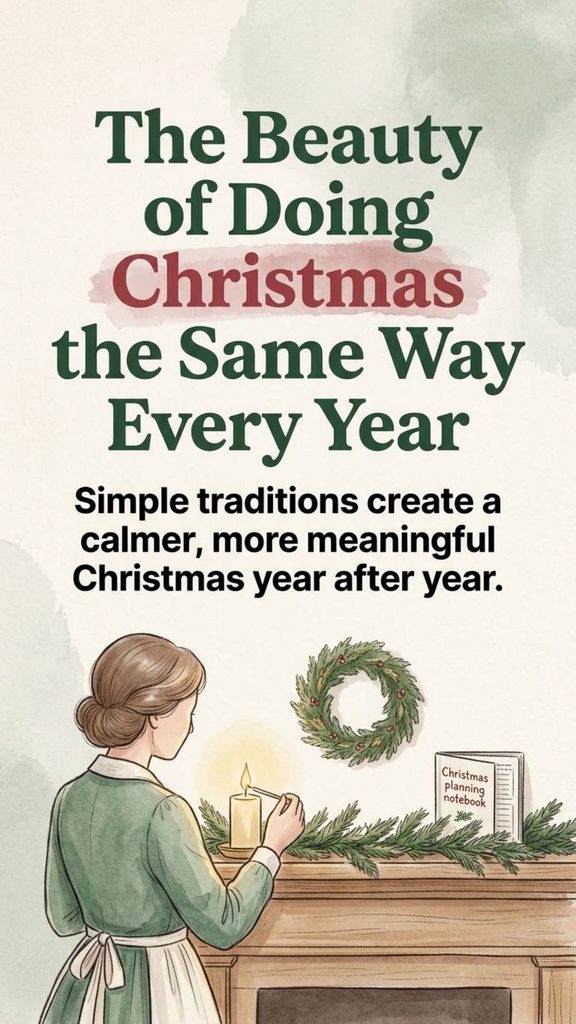
Christmas does not have to become a brand-new project every December.
There is a particular kind of comfort in unpacking the same ornaments, preparing the familiar meal, watching the movie everyone already knows by heart, or setting out the same stockings in the same place. None of these things are impressive because they are new. They matter because they return.
Yet modern holiday culture often pushes in the opposite direction. Every season seems to arrive with new decorating trends, new recipes, new outings, new crafts, and new ideas for making Christmas feel “special.” A homemaker can easily end up spending November and December trying to create a holiday that looks memorable while becoming too exhausted to enjoy it.
You Might Also Like:
- Loading posts...
Repeating Christmas traditions offers another way. Instead of asking, “What should we do this year?” you decide what belongs to your family’s Christmas and let familiarity do some of the work.
The result can be a holiday that feels calmer, more meaningful, and easier to manage.
Tradition Does Not Need to Be Invented
Many families already have Christmas traditions without realizing it.
Perhaps you make the same breakfast on Christmas morning. Maybe one evening is always reserved for driving through the neighborhood to see decorated houses. Perhaps someone makes the same dessert every year, the tree always goes up during the same week, or everyone gathers in the living room for the same Christmas film.
That is already tradition.
A tradition is not valuable because someone carefully designed it. It becomes valuable because people repeat it and attach memories to it.
This is especially helpful for homemakers who feel pressure to create meaningful family rituals from scratch. You may not need to create much at all. Start by noticing what your family already enjoys and what you naturally repeat.
Ask yourself:
- Which meals do we look forward to every Christmas?
- What decorations immediately make the house feel festive?
- Are there particular songs, stories, movies, services, outings, or gatherings we repeat?
- Which moments would the family actually miss if we stopped doing them?
- Which traditions feel peaceful rather than burdensome?
The answers give you the beginnings of a Christmas plan without requiring an elaborate new system.
Familiarity Is Part of What Makes Christmas Special
There is a reason repeated traditions can feel so comforting.
Most of the year changes constantly. Schedules shift. Children grow. People move. Jobs change. New responsibilities appear. Even the home itself changes over time.
Christmas traditions create small points of continuity.
The same recipe, the same box of decorations, or the same Christmas Eve routine can connect one year to another. Children may remember where a particular ornament always hung. Adults may remember eating the same dish at their grandparents’ table. A familiar song can bring back memories before anyone says a word.
This is why Christmas does not always need novelty.
A meal can become more meaningful after being served for fifteen Christmases than it was the first time. A handmade ornament often becomes more precious as it ages. A simple tradition may seem ordinary while it is happening, yet become one of the things family members remember most clearly years later.
Repetition gives ordinary actions history.
Stop Trying to Outdo Last Christmas
One of the easiest ways to make December exhausting is to treat every Christmas as an event that must surpass the previous one.
More lights.
More decorations.
More outings.
More handmade gifts.
More complicated food.
More activities for the children.
More perfectly planned moments.
There is nothing inherently wrong with adding something new. The trouble begins when novelty becomes an expectation.
A home does not become more festive simply because more activities are packed into the calendar. In fact, too much planning can make Christmas feel fragmented. Everyone rushes from one event to another while the quiet parts of the season disappear.
A useful rule is this: Christmas does not have to grow every year.
Some years may naturally include more. Others may need to be quieter because of work, illness, travel, a new baby, financial pressure, or simply limited energy.
Your traditions should be sturdy enough to survive ordinary life.
Create a Christmas Plan Once, Then Reuse It
One of the most practical ways to reduce holiday stress is to separate planning from doing.
Instead of reinventing Christmas every November, create a basic seasonal plan and reuse it.
This can be kept in a notebook, binder, digital document, or even a few pages tucked into the box with your decorations. It does not need to be decorative or complicated. It only needs to answer the questions that otherwise return every year.
You might record:
- When you normally decorate
- Which decorations go in each room
- Holiday meals and favorite recipes
- Gifts you commonly buy or make
- Christmas card information
- Annual events you want to attend
- Movies, books, or music your family enjoys
- Baking plans
- Hosting responsibilities
- Christmas Eve plans
- Christmas Day plans
- Supplies that need replacing
- Things you want to skip next year
Then, after Christmas, add a few notes while everything is still fresh.
Perhaps you made far too many cookies.
Maybe one outing was not worth the effort.
Perhaps everyone loved a simple dinner you almost did not make.
Maybe wrapping gifts two days earlier made Christmas Eve much calmer.
These details are easy to forget by the following year. A few notes can save hours of decision-making.
When December returns, you are not staring at an empty calendar wondering how to create Christmas. You already know what works.
Good Traditions Should Fit Real Life
A tradition that consistently makes everyone miserable deserves to be reconsidered.
Sometimes families continue activities simply because they have always done them. But not every repeated activity is worth preserving.
A useful tradition should usually be one of three things:
Meaningful. It reflects something your family genuinely values.
Enjoyable. People actually look forward to it.
Manageable. It fits your available time, money, and energy.
The best traditions often meet all three.
This does not mean every Christmas task has to be effortless. Cooking a special meal may require work. Hosting relatives may take preparation. Decorating the house may take an afternoon.
The question is whether the effort feels worthwhile.
If an elaborate tradition leaves you resentful every year, simplify it. If nobody enjoys the annual outing anymore, replace it. If preparing six desserts keeps you in the kitchen all day, choose two.
Tradition should support family life, not dominate it.
Choose a Few Anchors for the Season
You do not need twenty traditions to create a recognizable family Christmas.
A handful of dependable rituals can shape the entire season.
For example, your family’s Christmas rhythm might include:
- Decorating the house during the first or second weekend of December.
- Putting the same wreath on the front door.
- Baking one favorite cookie recipe.
- Watching one familiar Christmas movie.
- Attending a yearly community, church, or family event.
- Preparing the same Christmas Eve meal.
- Serving a traditional Christmas Day dinner.
Everything else can remain optional.
This is a useful way to protect yourself from the feeling that every festive opportunity must become an annual obligation.
If you attend a Christmas market one year and enjoy it, wonderful. You do not have to turn it into a permanent tradition.
If someone finds an interesting new recipe, try it. It does not have to replace the food everyone loves.
A strong holiday rhythm leaves room for spontaneity without depending on it.
Repeating Meals Can Make Christmas Easier
Holiday food is one of the simplest areas to standardize.
There can be enormous pressure to find impressive Christmas recipes each year. Yet a familiar menu often works better.
Once you have a meal your family enjoys, much of the planning disappears. You already know the ingredients. You know which dishes can be prepared ahead. You know which serving bowls you need. You know whether the oven will be crowded.
A repeated menu might include a main dish, two or three sides, bread, and one favorite dessert. It does not need to be restaurant-level cooking.
The familiarity itself becomes part of the celebration.
The same applies to breakfast, Christmas Eve snacks, cookie recipes, or drinks.
There is also nothing wrong with adjusting a tradition when circumstances change. A meal can evolve over time while keeping its basic identity.
Decorate From a Familiar Collection
Decorating can become expensive and tiring when every year comes with a new theme.
Instead, consider building a Christmas collection slowly.
Use the wreath you already own.
Bring out the same ornaments.
Hang the garland in the familiar place.
Reuse ribbons and baskets.
Display family-made decorations even if they do not perfectly match.
Replace worn items when necessary, but do not assume the whole house needs updating simply because a different color palette is popular this year.
A Christmas home becomes more personal when its decorations carry history.
An ornament from a child’s first Christmas, a wreath used for many years, inherited decorations, old candleholders, or a handmade garland can make a home feel more festive than a perfectly coordinated room bought in one shopping trip.
Make Room for Traditions to Change Hands
One of the loveliest parts of repeating Christmas traditions is that family members eventually begin to take ownership of them.
A child who once helped make paper decorations may eventually lead the activity for younger siblings. Someone who watched a parent bake a particular dessert may become the person who prepares it. The person who always puts up outdoor lights may eventually teach someone else how it is done.
Traditions do not have to stay frozen in exactly the same form.
They can mature with the family.
Allowing traditions to pass from one person to another also keeps the entire Christmas season from resting on one homemaker’s shoulders.
The goal is not to become the sole keeper of Christmas. It is to create rhythms that the household recognizes and can participate in.
Learn to Say No to Perfectly Good Christmas Ideas
This may be one of the most useful holiday skills.
There are many wonderful Christmas activities you may never do.
You may never make homemade Christmas cards.
You may not visit every light display.
You may skip the craft fair.
You may not bake twelve varieties of cookies.
You may have no interest in elaborate outdoor decorations.
You may never host a Christmas party.
None of those choices makes your Christmas less meaningful.
The fact that an activity is charming does not mean it belongs in your family’s December.
Trying to include every good idea usually leaves no room to enjoy the traditions that matter most.
A calm Christmas requires editing.
Let the Season Feel Familiar
Christmas traditions work because anticipation is part of the pleasure.
People know what is coming.
They know when the tree usually appears.
They know what food will be served.
They know which ornament they want to hang.
They know the movie someone will suggest.
They know the familiar routine of Christmas Eve.
This predictability is not boring. It can be deeply reassuring.
Children especially often enjoy repetition far more than adults expect. The details that may seem ordinary to a homemaker can become the things that define Christmas in a child’s memory.
Years later, someone may not remember the expensive gift or the complicated centerpiece. They may remember the smell of the same cake baking, the candles in the windows, the music playing while the tree went up, or the way everyone gathered in the kitchen on Christmas Eve.
Add New Traditions Slowly
There is still room for new ideas.
The easiest way to protect the calm of the season is to add them slowly.
If you discover something that genuinely fits your family, try it once. If everyone enjoys it and it is manageable, repeat it next year. After several years, it may naturally become part of your Christmas.
There is no need to declare every new activity a tradition immediately.
This gradual approach keeps your holiday from becoming overloaded.
It also allows traditions to develop naturally instead of forcing them.
A Simple Annual Christmas Reset
At the end of the season, take ten minutes to record what worked.
You can keep the review very simple:
Keep: Which traditions should definitely return?
Change: What needs to be easier next year?
Drop: What was not worth the effort?
Add: Is there one thing you would genuinely enjoy trying?
Then put those notes away with your Christmas plan.
That small habit can transform the following December.
Instead of starting over, you continue.
The Real Beauty Is in Repetition
A meaningful Christmas does not require constant creativity.
It is perfectly fine if your December looks suspiciously similar to last December.
Use the same wreath.
Cook the same dinner.
Read the same story.
Play the same music.
Go to the same gathering.
Put the stockings in the same place.
Bake the recipe everyone expects.
Do it again next year.
The beauty of tradition is rarely found in something extraordinary happening once. It is found in ordinary things returning so faithfully that they become part of the family’s story.
Christmas becomes easier when you stop trying to invent it every year.
Choose what matters. Let unnecessary things go. Keep a simple plan. Repeat the parts your family loves.
Then allow familiarity to do what it does best: turn small seasonal habits into memories.