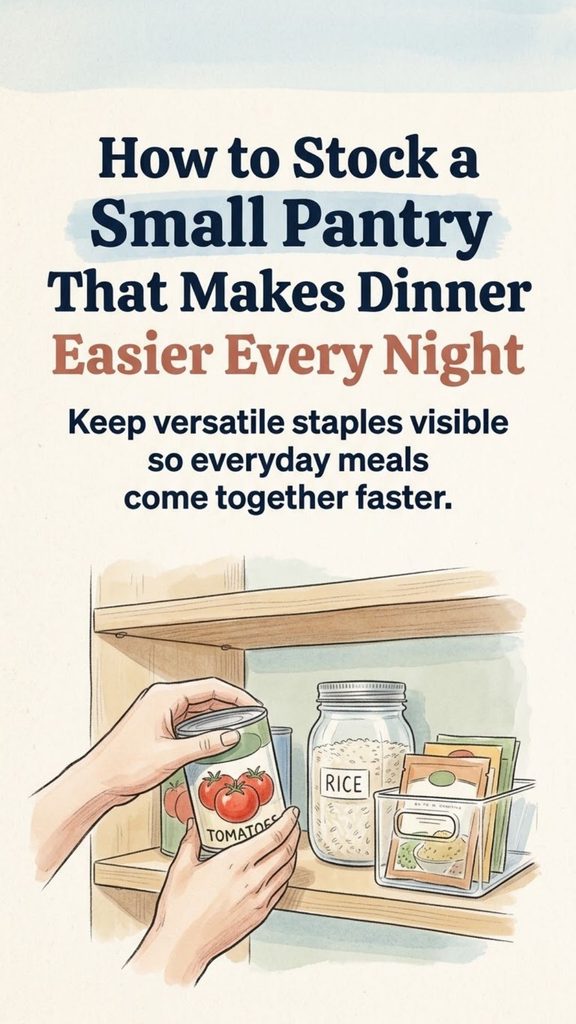
A useful pantry is not measured by how many shelves it has or how much food is packed into it. What matters is whether the ingredients inside actually help you make meals.
A pantry can be completely full and still leave you wondering what to cook. Cans are stacked behind one another, half-used ingredients are forgotten in corners, and foods bought for a single recipe take up valuable space. Meanwhile, the ingredients you use every week somehow seem to be the ones you are always running out of.
A smaller, more intentional pantry works differently. Instead of trying to prepare for every possible meal, you keep a reliable collection of foods that support the meals your household actually eats.
You Might Also Like:
- Loading posts...
That can make dinner planning easier, grocery shopping more predictable, and food storage far less overwhelming.
The goal is not minimalism for its own sake. It is to create a pantry that works.
A Small Pantry Is About Quantity, Not Square Footage
You do not need a tiny kitchen to use a small-pantry approach.
Someone with a large walk-in pantry may still choose to keep a relatively small selection of dependable ingredients. Likewise, someone living with one narrow cupboard can create a very capable pantry if the foods inside are chosen carefully.
Think of a small pantry as a focused pantry.
Instead of storing dozens of unrelated ingredients, you keep foods that:
- appear regularly in your meals
- work in more than one recipe
- are easy to see and reach
- get replaced often enough that they do not sit forgotten
- help you put together a meal when plans change
This approach is especially useful when storage is limited, but it can simplify almost any kitchen.
Why an Overfilled Pantry Can Make Dinner Harder
More food seems as though it should create more options. Sometimes it does. But more ingredients can also create more decisions.
A pantry packed with unrelated foods often includes things like specialty ingredients bought for one recipe, duplicate cans that were forgotten behind other items, products purchased because they were discounted, and foods that looked appealing at the store but never became part of an actual meal.
Eventually, the pantry contains plenty of food without containing many obvious dinners.
That is the difference between having food stored and having a pantry designed for cooking.
If you repeatedly stand in front of full shelves thinking, “There’s nothing to make,” you may not need more groceries. You may need a clearer connection between the foods you store and the meals you prepare.
Start With the Meals You Already Cook
Before buying pantry staples, make a list of the dinners your household actually eats.
This is one of the most effective ways to build a useful pantry because it reverses the usual process.
Instead of buying ingredients first and trying to invent meals around them later, you begin with familiar meals and stock the ingredients those meals require.
Write down perhaps 15 to 25 dinners that appear regularly in your home. They do not need to be impressive.
Your list might include meals such as:
- spaghetti with tomato sauce
- bean or beef tacos
- chicken and rice
- vegetable soup
- chili
- curry
- quesadillas
- pasta with vegetables
- rice bowls
- baked potatoes with toppings
- lentil soup
- tuna pasta
- stir-fry
Now look for ingredients that appear repeatedly.
Perhaps rice is used in four meals. Canned tomatoes may appear in pasta sauce, soup, chili, and curry. Tortillas might become tacos, quesadillas, wraps, or quick lunches.
Those repeating foods are the ingredients that deserve the most space in your pantry.
Your regular meals should determine your pantry, not the other way around.
Clear Out Foods That No Longer Support Your Meals
Before restocking, it helps to simplify what is already there.
You do not need to empty every cupboard and redesign the entire kitchen in one afternoon. Simply start looking at the food you have with a more practical question:
Will we realistically use this?
Remove expired foods and inspect anything that has been stored for a long time. Set aside unopened foods your household does not enjoy if they can be donated according to local food-donation guidelines.
Then look at the ingredients that remain.
You may notice several categories of pantry clutter:
One-recipe ingredients
These are products purchased for a recipe you made once and never repeated.
They are not automatically a problem, but if they have been sitting untouched for months, decide whether you realistically plan to use them.
Duplicates you did not know you owned
Poor visibility often leads to buying the same ingredient again because the first package disappeared behind something else.
Aspirational foods
These are ingredients connected to the person you imagine yourself becoming rather than the way you actually cook.
Perhaps you bought several unusual grains, sauces, or baking ingredients after seeing recipes online. If they never make it into your meals, they are taking space away from foods that would be more useful.
A practical pantry should reflect reality.
Build Your Pantry Around a Few Core Categories
There is no universal pantry list that works for every household. A family that cooks Mexican-inspired meals will stock differently from someone who regularly makes Mediterranean, Polish, Indian, vegetarian, or low-carbohydrate dishes.
Still, a few broad categories can help you organize your thinking.
Everyday Meal Bases
These are the ingredients that form the foundation of meals.
Depending on how you cook, yours might include:
- rice
- pasta
- couscous
- noodles
- oats
- tortillas
- potatoes stored appropriately outside or inside the pantry, depending on your kitchen setup
- other grains or starches you genuinely use
You do not need every possible option. Choose the ones that appear frequently in your normal meals.
Flavor Builders
These are the ingredients that turn basic foods into something that tastes like dinner.
Examples might include:
- canned tomatoes
- tomato paste
- broth or bouillon
- soy sauce
- vinegar
- cooking oils
- frequently used sauces
- herbs
- spices
- seasoning blends
This is an area where pantry clutter grows easily.
You probably do not need fifteen sauces if you regularly use only four of them. Keeping fewer options that you know how to use can actually make cooking easier.
Shelf-Stable Protein Options
Backup proteins are valuable because they can help you make a meal even when you have not thawed meat or gone shopping.
Depending on your household, useful choices might include:
- beans
- lentils
- chickpeas
- canned tuna or other canned fish
- nut or seed butters
- shelf-stable protein foods that fit your diet
These become especially useful when paired with flexible meal bases such as rice, pasta, bread, or tortillas.
Baking and Breakfast Basics
If you bake regularly, keep the ingredients you truly use.
That might include flour, sugar, baking powder, yeast, cocoa, oats, or other staples.
The same principle applies to breakfast foods. Do not stock a large category just because it is traditionally considered a pantry essential. Stock it because your household uses it.
Use the Ingredient Overlap Rule
One of the best ways to get more meals from fewer pantry items is to choose ingredients that work in several dishes.
Imagine two different pantries.
The first contains 40 highly specific ingredients that each belong to one recipe.
The second contains 25 flexible ingredients that can be combined in many different ways.
The second pantry may offer more practical dinner options even though it contains fewer products.
Rice, for example, can become part of a stir-fry, soup, rice bowl, curry, casserole, or side dish.
Beans may work in tacos, soups, salads, chili, or grain bowls.
Canned tomatoes can become pasta sauce, soup, chili, stew, or the base of a skillet meal.
Tortillas can become tacos, quesadillas, wraps, or quick baked meals.
The more meals an ingredient supports, the more valuable its pantry space becomes.
Decide How Much You Actually Need
Once you know what belongs in your pantry, the next question is quantity.
There is no perfect number because shopping habits, household size, budget, storage space, and meal frequency are different for everyone.
A simple starting point is to keep:
one item in use and one backup.
If you regularly use canned tomatoes, for example, keep enough for the next few meals plus one or two extras.
Then observe how quickly you go through them.
If your household uses three cans every week, two cans clearly will not be enough. If you use one can every two months, storing twelve cans probably makes little sense unless there is a specific reason.
Your pantry should develop its own rhythm.
Pay attention to how often you shop and how quickly foods disappear. Over several weeks, you will begin to know what “well stocked” means for your household.
Stock Up Carefully When Something Is on Sale
Buying extra food at a good price can save money, but only when the food will actually be eaten.
A discount does not create savings if the food sits unused until it is thrown away.
Before buying a large quantity, consider:
- how often you use the item
- how much storage space it will take
- whether you already have enough
- whether your household genuinely likes it
- whether you are likely to use it within an appropriate storage period
It often makes more sense to stock up heavily on a few dependable foods than to buy large quantities of random products simply because they are discounted.
Limited pantry space makes this even more important. Filling half a cupboard with one bargain item may prevent you from keeping other foods you use more frequently.
Let Grocery Shopping Become Maintenance
Once your pantry is built around your normal meals, grocery shopping becomes easier because you are no longer creating the system from scratch every week.
Most shopping trips become a matter of replacing what was used.
Before making your list, glance through the pantry.
Ask:
- What is almost gone?
- What will I need for this week’s meals?
- Which backup items did I open?
- Is there anything I keep buying but rarely use?
Over time, you may notice that many of the same foods appear on your grocery list repeatedly.
That is useful information.
Those are probably your true pantry staples.
Instead of searching for a universal list of 100 things every pantry “should” contain, build your own list from what you consistently buy and cook.
Organize for Visibility, Not Appearance
A pantry does not need matching containers and carefully printed labels to be functional.
The most useful pantry organization system is one that lets you quickly answer two questions:
What do I have?
What am I running low on?
Group similar foods together so that you can scan the shelf quickly.
For example:
- pasta and grains together
- canned vegetables together
- beans and legumes together
- baking supplies together
- sauces and condiments together
- snacks together
Keep frequently used items where they are easiest to reach.
When you buy replacements, place newer products behind older ones when practical. This encourages you to use the older package first.
Deep shelves can be tricky because food disappears into the back. Small clear bins or simple shelf organizers can help with packets, spices, baking supplies, and other small items.
The purpose is not to make the pantry look like a photograph.
The purpose is to prevent food from becoming invisible.
Use Awkward Spaces Carefully
Small kitchens often have more storage potential than they first appear to have.
The back of a pantry or kitchen door may accommodate shallow shelving if the door and surrounding space allow it. Narrow shelves can work well for lightweight items such as spices, small cans, packets, or condiments.
Shelf risers can help you see cans stored behind one another.
Turntables may be useful for bottles or condiments in certain cupboards.
But avoid adding organizers simply because they promise more storage.
Sometimes the better solution is not finding another place to put something. It is deciding you do not need to store it at all.
Keep a Few Backup Dinner Combinations
One of the best reasons to maintain a well-planned pantry is having dinner options when the day does not go as expected.
Choose a few meals that rely heavily on foods you normally keep available.
Examples might include:
- pasta with tomato sauce and beans
- rice with beans and vegetables
- lentil soup
- quesadillas with canned beans
- tuna pasta
- chickpea curry with rice
- soup made from broth, canned tomatoes, beans, and frozen vegetables
Your personal emergency meals should be foods your household actually enjoys.
Keep the required ingredients in rotation rather than storing them indefinitely for some distant emergency.
That way, a difficult evening does not automatically turn into an expensive last-minute food order.
Connect the Pantry With the Freezer and Refrigerator
Dinner becomes even easier when the pantry is not treated as an isolated storage area.
Think of your pantry, refrigerator, and freezer as one meal system.
Rice in the pantry might pair with frozen vegetables and chicken from the freezer.
Pasta might pair with canned tomatoes and cheese from the refrigerator.
Beans from the pantry can combine with frozen corn, tortillas, and refrigerated toppings.
This is where ingredient overlap becomes especially powerful.
You are no longer asking, “What pantry meal can I make?”
You are asking, “What meals can I make from the ingredients already in my kitchen?”
That is a much more useful question.
Adjust the Pantry as Your Life Changes
A pantry that worked two years ago may no longer suit your household.
Children grow. Work schedules change. Food preferences change. Someone may begin eating differently. You may start cooking more soups in winter and lighter meals during summer.
Your pantry should change too.
Every few months, notice which ingredients are moving and which ones remain untouched.
If you repeatedly stop using something, buy less of it.
If you constantly run out of another ingredient, increase your usual quantity.
This gradual adjustment is more effective than trying to design the perfect pantry once and expecting it to stay that way forever.
A Small Pantry Should Make Dinner Feel Easier
The purpose of a pantry is not to hold the maximum amount of food possible.
It is to support the way you actually cook.
A well-planned small pantry helps because the ingredients make sense together. You can see what you own. Your regular meals are supported. Grocery shopping becomes more predictable. Backup dinners are easier to assemble, and fewer forgotten foods disappear into the back of the cupboard.
Start with your real meals.
Identify the ingredients you use again and again. Keep reasonable backups of the foods that matter most, organize them so they stay visible, and be cautious about allowing one-time purchases to slowly take over your shelves.
You do not need a huge pantry to feel prepared.
You need the right foods, in the right quantities, for the way your household actually eats.