Paper clutter rarely becomes a problem because of one bill or one envelope. It builds because every piece of mail creates a small decision: pay it, file it, scan it, respond to it, or throw it away. When those decisions are postponed, the kitchen counter, desk, or entryway can quickly turn into a holding area for paperwork.
A good bill-and-mail system does not need dozens of folders or expensive organizers. It needs a clear place for incoming papers, a simple way to identify what requires action, and a routine for removing documents you no longer need.
The goal is not to keep every piece of paper perfectly organized. It is to make sure important bills get paid, deadlines are not missed, documents can be found when needed, and unnecessary paper does not take over your home.
You Might Also Like:
- Loading posts...
1. Gather the Paperwork Before You Organize It
If bills and mail are scattered throughout your home, begin by bringing them together.
Check the places where paper tends to collect:
- Kitchen counters
- Entryway tables
- Desk drawers
- Handbags and backpacks
- Filing cabinets
- Bedroom dressers
- Car consoles
- Storage boxes
Bring loose bills, statements, receipts, letters, insurance documents, school papers, tax documents, warranties, and other household paperwork to one work area.
You do not necessarily need to empty an entire filing cabinet if it is already organized. Focus first on loose and unprocessed papers.
If the amount feels overwhelming, work in smaller batches rather than trying to finish everything at once. One drawer, one pile, or 20 minutes of sorting is still progress.
2. Sort Everything Into Broad Categories First
Trying to create a detailed filing system before you know what you have usually makes the job harder.
Start with a few broad piles.
A practical first sort might include:
Action required: Bills to pay, forms to complete, letters requiring responses, appointment notices, renewals, and anything connected to a deadline.
File or keep: Documents that need to be retained but do not require immediate action.
Shred: Papers you no longer need that contain sensitive personal or financial information.
Recycle or discard: Advertising, envelopes, duplicate notices, outdated flyers, catalogs, and other non-sensitive papers you do not need.
Uncertain: Documents you are not ready to throw away because you need to determine whether they have financial, legal, tax, insurance, or other importance.
Keeping the first round simple helps you move quickly without stopping to create a folder for every document you touch.
3. Create Useful Categories for the Papers You Keep
Once unnecessary paper has been removed, divide the documents you are keeping into categories that reflect your household.
Possible categories include:
- Banking and credit
- Utilities
- Housing and mortgage or rental records
- Insurance
- Vehicle records
- Medical paperwork
- Employment and income records
- Taxes
- Education
- Warranties and major purchases
- Receipts
- Subscriptions and memberships
- Legal and identification documents
Avoid creating more categories than you actually need. A complicated filing system can become difficult to maintain.
For example, you may not need separate folders for electricity, water, internet, and phone bills if most statements are already available online. One folder labeled Utilities may be enough.
On the other hand, tax records, property documents, insurance policies, and major purchase records may deserve separate folders because you are more likely to need them later.
4. Decide What Really Needs to Be Kept
One of the biggest causes of paperwork clutter is keeping documents simply because you are unsure whether they can be discarded.
Ask a few questions about each paper:
- Will I need this to prove a payment or purchase?
- Is it connected to taxes?
- Could I need it for an insurance claim?
- Is it part of a contract or legal agreement?
- Does it establish ownership of property?
- Is it needed for a warranty?
- Is the same record available reliably online?
- Would replacing this document be difficult?
Some records deserve long-term or permanent storage. Examples may include birth certificates, marriage records, property deeds, certain legal documents, passports, and other important identity or ownership records.
These should generally be treated differently from ordinary household bills. Consider keeping irreplaceable documents in a secure location, such as an appropriate home safe or another protected storage arrangement.
Tax paperwork requires more judgment. There is no single rule stating that every tax-related document must always be kept for seven years. For U.S. federal income taxes, the IRS says the appropriate retention period depends on the circumstances. The general period is often three years, while certain situations require records to be retained for six or seven years, and some records may need to be kept longer. Property records can also be necessary until after the property is disposed of and the relevant tax period has passed.
If a document could have tax, legal, insurance, or contractual significance and you are uncertain about the retention requirement, check the rules that apply to your situation before destroying it.
5. Build a Separate System for Bills That Need Action
Current bills should not disappear into your long-term filing system before they are handled.
Create one clearly marked location for anything requiring action. This might be:
- A desktop tray
- A wall-mounted organizer
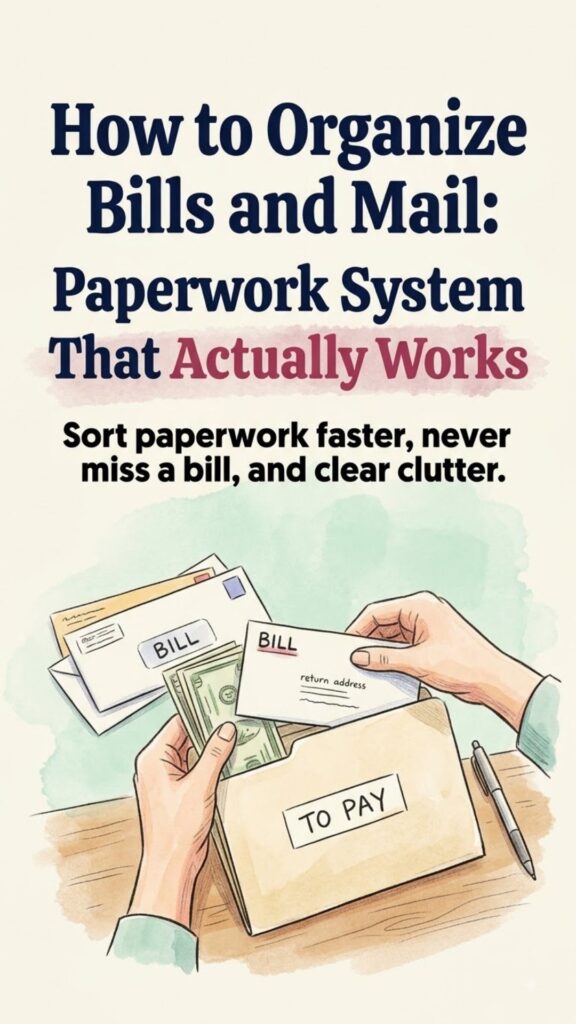
- A folder labeled To Pay
- A small accordion file
- A designated section of a home office
Then arrange bills according to due date.
You might divide them into:
Due soon
Due later this month
Already paid
Another simple approach is to keep all unpaid bills together and enter every due date into a calendar or budgeting system.
The physical paper should not be your only reminder that a payment is due. A calendar notification, budgeting app, recurring reminder, or other tracking method provides an additional safeguard.
6. Create a Monthly Bill Overview
Even when most of your bills are digital, maintaining one overview can make household finances much easier to manage.
Create a basic list containing:
- Bill or company name
- Approximate amount if predictable
- Due date
- Payment method
- Whether automatic payment is enabled
- Date paid, if you track payments manually
Include recurring expenses such as housing, electricity, water, internet, phone service, insurance, loan payments, credit cards, and subscriptions.
This gives you a single place to see what is coming instead of relying on individual envelopes and emails.
A bill calendar can also reveal expenses that are easy to forget because they are charged quarterly or annually rather than monthly.
Be Careful With Automatic Payments
Autopay can reduce the chance of forgetting recurring bills, but it should not mean ignoring those accounts.
Continue reviewing statements for:
- Unexpected price increases
- Duplicate charges
- Services you no longer use
- Billing errors
- Changes in payment dates
- Unusual transactions
For bills with variable amounts, make sure enough money will be available in the account before the withdrawal date.
7. Give Incoming Mail a Permanent Landing Spot
A paperwork system will fail quickly if new mail continues to land in random places.
Choose one location for incoming mail.
Ideally, it should be somewhere convenient enough that household members will actually use it, but not so hidden that important papers are forgotten.
As soon as you collect the mail, remove obvious clutter such as unwanted advertising and unnecessary envelopes.
Then place the remaining items into the appropriate category:
- Pay or act
- File
- Read
- Shred
- Recycle
The less time unopened mail spends sitting around, the less likely it is to become another pile.
8. Process Paperwork on a Regular Schedule
You do not need to organize mail every day.
What matters more is having a predictable routine.
For many households, a short weekly paperwork session is enough. During that time you can:
- Review upcoming bills.
- Pay anything that is due.
- Complete forms or respond to notices.
- File documents that have been handled.
- Scan papers you want to store digitally.
- Shred sensitive documents that are no longer required.
- Recycle ordinary paper clutter.
The session should become shorter as the system becomes established.
If you regularly need an hour or more just to process one week of household mail, that may be a sign that your filing system has become too complicated or you are keeping more paperwork than necessary.
9. Use Digital Storage Without Creating Digital Clutter
Going partly paperless can reduce physical clutter, but replacing one messy paper pile with hundreds of randomly named files does not solve the problem.
If you scan documents, create a simple folder structure.
For example:
Household Documents
- Banking
- Home
- Insurance
- Medical
- Taxes
- Vehicle
- Receipts
- Warranties
Give files useful names rather than leaving them as something like SCAN0048.pdf.
A filename such as:
2026-07 Electric Bill.pdf
or
2026 Home Insurance Policy.pdf
is much easier to find later.
For sensitive records, use storage methods with appropriate security protections. Strong unique passwords, multi-factor authentication, device security, and reliable backups are more important than simply placing everything in an online folder.
Also remember that scanning a document does not automatically mean the paper original should be destroyed. Certain original legal, identification, ownership, or certified documents may still be necessary.
10. Dispose of Sensitive Papers Properly
Before throwing paperwork into the trash or recycling bin, check whether it contains information that could be misused.
Examples include:
- Social Security numbers or other government identification numbers
- Bank account information
- Credit card information
- Medical information
- Tax information
- Signatures
- Passwords or security information
- Detailed financial statements
If a document contains sensitive information and is no longer needed, destroying it securely is safer than placing it intact in ordinary household waste.
A cross-cut shredder is a practical option for many homes. Community shredding services may also be available through local governments, financial institutions, office-supply businesses, or document-destruction companies.
Ordinary paper without sensitive information can generally be recycled where local recycling rules allow it.
11. Keep Frequently Needed Documents Easy to Find
Not every important document needs to be buried in long-term storage.
Some records are used regularly, including:
- Current insurance information
- Vehicle paperwork
- Current lease information
- School forms
- Active warranties
- Current medical paperwork
Keep these organized and accessible while still protecting sensitive information.
Labels are usually more useful than decorative organizers. The best filing system is one in which you can immediately tell where a document belongs.
If color coding helps you recognize categories quickly, use it. If it makes the system feel more complicated, skip it.
Function matters more than appearance.
12. Review Your Files Periodically
Even an organized filing cabinet becomes cluttered if nothing ever leaves it.
Once or twice a year, review your folders and remove documents that have passed their required retention period or are no longer useful.
You may discover:
- Expired insurance policies
- Old utility statements
- Manuals for appliances you no longer own
- Warranties that have expired
- Duplicate copies
- Receipts for items that are no longer returnable or relevant
- Cancelled subscription paperwork
Do not automatically discard old financial, tax, property, legal, or insurance documents during a cleanup. Confirm whether they still need to be retained first.
Annual reviews are also a good time to make sure important digital files are backed up and that household members know how essential records could be accessed in an emergency.
13. Adjust the System as Your Life Changes
Your filing needs will change over time.
Buying a house creates records you did not need as a renter. Starting a business can generate additional tax and financial paperwork. Having children may add school, medical, insurance, and identity documents.
Do not feel obligated to maintain the same filing categories forever.
Add a folder when a real need appears. Remove categories you no longer use. If a system consistently causes papers to pile up, simplify it.
A good organization system should require less effort than the clutter it is supposed to prevent.
A Simple Paperwork Routine to Keep
You can reduce most household paper clutter to four basic actions:
Act on it. File it. Shred it. Recycle it.
Give incoming mail one home, keep unpaid bills separate from long-term records, track important due dates somewhere other than the envelope itself, and schedule a regular time to process paperwork.
You do not need an elaborate home office or rows of matching filing boxes. A few labeled folders, a secure place for irreplaceable documents, a reliable bill calendar, and a consistent weekly routine can handle most household paperwork.
Once every paper has a clear next destination, bills and mail stop feeling like an endless organizing project. They become a small household task that can be handled, cleared away, and forgotten until the next batch arrives.