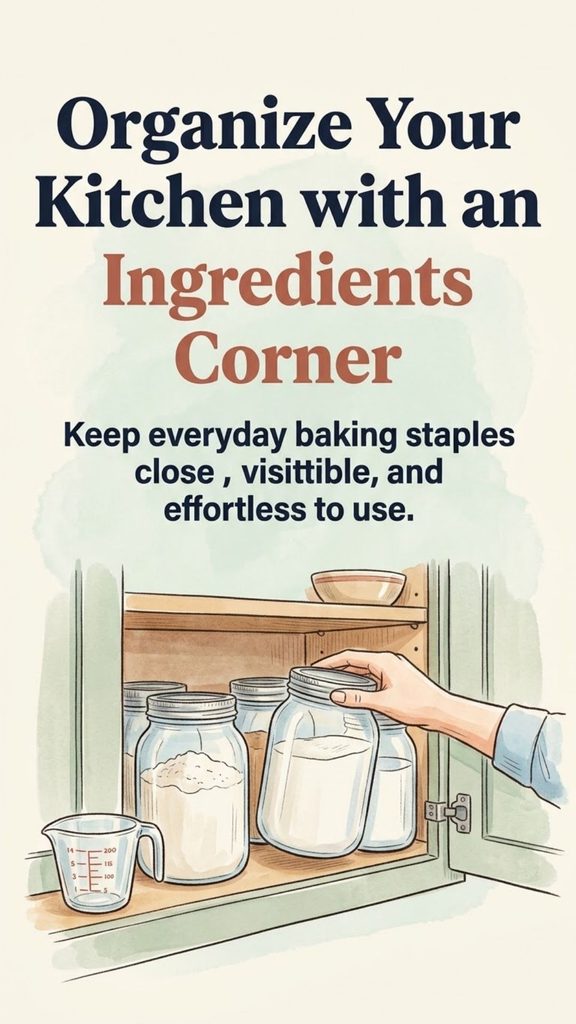
A beautiful pantry is satisfying to look at, but the most useful kitchen storage is not always the prettiest. If you regularly bake or cook from scratch, keeping flour, sugar, measuring cups, mixing bowls, and everyday ingredients several steps away from your main work surface can make even a simple recipe feel unnecessarily complicated.
A better approach is to create an ingredients corner: one compact area where the foods and tools you reach for most often are stored close to where you actually use them.
This does not require a large pantry, custom cabinetry, or a Pinterest-worthy kitchen. In fact, an ingredients corner works particularly well in ordinary kitchens because it focuses on function rather than perfect storage. Instead of organizing items according to traditional categories, you organize them according to how you cook.
You Might Also Like:
- Loading posts...
The result is a kitchen that is easier to work in, faster to reset, and far less frustrating.
Start With Where You Actually Work
Before buying containers or rearranging cabinets, pay attention to where you naturally stand when preparing food.
For many people, the busiest part of the kitchen is somewhere near the main countertop between the sink and stove. Your kitchen may be different. Perhaps you always mix dough beside the refrigerator, knead bread on an island, or prepare desserts at one end of a long counter.
That exact area should guide your organization.
Storage is most useful when it supports the movement you already make. If you repeatedly walk across the kitchen for flour, return for baking powder, cross the room again for measuring spoons, and then make another trip for oil, the problem is not that your kitchen lacks organization. The problem is that related items are stored too far apart.
Stand in the place where you do most of your mixing and preparation. Look at the cabinets, drawers, and countertop immediately around you. That is your most valuable storage space.
Items used frequently deserve to live there.
Give Prime Cabinet Space to Frequently Used Ingredients
Kitchen cabinets often get assigned traditional jobs without much thought. Plates go here. Glasses go there. Baking ingredients stay in the pantry. Small appliances fill another cabinet.
There is nothing wrong with those arrangements if they work for you. But frequency of use matters more than convention.
Think about a batch of muffins. You might open the flour container several times, reach for sugar, baking powder, salt, vanilla, measuring tools, and mixing bowls before the batter is ready.
A stack of dinner plates, by comparison, may only require one quick trip to the cabinet.
If baking ingredients are used constantly while you cook, they may deserve the convenient cabinet beside your work surface more than items that are simply stored there out of habit.
This can feel strange at first. Kitchen organization often improves, however, when you stop asking, “Where are people supposed to store this?” and start asking, “Where do I need this?”
Build the Ingredients Corner Around Your Available Space
You do not need one dedicated cupboard for this system. An ingredients corner can spread across a cabinet, drawer, shelf, and small section of countertop while still functioning as one organized zone.
Cabinets
Cabinets work well for dry ingredients because they keep visual clutter under control.
Upper cabinets can hold lightweight ingredients such as flour, sugar, cocoa, baking powder, baking soda, extracts, and spices. Lower cabinets are often better for heavier containers that would be awkward to lift overhead.
If possible, keep frequently used ingredients between approximately waist and shoulder height. Very high and very low shelves are better reserved for things you use occasionally.
Deep Drawers
A deep drawer can become one of the most efficient parts of an ingredients corner.
Unlike a traditional cabinet, a drawer allows you to look down and see almost everything at once. This makes it useful for:
- Measuring cups
- Measuring spoons
- Spatulas
- Whisks
- Rolling pins
- Small bowls
- Parchment paper
- Kitchen scales
- Other regularly used preparation tools
Use dividers only where they genuinely make things easier to retrieve and return. A drawer divided into too many tiny sections can become as frustrating as an unorganized one.
Countertops
Frequently used ingredients can also live on the counter if you have enough workspace.
Flour, sugar, oats, or another everyday staple can be stored in properly closed containers near the preparation area. The benefit is immediate access. The downside is that too many containers can quickly consume valuable work space.
A useful rule is to keep countertop storage limited to ingredients you reach for very frequently. Everything else can stay inside cabinets.
Combine Several Storage Types
Most kitchens work best with a combination.
For example, you might keep flour and sugar in a lower cabinet, baking powder and extracts in an upper cupboard, measuring tools in the drawer below, and a stand mixer on the counter.
The containers do not have to sit side by side for the system to work. What matters is that everything is within easy reach of the same work area.
Decide What Belongs in Your Ingredients Corner
The biggest mistake is trying to move your entire pantry into one cabinet.
Your ingredients corner should contain what you use regularly, not every possible baking ingredient you own.
Start by thinking about what you make most often.
Someone who bakes bread several times a week will need a different setup from someone who mostly makes cakes. A household that prepares pancakes every morning may want flour, oats, baking powder, cinnamon, and measuring tools close by. Someone who makes cookies occasionally may need far less.
Common everyday ingredients might include:
- All-purpose flour
- Bread or whole-wheat flour if regularly used
- Granulated sugar
- Brown sugar
- Powdered sugar
- Baking powder
- Baking soda
- Salt
- Cocoa powder
- Cinnamon and other frequently used spices
- Vanilla extract
- Cooking or baking oil
- Frequently used sweeteners
You do not need every variation nearby.
If you own several specialty flours but only use one of them regularly, keep that one in the ingredients corner and move the others somewhere less convenient. Do the same with oils, vinegars, extracts, and sweeteners.
Accessibility should reflect frequency.
Keep the Most Useful Tools Beside the Ingredients
Ingredients are only half of the system.
If your flour is beside you but your measuring cups are across the room, you have only solved part of the problem.
Think of the tools you repeatedly reach for during preparation and keep those nearby too.
Useful choices may include:
- Dry measuring cups
- Measuring spoons
- Liquid measuring jug
- Mixing bowls
- Silicone spatulas
- Whisk
- Wooden spoon
- Kitchen scale
- Hand mixer
- Pastry brush
- Rolling pin
Specialized equipment should earn its place.
Cookie cutters, piping tips, cake decorating tools, proofing baskets, and specialty pans can be useful, but they may not deserve prime storage if you only use them a few times a year.
Move occasional-use tools farther away before moving everyday essentials.
Organize for Visibility Before Beauty
An ingredients corner should make it immediately obvious what you have and where it belongs.
That is more important than making every container match.
Clear containers can be helpful for staples because you can see how much remains. They can also make ingredients easier to distinguish at a glance. If you decant food, use containers that close securely and are suitable for food storage.
Labels are still helpful even when containers are transparent. White flour, bread flour, powdered sugar, and cornstarch can look surprisingly similar once removed from their original packaging.
A simple label prevents guessing.
You can also include useful information such as the ingredient name and, if helpful, a best-by date copied from the original package.
Do not throw away preparation instructions you may need later. If a package contains important cooking directions or other information, keep that information accessible.
Use Turntables for Small Bottles and Jars
Small ingredients have a habit of disappearing behind each other.
Vanilla, almond extract, food coloring, baking spices, and small bottles of flavoring can easily turn a cabinet shelf into a search exercise.
A small rotating turntable can make these items easier to reach because the back of the cabinet becomes accessible without removing everything in front.
This works particularly well for containers with similar heights.
Avoid overloading the turntable. If you have to lift several bottles every time you rotate it, the organizer has stopped solving the problem.
Use Drawer Dividers Selectively
Measuring spoons and small baking tools tend to migrate around a drawer.
A few dividers can help establish obvious homes for them.
Keep commonly used tools in the easiest section to reach. Less frequently used gadgets can go toward the back.
You do not need a custom insert for every utensil. The best organization system is often the one that is simple enough to maintain when you are putting things away quickly.
If returning an object requires rearranging four other things, the system is probably too complicated.
Take Advantage of Vertical Space Carefully
Small kitchens often have unused vertical storage.
Hooks, cabinet-door organizers, pegboards, and under-shelf baskets can create additional room, but only when they improve access.
This is where it is easy to over-organize.
Hanging measuring cups may look charming, for example, but if they constantly knock against each other or get in your way, a simple drawer would be better.
Under-shelf baskets can be useful for lightweight items such as decorating supplies or small packets, but they should not make the shelf below difficult to use.
Every organizer should solve a real problem. If it creates another one, remove it.
Keep Recipes Near the Work Zone
If you frequently bake from printed recipes, handwritten cards, or cookbooks, give them a place in or near your ingredients corner.
A small recipe box can work well for family recipes. A binder is useful if you print recipes regularly. A cookbook stand can keep a book open without taking up as much preparation space.
Keep paper away from hot burners and wet areas.
You can also keep a small notebook nearby for recording adjustments. If a bread recipe needed more flour than expected or a cake baked better at a slightly different time, having somewhere to write that information can be surprisingly useful.
The goal is to reduce interruptions once you begin cooking.
Let Small Appliances Earn Their Counter Space
A stand mixer can become part of an ingredients corner if you use it frequently. The same may be true of a bread machine, food processor, or kitchen scale.
But countertop space is expensive.
A beautiful appliance that is used once every two months may not deserve to occupy the easiest working area in your kitchen.
Consider how often you actually use each appliance.
If pulling the stand mixer from a cabinet prevents you from baking because it is heavy and inconvenient, leaving it on the counter may make sense. If the food processor is rarely used, moving it to a less convenient cabinet may free several feet of valuable workspace.
Organization is not about hiding everything. It is about putting each thing where its usefulness justifies the space it occupies.
Make the Corner Pleasant Without Making It Impractical
Functional storage does not have to look cold.
A kitchen should be enjoyable to work in, and small details can give an ingredients corner warmth.
You might add:
- A favorite tea towel
- A simple recipe box
- A small vase of flowers
- A handmade pottery bowl
- A wooden utensil holder
- A framed recipe or small print
- Attractive containers you genuinely find easy to use
These details should complement the workspace rather than compete with it.
If a decorative object has to be moved every time you measure flour, it is occupying work space rather than decorating it.
The most inviting kitchens often achieve their charm through useful things: wooden spoons in a crock, flour in a well-used container, a mixer ready on the counter, or handwritten recipes kept nearby.
Adjust the Corner to the Way You Cook
There is no universal ingredients-corner checklist.
A bread baker might keep yeast, flour, salt, a scale, bench scraper, mixing bowl, and proofing basket nearby.
Someone who loves cookies may prioritize brown sugar, chocolate chips, vanilla, baking sheets, scoops, and cookie cutters.
A family that makes pancakes several mornings a week might build the corner around breakfast rather than traditional baking.
Your organization should reveal your habits.
Do not dedicate prime cabinet space to the version of yourself you imagine becoming. Give it to the foods and tools you actually use.
Avoid Overbuying Containers Before You Organize
It is tempting to begin a kitchen project by buying matching jars, baskets, drawer organizers, and labels.
Do the rearranging first.
Move your essentials into the new zone using the containers you already own. Cook with the setup for a week or two. Notice which areas are frustrating.
Only then decide whether another shelf, turntable, container, or divider would genuinely improve the space.
This prevents an ironic problem: buying more things in an attempt to become organized.
Storage products are tools, not the goal.
Leave Room for the System to Change
How you cook changes over time.
You may start baking bread regularly. A child may begin helping with cookies. You might stop using a particular appliance or begin buying flour in larger quantities.
An ingredients corner should be easy to adjust.
Every few months, look through it and ask whether the prime spots still contain your most frequently used items.
If something has not been touched in six months while another ingredient is constantly being retrieved from across the kitchen, make the swap.
The best kitchen organization is not permanent. It responds to real life.
A More Useful Kitchen Starts With Fewer Steps
An organized kitchen does not require a massive pantry or rows of matching containers. Often, the biggest improvement comes from a much simpler change: storing things close to where they are actually used.
That is the real purpose of an ingredients corner.
Put everyday ingredients beside your main preparation area. Keep measuring tools close to them. Move occasional supplies farther away. Make frequently repeated actions as easy as possible.
Your shelves may not look like a perfectly styled farmhouse pantry, and that is fine.
A kitchen earns its beauty by being lived in. Flour gets measured there. Dough gets mixed. Cakes rise. Bread cools. Families eat.
When your storage supports those ordinary activities instead of making you work around it, the kitchen becomes easier to use—and that is far more valuable than perfect-looking shelves.