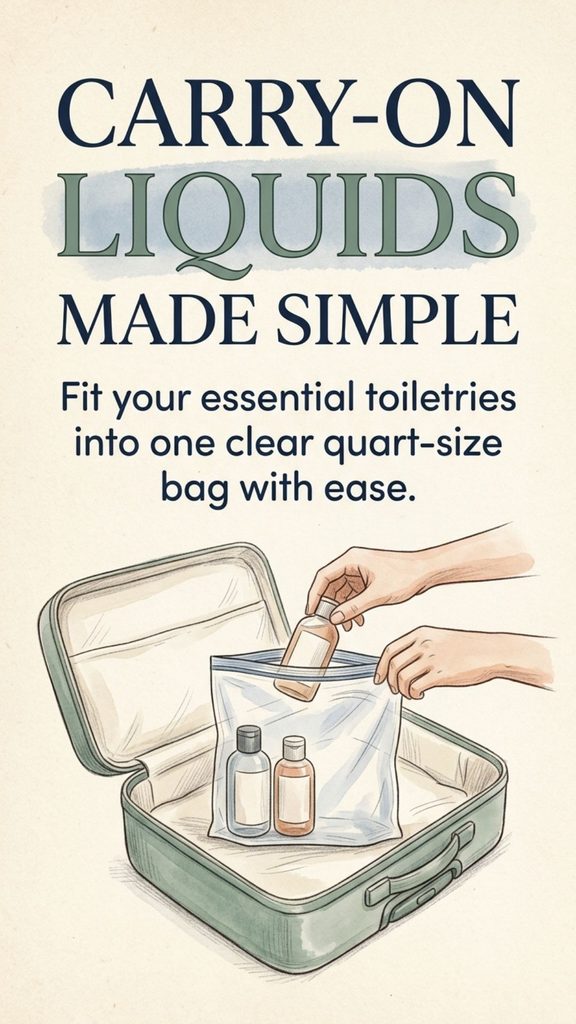
Packing toiletries for a flight can feel like a puzzle. You need your shampoo, toothpaste, skincare products, sunscreen, and other everyday essentials, but somehow everything has to fit into a small bag without breaking airport security rules.
The challenge becomes even greater when you’re traveling with only a carry-on suitcase. There’s no checked bag for full-size bottles, and discovering that your favorite moisturizer exceeds the liquid limit at security can be frustrating.
Fortunately, packing carry-on liquids doesn’t require giving up your entire skincare routine or purchasing dozens of miniature products. The trick is understanding which items count as liquids, choosing appropriately sized containers, and replacing a few products with practical alternatives.
You Might Also Like:
- Loading posts...
This guide explains the TSA’s 3-1-1 liquids rule, how to organize your toiletries, what you can pack outside your liquids bag, and the essential products worth bringing on your next trip.
Understanding the TSA 3-1-1 Liquids Rule
The Transportation Security Administration (TSA) regulates liquids carried through airport security checkpoints in the United States.
For most ordinary toiletries, travelers must follow the 3-1-1 liquids rule.
The name refers to three requirements:
- 3.4 ounces (100 milliliters): The maximum capacity of each individual liquid container.
- 1 quart-sized bag: All standard liquids, gels, creams, pastes, and aerosols must fit into one quart-sized, clear, resealable bag.
- 1 bag per passenger: Each traveler is generally allowed one such liquids bag.
These limits apply to the containers themselves, not just the amount of product remaining inside.
For example, a 200-milliliter shampoo bottle containing only 50 milliliters of shampoo still exceeds the permitted container size.
Instead, transfer the shampoo into a travel bottle with a capacity of 100 milliliters or less.
Your containers should fit comfortably inside the quart-sized bag, which must close completely.
The rule is designed around container size and screening requirements rather than the total number of products you bring.
You can check the official details on the TSA liquids rule page.
Which Toiletries Count as Liquids?
One of the most common packing mistakes is assuming that only runny products count as liquids.
Airport security rules also cover gels, creams, pastes, and aerosols.
That means products with thick or creamy textures often need to fit inside your liquids bag.
Common Products Subject to the Liquids Rule
| Toiletry | Counts Toward Liquids Limit? |
|---|---|
| Shampoo and conditioner | Yes, when liquid or creamy |
| Toothpaste | Yes |
| Facial cleanser | Yes, when liquid or gel |
| Liquid foundation | Yes |
| Mascara | Yes |
| Lip gloss | Yes |
| Liquid eyeliner | Yes |
| Moisturizing cream | Yes |
| Sunscreen lotion | Yes |
| Hair gel and styling cream | Yes |
| Perfume and cologne | Yes |
| Liquid hand sanitizer | Yes, under standard rules |
| Solid bar soap | No |
| Solid shampoo bar | No |
| Solid stick deodorant | Generally no |
| Powder foundation | No, though screening rules for powders may apply |
| Traditional solid lipstick | Generally no |
The physical form of the product matters more than its purpose.
A solid deodorant stick is treated differently from a roll-on liquid deodorant, for example.
If you’re unsure about a particular product, consult the TSA’s What Can I Bring? database before packing.
Airport security officers may also require additional screening for items that trigger an alarm, even when those items ordinarily comply with the rules.
Choose the Right Bag for Your Carry-On Liquids
You don’t need an expensive organizer to transport liquid toiletries through airport security.
A simple, transparent, quart-sized resealable plastic bag is usually sufficient for U.S. TSA screening.
The advantage is that it’s inexpensive, lightweight, easy to replace, and allows security officers to see the contents.
Reusable clear toiletry bags are another option, particularly for frequent travelers.
Look for one with a reliable closure, flexible sides, and a capacity that genuinely complies with the one-quart limit.
Be cautious about products advertised as “TSA-approved.”
A manufacturer’s marketing description doesn’t automatically guarantee that an oversized toiletry bag will be accepted at a security checkpoint.
If you prefer the simplest approach, use a standard quart-sized resealable bag.
Place it somewhere accessible inside your carry-on so you can remove it if security officers request it.
1. Simplify Your Skincare Routine Before Packing
Skincare products can fill a liquids bag surprisingly quickly.
Cleansers, toners, serums, moisturizers, facial oils, exfoliating products, and sunscreen may all compete for the same limited space.
The easiest solution is to prioritize what your skin genuinely needs.
For many travelers, a basic routine might include:
- A suitable facial cleanser.
- A moisturizer.
- A broad-spectrum sunscreen with SPF 30 or higher.
- Any prescribed or medically necessary skincare products.
Additional products can be included when space allows, but there’s usually no need to pack every item from your bathroom cabinet for a short trip.
Consider choosing a moisturizer that suits both morning and evening use.
If your skin tolerates it, temporarily simplifying optional treatments may also reduce the number of bottles you need.
However, avoid abruptly discontinuing prescribed skincare treatments without appropriate medical guidance.
A vacation is rarely the ideal time to experiment with unfamiliar products that could cause irritation.
2. Replace Liquid Toiletries With Solid Alternatives
<text>One of the most effective ways to save space is to choose products that don’t fall under standard liquids restrictions.</text>
Solid toiletries can be especially convenient for longer trips because they often last longer than miniature liquid versions.
Useful options include:
- Shampoo bars.
- Solid conditioner bars.
- Bar soap.
- Solid stick deodorant.
- Solid facial cleansing bars.
- Traditional solid lipstick.
- Powder foundation.
- Powder blush.
These products generally don’t need to occupy your quart-sized liquids bag when they are genuinely solid.
However, not every product marketed as a stick or bar is necessarily classified the same way.
Soft gels, pastes, and similar formulations may still be subject to liquid restrictions.
Choose solid products you’ve already tested at home. A shampoo bar that doesn’t suit your hair isn’t particularly helpful simply because it saves luggage space.
Store used soap and shampoo bars in suitable containers that allow them to dry between uses.
3. Use Smaller Refillable Travel Bottles
A common mistake is assuming that every toiletry needs a full 100-milliliter bottle.
For short trips, you may need considerably less.
Using a selection of smaller containers can make your liquids bag easier to organize.
For example:
| Product | Example Container Size |
|---|---|
| Facial cleanser | 30 ml |
| Moisturizer | 15–30 ml |
| Hair serum | 10–15 ml |
| Liquid foundation | 10–15 ml |
| Shampoo | 50–100 ml |
| Conditioner | 50–100 ml |
| Perfume | 5–10 ml |
These are packing examples, not recommended usage amounts. The quantity you need depends on your routine, the length of your trip, and how frequently you use each product.
Sunscreen deserves particular attention because adequate application and reapplication may require far more than a small sample bottle.
For a sunny vacation, purchasing sufficient sunscreen at your destination may be more practical than trying to fit the entire supply into your liquids bag.
Choose refillable containers designed for the products they will hold.
Label every bottle clearly, and check that caps are secure before packing.
Some products may not be suitable for transferring into another container because of stability, hygiene, packaging, or labeling requirements.
Keep those products in their original travel-sized packaging whenever possible.
4. Take Advantage of Hotel Toiletries
Before packing large amounts of shampoo, conditioner, or body wash, check which amenities your accommodation provides.
Many hotels and vacation rentals supply basic toiletries, although the products and quantities vary.
If suitable shampoo, conditioner, and soap will be available, you may not need to bring your own.
This can free up space for products that are more personal, such as facial moisturizer, contact lens solution, or specific hair treatments.
However, don’t assume every hotel supplies the same items.
Budget accommodations, vacation apartments, hostels, and smaller guesthouses may provide limited toiletries.
If you have sensitive skin, allergies, or particular product requirements, bringing your usual essentials may still be preferable.
5. Pack Dry Cleansing Cloths and Other Convenient Alternatives
Dry facial cleansing cloths are useful when you want to reduce the number of liquid products in your carry-on.
Some are activated with water and can replace bottled face cleanser during a short trip.
They take up little space, and you can pack approximately the number you’ll need.
Pre-moistened cleansing wipes are another option. TSA generally permits wet wipes without requiring them to fit inside the quart-sized liquids bag.
However, the product’s form and packaging can matter, so check the current rules for unusual products.
Choose gentle products suited to your skin and remember that some wipes may not remove sunscreen or makeup as effectively as your normal cleanser.
If you rely on a specific cleansing routine for a skin condition, prioritize suitable products over packing convenience.
6. Keep Your Hair Care Products Simple
Hair care can take up a surprising amount of space, particularly when you regularly use several styling products.
Instead of packing your entire collection, consider the actual activities planned for the trip.
For a weekend getaway, you may only need shampoo, conditioner, and one familiar styling product.
For a longer vacation, you might add a leave-in conditioner or hair treatment if your hair requires it.
A compact routine could include a shampoo bar, a conditioner bar, and a small container of leave-in conditioner.
This leaves more room in your liquids bag for other essentials.
If you pack aerosol hairspray or other pressurized toiletry products, follow the applicable TSA, FAA, and airline restrictions. Not every aerosol is permitted simply because its container is small.
Nonessential styling products are often the easiest items to leave at home.
7. Make Your Makeup Bag Travel-Friendly
Makeup doesn’t have to occupy most of your liquids allowance.
The simplest strategy is to select a few dependable products and substitute powders or traditional solid formulations where they work for you.
Face Makeup
Liquid foundation, concealer, primers, and creamy products generally fall under the liquids rule.
Powder foundation can be a useful alternative when you want to save space.
You might also choose one multitasking product instead of packing several complexion products.
Eye Makeup
Mascara and liquid eyeliner must typically fit inside your liquids bag.
Traditional solid pencil products may be more convenient.
Choose the makeup you actually expect to wear rather than packing several palettes and products for hypothetical occasions.
Lip Products
Traditional solid lipstick usually doesn’t count toward the liquid allowance, while lip gloss and liquid lip products generally do.
A familiar lipstick and a small lip balm may be sufficient for many trips.
The best travel makeup collection is one you can use easily without needing to unpack a large number of products every morning.
8. Know the Exceptions for Medications and Baby Supplies
Not every liquid must follow the standard 3-1-1 rule.
TSA allows certain medically necessary liquids in quantities exceeding 3.4 ounces (100 milliliters) when appropriate.
Examples can include liquid medications, medically necessary creams, and certain medical supplies.
These products don’t need to fit inside your regular quart-sized toiletries bag.
However, you should inform the security officer about them and be prepared for additional screening.
Baby supplies also have important exceptions.
Formula, breast milk, toddler drinks, and baby food, including certain purée pouches, can be carried in quantities greater than the standard limit.
Related cooling accessories may also be permitted under special rules.
You don’t necessarily need to be traveling with a child to transport breast milk or formula under TSA procedures.
Keep these items accessible rather than burying them beneath clothing.
For medications, retaining original packaging and prescription information where available can also help avoid confusion, particularly during international travel.
Consult the TSA’s official list of permitted items for current requirements.
9. Share Packing Responsibilities When Traveling Together
Traveling with a partner or family member can make toiletries easier to organize.
Each passenger is generally permitted their own compliant quart-sized liquids bag.
That means two travelers can divide shared products between their allowances without exceeding either person’s individual limit.
For example, one person might carry shampoo and conditioner while another carries toothpaste and a small moisturizer.
You can also share a single toothpaste tube, shampoo, or body wash during the trip rather than packing duplicate products.
Make sure each traveler remains within the applicable liquid limits and is comfortable carrying the items assigned to them.
This approach can be particularly useful for couples packing carry-on only for longer vacations.
10. Purchase Certain Toiletries After Arrival
For trips lasting several weeks, purchasing some products at your destination may be more convenient than carrying everything from home.
Large bottles of shampoo, conditioner, body wash, and sunscreen can take up valuable luggage space.
Consider buying these items after arrival if you’re confident they’ll be readily available.
Before deciding, research whether the destination has supermarkets, pharmacies, or other suitable shops near your accommodation.
Check approximate prices as well. Some tourist destinations charge significantly more for everyday toiletries, and preferred brands may be difficult to find.
If you have allergies or rely on specific products, bring enough of your usual supplies rather than assuming you’ll find suitable replacements.
For a weekend getaway, purchasing full-size bottles may create unnecessary waste. For an extended stay, it can be a practical solution.
11. Prevent Leaks Inside Your Carry-On Bag
Even properly sized toiletries can create problems if their containers leak.
A small amount of shampoo spilling inside your suitcase may soak clothing, documents, or electronics.
To reduce this risk:
- Choose sturdy bottles with reliable closures.
- Avoid filling refillable containers completely to the brim.
- Clean bottle openings before closing them.
- Check that lids and caps are tightly secured.
- Place liquid toiletries in a leak-resistant, transparent bag.
- Keep the toiletries bag away from electronics and important papers when possible.
For extra protection, individually seal products with a history of leaking inside small suitable bags.
Be aware that double-bagging doesn’t change the security limit: your standard liquids must still comply with the required container sizes and fit within the permitted quart-sized bag.
It’s also useful to carry an extra empty resealable bag. If your primary bag tears during the journey, you’ll have a replacement ready.
12. Keep Your Liquids Bag Accessible at Security
A carefully packed toiletries bag isn’t particularly helpful if it takes ten minutes to find at the security checkpoint.
Place it near the top of your carry-on suitcase or in an easily accessible compartment.
At U.S. checkpoints using standard screening procedures, officers may require travelers to remove their liquids bag for inspection.
Some checkpoints use equipment and screening procedures that allow certain items to remain inside baggage.
Passengers eligible for TSA PreCheck can generally leave compliant liquids in their carry-on during routine screening, although officers may still request additional inspection.
TSA PreCheck doesn’t eliminate the standard liquids quantity restrictions.
Follow the instructions given at your particular checkpoint rather than assuming every airport uses the same procedures.
If you’re traveling internationally, remember that screening rules and equipment can differ between countries.
A Practical Carry-On Toiletries Packing Checklist
The following checklist covers common essentials for a short trip.
Choose the products you personally need rather than treating every item as mandatory.
Liquids Bag Essentials
- Travel-size toothpaste
- Facial cleanser
- Facial moisturizer
- Sunscreen
- Shampoo, if needed
- Conditioner, if needed
- Liquid foundation or concealer
- Mascara
- Lip gloss or liquid lip product
- Hand sanitizer
These items may not all fit if each container is 100 milliliters. Use smaller containers, select only necessary products, and test the arrangement before departure.
Toiletries That Can Usually Travel Outside Your Liquids Bag
- Toothbrush
- Dental floss
- Solid soap
- Shampoo bar
- Solid stick deodorant
- Hairbrush or comb
- Traditional solid lipstick
- Powder foundation
- Dry facial cleansing cloths
- Cotton pads
- Hair ties
- Nail file, if permitted under applicable security rules
Keep medication and medically necessary supplies organized separately when appropriate.
Check current regulations if you’re carrying sharp grooming tools, unusually large powder containers, or products whose classification is unclear.
How to Pack Everything Into One Quart-Sized Bag
The most effective packing strategy is to organize products according to how much space they need.
Start by gathering every toiletry you intend to bring.
Separate them into three categories: items that must go into your liquids bag, solid products that can usually travel elsewhere, and products covered by special medical or infant-feeding exceptions.
Next, eliminate duplicates and products you probably won’t use.
Transfer suitable liquids into correctly sized travel containers, choosing the smallest practical size for each product.
Place larger containers inside the quart-sized bag first, arranging smaller items around them.
Flexible containers can sometimes help, but avoid packing the bag so tightly that the zipper or seal is strained.
When everything is inside, close the bag completely.
If it won’t close comfortably, remove something rather than hoping airport security will overlook the problem.
Finally, check every container label to confirm that its stated capacity meets the restriction.
This last step is particularly important when using reusable bottles that look small but actually hold more than 100 milliliters.
Sample Toiletry Packing Plan for Different Trip Lengths
Your ideal toiletries setup changes depending on how long you’ll be away.
| Trip Length | Practical Packing Strategy |
|---|---|
| 1–3 days | Use small samples, mini containers, and a basic routine |
| 4–7 days | Pack appropriately sized essentials and consider solid alternatives |
| 1–2 weeks | Combine travel sizes with hotel amenities or planned purchases |
| Several weeks | Bring personal essentials and purchase suitable routine products at your destination |
For longer trips, you can often wash clothing, replace consumable products, and restock supplies along the way.
There is usually no need to pack an entire month’s worth of every toiletry before leaving home.
However, prescription medications and specialized products may require more planning.
Common Carry-On Liquids Packing Mistakes
Several simple mistakes cause unnecessary problems during airport screening.
Using oversized containers: A large bottle isn’t permitted under the standard rule simply because it is almost empty.
Forgetting that creams count: Thick skincare products, toothpaste, and similar pastes are generally included in the liquids restriction.
Packing too many products: A routine with numerous optional products may leave insufficient room for essentials.
Trusting every “TSA-approved” label: The advertised bag must still comply with the actual applicable rules.
Forgetting international connections: An item accepted at one checkpoint may face different restrictions during a later transfer.
Buying unfamiliar toiletries immediately before departure: New products may cause irritation or may not perform as expected.
Ignoring special medical allowances: Medically necessary products may qualify for exceptions, so there is no need to automatically discard them because they exceed the ordinary limit.
A short packing review before leaving home can prevent most of these issues.
Frequently Asked Questions About Carry-On Liquids
Can I Bring Multiple 100 ml Bottles on a Plane?
Yes. Under the standard TSA rule, you may bring multiple containers holding 3.4 ounces (100 milliliters) or less, provided they all fit inside your single permitted quart-sized liquids bag.
Does Toothpaste Count as a Liquid?
Yes. Toothpaste is considered a paste and is subject to standard liquids restrictions unless a specific exception applies.
Can I Bring Full-Size Sunscreen in My Carry-On?
Ordinary sunscreen lotion is generally subject to the 100-milliliter container limit at U.S. airport security checkpoints.
For longer trips, consider buying additional sunscreen after arriving at your destination.
Do Makeup Wipes Count as Liquids?
TSA generally permits wet wipes without requiring them to fit in the standard quart-sized liquids bag.
Liquid makeup removers, however, are subject to the ordinary liquids rule.
Can I Bring Perfume on an Airplane?
Yes, perfume is generally allowed in carry-on baggage when the container meets applicable liquids restrictions.
For everyday travel, a small perfume atomizer can save space.
Do I Need a Special TSA-Approved Toiletry Bag?
No. A transparent, quart-sized, resealable bag that meets the requirements is sufficient.
You don’t need to purchase a product marketed specifically as TSA-approved.
Can I Bring Duty-Free Liquids Larger Than 100 ml?
Certain duty-free liquids purchased after security may be allowed under specific rules, including sealed tamper-evident packaging and proof of purchase.
International connections can complicate this because travelers may need to pass through security again.
Always check the rules for your complete itinerary before purchasing large liquid items at an airport.
Are International Carry-On Liquid Rules the Same as TSA Rules?
Not necessarily.
Many airports around the world use a 100-milliliter container limit, but rules concerning bag size, screening procedures, and exceptions can vary.
Some airports have introduced screening technology that permits different procedures, while others continue to enforce traditional restrictions.
Check official airport and aviation-security guidance for your departure and connecting airports before traveling.
Pack Smarter and Make Airport Security Easier
Packing liquids in a carry-on doesn’t have to be stressful.
Once you understand the 3-1-1 rule, choosing what to bring becomes much simpler.
Start with essential toiletries, replace suitable liquid products with solid alternatives, use properly sized containers, and keep your clear liquids bag organized and accessible.
Take advantage of hotel amenities when appropriate, buy additional everyday products at your destination if necessary, and remember that medications and infant-feeding supplies may qualify for special allowances.
Most importantly, don’t treat packing light as a competition to bring the fewest possible items. The goal is to have everything you genuinely need while avoiding unnecessary luggage, leaks, and security delays.
A little organization before departure can make your journey smoother and leave more room in your suitcase for the things that matter.