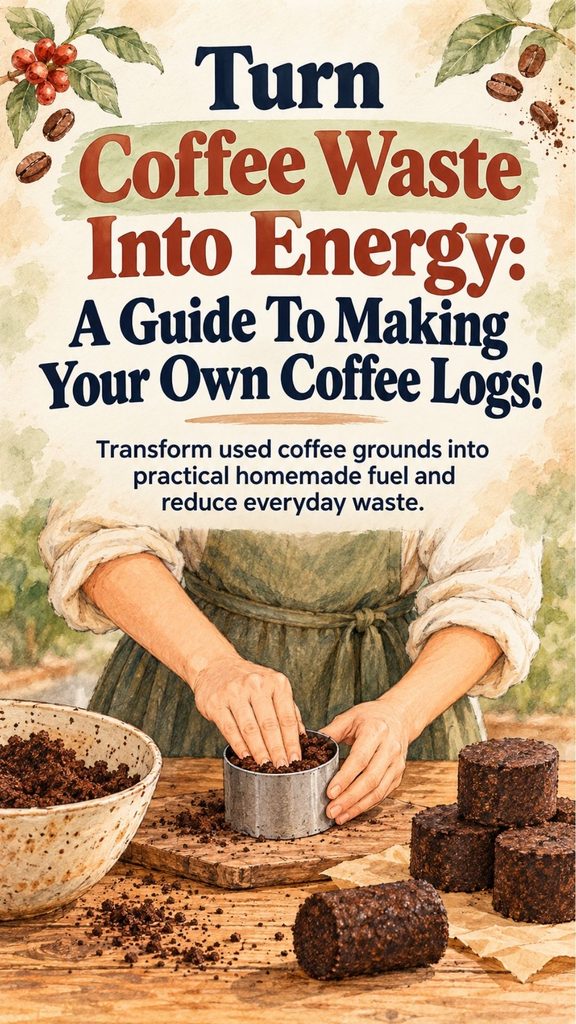
If you brew coffee every morning, you probably throw away a surprising amount of used coffee grounds over the course of a year.
Those grounds can go into compost, worm bins, or certain garden systems, but there is another possibility that attracts plenty of attention: turning spent coffee grounds into solid fuel.
The idea is not imaginary.
You Might Also Like:
- Loading posts...
Spent coffee grounds contain enough stored energy to be useful as a biomass fuel. Research has measured heating values roughly comparable to—and sometimes higher than—common woody biomass. One recent study reported coffee-ground biomass in the range of about 19.6–21.1 megajoules per kilogram, while earlier research has found similar or somewhat higher values depending on moisture, composition, and processing.
However, there is an important difference between a professionally manufactured coffee-based briquette and a handful of damp coffee grounds pressed into a cardboard tube at home.
Commercial biomass fuel is carefully dried, compressed, formulated, and tested.
A homemade log is not automatically equivalent.
So yes, coffee grounds have genuine fuel potential—but making and burning them responsibly requires a little more care than many DIY instructions suggest.
What Are Coffee Logs?
Coffee logs or coffee briquettes are compressed solid-fuel products containing spent coffee grounds.
Depending on the manufacturing process, coffee grounds may be:
- Mixed with sawdust or other woody biomass
- Dried to a controlled moisture level
- Compressed under high pressure
- Formed into pellets or briquettes
- Combined with a suitable binder where necessary
The finished fuel can then be burned in equipment designed for the particular type of biomass product.
Research into coffee-ground fuel has examined both pellets and briquettes containing different percentages of spent coffee grounds and wood material.
That makes coffee waste an interesting potential energy resource rather than merely a novelty craft.
Why Coffee Grounds Can Burn
Coffee grounds still contain organic material after brewing.
Once they are thoroughly dried, that material can burn like other forms of biomass.
One study measured a net calorific value of about 19.96 MJ/kg for spent coffee grounds containing roughly 9.6% moisture. The same study measured lower values for some sawdust and wood-shaving samples.
Another study found that pure spent-coffee-ground pellets had a lower calorific value of about 21.08 MJ/kg, compared with about 17.15 MJ/kg for the wood-sawdust pellets used for comparison.
That helps explain why coffee waste has attracted interest as a biomass fuel.
But calorific value alone does not tell you whether a homemade log will burn safely or efficiently.
Density, moisture, ash, airflow, emissions, structural strength, and the appliance being used all matter.
Coffee Grounds Alone Do Not Necessarily Make a Good Log
Loose dried coffee grounds burn very differently from a dense fuel briquette.
They are made of extremely small particles.
That creates several challenges.
A useful fuel log needs to:
- Hold together during storage
- Stay intact while being handled
- Allow enough air for combustion
- Have low enough moisture to burn efficiently
- Burn predictably inside the intended appliance
Research has found that increasing the percentage of coffee grounds can raise the energy potential of some biomass briquettes while reducing their mechanical strength.
In another experiment, 100% coffee-ground pellets had a high heating value but did not perform as well as desired during combustion because the pellets lacked sufficient physical strength.
This is why commercial briquettes often combine coffee waste with woody biomass and use industrial compression.
The Most Important Step: Dry the Coffee Grounds
Freshly brewed coffee grounds contain a lot of water.
Trying to make fuel from wet grounds creates several problems.
Wet biomass:
- Is harder to ignite
- Produces more steam
- Burns less efficiently
- Can smoke excessively
- May develop mold while being stored
EPA guidance for ordinary firewood similarly emphasizes the importance of dry fuel and recommends wood with a moisture content below about 20% for cleaner, more efficient combustion.
Although coffee briquettes are not ordinary firewood, the same basic principle applies:
Fuel needs to be thoroughly dry.
How to Dry Used Coffee Grounds
For small amounts, spread freshly used grounds in a thin layer on a tray.
Break up compacted clumps.
Place the tray somewhere with:
- Good airflow
- Low humidity
- Protection from rain
- Enough warmth to encourage drying
Stir the grounds periodically so moisture does not remain trapped underneath.
Do not store large quantities of damp grounds in a closed bucket while waiting to make briquettes.
They can mold surprisingly quickly.
For larger quantities, a controlled drying system is more practical.
Should You Add Sawdust?
Research suggests that mixtures of spent coffee grounds and woody biomass can be more practical than pure coffee grounds for briquette or pellet manufacture.
Sawdust can improve the structure of the fuel, although the exact result depends greatly on formulation and compression.
If experimenting with biomass briquettes, use only clean, untreated wood residues.
Never use sawdust from:
- Pressure-treated lumber
- Painted wood
- Plywood
- Particleboard
- MDF
- Laminated wood
- Wood containing glue or coatings
EPA guidance warns against burning painted, pressure-treated, glued, or manufactured wood because combustion can release harmful pollutants.
Clean sawdust from untreated solid wood is a very different material from construction waste.
What About Paper or Cardboard as a Binder?
Many homemade briquette recipes recommend soaking newspaper or cardboard until it becomes pulp and using that pulp to hold the fuel together.
This can physically create a solid briquette.
However, it is not something that should automatically be recommended for an indoor wood-burning appliance.
EPA wood-burning guidance lists household trash—including cardboard and many printed materials—among materials that should not be burned because combustion can release unwanted pollutants.
This is another reason commercial and homemade fuel should not be treated as interchangeable.
If your goal is reliable household heating, use a fuel approved for your heating appliance rather than improvising with household waste.
How Biomass Briquettes Are Properly Made
The general briquette-making process has several stages.
1. Collect the Biomass
Spent coffee grounds are collected after brewing.
For a meaningful amount of fuel, this often requires a larger source such as:
- Coffee shop
- Restaurant
- Office
- Café
- Commercial coffee operation
One household produces relatively little fuel material.
2. Dry the Grounds
Moisture must be removed before effective densification and combustion.
This is one of the most important steps.
3. Prepare the Other Biomass
If woody material is included, it should also be clean and appropriately dry.
4. Combine the Materials
Coffee grounds may be mixed with sawdust or another suitable biomass component.
The best ratio depends on the equipment, desired durability, emissions, and burn characteristics.
There is no universal household formula that can be guaranteed to work in every appliance.
5. Compact the Mixture
Industrial briquetting machines apply far more pressure than someone can normally achieve by pressing material into a pipe by hand.
High compression helps produce a dense, durable fuel.
A hand-operated briquette press may produce a usable experimental block, but the result should not be assumed to perform like a commercially tested fuel.
6. Dry the Finished Briquettes
Any water introduced during forming must be removed before storage or combustion.
The center of a thick briquette can remain damp long after the outside feels dry.
7. Store Them Dry
Finished biomass fuel should be protected from rain and high humidity.
If the briquettes become damp, their combustion performance deteriorates and they may develop mold.
Can You Make Coffee Logs at Home?
You can experiment with compressing dried coffee grounds and suitable biomass into briquettes.
But it is better to approach the project as small-scale biomass experimentation rather than assume you have created a direct substitute for firewood.
The biggest challenge is not shaping something like a log.
It is making a fuel that has predictable:
- Moisture
- Density
- Structural strength
- Heat output
- Smoke production
- Ash production
- Combustion characteristics
Professional biomass producers test these things.
Most homemade briquettes are not tested.
Can Homemade Coffee Logs Go in a Wood Stove?
Do not assume that they can.
Check the operating manual for your stove.
EPA guidance specifically warns that manufactured artificial logs are not appropriate for every appliance. For example, wax-and-sawdust firelogs intended for an open fireplace should not be burned in wood stoves or fireplace inserts.
Your stove was designed and tested for specific fuels.
Burning an improvised fuel may affect:
- Combustion temperature
- Airflow
- Emissions
- Chimney deposits
- Appliance components
- Warranty requirements
If the manufacturer does not approve compressed biomass briquettes, do not assume they are safe simply because they look like firewood.
What About an Open Fireplace?
An open fireplace is somewhat more forgiving about the shape of solid wood fuel, but it is also an inefficient way to heat a home.
EPA notes that traditional fireplaces can pull heated indoor air up the chimney and generally produce considerably more air pollution than modern certified wood heaters.
Even manufactured firelogs need to be burned according to their instructions.
The EPA recommends burning only one manufactured firelog at a time when that is what the manufacturer specifies.
A homemade coffee briquette does not come with equivalent safety testing.
Outdoor Fire Pits Are Not Automatically Risk-Free
You might assume that the easiest solution is simply to burn experimental coffee briquettes outside.
That removes some indoor-air concerns, but outdoor smoke still contains fine particles and other combustion products.
Local rules may also restrict:
- Open burning
- Biomass fuels
- Backyard fires
- Smoke during poor-air-quality conditions
Check local rules before burning.
Never burn experimental briquettes in enclosed patios, garages, tents, sheds, or other poorly ventilated spaces.
Combustion produces carbon monoxide.
Do Coffee Logs Really Burn Hotter Than Wood?
The statement needs context.
On a weight-for-weight laboratory energy basis, dried spent coffee grounds can have a calorific value similar to or greater than some wood biomass.
That is supported by research.
But saying a homemade coffee log will simply “burn 20% hotter than firewood” is too broad.
Actual performance depends on:
- Coffee-ground percentage
- Wood species being compared
- Moisture content
- Compression
- Briquette density
- Air supply
- Appliance design
- Combustion temperature
A loosely compressed homemade block is not equivalent to a dense laboratory pellet.
Do Coffee Logs Burn Longer?
Again, not automatically.
Density can help a fuel burn in a slower, more controlled way, but burn duration depends on the finished briquette and the appliance.
An industrially compressed briquette may behave very differently from one pressed manually into a homemade mold.
So it is reasonable to say that densified coffee biomass can be developed into an effective solid fuel.
It is not reasonable to promise that every homemade coffee log burns longer than every piece of firewood.
Do Coffee Logs Produce Less Smoke?
This claim also needs qualification.
Fuel composition alone does not determine smoke.
Combustion conditions matter enormously.
One study examining spent coffee grounds in a small boiler found that the fuel had useful heating value but also reported combustion-emission challenges, including higher nitrogen oxide emissions compared with wood pellets and a need for combustion equipment designed appropriately for the fuel.
Research on coffee pellets therefore should not be simplified into “coffee is smokeless.”
No biomass combustion is emission-free.
Are Coffee Logs Carbon Neutral?
It is safer to describe them as a waste-biomass fuel than to claim that they are automatically carbon neutral.
Burning coffee biomass releases carbon dioxide along with other combustion products.
The environmental calculation depends on factors such as:
- How coffee was grown
- How it was transported
- How the grounds were collected
- Energy used for drying
- Energy used for briquetting
- What fuel the coffee biomass replaces
- How efficiently it is burned
- What would otherwise happen to the waste
Using an existing waste stream can have advantages, particularly when it displaces another fuel efficiently.
But environmental impact is a lifecycle question, not simply a matter of calling something renewable.
The Biggest Advantage: Using a Waste Material
The genuinely interesting part of coffee fuel is not that everyone can heat a house for free using breakfast leftovers.
It is that a large waste stream may have additional value.
Coffee shops, food processors, cafés, restaurants, and factories can generate substantial quantities of spent grounds.
Research has explored turning that material into:
- Pellets
- Briquettes
- Boiler fuel
- Fire starters
- Other forms of bioenergy
A 2026 study noted that spent coffee grounds are generated in very large quantities and continue to attract attention as a solid-biofuel ingredient.
At commercial scale, this type of waste recovery makes much more sense than a household trying to collect enough grounds to heat an entire winter.
For Homeowners, Compost May Still Be Simpler
If you produce one or two small batches of coffee grounds per day, turning them into fuel may require more effort than it saves.
Other options include:
- Composting
- Vermicomposting in suitable amounts
- Municipal food-waste collection
- Adding them to an established compost system
The best use depends on your household.
Homesteading does not require turning every waste product into another DIY project.
Sometimes the simplest recycling loop is the best one.
If You Want to Experiment, Start Small
If the concept interests you, do not begin by producing a winter’s supply of homemade logs.
Start by learning about biomass briquetting.
Dry a small amount of coffee waste.
Study the type of briquette press available to you.
Use only clean biomass materials.
Pay particular attention to drying.
And before burning anything, determine whether the intended appliance is actually approved for that type of fuel.
That last step matters more than making a perfectly shaped cylinder.
Never Use Wet Coffee Logs
Whatever method you use, do not burn a damp homemade briquette.
Moisture consumes heat during combustion and tends to encourage smoky, inefficient burning.
EPA guidance for wood-burning appliances emphasizes that dry fuel and hot combustion produce better results than wet fuel and smoldering fires.
If a briquette:
- Feels damp
- Has developed mold
- Has softened during storage
- Has absorbed rain
- Is breaking apart because of moisture
do not treat it as ready fuel.
Store Biomass Fuel Carefully
Keep finished dry briquettes somewhere:
- Protected from rain
- Away from open flames
- Away from ignition sources
- With appropriate ventilation
- Away from excessive indoor dust
Do not keep large quantities of combustible material directly beside a stove or fireplace.
EPA recommends keeping flammable materials such as paper and other combustibles away from wood-burning appliances.
Maintain the Chimney and Appliance
Whatever approved solid fuel you burn, appliance maintenance matters.
Chimneys and wood-burning appliances need regular inspection and cleaning.
EPA guidance recommends regular professional inspection and maintenance because deposits and appliance problems can increase smoke and fire risk.
If smoke begins entering the room, treat that as a problem rather than a normal part of wood heating.
Coffee Waste Really Does Have Energy Potential
The science behind coffee biomass is much more interesting than the exaggerated claims surrounding some homemade coffee-log projects.
Spent coffee grounds do contain significant energy.
Researchers have successfully made and tested:
- Coffee-ground pellets
- Coffee-and-sawdust pellets
- Coffee-containing briquettes
- Coffee-based fire-starting materials
Studies show that the material can have a competitive heating value.
The challenge is turning loose wet waste into a dry, durable, predictable fuel and then burning that fuel in equipment suited to it.
That requires more than molding coffee grounds into a tube.
A Better Way to Think About Homemade Coffee Logs
Instead of seeing coffee logs as “free firewood,” think of them as an introduction to waste biomass and small-scale energy reuse.
The useful lessons are:
- Organic waste can still contain valuable energy.
- Drying is essential.
- Densification changes how biomass behaves as fuel.
- Clean feedstock matters.
- Not every binder is appropriate for combustion.
- A high calorific value does not guarantee clean combustion.
- The appliance matters as much as the fuel.
- Homemade fuel is not automatically equivalent to a tested commercial product.
Those principles make the project much more realistic.
Turn Waste Into Something Useful—But Do It Carefully
Used coffee grounds do not have to go straight into the trash.
They can become compost.
They can feed a properly maintained worm system in moderation.
At larger scales, they can become a genuine biomass fuel.
And with suitable equipment and careful experimentation, they can be incorporated into compressed briquettes.
But the safest lesson is not simply:
Mix coffee grounds with paper, press them into a tube, and throw them into any fireplace.
Coffee-based fuel works best when moisture, composition, compression, and combustion conditions are controlled.
If you want dependable home heating, use the fuel recommended for your appliance.
If you want to explore coffee briquettes, treat them as a biomass project and learn the process properly before burning them.
That keeps the most interesting part of the idea—turning a discarded resource into something useful—without pretending that every homemade coffee log is automatically cleaner, hotter, cheaper, or safer than seasoned firewood.