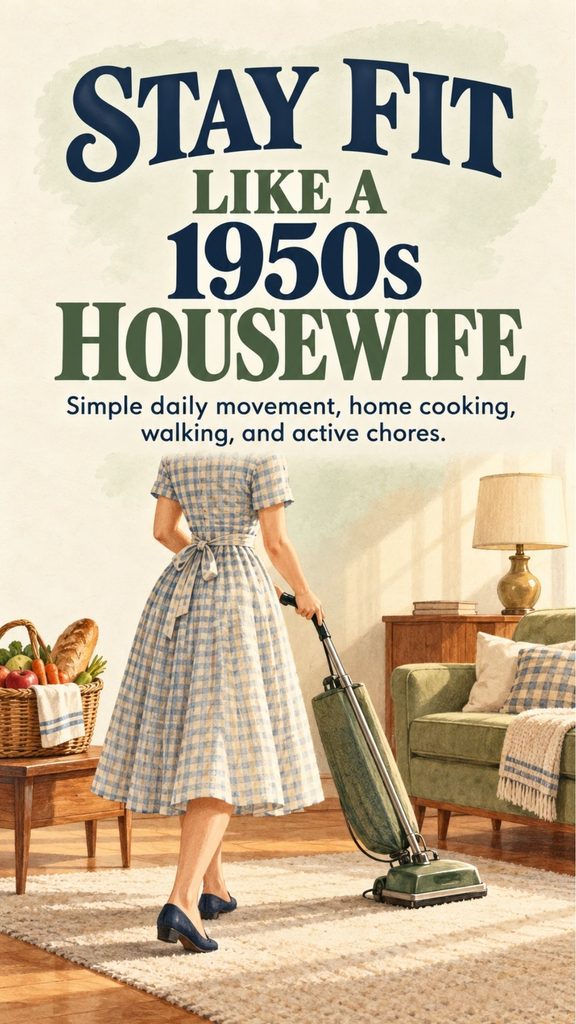
The idea of a “1950s housewife workout” sounds almost too simple: clean the house, cook from scratch, garden, hang laundry, walk more often, and let everyday life provide much of your movement.
There is something useful in that idea.
Modern life has removed a surprising amount of physical activity from ordinary routines. Washing machines, dryers, dishwashers, cars, delivery services, elevators, robot vacuums, prepared meals, and online shopping can save enormous amounts of time and labor.
You Might Also Like:
- Loading posts...
That is a good thing.
But it also means many of us can move through an entire day without moving very much at all.
The lesson to borrow from mid-century homemaking is not that women in the 1950s were universally thin, healthier, or exercising perfectly. They were not. Women of that era also encountered fad diets, dangerous weight-loss products, smoking, restrictive beauty standards, and limited understanding of many aspects of health.
Nor is there good reason to accept a viral claim that a typical 1950s housewife reliably burned “more than 1,000 calories a day doing housework.” Energy expenditure varies dramatically according to body size, duration, pace, and the particular chores being performed.
The more reliable idea is much simpler:
ordinary movement counts.
Housework, gardening, walking, cycling, carrying groceries, hanging laundry, and yardwork can all contribute to an active day. Current U.S. physical-activity guidance recommends adults get at least 150 minutes of moderate-intensity aerobic activity each week plus muscle-strengthening activity on at least two days.
So instead of trying to recreate a historically perfect housewife, borrow the parts of older daily life that naturally kept people moving.
1. Stop Thinking Exercise Only Counts at the Gym
A gym can be excellent.
So can running, swimming, strength training, fitness classes, and structured workouts.
But exercise is not the only form of physical activity.
CDC guidance recognizes that physical activity can occur in many settings, including transportation and household activities. General gardening can reach moderate intensity, while heavier continuous digging or hoeing may reach vigorous intensity for some people.
That means movement accumulated throughout the day has value.
Vacuuming briskly.
Walking to the shop.
Carrying laundry upstairs.
Working in the garden.
Cleaning the patio.
Cycling to visit someone.
These activities may not look like a formal workout, but they still get you out of a chair and using your body.
The key is intensity.
For aerobic activity to count toward the recommended moderate-intensity target, you generally need to be working hard enough that your heart rate and breathing increase. A simple “talk test” is useful: at moderate intensity, you can usually talk but not comfortably sing.
So a slow five-minute wipe of the kitchen counter is not equivalent to a brisk thirty-minute walk.
But an active day filled with meaningful movement can certainly contribute to overall fitness.
2. Vacuum With Purpose
Vacuuming is one of the easiest household chores to turn into active movement.
Instead of slowly moving from room to room while frequently stopping, try working at a steady pace.
Move furniture that is safe and reasonable to move.
Walk continuously.
Use your legs when bending rather than repeatedly rounding your back.
Switch hands occasionally if the vacuum allows it.
Carry equipment carefully between levels rather than rushing on stairs.
You do not need to vacuum daily just to burn calories.
Clean according to your household’s actual needs.
A home with shedding pets or allergies may need more frequent floor care than a low-traffic household.
The goal is not to create unnecessary chores for the sake of exercise.
It is to recognize that when a job needs doing, you can let your body do some work rather than treating every household movement as something to eliminate.
3. Use a Cleaning Routine to Reduce Sitting
One advantage of a traditional housekeeping rhythm is that it creates regular reasons to get up.
You might assign a larger task to each weekday:
Monday: laundry and linens.
Tuesday: bedrooms and dusting.
Wednesday: paperwork, mending, and errands.
Thursday: bathrooms.
Friday: floors and kitchen.
The point is not historical authenticity.
It is consistency.
If you work at a desk or spend long periods sitting, short household tasks can become movement breaks.
Run the vacuum.
Carry folded clothes upstairs.
Wipe bathroom surfaces.
Water outdoor plants.
Sweep the porch.
Then return to what you were doing.
CDC notes that any amount of physical activity has some health benefit and that recommended weekly activity can be broken into smaller chunks rather than completed all at once.
You do not need to wait until you have a free hour.
4. Cook More Often
Home cooking can add movement to the day, but it should not be romanticized as a weight-loss workout.
Chopping onions and stirring soup will not replace brisk walking or strength training.
What cooking at home can do is create a more deliberate relationship with food.
You control:
ingredients,
portion sizes,
salt,
added sugars,
cooking methods,
and how frequently highly calorie-dense convenience foods appear.
Cooking can also keep you on your feet rather than sitting while waiting for delivery.
But “homemade” is not automatically healthier.
A homemade cake is still cake.
A casserole can be extremely calorie-dense.
Butter, cream, fried foods, and large portions do not become nutritionally superior simply because you prepared them yourself.
Cook from scratch because it can be enjoyable, economical, and flexible—not because homemade food automatically produces weight loss.
5. Don’t Try to Eat an Imaginary 1950s Diet
It is tempting to believe that everyone in the 1950s ate wholesome home-cooked meals in small portions and therefore stayed thin.
History is more complicated.
Food habits varied widely by income, region, race, occupation, and family circumstances.
Processed foods were already becoming increasingly common.
Sugary desserts were popular.
Smoking rates were far higher than today.
Dangerous appetite suppressants and questionable diet products also existed.
There is no need to recreate a historical menu.
A healthier modern approach is to build meals mostly around foods such as:
vegetables,
fruit,
beans and lentils,
whole grains,
nuts and seeds,
appropriate protein sources,
and unsaturated fats.
If weight loss is medically appropriate for you, it generally requires a sustainable reduction in energy intake over time, often combined with increased physical activity and behavior changes. NHLBI emphasizes long-term lifestyle changes rather than temporary extreme diets.
The goal is not to eat like someone from 1955.
It is to eat in a way you can maintain in 2026.
6. Make Portion Awareness More Important Than Tiny Plates
You may hear that dinner plates were universally much smaller in the 1950s and that this explains why people ate less.
Plate size can influence how food is served, but it is not a complete explanation for body weight.
A more useful habit is learning to notice portions without becoming obsessive.
Serve a reasonable amount.
Eat slowly enough to register fullness.
Pause before automatically taking seconds.
Include protein and fiber-rich foods that help make meals satisfying.
Leave room for enjoyable foods without turning every dessert into either a forbidden object or an everyday requirement.
Moderation is useful when it means flexibility with boundaries.
It becomes less useful when it means constantly eating too little and feeling hungry.
7. Start a Garden
Gardening is one of the best examples of productive movement.
You squat.
Bend.
Reach.
Carry.
Walk.
Dig.
Pull.
Push.
Lift.
Depending on the job and your pace, gardening can range from light activity to moderate or vigorous exercise. CDC specifically lists general gardening as a moderate-intensity activity and heavy continuous digging or hoeing as vigorous activity.
Gardening also gives you something tangible at the end of the work.
Herbs.
Flowers.
Vegetables.
Fruit.
A tidier yard.
You do not need a large “victory garden.”
A few containers can provide lighter activity.
A raised bed can make gardening more accessible.
A larger vegetable plot provides significantly more work.
Use tools and bed heights appropriate to your body, especially if you have back, knee, or mobility limitations.
8. Walk More Often
This is probably the most valuable retro habit to borrow.
Walking requires little equipment.
It can be social.
It can be practical transportation.
And brisk walking is one of the standard examples of moderate-intensity exercise in current physical-activity recommendations.
Try walking:
after dinner,
while talking with a friend,
to a nearby shop,
while waiting for a child’s activity,
during a lunch break,
or simply around the neighborhood.
If your area is not safe or practical for walking, use an indoor mall, treadmill, community center, or another accessible environment.
You do not need a vintage dress and shopping basket.
You just need to walk.
9. Ride a Bicycle When It Makes Sense
Bicycles once served as ordinary transportation for many people rather than exclusively as exercise equipment.
That is still a useful way to think about them.
Ride to a nearby destination if road conditions and infrastructure make it safe.
Take a recreational ride.
Use a stationary bike indoors if outdoor cycling is impractical.
Moderate cycling on relatively flat terrain can qualify as moderate-intensity physical activity.
The important part is safety.
Wear an appropriate helmet.
Use lights when visibility is poor.
Follow local traffic laws.
Do not try to recreate mid-century cycling practices that ignored modern safety standards.
10. Hang Laundry Outside if You Enjoy It
Line drying adds a little more movement to laundry day.
Carry the basket.
Reach upward.
Walk along the line.
Take everything down later.
It also reduces dryer use and can be gentle on certain fabrics.
But it is not a significant fitness program on its own.
And one claim needs correcting: hanging laundry outside is not a reason to deliberately seek unprotected sun exposure for vitamin D.
Ultraviolet radiation can damage skin and increase skin-cancer risk.
Enjoy being outside, but use shade, clothing, hats, and sunscreen as appropriate to the UV conditions and your exposure.
Line drying is useful because it saves energy, gives you some fresh air, and gets you moving.
That is plenty.
11. Carry Things—Safely
Older daily life involved much more carrying.
Laundry baskets.
Groceries.
Coal or wood in some households.
Water and household supplies in others.
Modern convenience has removed much of that physical work.
You can safely preserve a little of it.
Carry groceries from the car rather than trying to park directly beside the door.
Carry a laundry basket upstairs.
Move manageable garden supplies.
Use a watering can.
But do not treat household lifting as a substitute for proper strength training.
And do not attempt awkward heavy loads merely to burn calories.
Strength develops most safely when resistance can be controlled and gradually increased.
12. Add Actual Strength Training
This is where a purely vintage-housework approach becomes incomplete.
Current physical-activity recommendations call for muscle-strengthening work involving all major muscle groups on at least two days per week.
Housework may involve muscles, but it does not necessarily provide the structured, progressive resistance needed to maintain strength optimally.
Especially as we age, strength matters for:
mobility,
balance,
bone health,
independence,
and everyday function.
You do not need a bodybuilding gym routine.
Try:
bodyweight squats to a chair,
wall push-ups,
resistance bands,
light dumbbells,
appropriately challenging yoga positions,
or weight machines.
Gradually make the exercises more challenging as you become stronger.
The strongest modern version of a “1950s housewife workout” combines active daily life with deliberate strength training.
13. Try a Vintage Exercise Routine for Fun
Vintage fitness programs can be entertaining.
Television exercise pioneers such as Jack LaLanne helped bring structured exercise into people’s homes during the mid-20th century.
Trying an old routine can be a fun way to break boredom.
But not every vintage exercise recommendation meets modern understanding of biomechanics or safety.
Some old routines include:
repetitive bouncing,
extreme stretches,
neck movements,
or exercise techniques that may not suit everyone.
Treat vintage workouts as inspiration rather than medical authority.
If a movement hurts, stop.
Modify exercises for your mobility and health.
If you have significant medical conditions, injuries, balance problems, or have been inactive for a long time, professional guidance can help you choose an appropriate starting point.
14. Spring Clean—but Don’t Turn Chores Into Punishment
A seasonal deep clean can produce a surprisingly active day.
Moving furniture.
Vacuuming.
Washing windows.
Carrying boxes.
Sweeping outdoor areas.
Cleaning cupboards.
Those activities can keep you moving for hours.
But there is a psychological line worth protecting.
Do not start measuring every household task according to how many calories it burns.
A home should be cleaned because cleaning is useful.
Movement is an added benefit.
If you begin scrubbing floors unnecessarily because you believe you need to “earn” dinner, a healthy activity has become something very different.
Exercise should support health, strength, energy, and enjoyment—not function as punishment for eating.
15. Stand and Move During Small Moments
Mid-century homemakers often moved continuously because there were fewer labor-saving options.
You can recreate some of that pattern without recreating the workload.
While the kettle boils, put away dishes.
During a phone call, walk around the house.
Carry laundry upstairs instead of leaving it at the bottom.
Take the stairs when appropriate.
Walk to speak to someone in another room.
Stretch after sitting for a long period.
Put gardening tools away individually rather than leaving everything outside.
None of these actions is dramatic.
Together, they make the day less sedentary.
16. Don’t Obsess Over How Many Calories Housework Burns
Calorie-burn numbers are much less precise than they look.
Two people doing the same chore can expend different amounts of energy based on:
body size,
fitness level,
speed,
technique,
duration,
and how much effort the job requires.
An online chart may tell you that vacuuming burns a particular number of calories per hour.
That does not mean your body follows the chart exactly.
Use movement to build an active lifestyle.
Do not try to audit every minute of housework as if the body were a cash register.
17. Weight Is Not the Only Measure of Fitness
Body weight can matter medically in some circumstances, but it does not describe fitness by itself.
Two people at the same weight can differ enormously in:
muscle mass,
cardiovascular fitness,
strength,
blood pressure,
blood glucose,
mobility,
sleep,
and overall health.
You can improve your health even if the scale barely changes.
You might:
walk farther,
become stronger,
lower blood pressure,
sleep better,
have more energy,
improve balance,
or find everyday tasks easier.
Those outcomes count.
18. If You Want to Lose Weight, Use Sustainable Habits
The statement “diets don’t work” is too broad.
Some structured dietary approaches do help people lose weight.
The real problem is that short-term restrictive plans can be difficult to maintain, and maintaining weight loss over the long term can be challenging.
NHLBI recommends sustainable lifestyle changes that may include an appropriate calorie reduction, regular physical activity, and behavioral strategies rather than relying only on temporary dieting.
A practical approach might include:
more vegetables and protein-rich foods,
fewer sugary drinks,
smaller amounts of highly calorie-dense snacks,
more home cooking,
consistent meal patterns,
more walking,
strength training,
and adequate sleep.
If weight management is complicated by medications, medical conditions, significant obesity, or repeated unsuccessful attempts, healthcare professionals can also discuss evidence-based treatment options.
There is no shame in needing more than “eat less, move more.”
19. Avoid Romanticizing the 1950s Body Ideal
Women in the 1950s were not walking around naturally content with their bodies.
Advertisements promoted slenderness.
Women dieted.
Some smoked partly because nicotine suppressed appetite.
Dangerous stimulant-based weight-loss products existed.
Bodies that did not fit fashionable ideals were criticized then just as they can be now.
So do not turn the era into another impossible standard.
The useful historical lesson is about movement built into daily life, not recreating a particular waist measurement.
20. Let Convenience Save You Where You Need It
You do not need to abandon the washing machine because hand washing burns more energy.
You do not need to stop using the dishwasher.
You do not need to mow a large lawn by hand simply because pushing equipment is more physical.
Convenience can free time for better kinds of activity.
Let the dishwasher run.
Then use the saved time to go for a walk.
Let the washing machine do its work.
Then spend twenty minutes strength training.
Use grocery delivery when life is difficult.
Then garden because gardening is something you actually enjoy.
Modern tools are not the enemy.
Sedentary routines are the issue.
A Modern 1950s-Inspired Active Day
A healthy modern version might look something like this:
Get up and get dressed.
Prepare breakfast.
Clean the kitchen.
Walk for twenty minutes.
Start laundry.
Vacuum or complete the day’s household task.
Cook lunch or prepare food.
Spend some time gardening.
Carry laundry and put it away.
Do a short strength workout.
Prepare dinner.
Take an evening walk.
You would not need to do every activity every day.
The point is simply that movement is scattered through the day rather than confined to one workout followed by ten sedentary hours.
Use the Talk Test Instead of Chasing Numbers
If you want to know whether an activity is providing moderate aerobic exercise, pay attention to how hard you are working.
At moderate intensity:
your heart beats faster,
you breathe harder,
and you can talk but would struggle to sing comfortably.
At vigorous intensity, speaking more than a few words without stopping for breath becomes difficult.
That is more useful than assuming all gardening or all cleaning automatically counts as moderate exercise.
Sometimes you are exercising.
Sometimes you are simply moving.
Both are better than endless sitting.
The Best Lesson From the 1950s Is to Build Movement Into Life
You do not need a vintage figure.
You do not need a 1950s menu.
You do not need to burn a mythical 1,000 calories cleaning the house.
And you certainly do not need to recreate the amount of unpaid domestic labor women were historically expected to perform.
What is worth borrowing is the idea that the body was often used throughout the day.
Walk.
Garden.
Cook.
Sweep.
Carry.
Cycle.
Hang the laundry if you enjoy it.
Take the stairs.
Clean what genuinely needs cleaning.
Then add the pieces that modern health guidance makes particularly clear: deliberate aerobic activity and regular muscle strengthening.
Adults should aim for at least 150 minutes of moderate activity each week and strength work on at least two days, with more activity potentially providing additional health benefits.
That is a much better goal than trying to look like a woman in a 1950s advertisement.
Use the conveniences that make modern life better.
Then deliberately put some movement back into the spaces where convenience removed it.
The result is not really a vintage workout at all.
It is simply an active life—and that idea never went out of style.