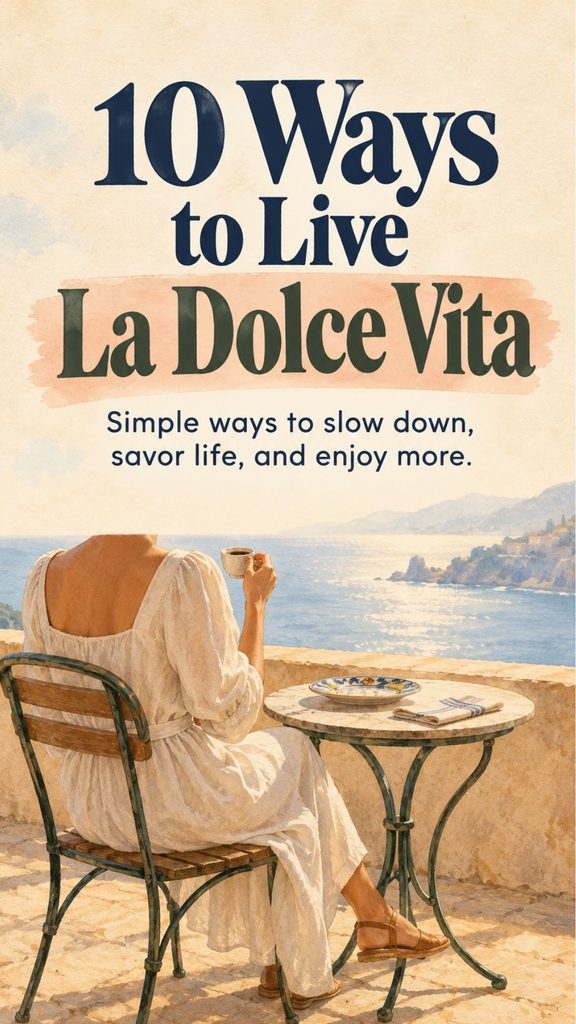
La dolce vita literally means “the sweet life,” but the idea is bigger than luxury, expensive travel, or sitting beside the Mediterranean with a beautifully dressed table.
At its best, la dolce vita is about paying attention.
It is choosing to enjoy a good meal instead of rushing through it.
You Might Also Like:
- Loading posts...
It is noticing architecture on an ordinary walk.
It is setting the table even when dinner is simple.
It is spending time with people you love.
It is owning fewer things but choosing them more carefully.
And it is understanding that pleasure does not always have to be earned, purchased, or saved for a special occasion.
You do not need to live in Italy to bring more of that spirit into your everyday life.
You can create it at home, in the way you eat, dress, decorate, spend your time, and connect with other people.
Here are ten practical ways to make life feel a little richer, slower, and sweeter.
1. Surround Yourself With Beauty
Beauty does not have to mean expensive interiors or designer furniture.
It can be very ordinary.
Fresh flowers in a drinking glass.
A bowl of lemons on the kitchen table.
A linen napkin.
A favorite painting.
A lamp with warm light.
A well-made wooden spoon.
A clean window looking out onto the garden.
The Italian idea of beauty is often connected with everyday life rather than being reserved solely for museums or formal occasions.
That is worth borrowing.
Use the dishes you like.
Wear the scarf you have been saving.
Frame family photographs.
Grow herbs on the windowsill.
Choose colors that make the room feel alive.
Repair or remove things that continually annoy you.
A beautiful home does not need to look perfect.
It should simply contain things that make you glad to be there.
Don’t confuse beauty with buying more
You do not need another shopping trip to make your surroundings prettier.
Start by rearranging what you already own.
Clear visual clutter.
Bring in a branch from the garden.
Move artwork to a place where you actually notice it.
Wash and display your nicest glassware.
Sometimes beauty appears when there is simply enough space to see what you already have.
2. Learn the Stories Around You
One of the pleasures of Italy is that history seems to sit beside ordinary life.
A street may contain buildings from several centuries.
A family recipe may carry generations of memory.
A village festival may continue a tradition older than anyone attending it.
You can cultivate that same curiosity wherever you live.
Learn about the history of your town.
Visit an old neighborhood.
Read about local architecture.
Tour a museum you have been meaning to visit.
Ask older relatives what life was like when they were young.
Record family recipes before they disappear.
Ask where your grandparents lived, what they cooked, what music they loved, and what traditions mattered to them.
History becomes much more interesting when it stops being a list of dates and becomes a collection of human stories.
Become a keeper of family knowledge
Write down:
family sayings,
recipes,
holiday traditions,
old photographs,
important names,
and stories that are repeatedly told at gatherings.
Do not assume someone else will remember them forever.
Preserving ordinary family history can be one of the most meaningful forms of homemaking.
3. Stop Rushing Through Everything
Perhaps the central lesson of la dolce vita is to stop treating life like a waiting room for the next task.
Many of us hurry even when there is no reason to hurry.
We drink coffee while answering messages.
Eat lunch while working.
Walk while looking at the phone.
Listen to someone while mentally planning what we need to do afterward.
Slow living does not require abandoning responsibilities.
It means giving certain moments your full attention.
Sit down for coffee.
Eat a meal without scrolling.
Take the longer walk occasionally.
Cook something slowly on a Sunday afternoon.
Stay at the table for another ten minutes after dinner.
Look at the sunset instead of merely photographing it.
Time still passes at the same speed.
The difference is whether you actually notice where it went.
Create small pauses
You do not need a two-hour lunch every day.
Try creating a few deliberate pauses:
ten quiet minutes with your morning drink,
a real lunch break,
an evening walk,
or a few minutes sitting outside after dinner.
Those small moments can make a busy life feel less frantic without requiring a complete lifestyle overhaul.
4. Make Relationships a Priority
Good food becomes better when shared.
So do beautiful places, funny stories, holidays, achievements, and ordinary afternoons.
Close relationships are built through repeated small interactions rather than occasional dramatic gestures.
Call someone.
Invite a friend for coffee.
Take dinner to a relative.
Sit with an elderly family member and ask questions.
Create a standing lunch date.
Send a message because you thought of someone, not because you need something.
Host a simple meal even if your home is not perfectly clean.
You do not need to entertain impressively.
A pot of pasta, bread, salad, and good conversation can be enough.
Let people stay a little longer
Modern hospitality often becomes another performance.
Perfect table.
Perfect food.
Perfect house.
Perfect decorations.
That pressure can stop people from inviting anyone over at all.
A sweeter approach is to make hospitality easier.
Serve something simple.
Let people help in the kitchen.
Bring out coffee after the meal.
Allow conversation to stretch.
A welcoming home matters more than an impressive one.
5. Develop a Personal Style
Italian style is often admired because it can look intentional without appearing overly complicated.
That does not mean you need designer clothing.
Style is not a price tag.
It is knowing what suits you and repeating it with confidence.
Maybe you love:
tailored trousers,
simple dresses,
silk scarves,
linen shirts,
gold jewelry,
beautiful leather shoes,
bright lipstick,
or vintage handbags.
Perhaps your style is much more casual.
That is fine too.
The goal is not to dress like another person.
It is to stop buying random clothes and gradually develop a wardrobe that feels coherent.
Buy less, wear more
Before purchasing something, ask:
Can I imagine wearing this regularly?
Does it work with several things I already own?
Do I like it, or do I only like that it is fashionable?
Would I buy it if nobody else saw the label?
A smaller wardrobe full of things you genuinely wear can feel far more luxurious than an overflowing closet.
Take care of what you own
Polish shoes.
Steam wrinkled clothes.
Sew on loose buttons.
Store good pieces properly.
Have worthwhile garments altered when necessary.
Care is part of style.
6. Make Ordinary Days Feel Special
The “sweet life” is not supposed to happen only during vacations.
Most of life is ordinary Tuesday.
That means the small details of ordinary days matter.
Buy better coffee if coffee is one of your greatest daily pleasures.
Drink it from a cup you love.
Put music on while you cook.
Eat lunch away from your computer.
Walk after dinner.
Open the windows on a beautiful morning.
Buy flowers occasionally—or cut greenery from outside.
Read on the balcony.
Use the good plates.
Cook something just because it sounds delicious.
None of these things needs to be expensive.
The point is to stop postponing enjoyment.
Spend more deliberately, not necessarily more
A sweet life is not the same thing as an expensive life.
If you love coffee, perhaps buy excellent coffee and stop wasting money on things you care much less about.
If travel matters to you, simplify elsewhere.
If flowers bring you enormous pleasure, budget for them.
Luxury becomes more meaningful when it is selective.
7. Eat in a Mediterranean Spirit
Mediterranean eating is often presented as another diet plan.
It is more useful to think of it as an overall pattern of eating.
Meals commonly emphasize foods such as:
vegetables,
fruit,
beans,
lentils,
whole grains,
olive oil,
nuts,
seeds,
herbs,
fish,
and moderate amounts of dairy, poultry, and other foods.
But the spirit matters too.
Meals are prepared from recognizable ingredients.
Food is seasonal when possible.
Portions can be satisfying without being enormous.
Eating is not treated purely as fuel.
Keep meals simple
A beautiful Mediterranean-style dinner might be:
beans cooked with tomato and herbs,
a salad,
whole-grain bread,
olive oil,
and fruit.
Or:
grilled fish,
roasted vegetables,
potatoes,
and yogurt.
Or simply:
pasta with tomato, garlic, olive oil, vegetables, and a little cheese.
You do not need twenty ingredients.
Good food often depends more on quality, freshness, and seasoning than complexity.
You do not need alcohol to live la dolce vita
Wine is culturally associated with many Mediterranean meals, but it is not necessary for a healthy diet or a beautiful life.
If you do not drink alcohol, there is no reason to start.
Sparkling water with citrus, coffee, tea, or another beverage can be enjoyed just as deliberately.
The ritual matters more than what is in the glass.
8. Shop Local When It Makes Sense
Buying from a small business can make shopping feel more personal.
The baker knows what came out of the oven that morning.
A farmer can tell you when something was picked.
A local craftsperson can explain how an object was made.
You may find something distinctive instead of purchasing the same mass-produced item seen everywhere.
When your budget and local options allow, consider:
farmers’ markets,
independent bakeries,
small cafés,
bookshops,
repair shops,
tailors,
local artisans,
or family-owned restaurants.
Local is not automatically better or cheaper
There is no need to turn this into another moral rule.
A supermarket can be the practical choice.
A chain shop may offer something your household needs at a much better price.
A local product is not automatically sustainable, ethical, or high quality merely because it was made nearby.
Shop thoughtfully rather than according to slogans.
The broader lesson is to know where your money goes and, when practical, support people doing work you value.
9. Practice “Less, but Better”
La dolce vita sounds luxurious, yet one of the easiest ways to make life feel richer is to stop drowning it in excess.
Too many clothes make getting dressed harder.
Too many decorative objects make a room feel cluttered.
Too many commitments leave no space for spontaneous pleasure.
Too many purchases can reduce appreciation for any single one.
Look around and ask:
What do I genuinely use?
What do I genuinely love?
What is simply taking up space?
Decluttering does not require turning your home into a minimalist showroom.
The goal is enough breathing room to appreciate the things that remain.
Curate instead of accumulate
Imagine replacing ten mediocre objects with one you truly love over time.
One excellent coat instead of several you rarely wear.
One beautiful serving bowl.
One comfortable chair.
One dependable handbag.
One fragrance you associate with yourself.
This does not have to happen immediately.
Slowly developing a collection of useful, meaningful things is far more satisfying than repeatedly buying whatever happens to be trending.
10. Spend More Time Outside
One of the simplest pleasures in life is stepping outdoors without an agenda.
Drink your morning coffee outside when weather allows.
Eat lunch on the balcony.
Walk through the neighborhood.
Sit in a park.
Garden.
Visit the coast, mountains, countryside, or whatever natural landscape is accessible to you.
Notice the temperature.
Clouds.
Birds.
Plants.
Architecture.
People passing by.
Outdoor time can make an ordinary day feel larger.
Sunshine is enjoyable, but protect your skin
Sunlight and outdoor activity can support well-being, but the idea that you should deliberately “soak up” unprotected sun for vitamin D is too simplistic.
Ultraviolet radiation damages skin and increases skin-cancer risk.
Enjoy being outside while using sensible sun protection when UV exposure is significant:
shade,
protective clothing,
hats,
and sunscreen.
You do not need a sunburn to enjoy summer.
Create Rituals Instead of Waiting for Motivation
Much of la dolce vita can be built through rituals.
Friday evening pasta.
Sunday morning coffee outside.
Flowers on the table.
An after-dinner walk.
A monthly museum trip.
A real lunch break.
Fresh bread on Saturday.
Calling your mother every Wednesday evening.
Rituals remove the need to continually decide whether you have time for the things that matter.
They become part of the architecture of your life.
Make Meals an Event Without Making Them Complicated
Food is central to the romantic image of Italian life, but the lesson is not that dinner requires three hours of cooking.
It is that meals deserve a little attention.
Put food on a plate instead of eating from the container.
Sit down.
Use a napkin.
Turn off the television occasionally.
Talk.
Notice the food.
That can transform a fifteen-minute meal more than an elaborate recipe.
If you live alone, the principle still works.
You are allowed to set the table for yourself.
Learn the Pleasure of the Passeggiata
The Italian tradition of an evening stroll offers a particularly simple lesson.
You do not always need a destination.
Walk because the evening is pleasant.
Walk to look at gardens.
Walk through town.
Walk with your partner.
Take children outside after dinner.
Call a friend and walk together.
This gentle transition between the day’s responsibilities and the evening can become something you look forward to.
And unlike many lifestyle upgrades, it requires almost nothing.
Don’t Turn Slow Living Into Another Competition
There is a strange irony in trying to perform la dolce vita perfectly.
The perfect espresso machine.
The perfect linen dress.
The perfect Italian holiday.
The perfect kitchen.
The perfect table.
Suddenly the sweet life has become another shopping list.
Avoid that trap.
A beautiful life is not a photograph.
Real homes contain dishes in the sink.
People become tired.
Dinner occasionally comes from the freezer.
Children interrupt conversations.
Plans go wrong.
Rain ruins the picnic.
The goal is not aesthetic perfection.
It is appreciation.
Protect Your Time
Saying yes to everything makes a leisurely life impossible.
If you want more time for relationships, meals, reading, walking, gardening, or simply sitting quietly, something else may need to receive less time.
Perhaps that means:
fewer unnecessary errands,
less scrolling,
fewer commitments accepted out of guilt,
less shopping,
or fewer evenings spent working after work should have ended.
Time is a resource.
Spend it as deliberately as money.
Notice What Is Already Good
Perhaps the greatest lesson of la dolce vita is that pleasure often already exists before we purchase anything.
The first coffee of the morning.
Warm bread.
A breeze through an open window.
Clean sheets.
Music from another room.
A conversation that lasts longer than expected.
Tomatoes at their best in summer.
The smell of dinner.
The familiar voice of someone you love.
A sunset you have seen a hundred times.
A sweet life is not one without problems.
It is a life in which problems have not made you stop noticing everything that is still beautiful.
Your Own Version of La Dolce Vita
You do not need an Italian villa.
You do not need a Vespa.
You do not need designer clothes, expensive wine, or a Mediterranean holiday.
Start where you are.
Make one meal more slowly.
Put flowers on the table.
Learn something about your town.
Call someone you love.
Wear something that makes you feel good.
Clear one cluttered surface.
Take an evening walk.
Sit outside with your morning drink.
Buy less, but choose more carefully.
Give ordinary pleasures your full attention.
That is the heart of la dolce vita.
The sweet life is not something waiting for you somewhere else.
Much of it is created by how carefully you live the life you already have.