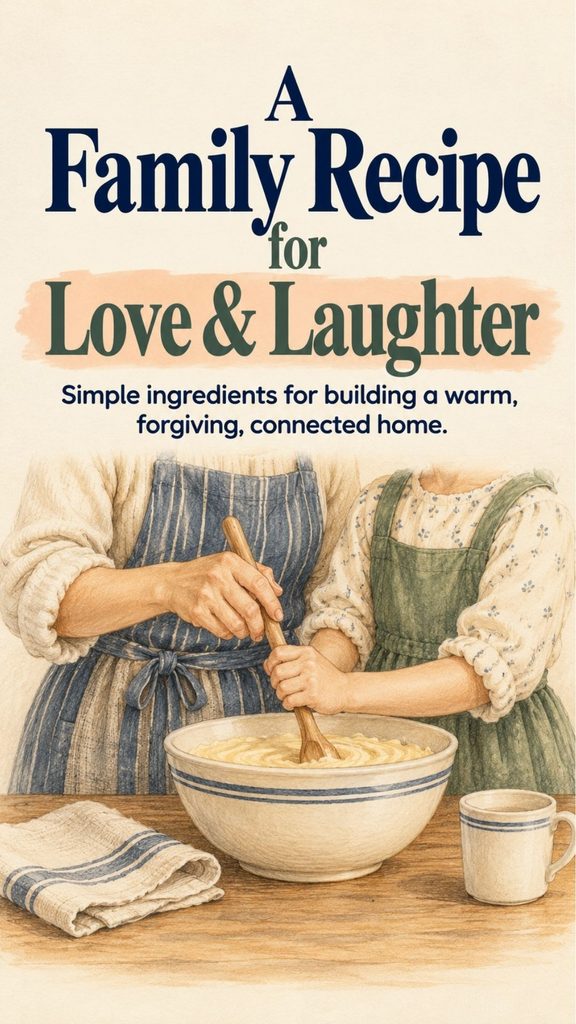
Some of the best family recipes are not written on stained index cards or tucked into old cookbooks.
They are built through ordinary days.
They are found in the way people speak to one another after a hard morning, the patience shown when plans go wrong, the laughter that breaks tension around the dinner table, and the willingness to forgive when someone makes a mistake.
You Might Also Like:
- Loading posts...
A charming old-fashioned “family recipe” puts it this way:
2 cups of love
1 cup of forgiveness
A scoop of laughter
3 tablespoons of patience
A pinch of hope
A dash of sass
Then comes the final instruction:
Mix well and enjoy.
It is playful, but there is a surprising amount of wisdom tucked inside those imaginary measurements.
A peaceful family life is rarely created through one perfect routine, an immaculate home, or never having disagreements. It grows from the qualities people practice repeatedly.
Here is what each ingredient can look like in real family life.
Start With 2 Cups of Love
Love is the largest ingredient for a reason.
But family love is not only something we feel.
It is something we repeatedly do.
It can look like getting up early to make breakfast for someone who has a long day ahead.
It is remembering how a family member takes their coffee.
It is listening when someone needs to talk even though you are tired.
It is checking on an elderly relative.
It is packing a child’s lunch.
It is making space at the table for one more person.
It is washing dishes after someone else cooked.
Many of the most meaningful expressions of love are incredibly ordinary.
They may never be photographed.
Nobody applauds them.
But they are the quiet work that makes people feel cared for.
A loving home does not require grand gestures every day.
It needs small acts repeated often enough that people know they belong there.
Add 1 Cup of Forgiveness
No family gets through life without hurting one another occasionally.
Someone speaks too sharply.
Someone forgets something important.
A child breaks something.
A partner makes a poor decision.
A sibling says something they later regret.
If every mistake is permanently stored and brought back during future disagreements, home can quickly become an exhausting place.
Forgiveness does not mean pretending nothing happened.
It does not mean allowing harmful behavior to continue.
And it does not mean that serious problems should be ignored.
In ordinary family conflicts, however, forgiveness means allowing genuine apologies, repaired behavior, and changed actions to matter.
Sometimes the most useful sentence in a home is simply:
“I was wrong.”
Another is:
“I forgive you.”
And sometimes:
“Let’s start again.”
Families need the freedom to have imperfect days without believing every imperfect moment defines the relationship.
Add a Generous Scoop of Laughter
A little humor can rescue an otherwise miserable day.
The dinner burns.
The dog runs through freshly mopped floors.
A birthday cake leans dramatically to one side.
Someone tells the same ridiculous story everyone has heard twenty times.
These moments can either become frustrations or family stories.
Laughter often decides which one.
You do not need to make fun of people or dismiss genuine problems.
Healthy humor is different.
It is the ability to notice that not everything needs to become a crisis.
Sometimes dinner really can be cereal.
Sometimes the crooked homemade decorations are better than perfect ones.
Sometimes the family photograph where everyone is laughing is the one you end up loving most.
A home with room for laughter feels less fragile because every small mistake does not threaten the mood of the entire day.
Stir in 3 Tablespoons of Patience
Perhaps this recipe needs more than three tablespoons.
Family life requires a remarkable amount of patience.
Children learn slowly.
People forget.
Projects take longer than expected.
Older relatives may need extra time.
Partners do not always communicate perfectly.
Everyone occasionally has a bad mood.
Patience does not mean never feeling irritated.
It means learning what to do with that irritation.
Instead of immediately responding, wait a moment.
Ask another question.
Lower your voice.
Give someone time to finish.
Let a child try something before doing it for them.
Recognize when a conversation would go better after everyone has eaten, slept, or cooled down.
Patience is especially valuable in the repetitive parts of family life.
Teaching a child to clean their room once is easy.
Teaching them repeatedly is parenting.
Showing someone how to cook one meal is easy.
Letting them learn through imperfect attempts takes patience.
The things that eventually become family skills and traditions usually begin with repetition.
Add a Pinch of Hope
Every household goes through difficult seasons.
Money becomes tight.
Someone loses work.
Illness interrupts normal routines.
Plans fail.
Relationships change.
The house needs repairs you cannot immediately afford.
A family member struggles.
Hope does not mean pretending those problems are insignificant.
It means refusing to believe the difficult season is the only season you will ever have.
Hope might be very practical.
“We cannot afford that right now, but we can start saving.”
“This year has been difficult, but we are going to make a plan.”
“We don’t know the answer yet, but we’ll take the next step.”
That little word—yet—can be powerful.
Hope allows a household to look beyond today’s difficulty without denying today’s reality.
Sometimes all a family needs is enough hope to make tomorrow’s plan.
Finish With a Dash of Sass
A “dash of sass” is the personality in the recipe.
Every family needs a little character.
The silly grandmother.
The uncle with terrible jokes.
The child who has an answer for everything.
The person who dances while cooking.
The one who insists on decorating for Christmas suspiciously early.
The family sayings nobody outside the household understands.
These things make a family feel like itself.
Sass does not need to mean disrespect.
Think of it instead as playfulness, confidence, personality, and the little quirks that keep family life from becoming too serious.
Those quirks eventually become memories.
Years later, people often remember the funny habits almost as clearly as the major events.
Mix Well With Time Together
Ingredients do very little sitting separately on a counter.
Family relationships are similar.
They need time together.
That does not mean every family needs elaborate outings.
Some of the strongest family memories come from ordinary routines:
Sunday breakfast,
Friday movie night,
working in the garden,
baking cookies,
driving somewhere together,
sitting outside after dinner,
playing cards,
or simply talking while someone folds laundry.
The activity is often less important than the repeated opportunity to be together.
Traditions grow this way.
You do something once.
Then again.
Eventually everyone begins expecting it.
Years later, someone says:
“We always used to do that.”
And suddenly you realize an ordinary habit became part of your family’s story.
Don’t Forget Good Communication
Even the best recipe can go wrong when something important is missing.
Families need communication.
Say what you mean kindly.
Ask instead of assuming.
Let people explain themselves.
Discuss expectations before resentment builds.
Talk about money.
Talk about schedules.
Talk about what is working and what is not.
And listen.
Listening is especially important because people do not always need a solution.
Sometimes they need someone to hear:
“This was hard.”
“I understand why you’re upset.”
“That sounds exhausting.”
A household where people feel heard usually handles problems better than one where everyone is trying to win every conversation.
Leave Room for Individuality
A strong family does not require everyone to be identical.
One person may love being around people.
Another needs quiet.
One may enjoy gardening.
Another would rather cook.
Someone loves tradition.
Someone else constantly brings new ideas.
Those differences can make family life richer.
Instead of trying to force everyone into the same personality, find ways for each person to contribute.
The organized person might manage the calendar.
The enthusiastic cook might plan Sunday dinner.
The gardener grows herbs.
The creative child makes birthday cards.
Families work beautifully when people are valued for what they genuinely bring rather than constantly compared with one another.
Serve Grace Generously
There will be days when none of the ingredients seem properly measured.
Patience will be missing.
The laughter will not come.
Forgiveness may take longer.
Someone will be upset.
The house will be messy.
Dinner will fail.
That is where grace matters.
Family life does not need to be perfect to be good.
The goal is not to create a home where nobody ever struggles.
It is to create one where people can struggle without losing their sense of belonging.
You clean up.
You apologize.
You try again.
You make another dinner tomorrow.
You have another conversation.
You begin another morning.
That willingness to start again may be one of the most important family traditions of all.
Create Your Own Family Recipe
The original playful recipe is a lovely starting point, but every family could write its own.
Maybe yours would include:
2 cups of love
1 cup of forgiveness
a large scoop of laughter
3 tablespoons of patience
a pinch of hope
a dash of sass
Then perhaps add:
a spoonful of honesty
a handful of gratitude
plenty of shared meals
a little music
a few family traditions
and
as much kindness as necessary.
There is no exact measurement.
There never was.
The important part is using the ingredients often.
Mix Well and Enjoy
A family is not a finished product.
It changes constantly.
Children grow.
People move.
New family members arrive.
Traditions evolve.
Homes change.
Circumstances shift.
Through all of those changes, the simplest ingredients continue to matter.
Love people openly.
Forgive when forgiveness is appropriate.
Laugh frequently.
Practice patience.
Keep hope during difficult seasons.
Allow everyone a little personality.
Spend time together.
Speak honestly.
Give one another room to grow.
And remember that some of the most valuable things a family creates will never appear on a recipe card.
They are being made quietly every day.
Mix them well.
And enjoy them while they are here.