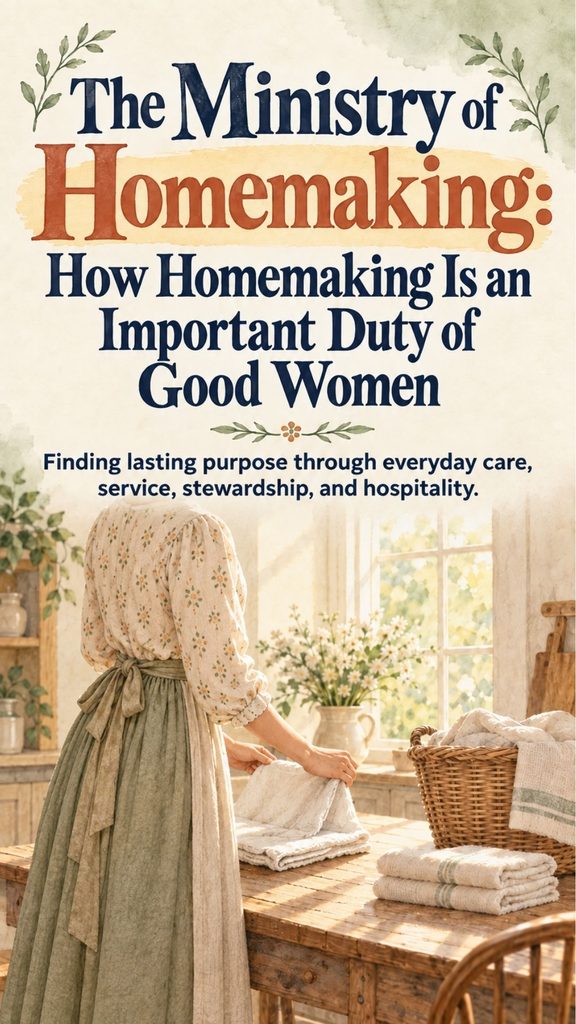
Homemaking is easy to underestimate because much of its work happens quietly. Meals are prepared and cleared away. Beds are made. Laundry is washed, folded, and returned to drawers. Children are comforted. Guests are welcomed. Groceries are planned. Rooms are tidied again after being used. Someone notices when soap is running low, when a family member needs encouragement, or when the atmosphere of the home has become hurried and tense.
None of these tasks looks extraordinary on its own, yet together they shape daily life.
For women who understand homemaking as part of their calling, it can be much more than keeping a clean house. It can become a ministry of service, stewardship, hospitality, care, and love.
You Might Also Like:
- Loading posts...
The value of homemaking is not found in creating a flawless home or fitting an idealized image of womanhood. A home can be simple, imperfect, noisy, and still be lovingly cared for. What matters is the intention behind the work: creating a place where people are nourished, protected, welcomed, and encouraged.
Homemaking can therefore be approached not as meaningless domestic labor, but as purposeful work with lasting influence.
Homemaking Is More Than Housework
Housework is part of homemaking, but homemaking reaches further.
Cleaning a floor is a household task. Creating an environment where people feel comfortable gathering is homemaking.
Cooking dinner is a task. Considering what your family needs, preparing food carefully, and bringing everyone together around the table is part of homemaking.
Washing clothing is a task. Making sure people have clean, suitable clothes available when they need them is an act of practical care.
The difference is not that ordinary chores suddenly become glamorous. They usually don’t.
The difference is understanding what those chores support.
A home functions because countless small needs are noticed and handled. When those responsibilities are approached thoughtfully, the work contributes to something larger than the individual task.
That is why homemaking can rightly be considered meaningful work.
A Home Shapes Everyday Life
Most of life is not made up of dramatic events.
It happens in ordinary mornings, weekday dinners, conversations in the kitchen, laundry days, bedtime routines, cups of tea, sick days, unexpected visitors, and evenings when everyone is tired.
The atmosphere of a home affects all of those moments.
A home does not need expensive furniture or perfect decor to feel peaceful.
Often, simple things matter more:
a reasonably clean table,
food available when people are hungry,
clean bedding,
a welcoming chair,
a calm voice,
a predictable routine,
and the feeling that someone cares about what happens there.
Homemaking provides structure to everyday life.
That structure can be especially valuable during difficult seasons. When work is stressful, money is tight, someone is ill, or life outside the home feels uncertain, familiar household rhythms can provide stability.
A simple meal, freshly washed clothes, or an orderly room will not solve every problem, but these ordinary forms of care can make difficult days easier to bear.
Homemaking Is an Act of Service
One of the most meaningful ways to understand homemaking is as service.
Service is often quiet.
It notices needs before receiving recognition for meeting them.
Preparing breakfast may seem insignificant, but it serves someone who needs nourishment before beginning the day.
Keeping the bathroom clean protects the comfort and hygiene of the household.
Planning groceries carefully helps ensure that family resources are used wisely.
Making a bed for a guest communicates, without words, that their presence was anticipated and welcomed.
None of these acts requires applause to have value.
That does not mean a homemaker should be treated as an invisible servant or expected to carry every household responsibility alone. Healthy homes require respect, cooperation, gratitude, and sensible division of labor.
Rather, the ministry of homemaking is found in willingly using one’s abilities to care for others.
Service offered freely is very different from being taken for granted.
Good Homemaking Does Not Require Perfection
One of the fastest ways to turn homemaking into misery is to confuse faithfulness with perfection.
A good homemaker does not need a spotless kitchen every hour of the day.
There will be laundry waiting to be folded.
Children will make messes.
Dinner occasionally burns.
The garden develops weeds.
The living room becomes untidy.
Some days are productive, while others are devoted almost entirely to handling unexpected problems.
A well-kept home is not a museum.
It is a place where people actually live.
Good homemaking means attending to what matters without becoming controlled by unrealistic standards.
Sometimes the most loving decision is to clean the kitchen.
Sometimes it is to leave the dishes until morning and sit beside someone who needs to talk.
Wisdom means recognizing the difference.
Creating Order Is an Important Part of Homemaking
Although perfection isn’t necessary, order is helpful.
Household disorder consumes time and energy.
When nobody knows where important papers are, food repeatedly spoils unnoticed, clean clothes disappear into piles, or basic supplies constantly run out, everyday life becomes harder than it needs to be.
Simple systems can prevent much of that frustration.
A homemaker might establish regular places for keys, important papers, shoes, cleaning supplies, and frequently used kitchen items.
Meals can be planned loosely before shopping.
Laundry can follow a predictable rhythm.
Bills and household paperwork can be handled in one place.
These systems don’t need to be elaborate.
The best system is usually the simplest one that people will actually maintain.
Order should serve the household.
The household should not become a servant to an overly complicated organizing system.
Feeding a Household Is Valuable Work
Food preparation is one of the oldest and most practical forms of homemaking.
Cooking at home can nourish people physically, but it also creates opportunities for connection.
A shared meal gives family members a reason to stop, sit down, and spend time together.
The food does not have to be elaborate.
Soup and bread can be enough.
So can eggs, vegetables, rice, pasta, or a simple casserole.
Hospitality does not require expensive recipes or impressive presentation either.
A visitor may remember the warmth of the welcome much longer than the menu.
Learning basic cooking skills also gives a homemaker flexibility.
Knowing how to make several inexpensive meals, use leftovers safely, bake a basic loaf, prepare vegetables, and turn pantry staples into dinner can make household life more resilient.
These are ordinary skills, but ordinary skills are often the ones used most.
Frugality Is Part of Wise Homemaking
Managing household resources carefully has traditionally been an important part of homemaking.
Frugality does not mean choosing the cheapest possible option every time.
It means using money, food, clothing, tools, and household supplies thoughtfully.
A frugal homemaker may mend something instead of immediately replacing it.
She may compare prices before shopping.
She may cook from ingredients already in the pantry.
She may line-dry clothing when practical, reuse suitable containers, grow herbs, buy secondhand, or avoid purchasing things that add little value.
The purpose is not deprivation.
It is stewardship.
Money that is not wasted on unnecessary purchases becomes available for things that matter more: savings, emergencies, education, hospitality, home repairs, generosity, or simply greater financial stability.
Homemaking Includes Emotional Care
A beautiful home can still feel unpleasant if everyone inside it is constantly criticized, ignored, or anxious.
The emotional atmosphere of a household matters just as much as its physical appearance.
Kind speech is part of homemaking.
So is listening.
So is apologizing.
So is welcoming someone after a difficult day without immediately presenting a list of complaints.
A homemaker often has considerable influence over the tone of the home, but this responsibility should never be placed on one person alone. Every family member contributes to the household atmosphere.
Still, choosing patience, encouragement, and hospitality can profoundly affect daily life.
A warm home is created through relationships as much as through furniture and cleaning.
Hospitality Turns Homemaking Outward
Homemaking becomes especially beautiful when the care cultivated inside the home extends beyond the immediate family.
Hospitality does not require a formal dining room or an immaculate house.
It may be as simple as offering coffee to a neighbor, bringing food to someone who is ill, welcoming a relative for dinner, or giving a tired friend a comfortable place to sit.
A home can become a place where people feel safe enough to speak honestly and relaxed enough to stay awhile.
That kind of hospitality cannot be purchased as decoration.
It grows from generosity.
The homemaker who develops practical skills—cooking, organizing, planning, gardening, sewing, cleaning, preserving food, or simply creating comfortable spaces—can use those abilities not only for her household but also for other people.
This is one reason homemaking can be understood as ministry.
Its benefits can reach well beyond the walls of the home.
Homemaking Can Preserve Valuable Skills
Modern convenience has made many household tasks easier, and that is often a good thing.
But convenience can also cause useful knowledge to disappear.
Skills such as cooking from scratch, mending clothes, gardening, preserving food safely, baking bread, caring for household linens, budgeting, and repairing simple items can make a household more capable and less dependent on constant purchasing.
A woman does not need to master every traditional skill.
Choose the ones that fit your circumstances.
Someone living in an apartment may never keep chickens or grow a large vegetable garden, but she may become excellent at meal planning and cooking.
Another woman may enjoy sewing but dislike baking.
Someone else may prefer gardening, organizing, or preserving family recipes.
Homemaking is broad enough to make room for different talents.
Teaching the Next Generation
Homemaking also provides opportunities to pass practical knowledge from one generation to another.
Children can gradually learn how to:
prepare simple food,
clean up after themselves,
care for clothing,
organize belongings,
help with laundry,
grow plants,
welcome visitors,
and participate in family responsibilities.
These aren’t merely chores.
They are life skills.
A child who learns how to cook a few meals, wash clothes, clean a bathroom, manage a simple budget, and maintain a living space will enter adulthood better prepared to care for themselves and others.
Boys and girls alike benefit from learning these skills.
Homemaking may hold particular meaning for women who choose it as a central vocation, but basic household competence is useful for everyone.
Homemaking and Marriage
Within marriage, homemaking can become one way a wife expresses care for her husband and family.
But a healthy marriage is not built on the assumption that one person exists to serve while the other only receives.
Both spouses have responsibilities toward one another.
The exact division of household work will differ between families.
One husband may work long hours outside the home while his wife manages most daily household responsibilities.
Another couple may both work outside the home and divide domestic tasks more evenly.
Some husbands cook.
Some wives handle household finances.
Some couples alternate tasks depending on schedules, health, children, or personal strengths.
There is no benefit in turning homemaking into a competition over who performs which chore.
What matters is that the household responsibilities are handled with cooperation, gratitude, and mutual respect.
Homemaking Can Be Work Even When It Is Unpaid
One reason homemaking is sometimes undervalued is that it does not always produce a paycheck.
But economic payment is not the only measure of useful work.
Planning meals takes work.
Caring for children takes work.
Maintaining clothing, cleaning, scheduling appointments, grocery shopping, organizing supplies, and managing household routines all require time and effort.
When these tasks are outsourced, people pay for them.
Their value does not disappear simply because they are performed inside one’s own home.
A woman who devotes substantial time to managing a household should not feel that she is “doing nothing.”
She is producing something that is difficult to quantify but easy to notice when it disappears: a functioning home.
Homemaking Should Not Become a Measure of a Woman’s Worth
There is an important distinction between valuing homemaking and reducing women to homemaking.
A woman’s worth is not determined by how clean her floors are, whether she bakes bread, whether she stays home full-time, or whether her life looks traditionally domestic.
Women live in many different circumstances.
Some are homemakers.
Some work outside the home.
Some combine paid work and homemaking.
Some are unmarried.
Some care for parents.
Some live alone.
Some are raising children.
Some are not.
The principles behind good homemaking—care, responsibility, hospitality, stewardship, patience, and service—can be practiced in many different lives.
Honoring homemaking should elevate valuable domestic work, not create another standard by which women harshly judge themselves or one another.
Build a Home That Serves the People in It
The goal of homemaking isn’t to impress visitors or create photographs that look perfect online.
The goal is to serve real people.
That means a functional kitchen matters more than a fashionable one.
Comfortable furniture matters more than constantly changing decor.
A family dinner prepared with ordinary ingredients can be more meaningful than an elaborate table no one has time to enjoy.
Clean towels, repaired clothing, thoughtful routines, and a welcoming atmosphere may seem modest, but these are the things that make everyday life work.
A good home should support the people living there.
It should not exhaust them in pursuit of appearances.
Finding Purpose in Ordinary Work
Many homemaking tasks repeat endlessly.
The floor cleaned today will need cleaning again.
The meal prepared tonight will be eaten.
The freshly washed clothes will return to the laundry basket.
This repetition can make domestic work feel insignificant.
But repetition does not make work meaningless.
People also eat repeatedly, sleep repeatedly, need encouragement repeatedly, and return home repeatedly.
The recurring nature of homemaking reflects the recurring needs of human life.
There is dignity in meeting those needs faithfully.
A meal doesn’t become pointless because everyone will be hungry tomorrow.
Neither does caring for the home.
The Ministry Hidden Inside Everyday Homemaking
The ministry of homemaking rarely looks dramatic.
Most of it happens in small, unseen acts.
Preparing a meal.
Changing the sheets.
Listening at the kitchen table.
Teaching a child how to cook.
Welcoming a visitor.
Repairing something instead of throwing it away.
Keeping track of the household budget.
Creating order after a chaotic week.
Making a room comfortable for someone who is sick.
Those actions may never attract public recognition.
Yet they shape the experience of the people who live inside the home.
For women who embrace homemaking as part of their calling, this is where its deeper value can be found.
Not in having the prettiest house.
Not in performing domestic perfection.
Not in proving that one type of woman is better than another.
But in transforming ordinary work into deliberate care.
A well-tended home can feed bodies, calm tired minds, strengthen relationships, welcome strangers, teach useful skills, and create memories that remain long after individual chores have been forgotten.
That is why homemaking deserves to be treated not as insignificant work, but as meaningful work—and, for many women, as a genuine ministry of everyday life.