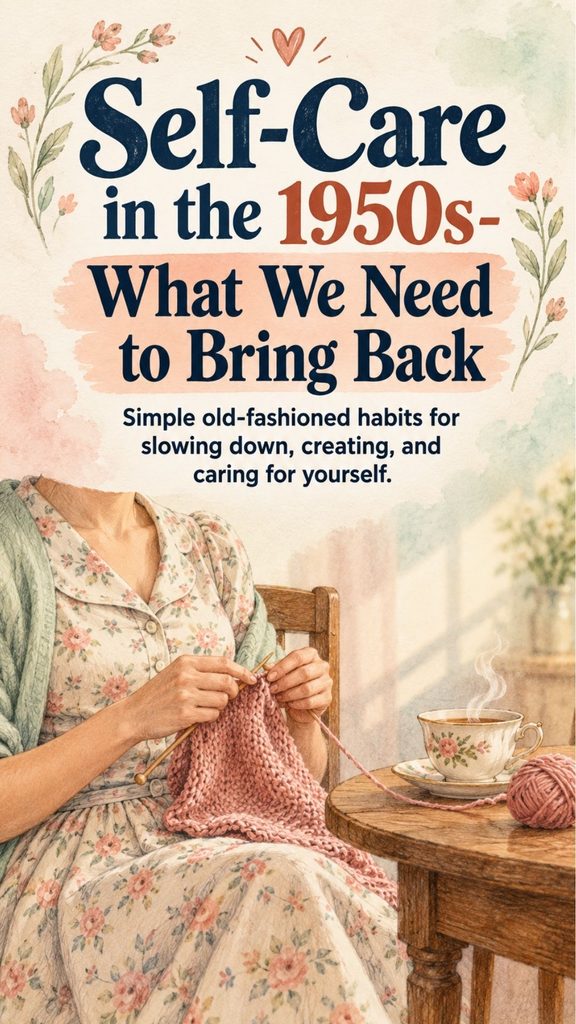
The 1950s are often remembered through polished magazine advertisements, tidy kitchens, carefully styled hair, and television families whose problems seemed to disappear before the closing credits. Real life was much more complicated.
Women managing homes, raising children, working inside or outside the home, caring for relatives, and meeting strong social expectations could experience exhaustion, loneliness, worry, and emotional strain just as people do today. Mental health was also discussed very differently, and many problems that would now be recognized more specifically were poorly understood, minimized, or described with broad terms such as nervousness or anxiety.
There was no modern language of bath bombs, wellness retreats, digital detoxes, or “self-care Sundays.” Still, people found ordinary ways to rest, socialize, enjoy themselves, and maintain personal routines.
You Might Also Like:
- Loading posts...
Some of those habits are surprisingly useful today.
Not everything about the 1950s deserves nostalgia, and there is no reason to recreate the pressure to maintain a perfect home or appearance. The better lesson is simpler: regular pleasures, hobbies, personal grooming, companionship, and unhurried leisure can make everyday life feel more manageable.
Here are several old-fashioned self-care habits that may be worth bringing back in a modern form.
Make Personal Grooming a Ritual Instead of Another Chore
Hair appointments were an important part of many women’s beauty routines during the mid-20th century. Hairstyles could require considerable maintenance, including setting, shaping, and regular salon visits.
Few people today want to spend hours maintaining an elaborate weekly hairstyle, but there is something valuable in deliberately setting aside time to care for your appearance simply because it makes you feel good.
Modern self-care might mean:
- getting a haircut you have been putting off
- scheduling an occasional blowout
- painting your nails at home
- taking time for a long shower or bath
- carefully styling your hair before an evening out
- putting on clothes that make you feel comfortable and put together
The point is not that women must look polished to be valuable. Personal grooming becomes self-care when it is done for your own comfort and enjoyment rather than from pressure to satisfy someone else’s expectations.
Even a small ritual can create a pleasant boundary between work and rest.
Bring Back a Slower Evening Skincare Routine
Beauty culture was prominent during the 1950s, and advertisements frequently encouraged women to use creams, cleansers, cosmetics, and other personal-care products.
Modern skincare is far more complicated in some ways. There are countless products promising brighter, smoother, younger-looking skin, and it is easy to feel as if an effective routine must contain ten different steps.
It does not.
A gentle evening routine can serve two purposes: basic skin care and a signal that the active part of the day is ending.
For many people, a practical routine may be as simple as removing makeup, cleansing gently, applying an appropriate moisturizer, and using any dermatologist-recommended treatment products.
What makes the routine relaxing is the pace.
Instead of hurriedly washing your face while thinking about the next chore, take a few quiet minutes. Put away your phone. Change into comfortable clothes. Wash your face, moisturize, brush your teeth, and let those repeated actions become part of winding down.
Consistency is generally more useful than collecting products you rarely use.
Rediscover the Pleasure of Making Something by Hand
One of the best old-fashioned forms of leisure requires almost no special explanation: sit down and make something.
Knitting, crochet, sewing, embroidery, woodworking, painting, baking, gardening, scrapbooking, and other hands-on activities can provide a kind of satisfaction that passive entertainment does not always offer.
Creative hobbies have never disappeared, but modern life makes it very easy to spend an open hour scrolling without intentionally deciding what to do with it.
You do not need to become highly skilled or turn a hobby into a business.
That is actually part of the appeal.
Make something badly if necessary.
Crochet a slightly uneven scarf. Paint without worrying whether the picture is good enough to frame. Mend a piece of clothing. Try embroidery. Press flowers. Start a small herb garden. Bake bread because you enjoy the process rather than because homemade bread is somehow morally superior to buying it.
A hobby should be allowed to remain a hobby.
Not every enjoyable activity needs to become productive.
Replace Some Screen Time With Quiet Entertainment
Previous generations certainly had distractions of their own. Radio and television were major forms of home entertainment during the 1950s. The difference was that entertainment was not carried in a pocket every hour of the day.
Today it is possible to move from television to social media to messages to news to videos without ever experiencing a truly quiet moment.
One useful habit to borrow from slower domestic life is simply having periods when nothing is demanding your attention.
You might spend an evening:
- listening to music while doing a craft
- working on a puzzle
- reading a novel
- writing in a journal
- playing cards
- sitting outside with a cup of tea
- completing a crossword
- tending houseplants
You do not need to eliminate technology. A little intentional separation is enough.
Sometimes the most restorative part of an activity is that it gives your mind only one thing to do.
Invite Someone Over Without Making It an Event
Hospitality does not have to involve a spotless house, an elaborate dinner, matching dishes, or three days of preparation.
That idea deserves to come back.
Casual social visits have long been an important part of everyday community life. A friend stopping for coffee, neighbors talking on the porch, relatives gathering around the kitchen table, or couples playing cards together can provide meaningful connection without requiring an occasion.
Modern entertaining often becomes unnecessarily complicated because people feel their home must look impressive before anyone sees it.
Try lowering the standard.
Invite a friend over for tea.
Serve coffee and cookies.
Order pizza and play cards.
Sit on the porch and talk.
Make an ordinary weeknight dinner and add one extra plate.
The goal is companionship, not performance.
This can matter especially for someone who spends much of the day at home. Homemaking can involve constant activity while still feeling socially isolating. Regular contact with people you enjoy can break up that isolation.
Bring Back Cards, Board Games, and Simple Social Evenings
Entertainment at home does not have to revolve around watching something.
Card games and board games create conversation naturally because everyone is participating rather than staring at separate screens.
You can keep it extremely simple. A deck of cards costs little, lasts for years, and can support dozens of games. Dominoes, checkers, puzzles, and familiar board games work just as well.
These evenings do not need themes, decorations, or carefully planned menus.
Put snacks on the table and play.
Part of what makes these activities restful is their ordinariness. Nobody has to produce an unforgettable experience. You simply spend a few hours together.
Take the Modern Version of a Sunday Drive
The leisurely Sunday drive is closely associated with an earlier era of American car culture. Families might go out simply to see the countryside, visit somewhere nearby, or enjoy being away from the house for a while.
Driving purely for entertainment is not always practical today. Fuel costs, traffic, and environmental concerns make unnecessary car trips less appealing.
But the underlying idea is still useful: leave the house without turning the outing into another obligation.
The modern version might be a walk through a quiet neighborhood, a trip to a nearby park, a bicycle ride, a scenic train journey, or a short drive to a place you already wanted to visit.
The important part is that there is no list of errands attached.
You are not rushing to the supermarket, hardware store, pharmacy, and post office.
You are simply going somewhere pleasant.
That distinction can make an ordinary outing feel surprisingly restorative.
Create Small Daily Pauses
Self-care is often presented as something elaborate that must be scheduled.
Many people would benefit more from ten calm minutes every day than from one ambitious wellness routine they never have time to follow.
A small pause could be drinking your morning coffee before checking messages, sitting outside after lunch, reading for twenty minutes before bed, or listening to a favorite record while folding laundry.
These habits are easy to dismiss precisely because they are small.
But small routines are often the ones people can actually maintain.
The purpose is not to escape all responsibilities. It is to prevent every available moment from automatically becoming another opportunity for work.
Stop Measuring Yourself Against the Perfect 1950s Homemaker
Perhaps the most important lesson from looking back at mid-century domestic life is recognizing the difference between an image and reality.
Advertisements and entertainment frequently presented carefully constructed ideals of femininity, marriage, housekeeping, beauty, and family life. Real households were never that perfect.
People had clutter.
They became frustrated.
Children misbehaved.
Meals went wrong.
Money was tight.
Relationships were difficult.
Homes were not always spotless.
Women did not wake every morning delighted to complete household chores while perfectly dressed.
Nostalgia becomes unhealthy when an idealized image from the past is used as a standard for the present.
You can enjoy vintage clothing, old recipes, traditional homemaking skills, handwritten routines, afternoon tea, sewing, gardening, or beautiful household rituals without adopting unrealistic expectations along with them.
Build a Self-Care Routine That Fits Your Actual Life
The most useful old-fashioned self-care habits tend to be remarkably ordinary.
Make something with your hands.
Call a friend.
Take care of your skin.
Go somewhere pleasant.
Play cards.
Read.
Sit outside.
Dress nicely because you feel like it.
Turn off the phone for an hour.
Have someone over even though the house is not perfect.
Choose two or three activities you genuinely enjoy and make room for them during the week. They do not need to cost much money or require elaborate preparation.
Self-care is not another household standard to achieve.
It is simply part of maintaining a life in which your own needs do not disappear beneath everyone else’s.
That may be the part of old-fashioned living most worth bringing back.