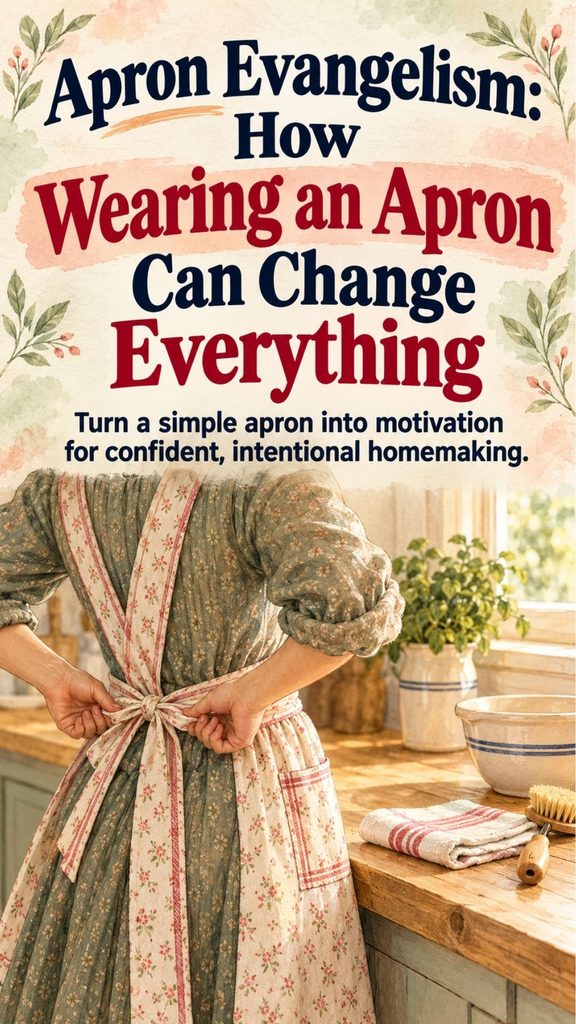
An apron is one of the simplest pieces of clothing in a household, yet it can have a surprisingly useful effect on the way a homemaking day feels.
At first glance, an apron is just protection.
You tie it around your waist or shoulders before cooking, cleaning, baking, gardening, or tackling a messy project, and it keeps flour, grease, water, dust, and dirt away from the clothes underneath.
You Might Also Like:
- Loading posts...
But an apron can become something more practical than that.
For many homemakers, tying one on creates a small mental transition: now I am ready to work.
It can mark the beginning of the day’s household routine in the same way putting on work clothes prepares someone for a job outside the home.
You do not need a vintage dress, pearls, heels, or a perfectly styled kitchen to benefit from that feeling.
An apron works just as well over jeans, leggings, a T-shirt, or a comfortable house dress.
What matters is the ritual.
An Apron Gives the Day a Starting Point
One reason homemaking can feel difficult is that there is no obvious beginning or end.
Household work happens around you constantly.
There is always another dish.
Another load of laundry.
Another meal.
Another surface to wipe.
Another item to put away.
Without a routine, it is easy to drift between resting, scrolling, cleaning, cooking, and other responsibilities without ever feeling fully started.
An apron can become a simple cue.
You finish breakfast.
You get dressed.
You tie on the apron.
Then you begin the household work you planned for that part of the day.
It sounds almost too simple to matter, but physical routines can make ordinary responsibilities feel more intentional.
It Turns Everyday Clothes Into Work Clothes
You do not need a separate homemaking wardrobe if you have a good apron.
A full apron can protect much of your clothing while you:
- Fry food
- Bake bread
- Wash dishes
- Clean counters
- Dust
- Work with dough
- Prepare preserves
- Water plants
- Handle craft supplies
- Complete light gardening tasks
That makes it easier to wear normal clothes around the house without constantly worrying about stains.
Instead of changing into old clothes every time you need to make dinner, simply add an apron.
When the messy job is finished, remove it and your clothes underneath are often still presentable enough for errands, visitors, or the rest of the day.
Aprons Can Help Separate Work From Rest
There is another useful side to the ritual.
If putting the apron on signals the beginning of homemaking work, taking it off can signal that a work period is finished.
This is especially useful for people who spend most of the day at home.
You might wear the apron while:
- Preparing breakfast
- Tidying the kitchen
- Cleaning
- Making lunch
- Doing afternoon baking
- Preparing dinner
Then remove it when the main household work is done.
The house will never be completely finished, but that does not mean you need to remain mentally “on duty” every minute.
A visible start and stop can make home life feel less endless.
Pockets Make an Apron Even More Useful
A good apron should not only look attractive.
It should work.
Large pockets can be surprisingly helpful when moving around the house.
You might temporarily carry:
- Clothespins
- A cleaning cloth
- A small notebook
- Seed packets
- A pen
- Hair ties
- Small toys that need returning
- Household items you find while tidying
The key word is temporarily.
Apron pockets are excellent for collecting little things while moving through the house, but empty them at the end of the task so they do not become portable junk drawers.
Choose an Apron for the Work You Actually Do
Not every apron serves the same purpose.
Full Bib Apron
This is the classic kitchen apron with coverage from the chest to the knees or lower.
It works well for:
- Cooking
- Baking
- Dishwashing
- Canning
- Messier cleaning jobs
If you want one all-purpose apron, this is probably the most practical style.
Waist Apron
A waist apron ties around the middle and leaves the upper body uncovered.
It can be useful for:
- Light cleaning
- Gardening
- Serving food
- Carrying small tools
- Everyday tidying
Large-pocket versions are particularly practical.
Cross-Back Apron
Cross-back aprons slip over the shoulders rather than relying on neck straps.
Some people find them more comfortable for long periods because the weight is distributed across the shoulders.
They are often made from linen or cotton and work well for general kitchen and homemaking use.
Heavy-Duty Work Apron
For woodworking, gardening, painting, or other rough jobs, choose a sturdier apron made from canvas, denim, or another durable material.
Save your delicate kitchen apron for indoor work.
Keep More Than One Apron
One apron is useful.
Two or three can make the habit easier.
Consider having:
- One everyday kitchen apron
- One apron for cleaning
- One older apron for garden or messy work
This helps prevent cleaning residue, soil, or outdoor grime from being brought into food-preparation areas.
It also means you still have an apron available when another is in the laundry.
Wash Aprons Like Working Textiles
Aprons are meant to get dirty.
Do not be afraid to use them.
Wash an apron when it becomes visibly soiled, develops an odor, or has been contaminated by food or cleaning products.
Cooking aprons may need washing frequently if they are exposed to grease, raw ingredients, or spills.
Let them dry completely before storing.
If you make your own, choose washable fabric so the apron can handle ordinary household use without becoming precious.
Cotton and Linen Are Good Everyday Choices
Both cotton and linen work well for homemaking aprons.
Cotton is widely available, easy to sew, and comes in countless patterns.
Linen is durable, breathable, and softens over time.
Cotton-linen blends can provide some of the advantages of both.
For heavier work, consider:
- Denim
- Canvas
- Duck cloth
Very delicate fabric may look beautiful but will not always stand up well to daily cleaning and washing.
Practicality should come first.
An Apron Does Not Need to Look Old-Fashioned
You can enjoy aprons without turning your wardrobe into a historical costume.
A modern apron might be:
- Plain linen
- Black cotton
- Striped canvas
- Floral print
- Gingham
- Denim
- Brightly colored
- Minimal and simple
If you love vintage style, choose ruffles, gathered skirts, floral prints, or old-fashioned shapes.
If you prefer modern simplicity, choose a clean cross-back apron in a neutral fabric.
There is no correct homemaker aesthetic.
The apron should suit the person wearing it.
Make Your Own Apron
An apron is also an excellent beginner sewing project.
The basic construction is much simpler than sewing most clothing because fit does not have to be exact.
A straightforward apron may require only:
- Fabric
- Thread
- Scissors
- Measuring tape
- Pins or clips
- Sewing machine
- Iron
A basic pattern usually includes:
- Apron body
- Waist ties
- Neck strap or shoulder straps
- Optional pockets
If you are learning to sew, an apron teaches useful skills such as hemming, straight seams, attaching straps, gathering, and adding pockets.
You can also make one from repurposed fabric such as a sturdy cotton tablecloth or suitable leftover yardage.
Make the Pockets Bigger Than You Think You Need
Tiny decorative pockets may look charming, but large pockets are far more useful.
If you sew your own apron, consider including at least one pocket large enough to hold a cloth, phone, clothespins, or small household items.
You can divide one large pocket into two sections with a simple vertical line of stitching.
That keeps small objects from disappearing into one oversized pouch.
Aprons Can Become Part of a Morning Routine
A simple homemaking morning might look like this:
- Get dressed.
- Make the bed.
- Open curtains or blinds.
- Start breakfast cleanup.
- Tie on the apron.
- Begin the first household task.
The apron becomes the transition between getting ready and starting work.
This can be especially useful if you struggle with feeling unfocused at home.
You do not need motivation for every chore.
Sometimes a routine is enough.
Use the Apron as a Reminder, Not a Measure of Worth
There is an important difference between using clothing as a helpful routine and believing that the clothing makes someone a better homemaker.
Wearing an apron does not make someone hardworking.
Not wearing one does not make someone careless.
A perfectly dressed person can still ignore the dishes.
Someone in sweatpants can run an exceptionally organized home.
An apron is simply a tool and, for some people, a useful mental cue.
Keep it in that category.
You Do Not Have to “Look the Part”
Old advertisements and television portrayals often showed homemakers with styled hair, pressed dresses, spotless kitchens, and carefully coordinated aprons.
Real homemaking rarely looks like that.
There are days when:
- Laundry is everywhere.
- Dinner is simple.
- You are tired.
- The kitchen needs cleaning.
- Someone is sick.
- Plans fall apart.
A useful homemaking routine should help on those days too.
You do not need makeup, perfect hair, or a particular body shape to tie on an apron and get through the day’s work.
Safety Matters Around the Stove
An apron should protect you, not create another hazard.
Choose one that fits close enough to the body that long ties, ruffles, or loose fabric will not reach an open flame or hot burner.
Tie loose hair back when necessary.
Keep dangling sleeves away from heat.
And remember:
An apron is not an oven mitt.
Ordinary apron fabric does not protect your hands from hot cookware.
Use proper dry oven mitts or potholders for hot pans.
Don’t Wipe Everything on the Apron
Older homemaking imagery sometimes treats the apron as a universal towel.
It is better to keep separate cloths for separate jobs.
Use:
- A clean dish towel for drying clean dishes
- A hand towel for hands
- Cleaning cloths for cleaning
- Proper oven mitts for hot cookware
The apron is primarily a protective garment.
Using one fabric surface for raw food, dirty hands, dishes, and counters can spread contamination rather than simplify work.
Aprons Can Be Seasonal Too
If you enjoy sewing or homemaking traditions, changing aprons with the seasons can be a simple pleasure.
You might keep:
- Light cotton for summer
- Linen for spring
- Warm plaid for autumn
- Festive prints for winter
This is entirely optional, of course.
One durable apron can serve for years.
But for people who enjoy fabric and sewing, seasonal aprons can make ordinary household routines feel a little more enjoyable without requiring major home decor changes.
Keep the Apron Where You Will Actually Use It
Do not hide your everyday apron in a distant closet.
Hang it near the kitchen, laundry room, or wherever you normally begin household work.
A hook on the back of a door works perfectly.
If the apron is visible and easy to reach, you are more likely to use it.
The same principle applies to most homemaking tools: convenience encourages consistency.
An Apron Can Become a Small Household Tradition
There is something pleasant about objects that become part of everyday family life.
An apron may eventually carry memories of:
- Baking with children
- Preparing holiday meals
- Canning summer produce
- Making birthday cakes
- Cleaning before guests arrive
- Learning to sew
- Cooking ordinary Tuesday dinners
It does not need to be expensive to become meaningful.
Sometimes the objects used most often are the ones that become most closely associated with home.
The Real Value of Wearing an Apron
An apron will not magically create a clean house.
It will not make children behave better.
It will not instantly transform someone into a perfect homemaker.
But it can do several useful things very well.
It can protect clothing.
It can provide useful pockets.
It can make messy work easier.
It can signal that the household workday has begun.
It can help create a routine.
And for someone who enjoys traditional homemaking, it can add a little old-fashioned charm to very ordinary work.
That is more than enough reason to keep one hanging in the kitchen.
Tie It On and Begin
Homemaking does not require a uniform.
But sometimes having a simple work garment makes the work feel more deliberate.
Tie on the apron.
Start the bread.
Clear the counter.
Water the herbs.
Fold the laundry.
Prepare dinner.
Then, when the day’s main work is finished, untie it and hang it back on its hook.
Tomorrow, it will be there again.
Not as a costume or a symbol of perfection, but as one simple, useful tool for caring for a home.