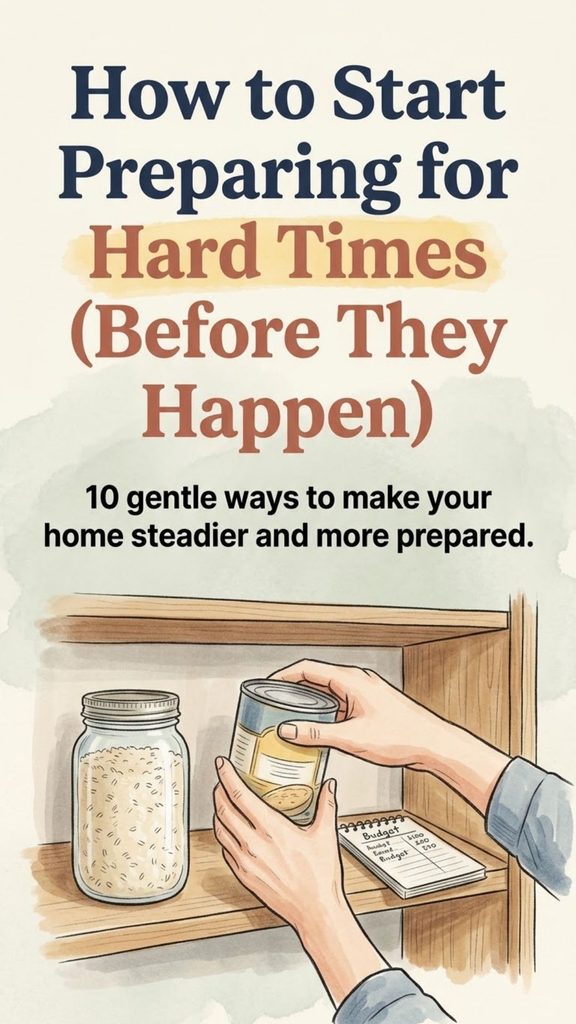
Hard seasons rarely arrive at a convenient time. A job can disappear, household expenses can rise, a car can need an expensive repair, or a family may suddenly need to manage on less income. Sometimes the change is temporary. Other times, it reshapes the household budget for months or years.
Preparing for those possibilities does not require panic buying, extreme stockpiling, or living as though disaster is around the corner. Practical preparedness is much quieter than that. It means strengthening the parts of your household that are most likely to help when money becomes tight or everyday life becomes difficult.
A useful emergency fund, a pantry filled with food you actually eat, basic cooking skills, manageable expenses, organized household information, and dependable relationships can all make a difficult period easier to handle.
You Might Also Like:
- Loading posts...
You do not have to build everything at once. In fact, gradual preparation is usually more realistic. Start with the areas that would give your household the greatest breathing room, then improve them little by little.
1. Find Out Where Your Money Is Really Going
The first step in preparing for financial difficulty is understanding your current spending.
Many households have expenses that quietly become automatic: unused subscriptions, frequent takeaway meals, impulse purchases, convenience fees, repeated small shopping trips, or services that are no longer especially useful.
None of these expenses automatically makes someone irresponsible. The problem is simply that it is difficult to reduce spending later if you do not know where the money is going now.
Track your spending for at least a few weeks. A notebook, spreadsheet, budgeting app, or bank statements can all work. What matters is seeing the complete picture.
Separate expenses into broad categories such as:
- Housing
- Utilities
- Groceries
- Transportation
- Insurance
- Debt payments
- Medical expenses
- Subscriptions
- Eating out
- Clothing
- Entertainment
- Miscellaneous spending
Then look for expenses that could be reduced without making everyday life unnecessarily miserable.
Perhaps you keep one streaming service instead of three. Maybe you plan one takeaway meal each month rather than ordering whenever the week becomes hectic. You might combine errands to reduce unnecessary driving or begin buying certain household items secondhand.
Small reductions matter because they create flexibility before there is an emergency.
2. Build an Emergency Fund Gradually
Savings can turn an unexpected expense from a crisis into an inconvenience.
There is no single emergency-fund amount that suits every household. A family with several dependents, a variable income, and an older vehicle may need a different cushion from someone with fewer obligations and very stable employment.
If you currently have little or no emergency savings, start with a modest first goal rather than becoming discouraged by a large number.
Save whatever is realistic: $5, $10, $25, or more at a time. Consistency matters more than beginning with a large amount.
Eventually, many households aim to build enough savings to cover several months of essential expenses, but reaching that level may take years. The important part is beginning.
Keep emergency savings separate from everyday spending if possible. That makes it less tempting to use the money for ordinary purchases.
Before spending from the fund, ask whether the expense is genuinely unexpected, necessary, and difficult to cover from the normal household budget.
Car repairs required for work, an urgent home repair, or income lost during unemployment may qualify. A holiday sale usually does not.
3. Build a Pantry Around Meals, Not Random Stockpiles
A well-stocked pantry can be one of the most useful household buffers during difficult times.
The goal is not to fill every shelf with survival food. Instead, keep a reasonable supply of foods your household already uses and rotate them through normal meals.
Depending on your family’s diet, practical staples might include rice, pasta, oats, flour, canned tomatoes, beans, lentils, shelf-stable milk, canned fish, cooking oil, frozen vegetables, herbs, spices, and baking ingredients.
The best pantry is built around actual meals.
Think about inexpensive dishes your household enjoys and identify the ingredients required to make them. A few dependable meal combinations are more valuable than shelves full of ingredients you do not know how to use.
For example, pantry and freezer staples might allow you to make:
- Vegetable and lentil soup
- Pasta with tomato sauce
- Rice and beans
- Oatmeal with fruit
- Homemade bread with soup
- Curry with rice
- Baked potatoes with simple toppings
- Stews using inexpensive vegetables and small amounts of meat
Build your supply slowly. Buying one extra jar, packet, or can during normal grocery shopping is usually easier on the budget than attempting a large stock-up.
Remember to rotate your pantry. Use older food first and replace what you consume. Check storage instructions and best-before or use-by dates rather than assuming shelf-stable means indefinite.
4. Strengthen Your Basic Cooking Skills
Knowing how to turn inexpensive ingredients into filling meals is one of the most useful forms of household preparedness.
You do not need to become an accomplished baker or cook everything from scratch. Focus first on flexible skills that reduce your dependence on expensive convenience foods.
Useful basics include learning how to:
- Make soup from vegetables and leftovers
- Cook rice, beans, lentils, and other inexpensive staples
- Roast vegetables and basic cuts of meat
- Make simple sauces and dressings
- Bake an easy loaf, flatbread, or muffins
- Freeze leftovers safely
- Turn leftover ingredients into another meal
- Plan meals around what is already in the refrigerator
Meal stretching is especially useful when money is tight.
A smaller amount of meat can sometimes be combined with beans, lentils, rice, potatoes, vegetables, or pasta to make a larger meal. Leftover roast chicken can become soup, sandwiches, or a casserole rather than being forgotten at the back of the refrigerator.
The goal is not deprivation. It is getting more useful meals from the food you already purchase.
5. Test Whether Your Household Could Manage on Less Income
If your household currently has financial breathing room, try occasionally budgeting as though your income were lower.
You do not necessarily have to live entirely on one income. That may be unrealistic for households where both incomes are needed for essential expenses.
Instead, choose an amount and temporarily reduce the money available for discretionary spending.
For example, you could direct a portion of income immediately toward savings or debt repayment and operate the household using what remains.
This exercise can reveal useful information.
You may discover that certain expenses are more flexible than expected. You may also find that other costs cannot realistically be reduced.
Either result is valuable because it helps you create a realistic emergency budget before you urgently need one.
Prepare two budgets:
Your normal budget reflects everyday household spending.
Your bare-bones budget includes only essential expenses such as housing, food, utilities, transportation, insurance, medication, and minimum debt obligations.
Knowing the difference between those two amounts gives you a clearer idea of what your household would actually require during a financial emergency.
6. Reduce Expenses While You Still Have Choices
Cutting spending voluntarily is usually easier than being forced to do it overnight.
Look at recurring expenses and decide which ones genuinely improve your family’s life.
Some spending may absolutely be worth keeping. Other expenses may simply have continued because nobody stopped to reconsider them.
Try replacing some paid activities with lower-cost alternatives before money becomes tight.
Library books can replace some book purchases. Home movie nights can replace frequent cinema trips. Walking, picnics, gardening, crafts, visiting friends, and local community events can provide entertainment without requiring much spending.
This is not about eliminating every pleasure from life. A household budget that allows no enjoyment is often difficult to sustain.
The better goal is learning that enjoyment does not always have to depend on spending money.
7. Sell Useful Things You No Longer Need
Decluttering can support preparedness in two ways: it simplifies the home and may produce a little extra money.
Start with items that still have value but are no longer serving your household.
Possible examples include:
- Small appliances you never use
- Children’s items that have been outgrown
- Furniture that no longer fits your space
- Tools you own in duplicate
- Electronics
- Hobby supplies
- Clothing in good condition
The amount you earn may be modest, so avoid assuming decluttering will solve major financial problems. Still, even small amounts can be directed toward emergency savings, groceries, debt reduction, or necessary household supplies.
Decluttering also helps you understand what you already own. That can prevent buying duplicates simply because something was buried in a cupboard or storage box.
8. Create a Simple Household Information System
Financial preparedness is not only about money and food. Information matters too.
During an emergency, trying to remember account numbers, contact details, insurance information, medication lists, or monthly obligations can add unnecessary stress.
Create a simple household binder, folder, or secure digital system containing information such as:
- Monthly bills and payment dates
- Insurance information
- Emergency contacts
- Important medical information
- Household maintenance records
- Basic pantry inventory
- Account and service contact information
- Copies or locations of essential documents
Be careful with highly sensitive information. Passwords, financial login details, identification documents, and similar records should be stored securely rather than left in an easily accessible household binder.
The goal is to make essential information available to the appropriate family members if the person who normally manages the household becomes ill or unavailable.
9. Learn a Few Skills That Reduce Dependence on Spending
Practical household skills become especially valuable when money is limited.
You do not need acreage, livestock, or an elaborate homestead. Self-reliance can begin with very ordinary abilities.
You might learn to grow herbs in containers, repair a loose button, preserve seasonal produce safely, bake basic bread, mend simple clothing, perform minor household maintenance, or make meals from inexpensive staple ingredients.
Choose skills based on what your household actually uses.
Growing expensive herbs that you regularly buy may be worthwhile. Growing vegetables nobody in your family eats probably is not.
Likewise, homemade products are not automatically cheaper. Some require ingredients, equipment, storage space, or considerable time. Compare the real cost before assuming DIY always saves money.
The best skills are the ones you will continue using because they genuinely make your household more capable.
10. Strengthen Relationships Before You Need Help
Preparedness can become very focused on money, supplies, and practical skills, but relationships are also an important source of resilience.
People often cope better with difficult seasons when they have trusted family members, friends, neighbours, or community connections.
Strong communities are built through ordinary actions long before anyone needs assistance.
Offer a neighbour a hand when you can. Check on family members. Share surplus garden produce. Exchange skills. Help someone move furniture. Watch a friend’s child for an hour. Accept help graciously when someone offers it to you.
Healthy community is not about helping people only because you expect something in return. It is about building relationships in which people naturally look out for one another.
During job loss, illness, bereavement, or another difficult period, practical support from trusted people can be just as meaningful as financial preparation.
Keep Basic Household Supplies Without Overbuying
Food is not the only category worth considering.
Think about everyday items that would be inconvenient to run out of during a financially difficult month, short illness, storm, or temporary disruption.
That might include reasonable quantities of:
- Toilet paper
- Soap
- Laundry detergent
- Basic cleaning supplies
- Pet food
- Batteries
- Necessary hygiene products
- Regularly used over-the-counter items
- Prescription medications, where permitted and appropriate
The emphasis should be on reasonable quantities.
Buying excessive amounts can create new problems by tying up money, using valuable storage space, and allowing products to expire before they are used.
A small reserve of frequently used essentials is usually more practical than an enormous stockpile.
Protect the Things You Already Own
One of the most overlooked forms of preparedness is maintenance.
Replacing a neglected appliance, vehicle, roof, or piece of equipment can be far more expensive than caring for it properly.
Stay reasonably current with basic maintenance. Change filters when required. Repair small leaks before they become larger problems. Follow vehicle maintenance schedules. Clean appliances according to their instructions. Store tools properly.
You cannot prevent every breakdown, but good maintenance can reduce avoidable expenses and extend the useful life of many household items.
The same principle applies to food. Organize the freezer, rotate pantry items, and store ingredients properly so money is not lost through unnecessary waste.
Avoid Going Into Debt to “Prepare”
Preparedness should make your household more financially secure, not less.
It is easy to become anxious and feel that you need expensive equipment, huge food reserves, specialized gadgets, or every imaginable emergency supply immediately.
Most households do not need to do that.
Start with ordinary risks first: temporary income loss, unexpected repairs, rising bills, illness, transportation problems, and short interruptions to normal routines.
A modest emergency fund and several weeks of familiar food may be more useful to your household than expensive equipment purchased on credit.
Build gradually and stay within what you can realistically afford.
Start With the Weakest Part of Your Household Plan
Preparing for hard times becomes much less overwhelming when you stop trying to fix everything at once.
Look at your household and identify the area that currently feels most vulnerable.
If there is no emergency fund, begin saving.
If groceries are constantly stretching the budget, strengthen your meal planning and pantry.
If household spending is unclear, track expenses.
If you depend heavily on convenience food, learn three or four inexpensive meals.
If important paperwork is scattered everywhere, organize it.
Once that area becomes stronger, move to the next.
A resilient household is rarely built through one dramatic decision. It develops through dozens of ordinary choices made while life is relatively stable.
Preparation Is Really About Creating Options
Hard times can still be difficult even when you prepare well. Savings can run low. Repairs can be expensive. Jobs can disappear unexpectedly. No pantry, budget, or household system can remove every uncertainty.
Preparation does something more realistic: it gives you options.
Savings can buy time. Pantry food can reduce grocery spending for a while. Cooking skills can make a limited food budget stretch further. Lower monthly expenses can make an income reduction easier to absorb. Organized records can reduce confusion. Strong relationships can provide support when life becomes heavy.
You do not have to transform your household in a weekend.
Save a little. Learn one useful skill. Cancel one expense you no longer value. Add a few practical foods to the pantry. Organize one folder. Make one inexpensive meal from what you already have.
Those small actions may not feel dramatic, but taken together, they build something valuable: a household that is better able to adjust when life does not go according to plan.