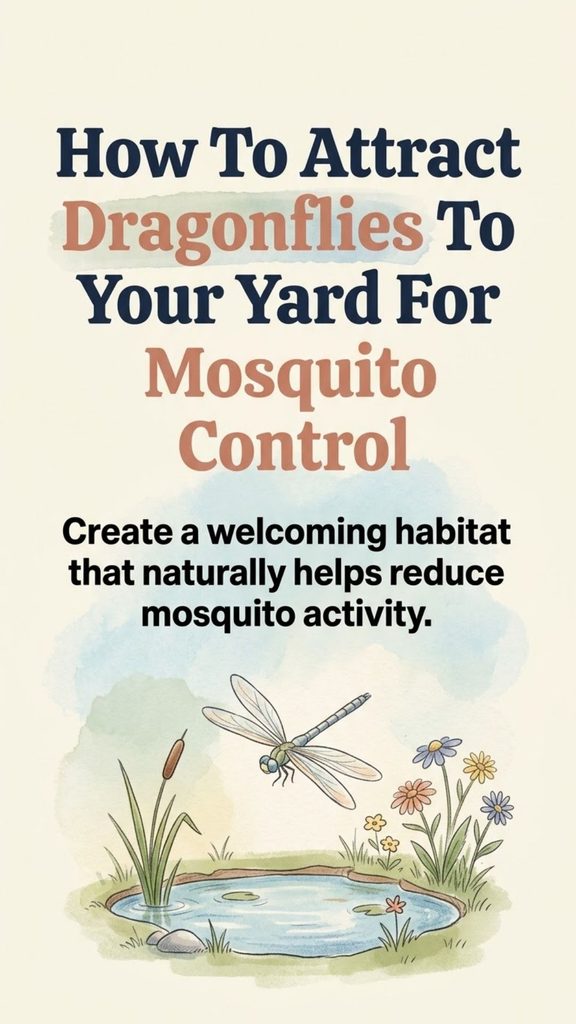
Dragonflies are some of the most useful predators you can encourage in a wildlife-friendly yard. Adult dragonflies hunt flying insects such as mosquitoes, midges, gnats, and flies, while their aquatic young prey on small organisms in ponds and wetlands, including mosquito larvae. Smithsonian Gardens notes that an adult dragonfly may catch more than 30 mosquitoes in a day, although mosquitoes are only one part of a much broader diet.
That makes dragonflies valuable allies, but there is an important distinction: attracting dragonflies should be viewed as one part of a natural mosquito-management strategy, not as a guarantee that mosquitoes will disappear. Dragonfly populations move between habitats, feed on many types of insects, and cannot be controlled precisely enough to replace basic mosquito prevention. Penn State Extension describes these predators as beneficial but also unpredictable when used specifically for mosquito suppression.
The best approach is to create the kind of healthy freshwater habitat dragonflies actually need while also preventing your yard from becoming a mosquito nursery.
You Might Also Like:
- Loading posts...
Why Water Matters More Than Anything Else
If you want dragonflies to stay rather than simply fly through your property, water is the most important feature you can provide.
Dragonflies spend much of their lives underwater as immature nymphs. Adults return to freshwater habitats to reproduce, and the young develop in ponds, wetlands, streams, lakes, and other suitable aquatic environments before eventually climbing out of the water and transforming into winged adults.
A backyard wildlife pond can therefore provide far more useful habitat than simply putting out a shallow bowl of water.
A good dragonfly pond does not need to be enormous, but it should offer varied conditions rather than being a smooth container filled with open water. A combination of shallow margins, somewhat deeper areas, aquatic vegetation, stones, and emerging stems creates more opportunities for different dragonfly and damselfly species.
Penn State Extension recommends ponds with varied depths and a mixture of submerged, floating, and emergent vegetation. Greater habitat diversity can support a greater variety of odonates—the insect group that includes dragonflies and damselflies.
There is no magic depth that makes a pond safe from mosquitoes. Mosquitoes can reproduce around sheltered, stagnant pond margins even when the center of the pond is much deeper. Pond design and management matter more than simply making the water two feet deep.
Give Dragonflies Plenty of Aquatic Plants
Plants around a dragonfly pond do much more than make it attractive.
Submerged plants provide cover for aquatic life. Emergent plants—those rooted underwater with stems rising above the surface—are particularly useful because mature dragonfly nymphs need a way to leave the water when they are ready to become adults. They can climb a stem, reed, stick, or similar structure and complete their final transformation above the waterline.
Floating and shoreline vegetation can also provide shade, shelter, egg-laying habitat, and places for adult dragonflies to perch.
Whenever possible, choose aquatic and marginal plants native to your region. Suitable choices depend heavily on climate, soil, pond depth, and location, so a native plant nursery or local extension service is a better guide than a universal list of species.
Avoid assuming that fragrant herbs or colorful flowers directly attract dragonflies in the same way flowers attract bees and butterflies. Dragonflies do not visit flowers for nectar. Flowering plants can still be useful because they support a diverse insect community, but for dragonflies themselves, water, prey, vegetation, perching sites, and suitable breeding habitat are much more important.
Add Places for Adults to Perch and Bask
Watch dragonflies for a while and you will notice that they spend plenty of time sitting still.
They frequently perch on reeds, branches, stems, stakes, and other upright structures between hunting flights. Flat stones near water can also provide useful basking areas.
You do not need an elaborate setup. A few sturdy natural branches near the pond, upright stems emerging from the water, and stones along the sunny edge can make the habitat more useful.
Leaving some plant stems standing rather than cutting every part of the pond margin to ground level can provide additional perching and emergence sites.
The aim is not to make the pond look neglected. It is to avoid creating an environment so tidy that wildlife has nowhere to land, hide, hunt, or develop.
Put the Pond Where It Receives Sun
Dragonflies are often especially active in warm, sunny areas.
Penn State Extension recommends plenty of sunlight around backyard dragonfly ponds because adults use sunny locations for basking. Protection from strong prevailing winds can also make the area more inviting.
Try to provide a reasonably open area around at least part of the pond rather than surrounding every inch with dense shrubs or overhanging trees.
Large deciduous trees directly above a small pond can create another problem: falling leaves may contribute large amounts of decomposing organic material to the water. A little natural debris is normal, but a small pond packed with decaying leaves can become difficult to manage.
A useful layout combines sunlight over the water, some vegetation for shelter, and nearby shrubs or other plantings that offer protection without completely shading the pond.
Be Careful About Adding Fish
A decorative pond filled with goldfish or koi may be beautiful, but it is not necessarily the best nursery for dragonflies.
Fish can eat aquatic insects, including dragonfly and damselfly nymphs. Penn State Extension specifically advises against introducing ornamental fish when the primary goal is to create habitat for odonates.
This does not mean fish are universally bad for backyard ponds. They can serve other purposes, and some fish eat mosquito larvae. The important point is that a pond designed primarily for dragonfly reproduction and a pond designed primarily for ornamental fish may require different management choices.
If your main goal is supporting dragonflies, a fish-free wildlife pond usually gives their aquatic young fewer predators to contend with.
Do Not Let Your Dragonfly Pond Become a Mosquito Factory
Creating standing water to attract dragonflies raises an obvious concern: mosquitoes also need water to reproduce.
A poorly maintained pond can produce mosquitoes before enough natural predators become established.
One option is gentle water movement. A fountain, waterfall, or small pump can reduce stagnant areas that mosquitoes favor. If a pump has an exposed intake, however, screening may be needed because aquatic dragonfly and damselfly nymphs can be pulled into the equipment.
More importantly, continue eliminating unnecessary standing water elsewhere in the yard. Buckets, clogged gutters, plant saucers, discarded containers, tarps, toys, wheelbarrows, and other objects that trap rainwater can become mosquito breeding sites.
Penn State Extension identifies eliminating or treating these small sources of standing water as one of the most effective steps homeowners can take against mosquitoes.
A carefully designed wildlife pond is very different from accidentally leaving numerous stagnant containers around the property.
Reduce Broad-Spectrum Pesticide Use
If you are trying to encourage insect predators, routinely spraying the entire yard with non-selective insecticides works against that goal.
Products that kill adult mosquitoes can also affect other insects. Penn State Extension warns that routine applications of non-selective insecticides can harm non-target organisms and potentially enter waterways.
Instead of treating every insect as a problem, identify the pest first and use the least disruptive control that solves it.
This does not mean every pesticide should be rejected under every circumstance. Serious pest problems sometimes require targeted treatment. The important distinction is between carefully managing a known pest and repeatedly spraying an entire garden simply because insects are present.
A yard capable of supporting dragonflies needs insects. They are the dragonflies’ food supply.
Create a More Natural Pond Edge
Perfectly vertical pond walls may be easy to construct, but a gradual shoreline creates more varied habitat.
Where practical, include shallow sections along parts of the edge, then transition toward deeper water. This allows different aquatic and marginal plants to grow at appropriate depths while giving small animals multiple habitat zones.
Stones, gravel, natural branches, emergent vegetation, and patches of damp soil around the edge can help the pond feel more like a functioning miniature wetland than a container of water.
Do not assume, however, that dragonflies require a muddy bog specifically to emerge. What developing nymphs truly need is a suitable structure that allows them to climb out of the water, such as vegetation, rocks, or sticks.
Providing several habitat types is better than trying to reproduce one supposedly perfect dragonfly feature.
Let Some of Your Yard Stay a Little Wild
A yard designed exclusively around short turf and perfectly clipped edges provides fewer opportunities for wildlife than one containing several layers of vegetation.
Consider allowing native grasses, flowering plants, shrubs, and other vegetation to occupy areas that do not need to be lawn. Near the pond, allow some stems and natural structures to remain instead of removing every piece of plant material immediately.
Native plants are especially valuable because they are adapted to local conditions and contribute to local food webs.
You do not need to turn the entire property into an unmanaged meadow. Even a deliberately planted pond border or a less manicured garden corner can add valuable habitat while still looking intentional.
The best wildlife gardens usually contain a balance: open sunny areas for dragonflies to hunt and bask, vegetation for shelter and perching, and freshwater habitat where their young can develop.
Remember That Dragonflies Eat More Than Mosquitoes
Dragonflies are impressive hunters, but calling them dedicated mosquito-control machines gives the wrong impression.
Adults catch whatever appropriately sized flying prey is available. Their diet may include mosquitoes, midges, flies, and many other insects. Their aquatic young are also generalist predators.
This is one reason estimates claiming that every dragonfly eats hundreds of mosquitoes every day should be treated cautiously. Smithsonian Gardens gives a figure of more than 30 mosquitoes per day for an adult dragonfly, while other estimates vary considerably. The exact number depends on species, prey availability, conditions, and what other insects are available.
A better reason to attract dragonflies is that they become part of a healthier predator-prey community that can contribute to natural insect control.
Give the Habitat Time to Develop
Dragonfly habitat does not always produce instant results.
Once eggs hatch, the aquatic stage may last months or, in some species, considerably longer. Some dragonfly nymphs remain underwater for years before emerging as adults.
That does not mean you necessarily have to wait years before seeing your first visitor. Adult dragonflies are capable fliers, and where suitable freshwater habitat already exists nearby, they may investigate a new backyard pond surprisingly quickly. Penn State Extension notes that species capable of using small ponds may find newly created backyard habitat when source populations are nearby.
Establishing a breeding population is different from attracting a few visiting adults, however. Allow the plants, water conditions, prey community, and pond structure time to mature.
Combine Dragonfly Habitat With Practical Mosquito Prevention
Dragonflies can contribute to mosquito control, but your best results come from combining wildlife-friendly gardening with direct mosquito prevention.
Regularly inspect the property for accidental standing water. Empty containers after rain, maintain gutters, refresh birdbaths frequently, and prevent water from collecting in unused equipment or containers. For permanent water that cannot be drained, appropriately labeled biological larvicides such as products containing Bacillus thuringiensis israelensis (Bti) are among the options used for mosquito larvae. Always follow the product label and consider the needs of the wildlife living in the water.
This approach tackles mosquitoes where they breed while preserving a garden that can still support beneficial predators.
A Dragonfly-Friendly Yard Is About Habitat, Not a Single Plant
The simplest way to attract more dragonflies is not to search for one magical flower or herb. Build the conditions they need to complete their life cycle.
Give them clean freshwater, a variety of aquatic plants, upright stems for emergence and perching, sunny areas for basking, and enough natural habitat for a healthy insect community. Avoid unnecessary broad-spectrum pesticide use, and think carefully before adding fish to a pond intended primarily for dragonflies.
At the same time, keep mosquito expectations realistic. Dragonflies can eat mosquitoes and their aquatic young can prey on mosquito larvae, but they should complement—not replace—basic mosquito prevention.
Create the right habitat, maintain it thoughtfully, and give nature some time. The reward is not simply fewer unwanted insects. It is a livelier yard filled with some of the most fascinating aerial hunters you can invite into a garden.