A traditional wooden fence usually means posts, rails, boards, and a long line of nails or screws holding everything together. That method is proven and dependable, but it is not the only way to create a wood privacy screen.
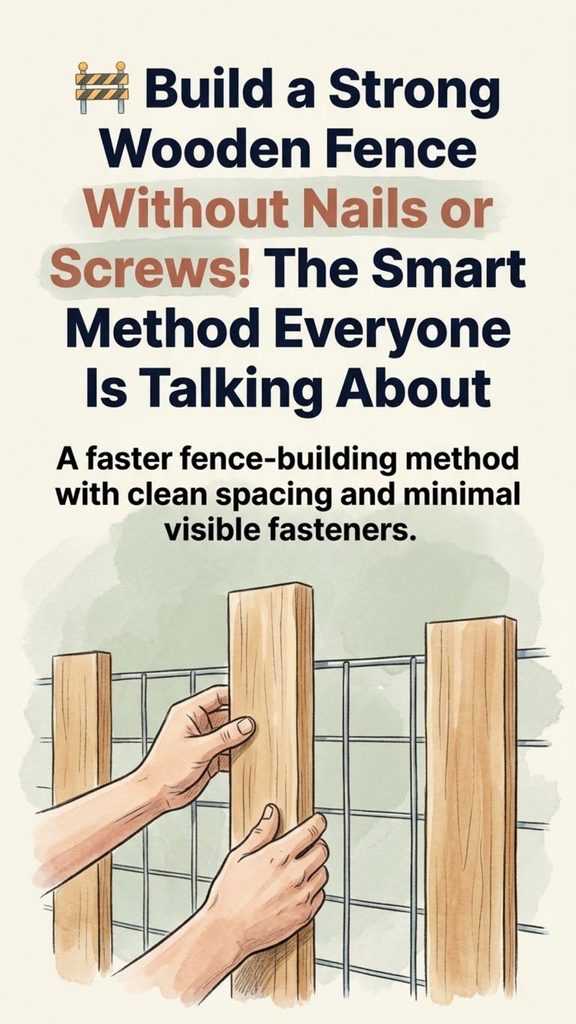
One clever alternative uses a rigid wire-mesh framework to position and support individual wooden slats. Instead of fastening every board repeatedly through its face, the slats are fitted through or between sections of mesh so the metal grid helps maintain their position and spacing. The result can be a surprisingly clean, modern-looking fence with far fewer visible fasteners.
The idea is especially appealing for small backyard partitions, decorative screens, garden boundaries, and other light-duty projects where appearance and quick assembly matter. However, calling it a completely “nail-free” or “screw-free” fence can be misleading. The wooden infill may require few or no visible face fasteners, but the posts, frame, mesh panels, and connections still need to be securely anchored.
You Might Also Like:
- Loading posts...
Understanding that difference is the key to making this DIY method useful rather than simply copying a viral construction trick.
How the Wire-Mesh and Wood Slat Method Works
The basic concept is simple.
A strong metal mesh panel creates an evenly spaced grid. Narrow wooden boards or slats are inserted through openings in the mesh in a repeated pattern. Depending on the design, they may pass alternately in front of and behind sections of the wire, creating enough restraint to keep them aligned.
The mesh essentially becomes both a guide and part of the support system.
This has an immediate advantage during installation: you do not have to measure the position of every individual board from scratch. The grid provides consistent reference points, helping the slats remain parallel and evenly spaced.
It can also hide much of the fence’s hardware behind the finished wood surface. From a distance, the viewer sees a row of clean wooden boards rather than hundreds of screw or nail heads.
That makes the system particularly attractive for contemporary fences where simple lines are part of the design.
It Is Better Described as a Low-Fastener Fence
There is an important distinction between holding wooden slats in place and building the structure that keeps an entire fence standing.
A wire panel can help retain lightweight wooden infill, but it does not eliminate the need for properly installed structural components.
Fence posts still need to resist movement. Frames and mesh need reliable connections. Gates require appropriate hinges and hardware. Tall privacy fences may also experience substantial wind pressure because their broad surface acts much like a sail.
For that reason, this technique is best thought of as a minimal-visible-fastener infill method, not a way to avoid structural connections altogether.
If a fence is tall, exposed to strong wind, installed on difficult ground, or positioned where failure could create a hazard, its structural design deserves more attention than the decorative slat system.
Local fence requirements can also vary considerably, including rules for fence height, setbacks, property boundaries, and permits. Check the requirements that apply where the fence will be installed before starting a permanent structure.
Choosing the Right Mesh Is Crucial
Not every type of wire fencing is suitable for this idea.
The mesh needs enough stiffness to hold its shape after wooden slats are inserted. Thin, flexible fencing may bow, sag, or distort once several boards are woven into it.
A rigid welded-wire panel is generally better suited to this style of construction than very soft mesh because its intersections resist movement and help maintain consistent spacing.
Mesh opening size matters too.
If the openings are much larger than the wooden boards, the slats may move excessively. If they are too tight, inserting the wood can become difficult and may bend the wire or damage the board edges.
The wood and mesh should therefore be selected as a system rather than purchased separately without considering how they fit together.
Before buying enough material for an entire fence, making one small test section is a sensible approach. It quickly reveals whether the slats fit properly and whether the finished panel feels sufficiently rigid.
Select Wood That Can Handle Outdoor Conditions
The wooden slats will spend their lives exposed to changing humidity, rain, sunlight, and temperature.
Wood naturally exchanges moisture with its environment, and those changes can cause dimensional movement, including swelling and shrinking. The USDA Forest Products Laboratory notes that moisture relationships have an important effect on wood’s physical properties and dimensional stability.
That matters particularly with a mesh system because the wood fits inside relatively fixed openings. Slats installed extremely tightly may become harder to move or may press against the metal as moisture levels change.
Choose lumber appropriate for exterior use and avoid severely twisted, bowed, or unstable pieces. Straighter stock makes installation easier and produces a much neater finished fence.
The boards should also be reasonably consistent in thickness. A mixture of noticeably different dimensions may lead to loose sections in some areas and overly tight sections in others.
Cut ends deserve attention as well because exposed end grain readily takes up moisture. Follow the recommended finishing or treatment procedure for the particular lumber you choose.
How to Build the Fence
The exact construction will vary with the design, but a careful installation generally follows this sequence:
- Plan the fence line first. Confirm boundaries, determine the total length and desired height, locate gates, and check applicable local requirements before digging.
- Install a stable post system. Set suitable posts at appropriate intervals for the fence design, soil, height, and expected environmental loads. Make sure every post is plumb before building the infill sections.
- Build or install the supporting frame. Add whatever rails or perimeter framing the particular mesh panel requires. The purpose is to give the wire a rigid structure rather than expecting the wooden slats to stabilize the entire fence.
- Attach the wire mesh securely. Keep it square and properly tensioned without pulling it so aggressively that the panel distorts. Loose mesh will make the wooden slats difficult to align.
- Cut the wooden slats consistently. A stop block on a saw setup can help produce equal lengths. Sand or ease rough edges where needed so the boards can pass through the grid without catching.
- Insert the boards in a consistent pattern. Work methodically from one side of the panel toward the other. If the design uses an alternating weave, keep the same sequence throughout the entire section.
- Check alignment frequently. Do not wait until the whole fence is filled before checking your work. Step back every few boards and look for uneven spacing, leaning slats, or mesh distortion.
- Secure the panel where necessary. Depending on the construction, discreet retaining hardware may be appropriate to prevent boards from sliding or being lifted out. Use exterior-rated components compatible with the other materials.
- Finish and protect the wood. Apply the exterior finish suitable for your chosen lumber and maintain it according to the product instructions.
Why This Method Can Be Faster
The biggest productivity advantage comes from using the mesh as a positioning guide.
With a conventional vertical-board fence, each board normally has to be positioned, checked for spacing and level, and then fastened to the supporting rails. The process is straightforward but repetitive.
With a grid-assisted system, much of that alignment is built into the panel. Once the posts, framing, and mesh are correctly installed, the repetitive part of fitting the slats can move quickly.
There are fewer visible attachment points to deal with, and consistent spacing can be easier to maintain.
For a long fence, however, the time saved depends on the particular design. Cutting dozens of accurately sized slats and weaving each one through a tight panel still takes work. It is better to see this as an alternative workflow rather than assume it will always be dramatically faster than traditional construction.
The Clean Appearance Is a Major Advantage
One reason this style attracts attention is that the finished surface can look unusually neat.
Traditional fencing often leaves rows of nail or screw heads visible across the boards. There is nothing inherently wrong with that, but a low-fastener design creates a different aesthetic.
The repeating wood and metal pattern can look modern while still keeping the warmth of natural timber. Depending on board width and spacing, the fence can provide anything from an airy garden screen to substantial visual privacy.
The wire can also become part of the design instead of something that needs to be hidden completely.
For contemporary gardens, patios, vegetable areas, and compact outdoor spaces, that combination of natural wood and geometric metal can work particularly well.
Allow for Wood Movement
One of the easiest mistakes with this project is creating a fit that is too perfect on installation day.
Wood does not remain dimensionally identical throughout the year. Changes in moisture content can produce swelling, shrinkage, checking, and warping. Exterior exposure to moisture and sunlight also contributes to weathering over time.
Do not force oversized boards through mesh openings simply because they can be hammered into place.
A slat that is already under substantial pressure while dry may behave differently after absorbing moisture. Conversely, boards installed while wetter may shrink later and fit more loosely.
Appropriate clearance depends on the wood species, board dimensions, moisture condition, mesh geometry, and local environment, so there is no universal spacing measurement that works for every version of this fence.
This is another reason a test panel is valuable.
Where This Fence Style Makes the Most Sense
A mesh-supported wooden slat system is particularly appealing when the fence is primarily serving as a privacy screen, garden divider, decorative boundary, patio enclosure, or visual feature.
It can also be useful where a homeowner wants to combine the clean repetition of a metal grid with the appearance of wood.
It becomes less attractive when maximum structural resistance is the dominant requirement.
A fully framed and conventionally fastened fence may be more appropriate in particularly exposed locations, around areas requiring a specific safety barrier, or wherever building requirements call for a particular construction method.
A decorative idea should never take priority over structural reliability.
Pay Attention to Metal and Wood Durability
The wooden boards are only half of the system.
Because the wire mesh becomes a permanent part of the fence, it also needs to survive outdoor exposure. Appropriate corrosion-resistant mesh and exterior-rated hardware are important. Once corrosion develops inside a tightly assembled panel, replacing the metal may require taking apart a large portion of the fence.
Contact points deserve occasional inspection because moisture and debris can collect where pieces meet.
Wood also needs maintenance. Sun and rain gradually change exposed timber, while repeated moisture cycling contributes to surface deterioration and movement. The USDA Forest Service notes that exterior wood requires suitable material selection, design, and finishing when exposed to weather.
A beautiful installation on day one is only part of a successful outdoor project. It should also be designed so damaged pieces can be repaired or replaced later.
Common Problems to Avoid
Poorly aligned posts cannot be corrected by carefully spaced slats. Start with the structure.
Do not rely on flexible mesh to behave like rigid framing. Avoid untreated or unsuitable wood simply because it is inexpensive. Do not jam boards into openings without allowing for natural movement. Do not leave sharp wire edges exposed where people or animals can contact them.
It is also a mistake to assume that eliminating visible screws automatically makes a stronger fence.
Traditional screws, nails, bolts, brackets, and other mechanical fasteners exist because properly selected connections transfer forces reliably between structural parts. The USDA Wood Handbook devotes an entire chapter to wood fastenings as part of wood engineering and construction.
The clever part of this fencing method is hiding or reducing fasteners where they are not needed—not removing essential structural connections.
Is a Wire-Mesh Wooden Fence Worth Building?
For the right project, this is a genuinely interesting alternative to conventional fence boards.
The mesh can speed alignment, keep spacing consistent, reduce the number of visible fixings, and create a distinctive modern appearance. It can also make repetitive installation surprisingly straightforward once the supporting structure has been completed.
Its weaknesses are equally important.
The finished result depends heavily on straight wood, appropriately sized mesh, secure structural framing, weather-resistant materials, and accurate installation. A loosely assembled panel will not become strong simply because the boards are trapped inside wire.
The smartest version of this idea therefore combines old-fashioned structural common sense with the newer slat-retention technique.
Build the posts and frame to last. Choose exterior materials carefully. Let the mesh simplify alignment and hold the decorative wooden infill. Allow the wood to move naturally, and use discreet fasteners wherever they genuinely improve safety and durability.
Done properly, the result is not really a fence “without screws or nails.” It is something more practical: a clean-looking wooden fence that uses far fewer visible fasteners while still respecting the basic principles that keep outdoor structures standing.