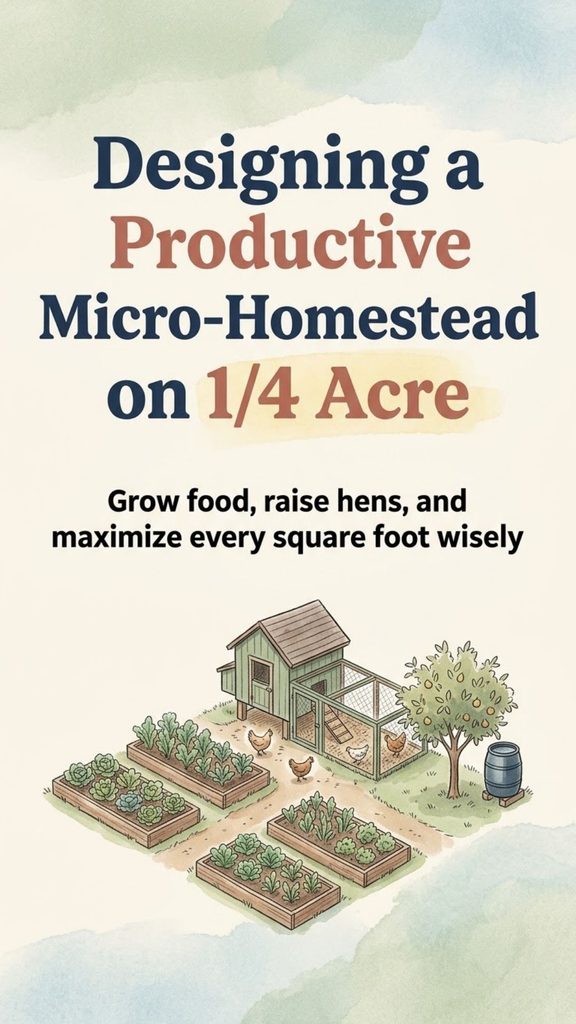
A quarter acre may not sound like much land, but it offers far more possibilities than many new homesteaders realize. At approximately 10,890 square feet, a 1/4-acre property can hold a productive vegetable garden, herbs, fruit trees, berries, composting systems, rainwater collection, and—in places where local rules permit it—even a small flock of chickens.
The key is not trying to squeeze every possible homesteading activity onto the property. A successful micro-homestead is designed around efficiency. The most productive spaces are usually those where sunlight, water, soil, pathways, storage, and daily chores have been considered before anything permanent is built.
A small homestead also does not have to provide every calorie your household eats. Growing vegetables, producing some fruit and eggs, composting household scraps, preserving seasonal harvests, and reducing dependence on purchased food are meaningful forms of self-sufficiency.
You Might Also Like:
- Loading posts...
If you are starting with a quarter acre, thoughtful planning will usually accomplish more than simply planting as much as possible.
Start by Understanding the Land You Already Have
Before building raised beds or ordering fruit trees, spend time observing the property.
Sunlight should be one of the first things you study. Many fruiting vegetables, including tomatoes, peppers, cucumbers, squash, and beans, perform best with plenty of direct sunlight. Leafy greens and some herbs can tolerate more partial shade.
Watch the property at several times during the day. A spot that looks sunny in the morning may be shaded by the house, fence, or mature trees during the afternoon.
Also look at:
- Areas where water collects after rain
- Dry or exposed areas
- Strong prevailing winds
- Existing trees and their root zones
- Slopes
- Roof downspouts
- Outdoor faucets
- Utility lines
- Gates and access points
- Existing sheds, patios, and fences
These observations can save considerable work later.
A vegetable garden placed far from your water supply, for example, may become frustrating to maintain. A greenhouse in a heavily shaded corner will not perform as expected. Chickens positioned beside a bedroom window may create problems that could have been avoided with better planning.
Sketching the property can make these relationships easier to see. Mark the house, driveway, fences, trees, water sources, sunny areas, and anything else that cannot easily be moved.
Check Local Rules Before Designing Around Livestock or Structures
Urban and suburban homesteading often comes with restrictions that rural properties do not have.
Before buying chickens, bees, building materials, or a greenhouse, check the regulations that apply to your property.
Rules may affect:
- Whether chickens are permitted
- Maximum flock size
- Whether roosters are allowed
- Coop setbacks from neighboring properties
- Beekeeping
- Accessory structures
- Greenhouse placement
- Fencing
- Rainwater systems
- Composting
- On-site produce sales
Homeowners associations can also have rules separate from municipal regulations.
It is much easier to adapt a plan before building than to move a coop or dismantle a structure later.
Test and Improve the Soil
Soil is one of the most important resources on a micro-homestead.
Instead of automatically replacing existing soil or assuming it is poor, have it tested when possible. A soil test can provide information about pH and nutrient levels and may help identify what amendments are actually needed.
Different plants prefer somewhat different soil conditions, so there is no single perfect pH for every crop. Most common vegetables grow well in soil that is slightly acidic to near neutral, but it is better to adjust soil according to what you intend to grow rather than chasing one universal number.
Organic matter is especially valuable.
Finished compost can improve soil structure, support biological activity, and help both sandy and heavy soils behave better.
For new garden areas, a no-dig approach can work well. Instead of repeatedly turning the soil, gardeners can cover unwanted vegetation where appropriate, add compost, and protect the surface with mulch.
Raised beds are another option, particularly where the native soil is difficult to work, poorly drained, or unsuitable for food production.
There is no need to follow an arbitrary soil recipe for every raised bed. Good-quality garden soil combined with finished compost is often a more practical starting point than relying on large quantities of expensive vermiculite or perlite.
Divide the Homestead Into Useful Zones
On small properties, convenience matters.
Elements that require frequent attention should usually be placed closest to the house.
A kitchen herb bed, salad greens, compost bucket, greenhouse seedlings, and vegetables that need regular harvesting are much easier to manage when they are nearby.
Less frequently visited areas can hold perennial crops, fruit trees, storage, or other lower-maintenance features.
A possible quarter-acre design might include areas for:
- Annual vegetables
- Culinary herbs
- Fruit trees
- Berries
- Composting
- Chickens
- Seed starting
- Water storage
- Tool storage
- Flowers for pollinators
- Paths and working areas
Do not feel obligated to include all of them.
A garden that occupies 1,000 square feet and is properly maintained can be more productive than a 3,000-square-foot garden that becomes overwhelming by midsummer.
Design Paths Before Filling the Property With Beds
Garden paths are easy to underestimate.
Without adequate paths, harvesting becomes awkward, wheelbarrows cannot reach the beds, hoses crush plants, and routine maintenance becomes harder than necessary.
Main paths should be wide enough for the equipment you expect to use. Smaller footpaths between beds can be narrower.
Try to design beds so you can reach the planting area without stepping into the soil. Avoid beds so wide that you must climb into them for weeding or harvesting.
Permanent beds can reduce soil compaction because the growing areas remain separate from walking areas.
Mulched paths can also help suppress weeds and make the garden easier to use after rain.
Use Vertical Space
One of the best advantages available to small-space growers is height.
Instead of allowing every crop to spread horizontally, train suitable plants upward.
Trellises can support:
- Pole beans
- Cucumbers
- Peas
- Indeterminate tomatoes
- Some small melons
- Certain squash varieties
Vertical growing leaves more soil available for other crops and often improves accessibility and airflow.
Fences can also become productive spaces.
Depending on sunlight and the crop, they may support climbing vegetables, espaliered fruit trees, berries, or trellised vines.
The important point is to consider the shadow created by tall structures. Trellises should be positioned so they do not unnecessarily shade sun-loving vegetables.
Focus the Vegetable Garden on Foods You Actually Eat
A productive homestead garden should not be measured by the number of different crops growing in it.
Grow what your household uses.
Tomatoes may be valuable if you eat fresh tomatoes and preserve sauce. Garlic is useful because it stores well. Salad greens can provide repeated harvests during suitable weather. Beans can produce heavily in relatively little ground space when trellised.
Other productive choices can include:
- Peppers
- Cucumbers
- Zucchini
- Bush or pole beans
- Onions
- Carrots
- Beets
- Kale
- Chard
- Herbs
- Sweet potatoes where the climate allows them
Your climate will determine which crops offer the best return.
Cool-season vegetables that flourish in one region may struggle during another region’s summer. Heat-loving crops may need a longer season than northern gardeners can provide outdoors.
Base planting dates on your local frost dates and growing season rather than a general homesteading calendar.
Use Succession Planting for More Harvests From the Same Bed
Growing more food does not always require more land.
Succession planting means using the same space for more than one crop during the growing season.
For example, an early planting of radishes or lettuce may finish before a warm-season crop needs the space. Later, when summer vegetables decline, cool-season greens might take their place.
Fast-growing crops can also be sown in smaller batches rather than all at once. This can produce a steadier harvest instead of more food than you can use during one short period.
Timing depends heavily on climate, so maintain a simple garden record. Note planting dates, harvest dates, pest problems, and weather conditions.
After a few seasons, those records become far more valuable than a generic planting schedule.
Rotate Crops Where Practical, but Do Not Obsess Over a Perfect System
Crop rotation is useful because repeatedly growing related plants in the same soil can allow certain pests and diseases to persist.
On a small homestead, however, creating a perfectly separated three- or four-year rotation may not always be realistic.
Instead, avoid repeatedly planting the same crop family in exactly the same bed when you have alternatives. Remove diseased plant material, maintain healthy soil, control weeds that harbor pests, and diversify what you grow.
Cover crops can also be useful during periods when beds would otherwise remain empty. Depending on the crop chosen, they may protect bare soil, add organic material, suppress weeds, or contribute nitrogen when legumes are used appropriately.
Add Perennial Foods Around the Edges
Annual vegetables demand regular planting and maintenance. Perennial foods can make a micro-homestead more productive without requiring the same amount of yearly work.
Fruit trees are an obvious choice, but full-size trees can become too large for a small property.
Dwarf or semi-dwarf trees are often easier to fit into limited spaces, although final size depends on both the variety and rootstock.
Possible fruit choices include:
- Apples
- Pears
- Peaches
- Plums
- Figs
- Citrus in suitable climates
Before buying fruit trees, check their cold-hardiness, chilling requirements where relevant, disease resistance, mature size, and pollination needs. Some varieties require another compatible cultivar nearby for reliable fruit production.
Espalier—the practice of training trees into a flatter form against wires or supports—can be particularly useful along sunny boundaries.
Berries are another excellent use of small spaces.
Strawberries can grow in beds and borders, while raspberries, blackberries, blueberries, currants, or other berries may work depending on your climate and soil.
Blueberries deserve special attention because they require distinctly acidic soil. They should not simply be treated like ordinary garden shrubs.
Consider Chickens Only After Solving the Space Question
A backyard flock can be a valuable addition to a small homestead, but chickens require more than a small coop.
They need appropriate housing, ventilation, protection from predators, clean water, feed, shade, nesting space, and enough room to behave normally.
A handful of laying hens can provide a regular supply of eggs, but production varies with breed, age, nutrition, daylight, health, and season.
Chicken manure can eventually become a useful garden resource, but fresh manure should not simply be spread heavily around growing vegetables. Composting manure with bedding and other materials produces a much more manageable soil amendment.
Chickens can sometimes be allowed into garden areas after crops have finished, where they scratch through plant debris and eat some insects. However, unsupervised chickens can also quickly damage vegetables, seedlings, mulch, and beds.
Design animal areas separately from productive gardens unless you have a controlled system for integrating them.
Think Carefully Before Adding Bees or Other Livestock
Small properties encourage people to consider compact livestock such as quail or honey bees.
Neither should be added simply because they occupy little physical space.
Beekeeping requires equipment, knowledge, management, consideration of neighbors, and awareness of local regulations. Honey bees are also only one part of pollination; native bees and other beneficial insects play valuable roles.
You can support pollinators without keeping a hive.
Planting a variety of flowering species that bloom at different times, reducing unnecessary pesticide use, and providing suitable habitat can make the property more welcoming to beneficial insects.
Make Watering Efficient
A productive food garden needs dependable water.
Before expanding the garden, calculate how you will irrigate it during the hottest or driest part of the year.
Drip irrigation and soaker systems deliver water directly around plants and can reduce losses from unnecessary spraying when properly designed and maintained.
Mulching exposed soil can help slow moisture loss, moderate soil temperature, and suppress weeds.
Rain barrels connected to roof gutters can provide supplemental water, although the useful amount depends on local rainfall, roof area, storage capacity, and garden demand.
Larger rainwater systems require careful planning because water is heavy and overflowing tanks need somewhere safe to drain.
Greywater is much more complicated. Regulations vary considerably, and household wastewater may contain salts, detergents, pathogens, or other substances unsuitable for some uses. Do not route household water into edible gardens without understanding local rules and safe greywater practices.
Compost Household and Garden Waste
Composting helps turn some of the homestead’s waste into a useful soil amendment.
You do not need a huge composting station. A simple enclosed pile, tumbler, two- or three-bin system, or worm bin can work depending on your available space.
Good compost generally combines nitrogen-rich materials such as fresh plant trimmings and vegetable scraps with carbon-rich materials such as dry leaves and shredded cardboard.
Avoid adding materials likely to create serious odor, pest, or safety problems in a small backyard system.
Chicken bedding and manure can also be composted.
Locate the compost area somewhere accessible enough that you will actually use it. A compost pile hidden at the farthest corner of the property may sound tidy, but carrying kitchen scraps across the entire yard every day quickly becomes inconvenient.
A Greenhouse Can Help, but It Is Not Necessary
Greenhouses are useful for starting seedlings, protecting plants, and extending the growing season.
They do not automatically make year-round food production possible in every climate.
Winter light levels, heating requirements, summer overheating, ventilation, crop choice, and regional temperatures all affect how useful a greenhouse will be.
For many quarter-acre homesteads, a modest greenhouse, cold frame, low tunnel, or indoor seed-starting setup provides more practical value than dedicating a large portion of the property to protected growing.
Start with the season-extension problem you actually need to solve.
Plan for Food Storage, Not Just Food Production
A productive homestead can create another problem: too much food arriving at once.
Before planting dozens of tomato plants or several zucchini hills, think about what will happen after harvest.
Depending on the crop, preservation options include:
- Freezing
- Drying
- Refrigeration
- Root-cellar-style storage
- Fermentation
- Water-bath canning for appropriate high-acid foods
- Pressure canning for suitable low-acid foods
Safe canning requires tested recipes and correct processing methods. It is not a place for improvisation.
Growing crops that store naturally can also simplify preservation. Garlic, onions, winter squash, potatoes, and certain root vegetables can keep for extended periods under suitable conditions without occupying freezer space.
Build the Homestead in Stages
The easiest way to turn a 1/4-acre dream into an exhausting project is to build everything during the first season.
Start with the systems that provide the greatest benefit.
Year One: Establish the Basics
Begin with a manageable vegetable garden, compost system, basic irrigation, and a few herbs.
Observe where weeds, pests, flooding, heat, and shade become problems.
Year Two: Add Perennials
Plant fruit trees, berries, perennial herbs, and long-term landscaping once you understand the property better.
Year Three: Expand Carefully
Consider chickens, a greenhouse, additional beds, larger rainwater storage, or other systems based on what you actually need.
This staged approach allows the homestead to develop around experience rather than assumptions.
Common Micro-Homestead Mistakes
Small properties leave little room for poorly planned decisions.
One of the most common mistakes is planting too much. A giant spring garden can become a giant summer maintenance problem.
Another is ignoring mature plant size. Tiny fruit trees, berry bushes, and perennial herbs can eventually occupy far more space than they did at planting.
Other problems include placing permanent structures too early, failing to create enough pathways, planting trees where they shade vegetable beds, ignoring access to water, and trying to make every square foot productive.
Not every part of the property needs to grow food.
You still need room to move, sit, work, store tools, turn compost, hang laundry, entertain guests, or simply enjoy the garden.
Self-Sufficiency Does Not Have to Mean Complete Independence
A quarter-acre homestead can contribute significantly to a household, but complete food self-sufficiency is a much larger challenge than growing a large garden.
Staple calories, cooking oils, grains, animal feed, year-round storage, livestock needs, climate, water, and household size all influence how independent a property can realistically become.
There is nothing unsuccessful about continuing to buy groceries.
A family that grows much of its summer produce, harvests herbs outside the kitchen, gathers eggs from a backyard flock, composts food scraps, preserves tomatoes, and picks berries from its own garden has already created a highly productive home landscape.
The better question is not, “Can this quarter acre provide everything?”
It is, “How much useful food and resilience can this land provide without making the household harder to manage?”
Build a Homestead That You Can Sustain
The strongest micro-homestead is not necessarily the one with the most raised beds, animals, or complicated systems. It is the one that continues functioning several years after the excitement of starting has passed.
Design around your available time as carefully as you design around sunlight.
Keep frequently harvested crops near the house. Make water easy to reach. Leave generous working paths. Build healthy soil. Choose fruit trees for their mature size rather than their appearance at the nursery. Grow foods your household genuinely enjoys, and add new projects only when the existing ones are under control.
A quarter acre is enough space to create something remarkably productive, but it does not need to become crowded to be successful.
Start with good soil, dependable water, a manageable garden, and a clear plan. Then allow the property to grow gradually with your skills. Over time, that modest piece of land can become a resilient combination of food garden, orchard, compost system, wildlife habitat, and working homestead—without needing acres of countryside to make it worthwhile.