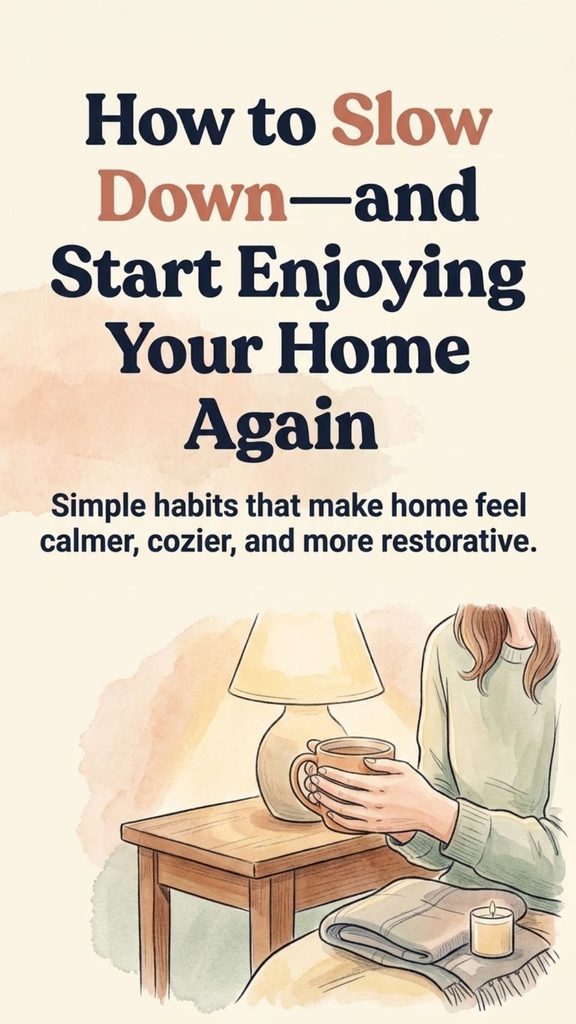
A home can be clean, organized, and fully functional yet still feel strangely tiring. The dishes are washed, the laundry is moving, dinner gets made, and the floors are reasonably tidy, but the day feels like one long sequence of jobs.
You move from one task to another without really settling anywhere. Coffee is consumed while standing. Meals are rushed. Evenings disappear into phones, television, errands, or the thought of everything that still needs to be done tomorrow.
Eventually, home can start feeling less like the place where life happens and more like the place where work never ends.
You Might Also Like:
- Loading posts...
Enjoying your home again does not necessarily require redecorating, remodeling, or buying better furniture. Often, the bigger change comes from slowing the pace of daily life enough to notice the home you already have.
A slower home is not an aesthetic. It is a way of using your time, attention, routines, and surroundings more deliberately.
Recognize When Home Has Become Another Workplace
Household work is real work. Meals need preparing, surfaces become dirty, laundry accumulates, and clutter seems to regenerate on its own.
The difficulty begins when every moment at home becomes another opportunity to complete something.
You walk into the kitchen and immediately notice the counter that needs wiping. You sit on the couch and remember the laundry. You go upstairs and notice something that should be put away. Even when you technically stop working, your mind may continue scanning the room for unfinished tasks.
That constant awareness can make relaxation difficult.
A useful first step is simply recognizing that a home will always contain something that could be done. There is no permanent finish line. Laundry will return. Meals will create dishes. Dust will settle again.
If rest is postponed until everything is complete, rest will always be postponed.
Enjoying your home requires learning where household care ends for the day and ordinary living begins.
Slow Living at Home Is About Attention, Not Appearance
Slow living is sometimes presented as a particular decorating style: neutral colors, handmade pottery, linen curtains, wooden furniture, candles, and rustic kitchens.
Those things can be lovely, but they are not what makes a home slow.
You can live slowly in a small apartment, a modern house, a busy family home, or a space filled with colorful belongings. The important question is not what the room looks like. It is how you experience being there.
Slowing down may mean sitting at the table to finish breakfast rather than eating while doing three other things. It may mean opening a window while you cook and noticing the evening air. It might mean folding laundry while listening to music instead of treating the task like a race.
The goal is not to make every chore meaningful or beautiful. Some chores are simply chores.
But when you stop rushing through every ordinary moment, home starts feeling less like a list of responsibilities and more like a place you actually inhabit.
Stop Treating Your Home Like a Permanent Improvement Project
There is always something you could improve.
A more organized pantry.
A better storage system.
New cushions.
A freshly painted room.
Matching containers.
A more attractive laundry area.
Another kitchen appliance.
Home inspiration can be useful, but constant exposure to beautifully styled spaces can also create the feeling that your own home is perpetually unfinished.
That mindset makes contentment difficult.
Instead of asking, “What should I change next?” occasionally ask, “What already works?”
Maybe the sofa is old but comfortable. Perhaps your mismatched mugs are the ones everyone reaches for first. The kitchen table may have scratches because people actually use it. The bedroom may not look professionally styled, but the bedding is comfortable and the room feels peaceful at night.
A home does not need to be continually upgraded to be enjoyable.
Sometimes the quickest way to appreciate your surroundings is to temporarily stop trying to improve them.
Create Small Pauses in Ordinary Days
Slowing down rarely begins with dramatic lifestyle changes.
It begins with pauses.
A pause can be five minutes before the rest of the household wakes. It can be finishing tea without checking your phone. It can be sitting on the porch after dinner or standing near an open window for a moment before starting the next task.
These moments may seem insignificant, but they interrupt the habit of rushing automatically from one responsibility to another.
Try choosing one natural pause in your day.
Perhaps after lunch, sit down for ten minutes instead of immediately cleaning the entire kitchen.
After putting dinner in the oven, resist the urge to begin another job and make a cup of tea instead.
When you finish tidying in the evening, sit somewhere comfortable before reaching for your phone.
You do not need hours of free time to experience your home differently. Sometimes a few deliberate minutes are enough to remind you that you live there too.
Declutter for Calm, Not for Perfection
Clutter can make a room feel busy even when nothing is actually happening.
A counter covered with papers, packages, dishes, and miscellaneous objects quietly suggests that there is work waiting. The same is true of an overloaded coffee table or a bedroom chair permanently buried under clothes.
You do not need to declutter your entire house to notice a difference.
Choose one small area that you look at frequently.
It might be:
- Your bedside table
- One kitchen counter
- The dining table
- The coffee table
- The bathroom vanity
- The entryway
Remove what does not belong there. Put away what has a proper home. Discard obvious rubbish. Leave some empty space.
Then stop.
Do not turn one cleared counter into an unexpected six-hour organizing project.
A few calm surfaces scattered through the house can change the feeling of a room without requiring minimalist perfection.
Make One Corner of a Room Genuinely Comfortable
Trying to make an entire room perfect can become another project.
Instead, create one place you actually want to use.
A chair near a window with a reading lamp and blanket can become somewhere to sit in the afternoon. A kitchen table kept mostly clear can become a pleasant place for breakfast. A bedside table with just a lamp, book, and glass of water can make the end of the day feel calmer.
Comfort matters more than styling.
If a beautiful chair is uncomfortable, you probably will not sit there. If a decorative table is covered with objects that have to be moved every time you want to use it, the arrangement is working against you.
The best cozy spaces invite ordinary life.
They are places where you can read, eat, talk, sew, write, rest, drink tea, or simply sit for a few minutes without needing to rearrange everything first.
Rediscover Simple Comforts You Already Have
Many pleasures associated with home cost very little.
Fresh coffee in a favorite mug.
Bread or muffins baking in the oven.
Clean sheets.
A warm shower in the evening.
A window cracked open during rain.
Music playing while dinner cooks.
A lamp turned on before sunset.
A blanket brought to the couch.
Soup simmering on a cold afternoon.
These things are ordinary, which is precisely why they are easy to overlook.
Slower homemaking is partly the practice of noticing them again.
You do not need to turn every evening into an elaborate ritual. Simply use the things you already own rather than saving them for some imaginary better occasion.
Light the candle.
Use the pretty dish.
Put the quilt on the bed.
Drink from the mug you like.
Enjoyment does not have to wait for guests, holidays, or a perfectly clean house.
Let Meals Become an Anchor in the Day
Food naturally creates opportunities to slow down.
A meal does not have to be complicated to provide a sense of rhythm. A pot of soup, pasta with a simple sauce, eggs and toast, or leftovers warmed properly and served at the table can still feel like a real meal.
Try occasionally eating without another form of entertainment running at the same time.
Put phones away.
Turn off the television.
Sit down.
Notice the food.
Talk if someone is eating with you.
If you are eating alone, enjoy the quiet instead of automatically filling it with scrolling.
Meals create natural boundaries within the day. Breakfast begins things. Dinner often marks the transition toward evening. Treating those moments with a little more attention can make an otherwise rushed day feel more grounded.
Create an Evening Signal That the Work Is Finished
One reason it can be difficult to relax at home is that household work has no obvious closing time.
There is always another dish, email, load of laundry, or item that could be put away.
Creating a simple evening transition can help.
You might spend ten minutes resetting the kitchen, then deliberately stop.
Turn off bright overhead lights and switch on lamps.
Change into comfortable clothes.
Make tea.
Play quieter music.
Close the laptop.
Put your phone somewhere other than directly beside you.
The exact ritual matters less than repetition. Over time, the same small actions can become a familiar signal that the active part of the day is ending.
The house does not need to be perfect first.
It only needs to be functional enough for tomorrow.
Give Yourself Permission to Rest Before Everything Is Done
Many homemakers operate under an invisible rule:
You can rest when everything is finished.
Unfortunately, a home is never finished.
There will always be another meal, another load of washing, another grocery trip, another surface that could be wiped.
Rest cannot be treated only as a reward for perfect productivity.
People need periods of recovery simply because they are human.
That might mean reading for half an hour even though there are dishes in the sink. Sitting outside while the laundry waits in the dryer. Watching a film without folding clothes at the same time.
This does not mean abandoning responsibilities. It means recognizing that responsible homemaking includes caring for the person doing the work.
Rest and household care do not need to be enemies.
Replace Perfect With Good Enough
Perfection makes home difficult to enjoy.
If you believe the living room must be completely tidy before you can relax in it, every misplaced item becomes a barrier to enjoyment.
Try deciding what “good enough” looks like instead.
Maybe the kitchen is good enough when the food is put away and the counters are mostly clear, even if two pans are still drying.
Perhaps the bedroom is good enough when the bed is comfortable and the floor is clear, even though the dresser could use dusting.
Your standards do not have to disappear. They simply need to leave room for life.
A home exists to be used. People will leave books out, cook meals, bring in bags, wear clothes, make crumbs, and move cushions.
Evidence of living is not evidence that you have failed at homemaking.
Set Up Your Home to Make Everyday Life Easier
Slower living becomes much easier when the home supports ordinary routines.
This does not require elaborate organization systems.
Often, the simplest systems work best.
Keep frequently used items where they are used.
Give incoming mail one obvious place instead of allowing it to spread across several surfaces.
Keep a laundry basket where clothes naturally accumulate.
Store everyday cookware somewhere easy to reach.
Create a small place near the door for keys and other things you regularly take outside.
Keep basic pantry foods available for nights when elaborate cooking is unrealistic.
Good home systems reduce unnecessary decisions.
They are not about creating an Instagram-worthy cupboard. They are about removing friction from daily life so that ordinary tasks consume less attention.
Spend Less Time Escaping From Home
When a house feels stressful, overstimulating, or constantly unfinished, leaving can feel easier than staying.
Shopping, eating out, browsing stores, or endlessly scrolling online can sometimes become default entertainment simply because being at home does not feel particularly restorative.
Making home more pleasant may change that.
A comfortable chair can encourage reading.
A usable kitchen encourages cooking.
A clear table makes puzzles, crafts, meals, or conversation easier.
A pleasant outdoor chair can turn ten minutes outside into a favorite part of the day.
Enjoying home can also be surprisingly frugal. Many satisfying activities require little or no new spending once you already have the basics.
The objective is not to become a person who never goes anywhere. It is simply to make staying home feel like a genuine choice rather than something you tolerate between outings.
Protect Some Time From Screens
Screens are useful, entertaining, and deeply woven into modern life. They are also remarkably effective at making an hour disappear.
You do not necessarily need strict digital rules.
Try creating a few small screen-free spaces instead.
Keep the phone away during dinner.
Leave it in another room while reading.
Spend the first ten minutes after waking without checking notifications.
Turn off the television during one evening each week and do something else.
When constant input becomes quieter, the details of your actual surroundings become easier to notice.
You may hear the rain.
Notice the sunset through a familiar window.
Finish a book.
Have a longer conversation.
Remember a hobby that disappeared somewhere between errands and scrolling.
Bring Back Quiet Hobbies
A home feels richer when it contains activities that are not purely productive.
Reading, knitting, gardening, baking, drawing, journaling, puzzles, sewing, woodworking, tending houseplants, listening to music, or working on a small craft can provide something that passive entertainment often does not: a sense of participation.
You are not simply consuming something. You are doing something.
A hobby does not need to become a side business, a social media account, or another area in which you try to excel.
It is allowed to remain enjoyable and imperfect.
In fact, keeping some activities free from productivity may be exactly what makes them restorative.
Try a Slower Home This Week
There is no need to reinvent your life overnight.
Choose three small experiments.
First, clear one surface that you look at every day.
Second, spend five or ten minutes sitting somewhere in your home without doing another task at the same time.
Third, choose one evening to make deliberately slower. Prepare an uncomplicated meal, reduce screen time for an hour, turn on a lamp instead of harsh overhead lighting, and choose something quiet afterward.
Then notice how the house feels.
Not how it photographs.
Not whether anyone else would find it impressive.
Simply how it feels to you.
Your Home Is Meant to Be Lived In
The purpose of slowing down at home is not to create another lifestyle standard you have to maintain.
You do not need perfectly organized cupboards, daily homemade bread, immaculate rooms, or candlelit evenings every night.
The goal is much simpler.
You want to be able to enter your home and occasionally feel that you have arrived somewhere rather than stepped into another shift of work.
You want ordinary rooms to hold ordinary pleasures.
You want enough margin in the day to sit down.
You want to notice what is already good instead of constantly searching for what needs fixing.
Your home can still be busy. It can still contain chores, unfinished projects, noisy evenings, unexpected messes, and seasons when life moves faster than you would like.
But even within those seasons, small pauses matter.
Slow down enough to drink the coffee while it is still warm. Sit in the chair you bought to sit in. Eat at the table. Use the blanket. Open the window. Leave one chore for tomorrow.
A home becomes enjoyable not when everything inside it is perfect, but when you give yourself enough time to actually live there.