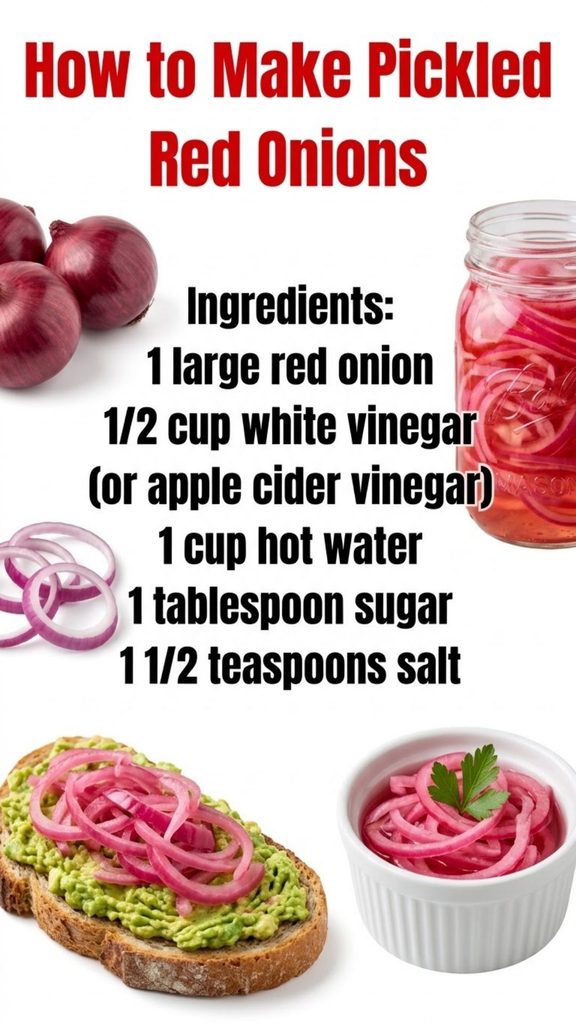
Pickled red onions are one of those small kitchen staples that can completely change a meal. Their sharp raw-onion bite softens in the brine, the slices turn a brilliant pink, and the flavor becomes tangy, lightly sweet, and salty enough to wake up everything from tacos and sandwiches to salads and grain bowls.
The best part is that you do not need traditional canning equipment or an afternoon in the kitchen. These are quick refrigerator pickles, which means the onions are covered with a simple vinegar brine and stored in the refrigerator rather than processed for shelf-stable storage.
With one red onion and a few basic pantry ingredients, you can have a jar ready in minutes.
You Might Also Like:
- Loading posts...
Quick Pickled Red Onion Ingredients
For one medium jar, you will need:
- 1 large red onion
- 1/2 cup white vinegar or apple cider vinegar
- 1 cup hot water
- 1 tablespoon sugar
- 1 1/2 teaspoons salt
Choose vinegar labeled around 5% acidity when possible. White vinegar produces a clean, sharp flavor, while apple cider vinegar gives the onions a slightly fruitier taste.
You will also need a clean heat-resistant jar or container with a lid.
How to Make Pickled Red Onions
1. Slice the Onion Thinly
Peel the red onion and cut it in half from top to root.
Using a sharp knife or mandoline, slice the onion into thin half-moons or rings. Thin slices soften and absorb the brine faster than thick pieces.
Aim for relatively even slices so they pickle at roughly the same rate.
If you prefer onions with more crunch, make the slices slightly thicker.
2. Pack the Onion Into a Clean Jar
Place the sliced onion loosely into a clean jar.
Do not pack the onion down so tightly that the brine cannot circulate around the slices. A little space between the layers helps the liquid reach everything evenly.
Depending on the size of your onion, you may need a pint-size jar or something slightly larger.
3. Make the Pickling Brine
Pour the hot water into a heat-safe measuring jug or bowl.
Add the sugar and salt, then stir until both are fully dissolved.
Stir in the vinegar.
Using hot water helps dissolve the sugar and salt quickly, but the mixture does not need to boil.
For a sharper pickle, you can reduce the amount of water slightly or use equal parts vinegar and water. The recipe above creates a relatively mild refrigerator pickle.
4. Pour the Brine Over the Onions
Carefully pour the brine into the jar until the onions are covered.
Use a clean spoon to gently press down any slices floating above the liquid.
If your jar is very full, pour slowly because the liquid level may rise as it settles between the onion slices.
5. Let Them Cool
Leave the jar uncovered or loosely covered until it has cooled enough to refrigerate safely.
Once cooled, secure the lid and place the jar in the refrigerator.
These onions are intended to be refrigerated at all times. This recipe is not designed for shelf-stable canning.
When Are Pickled Red Onions Ready to Eat?
One of the advantages of quick pickling is that you do not have to wait very long.
Thinly sliced onions can begin tasting good after about 30 minutes to an hour, although their flavor improves as they continue soaking.
After several hours, the onions become noticeably more tender and tangy. By the next day, the flavor is more developed and the slices usually have their characteristic bright pink color.
If you prefer a crisp texture, start using them the same day.
For softer, more strongly pickled onions, let them sit overnight.
How Long Do Pickled Red Onions Last?
Keep quick pickled onions covered and refrigerated.
For best quality, plan to use them within about 2 to 3 weeks. Always use a clean fork or spoon when removing onions from the jar rather than reaching in with your fingers.
Discard the batch if you notice signs of spoilage such as an unpleasant or unusual odor, visible mold, unexpected bubbling, or a texture that seems clearly abnormal.
Because these are refrigerator pickles rather than canned pickles, they should never be stored at room temperature for long periods.
White Vinegar vs. Apple Cider Vinegar
Both work well, but they create slightly different results.
White Vinegar
White vinegar has a clean, direct acidity. It allows the natural flavor and color of the red onion to remain prominent.
It is a good choice for:
- Tacos
- Burgers
- Sandwiches
- Salads
- Mexican-inspired meals
Apple Cider Vinegar
Apple cider vinegar has a softer, fruitier flavor.
It works particularly well with:
- Grain bowls
- Roasted vegetables
- Pork
- Chicken
- Fall salads
- Avocado toast
You can also combine the two if you prefer a flavor somewhere in between.
Can You Reduce the Sugar?
Yes.
The sugar is there mainly to balance the vinegar’s acidity. It does not need to make the onions noticeably sweet.
You can reduce the tablespoon of sugar if you prefer a sharper pickle.
You can also leave it out entirely, although the final flavor will be more tart.
For most people, a small amount of sugar creates a more balanced brine without turning the onions into sweet pickles.
Easy Flavor Additions
The basic recipe is useful precisely because it is simple, but you can customize the jar once you are comfortable with the original version.
Try adding one or two extras rather than overcrowding the brine.
Good options include:
- A few whole black peppercorns
- A small garlic clove
- A pinch of chili flakes
- A thin slice of jalapeño
- A few coriander seeds
- A small sprig of fresh dill
- A bay leaf
Keep the additions simple if you want the onions to remain versatile enough for many different meals.
What to Eat With Pickled Red Onions
A jar of pickled onions can rescue an otherwise ordinary meal.
Their acidity is particularly good with rich, creamy, fatty, or strongly seasoned foods.
Tacos
This may be their most obvious use.
Pile pickled onions over beef, chicken, pork, fish, beans, roasted vegetables, or avocado tacos. Their acidity cuts through rich fillings while adding crunch.
Avocado Toast
Top avocado toast with a small handful of pickled red onions, black pepper, and herbs.
The sharp onion contrasts especially well with creamy avocado.
Burgers and Sandwiches
Use them instead of raw onions on:
- Hamburgers
- Pulled pork sandwiches
- Grilled chicken sandwiches
- Turkey sandwiches
- Veggie burgers
- Wraps
Because the pickling process softens their harshness, they tend to be easier to eat in generous amounts than raw onion.
Salads
Add a forkful to green salads, potato salads, bean salads, cucumber salads, or grain bowls.
You may even need less additional dressing because the onions already bring acidity.
Eggs
Pickled onions are excellent with:
- Scrambled eggs
- Fried eggs
- Breakfast tacos
- Omelets
- Egg sandwiches
They add brightness to dishes that can otherwise taste quite rich.
Rice and Grain Bowls
Try them with rice, quinoa, couscous, lentils, roasted vegetables, beans, chicken, or tofu.
A spoonful can provide the acidic contrast that makes all the other ingredients taste more balanced.
Roasted Vegetables
Sweet roasted vegetables such as carrots, sweet potatoes, squash, and cauliflower pair especially well with tart pickled onions.
Add the onions after roasting rather than cooking them with the vegetables.
Why Do Red Onions Turn Bright Pink?
The dramatic color change is completely normal.
Red onions contain natural pigments called anthocyanins. These pigments respond to changes in acidity.
When the onion slices sit in an acidic vinegar brine, their color shifts toward a vivid pink or magenta. The effect becomes stronger as the onions spend more time in the brine.
So if the onions look more intensely pink the next morning than they did when you first filled the jar, that is exactly what you should expect.
How to Keep the Onions Crunchy
If you prefer crisp pickled onions, a few small details help.
Slice the onion evenly but not paper-thin.
Do not boil the onion in the brine. Pouring very hot liquid directly over extremely thin slices can soften them more quickly.
Refrigerate the jar once it has cooled appropriately.
And use the onions earlier in their storage period. They naturally soften somewhat as they remain in the acidic brine.
Common Pickled Onion Mistakes
Cutting the Onion Too Thick
Very thick slices take longer for the brine to penetrate and can retain a strong raw-onion flavor.
Not Covering the Onions With Brine
Try to keep the onion slices submerged as much as reasonably possible.
Using a Dirty Jar or Utensils
Start with a thoroughly cleaned container and use clean utensils whenever you serve the onions.
Treating Refrigerator Pickles Like Canned Pickles
This is an important distinction.
A quick-pickle recipe is designed for refrigeration. It should not be placed in a pantry and treated as shelf-stable simply because it contains vinegar.
Shelf-stable pickling requires tested canning recipes, specific acidity levels, processing methods, and appropriate jars.
Making Too Much at Once
Pickled onions are so quick to prepare that there is little reason to make enormous batches.
One onion at a time gives you fresher results and takes only a few minutes.
A Simple Kitchen Staple Worth Keeping Around
Quick pickled red onions are proof that a useful homemade condiment does not have to be complicated.
Slice one onion, dissolve salt and sugar in hot water, add vinegar, pour the brine over the onion, and refrigerate. Within a short time, an ordinary red onion becomes something tangy, colorful, and remarkably versatile.
Keep a jar beside your other refrigerator condiments and you may be surprised by how often you reach for it. A spoonful can brighten tacos, sandwiches, salads, eggs, roasted vegetables, burgers, grain bowls, and even a simple slice of avocado toast.
Once you see how easy they are to make, buying a jar of pickled onions may feel unnecessary.