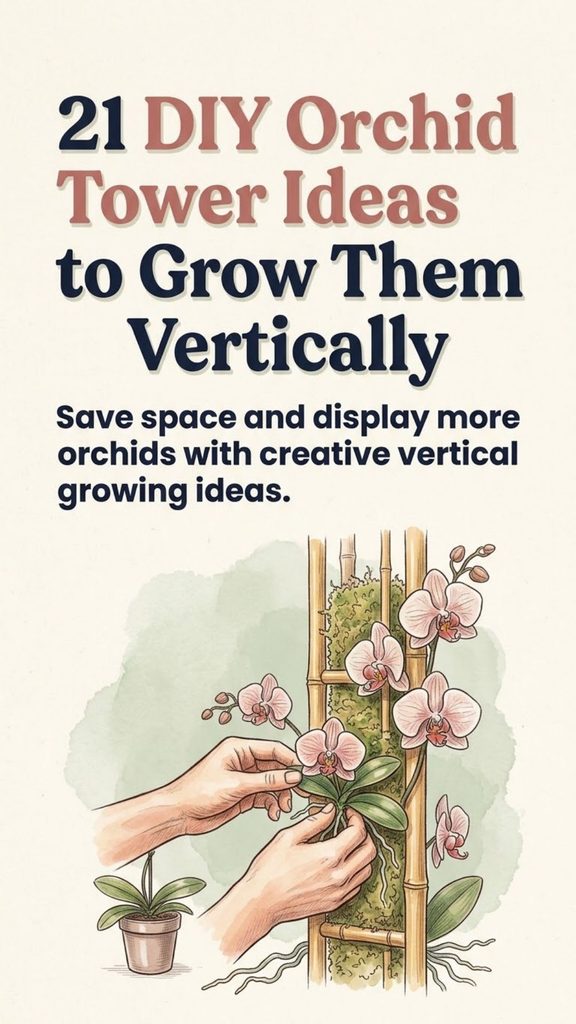
Orchids can quickly take over a windowsill, greenhouse bench, or patio once a collection starts growing. A vertical orchid tower solves part of that problem by using height instead of spreading every plant across tables and shelves. Done well, it can also turn a group of individual orchids into an impressive living display.
The important part is remembering that an orchid tower is more than a decorative plant stand. Orchids still need the right balance of light, water, drainage, air around the roots, and humidity. Many commonly grown orchids are epiphytes—plants adapted to growing on trees or other supports rather than in ordinary garden soil—but not all orchids grow this way. Most epiphytic orchids need an airy root environment, which is why coarse bark, sphagnum moss, baskets, and mounts are commonly used instead of dense potting soil.
Whether you want a simple stand holding a few pots or a dramatic moss-covered column, these 21 orchid tower ideas offer options for indoor rooms, patios, shade houses, and larger collections.
You Might Also Like:
- Loading posts...
Before You Build an Orchid Tower
A beautiful structure will not help if the growing conditions are wrong.
Before choosing a design, consider the orchids you actually grow. Mounted plants and orchids grown with very little potting medium dry much faster than conventional potted plants. The American Orchid Society notes that mounted orchids can be particularly challenging indoors because they usually require higher humidity and more frequent watering.
Your tower should also be sturdy enough to remain upright when the orchids are watered. Wet moss, pots, bark, and mature plants can add considerable weight.
Whenever possible:
- Keep orchid crowns and growing points from remaining constantly wet.
- Allow air to move between individual plants.
- Use orchid-appropriate media rather than ordinary garden soil.
- Make sure water can drain freely.
- Leave enough room to inspect roots and remove individual plants.
- Match plants with similar light and watering requirements on the same tower.
With those basics covered, you can get much more creative with the structure itself.
1. Turn a Tall Perforated Planter Into an Orchid Column
A tall cylindrical planter is one of the simplest starting points for a vertical orchid display.
Choose a sturdy container with openings along the sides, or use an appropriate planting column designed for vertical growing. Individual orchids can then be positioned in openings around the tower while an airy medium helps keep the root zone from becoming compacted.
This works particularly well outdoors or in a greenhouse where watering and drainage are easy to manage.
Do not pack the entire column tightly with wet sphagnum. Orchid roots need oxygen as well as moisture, and media that stays waterlogged can encourage root decline.
2. Stack Small Orchid Pots Around a Central Metal Rod
For a tower that can be rearranged, create a strong central support and attach or stack individual orchid pots vertically.
A steel rod secured into a heavy base can serve as the backbone. Small pots can be arranged at alternating angles rather than directly above one another, giving leaves and flower spikes more room.
The biggest advantage is that every orchid remains in its own container. You can replace a plant, repot it, or move it temporarily without dismantling the whole tower.
Make sure the rod and base can support the finished weight safely.
3. Build a Moss-Covered Orchid Pole
A moss-covered column can create the appearance of orchids growing along a miniature tree trunk.
Start with a rigid central support wrapped in plastic mesh or another material that can hold sphagnum without collapsing. Small epiphytic orchids can then be secured around the outside.
Use moss thoughtfully rather than making a permanently saturated column. Sphagnum holds substantial moisture, so its quantity should be adjusted according to the orchid, climate, humidity, and watering habits.
Mounted plants need closer monitoring than orchids growing in pots because they can dry rapidly.
4. Make a Large Botanical-Style Orchid Column
If you have a greenhouse, conservatory, covered patio, or spacious shade house, scale the moss-column idea upward.
A large central frame can support numerous orchids arranged from top to bottom. Mixing foliage sizes and allowing flower spikes to extend naturally can produce the kind of lush vertical display often associated with botanical collections.
Before building one, plan how you will water plants near the top and inspect plants in the center. A spectacular tower quickly becomes frustrating if half the orchids cannot be reached.
Large towers also need excellent structural stability and drainage.
5. Repurpose a Coat or Plant Stand
Not every orchid tower needs to be built from scratch.
A freestanding coat rack or tall metal plant stand with multiple arms can become a surprisingly practical orchid display. Hang lightweight baskets or secure small orchid pots at different levels.
This is a particularly good choice for renters because the structure can be moved without installing anything permanently.
Look for a stand with a wide, heavy base. Once several watered orchids are hanging from one side, a lightweight coat rack can become unstable.
6. Transform a Tiered Cake Stand
A large tiered serving or cake stand can work beautifully for miniature orchids and compact hybrids.
Instead of placing every pot on one flat surface, arrange small orchids across multiple levels. This keeps the display compact while allowing individual plants to remain removable.
Choose a material that tolerates occasional moisture. Place saucers beneath pots indoors and protect wood or metal surfaces that might be damaged by repeated watering.
This idea works particularly well as a tabletop orchid tower rather than a full-height floor display.
7. Fill a Tall Plant Stand With Orchids
Sometimes the easiest DIY project is simply finding a better way to use something you already own.
A narrow multi-level plant stand can hold numerous orchids without occupying much more floor space than a single large planter.
Stagger the pots so leaves do not overlap heavily. Good spacing makes it easier to inspect plants and improves air movement.
Also consider light. Plants on the lowest shelves of a dense stand may receive far less light than those at the top, so rotate plants or choose species suited to each position.
8. Create a Natural Driftwood Orchid Tower
Orchids mounted on weathered wood can look remarkably natural because many popular orchids have epiphytic growth habits.
Choose a substantial piece of suitable hardwood or freshwater driftwood with branches, grooves, and rough areas where plants can be secured. A small amount of sphagnum can help newly mounted roots remain moist while they establish.
The American Orchid Society describes porous, rough mounting materials such as suitable hardwood and freshwater driftwood as useful choices because roots can attach to textured surfaces.
Secure the orchid firmly without crushing its roots or rhizome. Movement can make it harder for newly developing roots to establish themselves.
9. Build a Wooden Indoor Orchid Display Frame
For a larger indoor collection, create a tall rectangular wooden frame with crossbars or circular pot holders.
This is less of a traditional moss tower and more of a vertical orchid wall condensed into a freestanding structure.
Install hooks at different heights and hang each orchid in its own basket. Leaving open space between them keeps the structure visually light and makes maintenance easier.
Use a waterproof tray underneath if the tower is placed indoors. Even careful watering can produce drips.
10. Use a Hanging Metal Pot-Holder Frame
A metal frame with rings designed to hold flowerpots can become an instant orchid tower.
Place smaller pots toward the top and heavier plants lower down to improve stability. Cascading orchids can be positioned near the edges so their flowers hang naturally.
Because each plant remains separate, this design makes it much easier to accommodate different watering schedules than a tower in which all the roots share the same growing medium.
It is a good compromise between an elaborate DIY tower and an ordinary plant shelf.
11. Make a Wire-Mesh Orchid Column
Wire mesh is useful when you want to build a tower in a custom diameter.
Roll sturdy mesh into a cylinder and fasten it securely. The center can hold an appropriate airy substrate or structural material, while orchids are attached around the outside.
Do not assume that filling the entire cylinder with dense wet moss is automatically beneficial. Moisture must be balanced with oxygen at the roots.
A wire column works especially well in humid outdoor or greenhouse conditions where the mounted plants can be watered thoroughly and then allowed to drain and dry appropriately.
12. Build an Orchid Tower Inside a Large Pot
A broad, heavy container can serve as the base for an upright orchid support.
Insert a sturdy trellis, branch, pole, or mesh cylinder into the container, anchor it securely, and arrange orchids vertically around the support.
The pot’s primary role is stability, so the orchids do not necessarily need to share the material inside it. Individual orchid pots can be hidden among decorative bark or attached directly to the structure.
This makes the tower easier to maintain because each plant keeps its own root environment.
13. Make a Slim Tower for a Narrow Corner
Vertical orchid growing is especially helpful where floor space is limited.
A narrow pipe or pole can become the central support for small pot holders positioned at intervals. PVC can be used structurally, but it is usually easier to maintain orchids in removable pots or baskets than to place their roots directly inside small holes cut into a pipe.
Keep enough distance between levels for foliage and flower spikes.
A slim tower can fit beside a bright window, on a sheltered balcony, or in an otherwise unused greenhouse corner.
14. Mount Orchids on an Upright Wood Log
A vertical section of suitable wood can become a striking natural orchid display.
Anchor the log securely so it cannot tip, then attach orchids at several heights. Use ties, line, clips, or other gentle supports rather than driving nails through orchid tissue or roots.
Wait for active root growth when possible before mounting. New roots are better positioned to begin gripping the surface.
The American Orchid Society recommends securing mounted orchids firmly while protecting tender roots and encouraging them to establish against the mounting surface.
15. Create a Hanging Orchid Tower
If floor space is almost nonexistent, take the tower off the floor completely.
Suspend several orchid baskets vertically from a strong overhead support, leaving enough distance between them for flowers and foliage.
Bamboo can serve as part of the supporting frame, but it is generally safer to keep orchids in baskets or on suitable mounts rather than assuming every piece of bamboo makes an ideal long-term rooting surface.
A hanging tower also needs careful watering. Remember that water from the upper orchids will drip onto the plants beneath them.
Avoid placing orchids with very different moisture requirements directly above one another.
16. Turn a Wooden Plank Into a Vertical Orchid Garden
A single broad plank can become an attractive orchid display for a wall, fence, or freestanding frame.
Attach small baskets or pot holders in a staggered arrangement. Leave enough room to remove individual containers for watering and repotting.
For an even more natural appearance, attach suitable miniature epiphytic orchids directly to appropriate wooden mounts fixed to the plank.
If the display will stay outdoors, choose materials that tolerate repeated wetting without rotting quickly.
17. Repurpose a Tomato Cage
An old tomato cage provides a ready-made vertical framework.
Place it inside a heavy pot and attach small orchid baskets around the rings. Alternatively, wrap portions with suitable mesh to create more mounting points.
This is inexpensive, lightweight, and easy to modify.
If you use coconut husk or coir around parts of the frame, remember that the goal is not to stuff every available space. Roots still need drainage and air.
Once the orchids grow, their foliage can gradually disguise the cage completely.
18. Build a Large Outdoor Orchid Stand
Gardeners with many orchids may prefer an open metal tower rather than a densely planted column.
A tall weather-resistant stand with multiple shelves or pot rings keeps the collection organized while allowing plenty of air around each plant.
An outdoor orchid stand should be placed according to the light needs of the orchids rather than simply where it looks attractive. Many commonly grown indoor orchids appreciate bright light but may be damaged by intense hot sun, depending on the species and climate.
Outdoor conditions also change watering requirements. Heat and wind can make baskets and mounted orchids dry significantly faster.
19. Create an Orchid Chandelier
For a more unusual display, suspend orchids from a circular or multi-tiered overhead frame.
Baskets can hang at slightly different heights, producing a chandelier effect when the plants bloom.
This design works beautifully under a covered patio, pergola, greenhouse roof, or another structure capable of supporting the weight.
Make sure each orchid can be removed individually. Permanent installations can become difficult to repot or inspect for pests.
Also check the hanging hardware regularly, especially if it remains outdoors.
20. Combine Orchids With Lilies in a Tiered Display
Orchids and lilies can create a dramatic floral combination, but they should generally be treated as separate plants rather than planted together in one shared medium.
Most commonly cultivated epiphytic orchids require coarse, highly aerated media, while garden lilies are terrestrial bulbs typically grown in soil. Growing both in the same root environment would make it difficult to satisfy their different needs.
Instead, create the illusion of one tower by placing individual orchid and lily containers within a tiered stand or decorative outer planter.
That gives you the visual combination without compromising the care of either plant.
21. Build a Modular DIY Orchid Tower
For the most adaptable design, build a tower around removable modules.
Start with a heavy base and a weather-resistant central frame. Add hooks, rings, shelves, or clips that can hold individual baskets or mounted orchids. Arrange larger plants near the bottom and smaller orchids higher up.
The advantage of a modular tower is flexibility. As orchids grow, flower, or enter different stages of care, you can move them without rebuilding the structure.
You can also group plants by their growing requirements instead of choosing positions only for appearance.
Over time, roots, leaves, and flower spikes will soften the framework and make the structure look increasingly natural.
Potted or Mounted: Which Is Better for an Orchid Tower?
Both approaches can work, but they require different levels of care.
Potted towers are generally easier for ordinary home growing. Each orchid retains its own growing medium, watering can be adjusted separately, and plants can be removed for repotting.
Mounted towers produce a more natural appearance and can provide excellent air movement around epiphytic roots. The tradeoff is faster drying. Mounted plants may require much more frequent watering, particularly during warm weather.
If you are new to orchids, starting with removable pots or baskets is often the more forgiving choice.
Common Orchid Tower Mistakes to Avoid
Vertical growing saves space, but it can create new problems if the structure is overcrowded.
Do not pack plants so tightly that leaves remain pressed together. A tower should make good use of vertical space without becoming a solid wall of constantly damp foliage.
Be careful with watering from the top. The plants at the bottom may receive runoff from every orchid above them and stay much wetter than expected.
Another common mistake is putting every orchid on the tower simply because it fits. Orchids vary widely in their requirements. A plant that prefers to dry quickly should not necessarily share the same moss column with one that needs more consistent moisture.
And never use ordinary potting soil simply because a tower needs something to fill it. Most commonly grown epiphytic orchids need much more air around their roots than conventional soil provides.
Choosing the Best Orchid Tower for Your Space
The best orchid tower is not necessarily the tallest or most elaborate one.
For a living room, a tiered plant stand or wooden frame filled with removable pots is easy to maintain. A narrow pole-style stand works well for small spaces. In a humid greenhouse or protected outdoor growing area, moss columns, mounted logs, and mesh towers become more practical because keeping exposed roots hydrated is easier.
Large collectors may prefer an open metal tower that allows plants to be reorganized as they grow.
Whatever structure you choose, let the orchids determine the design. Give their roots air, give excess water somewhere to escape, provide suitable light, and make every plant accessible enough to care for properly.
A good orchid tower does more than squeeze additional plants into a small footprint. It gives each orchid room to grow while turning an ordinary collection into a vertical display that becomes more impressive with every new root and flower spike.