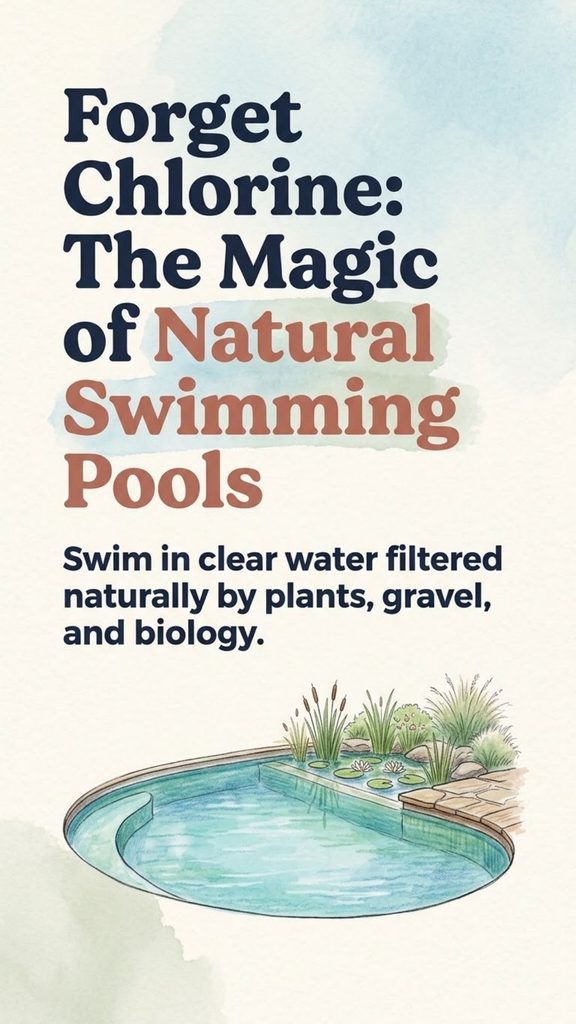
A swimming pool does not have to be a bright-blue basin kept clear by a constant disinfectant residual. Natural swimming pools take a different approach: they combine a dedicated swimming area with biological and mechanical water treatment designed to function more like a carefully managed aquatic ecosystem.
The appeal is easy to understand. Instead of the familiar look and smell of a conventional chlorinated pool, a natural pool can become part of the garden, surrounded by stone, aquatic plants, decking, and water that looks more like a clear pond than a manufactured swimming basin.
But the most successful natural pools are not simply ponds that happen to be deep enough for swimming. They are engineered water systems. Good circulation, nutrient control, filtration, correct sizing, plant management, cleaning, and water-quality monitoring all matter.
You Might Also Like:
- Loading posts...
Understanding that distinction is the key to deciding whether this type of pool belongs in your landscape.
What Is a Natural Swimming Pool?
A natural swimming pool, also called a natural swimming pond or biological swimming pool, is an artificial swimming area that relies primarily on biological, physical, and mechanical treatment rather than maintaining the continuous chlorine disinfectant residual typical of conventional pools.
Traditional versions usually contain two functional areas:
- A deeper area intended for swimming
- A regeneration or treatment area where water passes through plants, mineral substrates, biological filters, or a combination of these
More technologically intensive designs may use separate filtration equipment rather than a large planted zone. Some systems also incorporate skimmers, pumps, mineral filters, or ultraviolet treatment.
Research describes natural swimming ponds as systems that can use wetland-like treatment processes, including filtration, sedimentation, nutrient removal, microbial activity, and aquatic vegetation.
That means there is no single blueprint that defines every natural pool. A rustic swimming pond with extensive vegetation and a sleek rectangular bio-pool with concealed filtration can both belong to the same general category.
How a Natural Swimming Pool Stays Clear
The basic challenge is the same in every swimming pool: bathers, leaves, pollen, dust, insects, soil, and other organic material continually introduce nutrients and contaminants into the water.
A conventional pool responds largely through filtration and chemical disinfection. A natural system relies more heavily on controlling nutrients, circulating water through treatment areas, and supporting biological processes that compete with undesirable algae and microorganisms.
The Swimming Zone
This is the part people actually use.
It may look surprisingly conventional, with straight walls, steps, a deck, and a geometric shape. Other pools use sloping stone edges and irregular outlines so that the swimming area blends into the garden.
The important point is that the swimming zone is hydraulically connected to the treatment system. Water must move effectively rather than remaining stagnant in corners.
The Regeneration or Treatment Zone
In traditional natural swimming ponds, a shallower regeneration area contains aquatic vegetation and mineral media.
Plants are useful, but they should not be thought of as magical water purifiers. Their role is part of a larger nutrient-management system. Aquatic plants take up nutrients as they grow, while roots and mineral substrates provide surfaces where microbial communities can develop.
Other natural pools minimize visible vegetation and rely more heavily on dedicated biofilters.
Mechanical and Biological Filtration
Gravel, specialized mineral media, screens, skimmers, and biological filters can all play a part depending on the design.
Mechanical filtration physically captures suspended debris. Biological filtration provides surfaces colonized by microorganisms involved in breaking down or transforming organic material and nutrients.
Research on natural swimming ponds shows that treatment may involve physical processes such as straining and sedimentation alongside biological and physicochemical filtration.
Water Circulation
Circulation is one of the most important parts of the system.
Pumps may move water through planted beds, filters, skimmers, or other treatment components before returning it to the swimming area. Some designs make greater use of passive hydraulic principles, but assuming that every natural pool can operate with little or no pumping is unrealistic.
Poor circulation creates dead zones where debris can accumulate and water quality can deteriorate.
Studies examining biological swimming systems have emphasized that effective water turnover and treatment are important to microbiological performance.
Why People Choose Natural Swimming Pools
The attraction extends well beyond avoiding chlorine.
A Different Swimming Experience
One of the most noticeable differences is sensory.
A properly functioning natural pool does not depend on maintaining the same chlorine residual as a conventional pool, so swimmers generally do not experience the characteristic chlorinated-pool environment.
This can appeal to people who dislike chlorine odor or who experience irritation in conventional pools.
However, claims that natural pools are automatically healthier for every person should be treated cautiously. Chlorine is used in conventional pools for an important reason: it provides ongoing disinfection.
Removing that disinfectant changes the risk-management strategy rather than eliminating risk.
A Pool That Becomes Part of the Garden
Natural pools can achieve something that is difficult for an ordinary swimming pool: they can remain attractive even when nobody is swimming.
Aquatic plants, stone, timber decking, grasses, and naturalistic edges can transform the feature into part of the landscape.
A well-designed pool may resemble:
- A clear woodland pond
- A contemporary reflecting pool
- A formal garden basin
- A minimalist architectural pool
- A lush wetland garden
That makes natural swimming pools especially appealing where landscape design matters as much as recreation.
Opportunities for Biodiversity
A planted regeneration zone may provide habitat for insects, amphibians, birds, and other wildlife.
That biodiversity can be desirable, but homeowners should understand the tradeoff. Wildlife visiting the water can also introduce microorganisms and organic contamination.
One study of four private natural swimming pools found evidence that wildlife contributed to fecal contamination, illustrating why ecological value and swimming-water hygiene have to be managed together.
Reduced Dependence on Pool Chemicals
A traditional natural swimming pond is intended to function without routine chlorine disinfection.
That can reduce the need to purchase, store, and regularly dose chlorine products.
It does not mean the pool requires no water management. Owners still need to control nutrients, remove organic debris, maintain circulation equipment, manage vegetation, and in some systems monitor multiple water-quality parameters.
Some contemporary biological or bio-mineral designs also use technologies such as ultraviolet treatment, so the simple description “completely chemical-free” does not accurately describe every system.
Natural Pool vs. Conventional Pool
The choice is not as simple as deciding which one is “better.” Each solves the water-quality problem differently.
Disinfection
A properly operated conventional pool maintains a disinfectant residual in the swimming water.
A classic natural pool generally does not.
Instead, natural pools depend on filtration, ecological treatment, circulation, nutrient management, and careful control of contamination.
That difference is especially important after contamination is introduced by swimmers.
Appearance
Conventional pools are often designed as visually distinct recreational features.
Natural pools can be much more closely integrated into planting and landscaping, although modern versions can still have extremely clean architectural lines.
Water Clarity
Both types can have very clear water.
A natural pool, however, does not necessarily have the sterile visual appearance of a conventional pool. Some biofilm on underwater surfaces, occasional algae, aquatic insects, or seasonal changes can be normal in an ecosystem-based system.
Clear water alone should never be used as proof that microbiological water quality is safe.
Maintenance
Conventional pools require chemical testing, disinfection management, filtration, cleaning, and equipment care.
Natural pools trade some of those jobs for others: plant management, nutrient control, debris removal, biological filter care, sediment management, and close attention to circulation.
The amount of work depends heavily on the design.
Popular Natural Pool Design Styles
One of the strongest advantages of this type of pool is design flexibility.
Modern Minimalist Pools
A modern natural pool can look almost indistinguishable from a high-end conventional pool.
Straight edges, dark finishes, stone paving, submerged steps, concealed equipment, and timber decks create an architectural appearance. The biological treatment system may be located beside the pool or largely hidden from view.
Naturalistic Swimming Ponds
These designs intentionally resemble garden ponds.
Irregular shorelines, boulders, flowering marginal plants, grasses, and gradual transitions into the surrounding landscape produce a relaxed effect.
The swimming zone can still have a defined floor and considerable depth even though the edges look natural.
Eco-Resort Style Pools
Larger properties can combine a generous swimming area with planted shallows, timber platforms, waterfalls, stone walls, and extensive landscaping.
The effect is closer to swimming in a carefully managed lake than using a backyard pool.
Compact Urban Pools
A natural pool does not always require an enormous garden, particularly when a design uses more intensive external filtration rather than depending on a very large planted regeneration area.
Small sites are less forgiving, however. Every square meter has to be planned carefully, and filtration capacity cannot simply be sacrificed to make more room for swimming.
What Is Underneath a Natural Pool?
Construction details vary, but several components are common.
Waterproofing
Many natural pools use a flexible waterproof membrane, while others may use engineered structural shells.
The waterproof layer needs protection from stones, roots, settlement, and construction damage.
Protective Geotextile
Geotextile material is commonly installed above or below a flexible liner to reduce the risk of punctures and separate construction layers.
Its exact placement depends on the pool system.
Mineral Media
Gravel and other carefully selected substrates may be used in regeneration zones and filtration beds.
These materials can physically trap particles and, more importantly, provide enormous surface area for microbial communities.
Random garden gravel should not simply be added to a pool. Mineral composition, particle size, hydraulic flow, and nutrient content can affect how the system behaves.
Pumps, Skimmers, and Pipework
Even a natural-looking pond may contain sophisticated hidden engineering.
Skimmers remove floating debris before it decomposes. Pumps maintain circulation. Pipework moves water through treatment zones, and some systems include dedicated filter chambers.
Good natural-pool design combines ecology with hydraulics rather than relying on plants alone.
Choosing Plants for a Natural Swimming Pool
The right plants depend on climate, water depth, treatment design, and local ecology.
Depending on region and system requirements, designers may use marginal or aquatic plants such as rushes, sedges, irises, water lilies, and submerged species.
Plants should be chosen for function as well as appearance.
Important considerations include:
- Mature size
- Appropriate planting depth
- Local climate
- Growth rate
- Nutrient uptake
- Ease of maintenance
- Potential invasiveness
Avoid introducing an aquatic plant merely because it is attractive. Species that behave well in one region can become invasive in another.
Native or locally appropriate species are often easier to integrate responsibly.
Natural Swimming Pool Maintenance
Natural does not mean maintenance-free.
A neglected natural pool can accumulate nutrients and organic matter just as easily as any other body of water.
Remove Leaves and Debris
Fallen leaves, dead plant material, lawn clippings, and other organic matter eventually decompose and release nutrients.
Skimming and seasonal leaf removal therefore remain important.
Manage Aquatic Plants
Plants may need thinning, pruning, or removal of dead growth.
Removing excess plant material also removes some of the nutrients stored in that biomass rather than allowing it to decay back into the water.
Clean the Swimming Area
Sediment can settle on steps and the pool floor.
Depending on the design, owners may use a pool vacuum, robotic cleaner, brushes, or specialist equipment.
Maintain Pumps and Filters
Circulation systems need inspection, and mechanical filters require cleaning.
A blocked intake or failing pump can change water conditions surprisingly quickly during warm weather.
Expect Some Algae
A natural swimming pool is not a sterile environment.
Thin films of algae or biofilm on submerged surfaces can occur even when the water itself looks clear. Serious algae growth, however, can signal excess nutrients, poor circulation, inadequate treatment capacity, or another imbalance.
Are Natural Swimming Pools Safe?
This is the area where exaggerated claims should be avoided.
A well-designed natural pool can provide attractive recreational water, but the absence of chlorine means it does not have the same continuous disinfectant barrier found in a properly operated conventional pool.
Scientific research has identified microbiological challenges in natural swimming ponds. In one study of private systems, three of four pools exceeded recommended limits for either E. coli or enterococci at some point.
Research at a public natural swimming pool in Canada also found that treatment performance and turnover time were important to managing risks from pathogens introduced by bathers.
Another study of public swimming ponds found that most individual samples met proposed standards for fecal indicator organisms, but not every pond consistently complied.
The practical lesson is straightforward: a natural pool should be treated as a professionally designed recreational-water system, not simply as a decorative garden pond.
Good management may include:
- Correct hydraulic design
- Adequate filtration capacity
- Appropriate limits on bather load
- Regular system inspection
- Prevention of runoff entering the pool
- Management of wildlife contamination where practical
- Microbiological testing when appropriate or required
- Compliance with local health and building regulations
People should also follow ordinary healthy-swimming practices. Recreational water of any type can transmit illness if contaminated.
What About Mosquitoes?
The claim that natural pools cannot attract mosquitoes is too broad.
Mosquitoes prefer still or slow, sheltered water for breeding. Good circulation, clean edges, appropriate design, and aquatic predators may make a well-managed natural pool less favorable than a stagnant container or neglected pond.
However, shallow isolated pockets of standing water can still become breeding habitat.
The solution is good design and maintenance, not assuming an ecosystem will automatically solve the problem.
Can a Natural Pool Work in Cold Climates?
Yes. Natural pools are found in both temperate and colder regions.
In climates where water freezes, the pool is typically left filled rather than drained completely. Plants go dormant, and maintenance procedures change with the seasons.
Equipment must still be protected from freeze damage according to its design.
Cold winters are therefore not necessarily a barrier. The system simply needs to be engineered for local conditions.
What About Hot Climates?
Warm climates can also support natural swimming pools, but high water temperatures can increase biological activity and make nutrient management particularly important.
Strong sunlight may encourage algae, while evaporation can increase water demand.
Shade, circulation, pool depth, planting strategy, filtration capacity, and make-up water quality should all be considered during design.
There is no universally “perfect” climate for a natural pool. Local conditions influence how the system should be built.
How Much Does a Natural Swimming Pool Cost?
There is no useful universal figure.
Costs vary dramatically according to:
- Pool size
- Excavation conditions
- Structural system
- Liner or shell construction
- Filtration technology
- Amount of stonework
- Decking
- Aquatic planting
- Pumps and controls
- Site access
- Local labor costs
- Landscaping
- Whether the project is professionally built or partly DIY
A simple naturalistic swimming pond and a fully engineered architectural bio-pool are completely different projects.
It is also unsafe to assume that every natural pool will automatically be cheaper over its lifetime. Chemical purchases may be reduced, but pumps, filtration equipment, cleaning, plant management, replacement components, and professional servicing still have costs.
Compare complete installation and expected operating costs rather than choosing solely on claims of “free natural filtration.”
Who Is a Natural Swimming Pool Best For?
A natural pool can be an excellent fit for homeowners who want their swimming area to function as part of the landscape rather than as a separate feature.
It is particularly appealing to people who:
- Prefer a garden-like pool environment
- Want to reduce reliance on routine chlorine disinfection
- Enjoy aquatic planting and ecological landscaping
- Accept that a living water system changes with the seasons
- Are willing to maintain biological as well as mechanical components
- Have access to a designer familiar with natural swimming systems
It may be less suitable for someone expecting a completely sterile-looking pool with virtually no visible biological growth or someone unwilling to manage plants, filtration, and seasonal changes.
Common Myths About Natural Swimming Pools
“They Always Look Like Murky Ponds”
They do not have to.
Correctly sized filtration, careful nutrient management, and adequate circulation can produce impressively clear water. Contemporary natural pools can be extremely clean and architectural in appearance.
But crystal clarity should not be confused with microbiological safety.
“They Take Care of Themselves”
No pool does.
Natural pools replace some conventional maintenance jobs with ecological ones. Leaves still fall. Pumps still need servicing. Plants grow. Sediment accumulates. Water conditions change.
A stable system may become easier to manage once established, but it still requires attention.
“Plants Are All You Need to Keep the Water Clean”
Plants are only one part of the treatment system.
Hydraulic circulation, filter sizing, mineral media, microbial processes, physical debris removal, pool geometry, nutrient inputs, and bather load can all be equally important.
A beautiful regeneration garden cannot compensate for poor engineering.
“Natural Means Completely Risk-Free”
Natural water is not sterile water.
Swimming ponds can contain microorganisms, including organisms introduced by bathers, animals, runoff, and the surrounding environment. That does not make natural pools inherently unacceptable; it means their risks must be managed differently from those of chemically disinfected pools.
Planning a Natural Pool the Right Way
The most important decisions happen before excavation begins.
Start by evaluating the site: sunlight, drainage, groundwater, surrounding trees, soil, access, available area, and the possibility of surface runoff entering the pool.
Then decide what kind of system you actually want.
A heavily planted swimming pond behaves differently from a minimalist bio-pool. The amount of regeneration area, filtration technology, pump capacity, and required maintenance should be designed as one system rather than chosen separately.
It is also worth checking local regulations early. Rules governing residential pools, safety barriers, electrical work, water discharge, building permits, and microbiological standards vary widely.
For a system intended for frequent use, professional expertise in natural-pool hydraulics and water treatment can be more important than elaborate landscaping.
A Better Kind of Pool for the Right Home
The strongest argument for a natural swimming pool is not that nature somehow does all the work.
It is that engineering and ecology can be combined to create a different kind of swimming environment.
A thoughtfully designed natural pool can offer clear water, beautiful planting, wildlife value, and a landscape feature that remains attractive throughout the year. It can also reduce dependence on routine chlorine treatment and turn a backyard pool into something that feels much more connected to the garden around it.
The tradeoff is that a living system must be treated like one. Water circulation matters. Nutrients must be controlled. Plants and filters need maintenance. Hygiene cannot be assumed simply because the water looks clean.
Build it with those realities in mind, and a natural swimming pool can be far more interesting than a conventional blue rectangle—not because it is magical, but because every part of the pool has been designed to work with biological processes rather than trying to eliminate them.