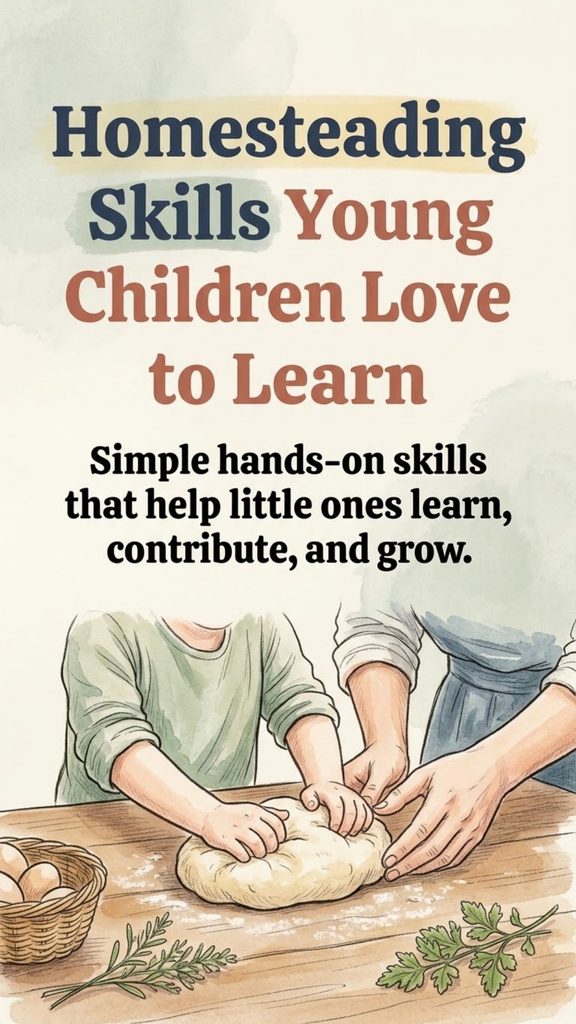
Young children often want to do more than simply watch adults work. Give them a small watering can, a bowl of bread dough, a basket for collecting eggs, or a few beans to snap, and many will happily stay involved far longer than expected.
That eagerness can fit naturally into homestead life. Gardening, cooking, animal care, simple handcrafts, and seasonal chores all give children opportunities to practice real skills while contributing to family routines.
The goal is not to turn preschoolers into miniature adults or expect them to handle jobs beyond their abilities. It is to give them meaningful work in small, manageable pieces. A three-year-old may carry one piece of firewood while an adult stacks the rest. A five-year-old may plant a row of peas but still need help reading seed-packet directions. Those small contributions matter.
You Might Also Like:
- Loading posts...
Every child develops differently, so age should be treated as a rough guide rather than a deadline. Interest, coordination, attention span, strength, and the level of adult supervision required are all more important than reaching a particular birthday.
Here are practical homesteading skills many young children can begin learning, along with safer ways to introduce them.
Cooking Simple Foods From Scratch
Cooking may be one of the most useful skills children can learn at home because there are jobs available for almost every ability level.
Preschool-age children usually enjoy tasks where they can see an immediate result. They can pour pre-measured ingredients into a bowl, tear lettuce, stir batter, mash soft foods, sprinkle herbs, or arrange vegetables on a tray.
Depending on the child and the level of supervision, other possible jobs include:
- washing fruits and vegetables
- shelling peas
- snapping green beans
- peeling bananas or hard-boiled eggs
- spreading soft butter
- kneading dough
- measuring dry ingredients
- scooping muffin batter
- whisking eggs
- cutting very soft foods with a child-appropriate kitchen tool
Kitchen participation should increase gradually. Heat, sharp knives, heavy cookware, hot liquids, raw meat, and electrical appliances require closer supervision and may not be appropriate for every young child.
One useful approach is to give children responsibility for one predictable part of a meal. A child might always wash the potatoes, tear lettuce for salad, or mix pancake batter. Repetition helps turn a fun activity into a real skill.
Baking Bread
Bread deserves special attention because it combines cooking, measurement, patience, and sensory play in one activity.
Even very young children can help pour flour, stir ingredients, shape rolls, or press dough into a pan. Kneading is especially appealing because children can push, fold, stretch, and squeeze the dough without needing highly precise movements.
Bread also demonstrates that food changes over time. Children can watch dough become smoother as it is kneaded, see it rise, and observe how heat turns a sticky mixture into a finished loaf.
Keep their role simple at first. They do not need to understand yeast percentages or hydration ratios to learn something useful. Let them become comfortable handling dough, measuring ingredients, and following the sequence of a recipe.
As they grow, they can begin learning why measurements matter, how yeast works, and how to judge whether dough has risen enough.
Feeding and Watering Small Farm Animals
Animal chores can help children understand that caring for livestock and poultry is a responsibility, not just an entertaining part of rural life.
A young child may be able to scatter an appropriate amount of chicken feed, carry a lightweight feed scoop, refill a small water container with help, or accompany an adult during morning chores.
The important part is teaching observation along with the physical job.
Ask children to notice things such as:
- Is the water container full and clean?
- Are all the animals present?
- Is one animal behaving differently?
- Is a gate properly closed?
- Has the feed gotten wet?
- Does anything in the enclosure look damaged?
Children should always be closely supervised around livestock. Even normally calm animals can move suddenly, and larger animals can unintentionally knock down or injure a small child.
Teaching respectful behavior around animals is as valuable as teaching the chore itself.
Gathering Eggs
Few homestead jobs feel as rewarding to a young child as discovering eggs in a nest box.
A small basket with a handle makes the task easier. Teach children to hold eggs gently, avoid squeezing them, and place them in the basket rather than tossing or dropping them.
If the nesting boxes are high, use a stable step intended for the child’s size rather than an improvised object. Adults should stay nearby, particularly if hens are protective, the coop floor is uneven, or reaching the boxes requires climbing.
Gathering eggs also creates natural opportunities to talk about cleanliness and food handling. Children can learn that eggs that are cracked, heavily soiled, or unusual may need adult attention rather than simply going into the kitchen with the others.
Local egg-storage and washing practices can differ depending on how eggs are produced and handled, so families should follow appropriate food-safety guidance rather than treating washing as an automatic next step.
Watching Chicks Hatch
Hatching poultry can turn animal care into a weeks-long learning project.
Children can help an adult place suitable eggs into an incubator, mark a calendar, observe temperature and humidity readings, and watch changes through the incubation period.
Some incubators automatically turn eggs, while others require manual turning. If children help, an adult should make sure the incubator manufacturer’s directions are being followed accurately.
Candling eggs can be fascinating as well. With an adult’s help, children may observe signs of development without repeatedly or carelessly handling the eggs.
The most valuable lesson is not simply seeing a chick hatch. Children also learn that raising poultry requires patience, proper equipment, cleanliness, suitable brooder conditions, food, water, and continued care after hatching.
Gardening
Gardening may be one of the easiest homesteading skills to adapt for small children.
Seeds are light, soil is forgiving, and children can see visible changes as plants grow.
Simple garden jobs include:
- filling small pots with soil
- making shallow planting holes
- placing large seeds such as beans or peas
- watering seedlings
- pulling easily identified weeds
- carrying mulch
- harvesting ripe produce
- looking for insect damage
- gathering fallen leaves for compost
Large seeds are often easier for little fingers to handle than tiny ones. Beans, peas, squash, sunflowers, and corn can be more manageable than seeds that resemble grains of dust.
Giving a child a small garden area can also be motivating. It does not need to be large. A few containers or a short section of a raised bed may be enough.
Let children help choose what to grow, while keeping expectations realistic for your climate and growing season. A garden becomes much more interesting when they feel some ownership of it.
Planning the Garden
Gardening does not have to stop when winter arrives.
Children can help look through seed catalogs, identify vegetables they recognize, draw garden pictures, or create a simple planting notebook.
A younger child might cut out pictures of tomatoes, carrots, pumpkins, or flowers and glue them onto pages. An older preschooler may enjoy drawing a basic garden map.
This does not need to become a formal lesson. The purpose is simply to connect planning with the work that will happen later.
When planting season arrives, children can look back at what they chose and help turn those plans into an actual garden.
Preserving Produce by Freezing
Food preservation is an important part of many homesteads, but not every preservation method is equally suitable for young helpers.
Freezing is often easier to include children in because much of the preparation happens away from pressurized equipment and boiling jars.
Depending on the food, children can help:
- bring harvested produce inside
- sort damaged pieces from good ones
- wash produce
- snap beans
- shell peas
- remove stems from berries
- portion cooled food into freezer-safe containers with adult help
- add labels or dates
Some vegetables need blanching before freezing, which involves boiling water and should remain an adult-controlled step when young children are present.
Pressure canning and boiling-water canning involve high heat, hot glass, steam, and specific food-safety procedures. Those processes are better handled by knowledgeable adults while very young children participate only from a safe distance.
Learning Basic Hand Sewing
Simple sewing can introduce children to mending, clothing repair, and useful handcraft skills.
Start with an easy project rather than expecting neat stitches immediately. A child might sew two pieces of felt together, attach a large button with help, or repair a small tear in a doll’s clothing.
Young children require direct supervision around needles, scissors, pins, and other sharp tools.
Some parents prefer blunt tapestry needles and loosely woven fabric for early practice. Others may gradually introduce ordinary sewing tools once the child has the coordination and judgment to use them safely.
The important principle is to teach control rather than merely handing over equipment.
Show how to hold the needle, where fingers should stay, how to pass it safely, and where the needle goes when the project is put down.
Learning to Knit
Knitting requires patience and coordination, so readiness varies considerably.
Some children become fascinated with yarn at four or five years old. Others have little interest until much later.
Begin with very simple movements. Thick yarn and larger needles may be easier for small hands to see and control than fine yarn and tiny needles.
Do not worry about perfect tension at first. Learning how yarn moves around the needles and successfully making a few stitches is already progress.
Knitting is particularly useful as a lesson in persistence because mistakes are normal. A dropped stitch is not a failure; it is simply something that can be fixed.
Exploring Wool and Yarn Making
Families who keep fiber animals or enjoy traditional crafts may introduce children to the steps between fleece and finished yarn.
Even before a child is ready to operate spinning equipment, they can help sort clean fiber, gently handle wool, compare textures, or watch an adult spin.
A spinning wheel requires coordination between hands and feet, so close supervision is necessary. Moving parts should always be treated with care.
Breaking the process into smaller skills can make learning easier. A child may first practice treadling without trying to manage fiber. Later, with an adult beside them, they can work on drafting fiber before eventually combining the movements.
Some children will love the repetitive process. Others will try it once and move on. Both reactions are perfectly reasonable.
Checking Gates and Fences
Children are often excellent observers because they notice small changes adults walk past every day.
During routine walks around animal areas or gardens, ask them to help look for:
- loose fencing
- open gates
- holes beneath a fence
- broken latches
- branches resting on wire
- places where animals may have been digging
- damaged garden netting
They should report problems rather than attempt repairs involving wire cutters, power tools, electrical fencing, heavy materials, or unfamiliar animals.
This turns an ordinary walk around the property into a useful lesson about prevention. A small opening noticed today may prevent an escaped chicken or damaged garden tomorrow.
Stacking and Carrying Firewood
Carrying wood can give energetic children a satisfying physical job.
Young children can move small, lightweight pieces while an adult handles the heavier logs. They can also collect kindling or help bring a few pieces to a designated storage area.
The woodpile itself needs adult attention. Poorly stacked firewood can shift or collapse, so children should not climb on wood stacks or work beside unstable piles.
Gloves can help protect hands from rough bark and splinters.
This is also a good example of scaling a real adult task to a child’s ability. The child does not need to move an entire cord of wood to make a meaningful contribution. Carrying six small logs is still useful work.
Harvesting From the Garden
Harvesting is one of the best ways to help children connect gardening with food.
Teach them how to recognize something that is ready to pick. Show the difference between a ripe tomato and a green one, a full-sized cucumber and a tiny developing fruit, or a mature bean and one that needs another day.
Some crops can be harvested by hand, while others need scissors, pruners, or a knife. Adults should control cutting tools until a child is ready to use an appropriate tool safely under supervision.
Children may occasionally pick something too early. Unless the mistake would cause a real problem, treating it as part of learning is usually more productive than making harvest time stressful.
Composting Kitchen and Garden Scraps
Composting is another simple skill children can participate in without needing to understand all the biology behind decomposition.
They can carry a small container of approved kitchen scraps to the compost pile, add dry leaves, or help spread finished compost around plants.
Teach clearly what belongs in your compost system and what does not. A picture chart can help younger children sort materials.
As they grow, children can begin learning why a compost pile needs a balance of materials, moisture, and air.
The larger lesson is especially valuable: garden waste and many kitchen scraps do not always have to become trash. They can be returned to the soil.
Give Children Real Work, Not Perfect Work
Homestead skills are learned through repetition. A child’s first loaf may be oddly shaped. A basket may contain a cracked egg. A row of seeds may wander instead of forming a straight line. Beans might take twice as long to snap when a four-year-old is helping.
That does not make the activity unsuccessful.
Young children usually become more capable when adults give them work that is genuinely useful but small enough to manage. Start beside them, demonstrate the job, supervise closely where safety matters, and gradually give them more responsibility as their judgment and coordination improve.
It also helps to avoid forcing every activity. One child may spend an hour happily planting seeds but dislike sewing. Another may be fascinated by animals and have little patience for gardening. Homesteading offers enough variety that children can discover where their interests lie.
A useful progression is simple: watch together, do it together, then let the child do the safe parts independently while you remain nearby.
The greatest benefit is not how much work a preschooler can remove from an adult’s chore list. It is the gradual development of competence. Cooking a simple meal, caring for an animal, growing a vegetable, repairing something instead of throwing it away, and helping preserve food are practical skills that can stay useful for life.
When children are allowed to contribute at an appropriate level, everyday homestead chores become more than jobs that need to be finished. They become opportunities to learn how food is produced, how living things are cared for, how useful things are made, and what it means to be a dependable part of a family.