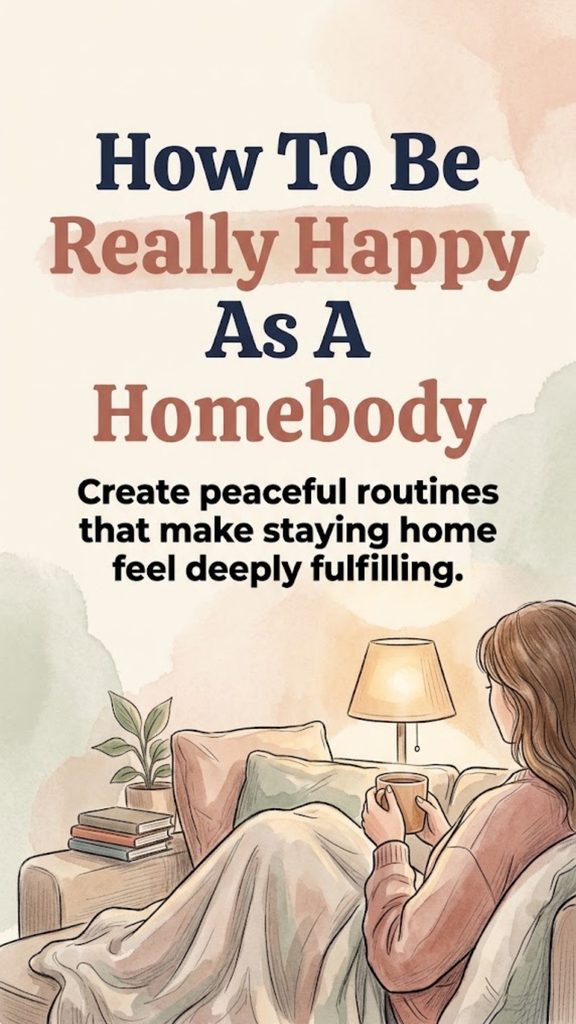
There is nothing inherently dull about a quiet life.
For someone who genuinely enjoys being at home, an evening with a good book, a favourite series, a warm drink, or a peaceful hobby can feel far more satisfying than a crowded restaurant or a calendar packed with plans. The problem begins when you start judging that preference against someone else’s idea of what a happy life should look like.
Being a homebody can be deeply fulfilling, but happiness at home does not happen simply because you spend more time there. A satisfying home-centered life still needs variety, purpose, movement, connection, and things to look forward to.
You Might Also Like:
- Loading posts...
The goal is not to shut the world out. It is to build a life in which home feels like a place of comfort and possibility rather than a place where every day starts to look the same.
Stop Treating Staying Home as a Lesser Choice
A useful place to begin is with the way you think about your own preferences.
Modern social life often rewards visibility. Trips, parties, restaurants, events, and busy weekends are easy to photograph and share. A peaceful Saturday spent cooking, reading, gardening, organizing a room, or watching an old film is much less visible, but that does not make it less meaningful.
Ask yourself a more useful question than, “Should I be going out more?”
Ask, “Does the way I spend my time actually leave me feeling satisfied?”
There is an important difference between choosing to stay home because you enjoy it and staying home because fear, low mood, exhaustion, or avoidance has made everything outside feel impossible. A healthy homebody life is usually a chosen one. You can leave home, maintain relationships, handle responsibilities, and participate in the wider world—you simply prefer a slower rhythm.
Once you recognize that distinction, there is much less reason to feel guilty about enjoying your own space.
Make Your Home Pleasant to Live In, Not Just Pretty to Look At
If home is where you spend much of your free time, its atmosphere matters.
This does not require an expensive renovation or a perfectly styled living room. Comfort usually comes from much simpler things: good lighting, a chair you actually enjoy sitting in, clean bedding, enough storage, a room that smells fresh, and surfaces that are not constantly buried under clutter.
Pay attention to how your home functions.
If you read often, give yourself a comfortable reading spot with a nearby lamp.
If you enjoy tea or coffee, keep the things you use together rather than searching through three cupboards every evening.
If you like movies, make the sofa genuinely comfortable instead of decorating it with cushions no one is allowed to move.
If you enjoy cooking, keep your most-used tools easy to reach.
Your home should support the way you really live rather than the way a photograph suggests you ought to live.
Warm lamps, soft textiles, plants, artwork, books, candles, and natural materials can make a room feel inviting, but practicality matters just as much. A beautiful space that constantly frustrates you will not feel peaceful for long.
Give Ordinary Evenings a Little Ceremony
One danger of spending a lot of time at home is that evenings can blur together.
Work ends, dinner happens, the television goes on, the phone appears, and suddenly it is bedtime.
A small evening ritual can give the day more shape.
You might tidy the main room for ten minutes, turn on a lamp instead of the bright ceiling light, change into comfortable clothes, prepare a favourite drink, and decide deliberately how you want to spend the next hour.
None of these actions is remarkable on its own. Together, however, they mark a transition between obligation and rest.
This is the useful side of “romanticizing” everyday life. It is not pretending that your life is perfect. It is paying enough attention to ordinary pleasures that you actually notice them.
Use the mug you like.
Put clean sheets on the bed before you desperately need to.
Play music while making dinner.
Sit near the window when it rains.
Buy flowers occasionally, or bring in a few branches from the garden.
Small pleasures are easy to overlook precisely because they are small.
Build a Home Life Around Interests, Not Only Entertainment
A comfortable home can quickly become a place of passive consumption if most evenings revolve around scrolling, streaming, and browsing.
There is nothing wrong with watching television or relaxing online. The problem is that passive entertainment does not always leave you feeling satisfied after several hours.
A richer home life usually includes things you actively participate in.
That might mean:
- reading books that genuinely interest you
- learning to bake or cook something new
- gardening indoors or outside
- sewing, knitting, drawing, painting, or woodworking
- studying a language
- doing puzzles
- writing
- learning photography
- researching family history
- restoring old furniture
- keeping a journal
- taking an online class
- building a small creative or business project
You do not need to turn every hobby into a side income or a self-improvement project. An activity can be worthwhile simply because you enjoy doing it.
The point is to give your evenings depth.
A homebody who has things to explore, make, improve, read, and learn rarely has to depend on constant outside stimulation for a sense of novelty.
Protect Your Quiet Time Without Becoming Unavailable
Enjoying solitude does not mean rejecting other people.
In fact, one of the healthiest ways to maintain a home-centered lifestyle is to become more intentional about socializing rather than abandoning it.
You may prefer dinner with one close friend to a large party. You may enjoy having family over for coffee more than spending an entire weekend away. You may prefer a long phone conversation to several nights of casual social plans.
That is perfectly reasonable.
What matters is that important relationships continue to receive attention.
Declining every invitation can eventually weaken friendships, even when no harm is intended. If you rarely want to go out, consider occasionally bringing connection into your home instead.
Invite someone for lunch.
Have a friend over for a film.
Cook dinner with a relative.
Meet someone for a short morning walk rather than committing to an entire evening.
A good homebody life should make relationships more manageable, not make meaningful relationships disappear.
Learn the Difference Between Solitude and Isolation
Solitude is usually restorative because it is chosen.
Isolation often feels different. It can involve wanting connection but not knowing how to reach for it, repeatedly avoiding people despite feeling lonely, or realizing that weeks have passed without meaningful interaction.
That distinction is worth noticing.
You can love being alone and still need other people. Human beings generally benefit from supportive relationships, even if the amount and type of social contact they prefer varies widely.
If staying home consistently leaves you feeling lonely, restless, fearful, or disconnected, the solution may not be to make your home even more comfortable. It may be time to add some connection back into your routine.
The aim is not maximum solitude. It is the right balance for you.
Keep Your Body Moving
Home-centered routines can become physically sedentary without you noticing.
You do not need a gym membership or an intense exercise plan to change that.
Walking is one of the simplest options. A morning or evening walk also gives a homebody a gentle reason to leave the house without turning the outing into a major social event.
At home, you might stretch, follow a workout, use a stationary bike, dance to music, do household projects, or spend time gardening.
Movement provides contrast to quiet activities.
After an hour of reading, stand up and stretch.
Take a walk before settling in for a film.
Do some gardening before an afternoon indoors.
The idea is not to turn relaxation into another productivity contest. It is simply easier to enjoy rest when your entire day has not consisted of sitting in the same position.
Make Food Part of the Pleasure of Home
Homebodies have one advantage that busy schedules often make difficult: the opportunity to make meals part of the rhythm of the day.
This does not mean cooking elaborate recipes every night.
It might mean keeping ingredients for a few comforting meals you know how to prepare well. You could make soup on a cold afternoon, bake something on a slow weekend, prepare a favourite breakfast, or experiment with a recipe you have been saving.
Even simple meals feel different when they are eaten deliberately rather than hurriedly in front of a phone.
If cooking is not your hobby, make it easier rather than more ambitious. Keep a short collection of dependable meals, prepare ingredients ahead of time, and stock foods you genuinely like.
A comfortable home life is easier to enjoy when basic routines do not constantly feel like chores.
Create Things to Look Forward To
Routine can be comforting, but too much sameness eventually becomes dull.
A happy homebody still needs anticipation.
Fortunately, something to look forward to does not have to involve plane tickets or a large event.
Plan a themed movie night.
Start a book you have been saving.
Order ingredients for a recipe you want to try.
Begin a small decorating project.
Have a seasonal cleaning afternoon followed by a favourite meal.
Invite someone over next weekend.
Plant bulbs for spring.
Plan a day trip and return home the same evening.
Rotate your activities with the seasons. Summer evenings might involve the garden or porch. Autumn can bring baking, books, and earlier candlelit evenings. Winter may suit puzzles, films, crafts, and slow cooking. Spring offers cleaning, planting, open windows, and small household projects.
Anticipation keeps a peaceful life from becoming a monotonous one.
Reduce Mindless Scrolling
A surprising amount of dissatisfaction at home can come from spending your quiet time looking at other people’s lives.
You sit comfortably on your own sofa, perfectly happy five minutes earlier, then scroll past a party, a holiday, a restaurant, a new house, and someone else’s perfectly photographed weekend. Suddenly your evening feels inadequate.
Nothing about your actual evening changed.
Only the comparison did.
Social media can be useful and enjoyable, but endless scrolling can crowd out the very things homebodies say they value: concentration, peace, hobbies, reading, films, conversations, and unhurried evenings.
Try giving your attention somewhere else before automatically opening an app.
Read ten pages.
Make tea.
Put on music.
Call someone.
Finish a small project.
Watch one programme without simultaneously scrolling through another screen.
A quiet life becomes much richer when you are actually present for it.
Keep Some Connection With the Outside World
Loving your house does not mean every pleasant activity has to happen inside it.
Libraries, gardens, museums, farmers’ markets, cafés, walking paths, bookstores, and quiet parks can suit a homebody perfectly because they offer a change of scenery without demanding intense social interaction.
Think of going out as enrichment rather than escape.
A few hours elsewhere can make returning home feel even better.
It also keeps your world from shrinking unnecessarily. New places, conversations, books, food, scenery, and experiences bring fresh material back into your home life.
The happiest homebodies often have a strong base rather than a closed boundary.
Stop Apologizing for a Quiet Life
Not everyone will understand why staying home sounds better to you than another night out.
That is fine.
You do not need to persuade people that homebody life is superior. It is not superior. It is simply one way of arranging a satisfying life.
Some people are energized by frequent gatherings and constant activity. Others prefer long periods of quiet punctuated by smaller amounts of social contact. Most people fall somewhere between those extremes.
Knowing your preference helps you make better choices.
You can say no to plans without inventing an elaborate excuse. You can leave an event earlier than someone else might. You can reserve part of the weekend for yourself.
At the same time, being a homebody should not become a rigid identity that prevents you from trying anything unfamiliar.
Sometimes the dinner you nearly skipped will be wonderful.
Sometimes the trip will be worth the disruption.
Sometimes you will be delighted to return home afterward.
Both things can be true.
Build a Life You Enjoy Coming Home To
The real pleasure of being a homebody is not simply spending more hours inside four walls. It is creating a rhythm of life that feels calm, interesting, connected, and genuinely yours.
Make your rooms comfortable enough to live in rather than merely admire. Protect quiet time, but keep the relationships that matter. Develop interests that give your evenings substance. Move your body. Cook food you enjoy. Put down your phone often enough to notice your surroundings. Give yourself small occasions to anticipate.
Most of all, pay attention to the difference between peaceful solitude and unhappy withdrawal.
If home leaves you rested, interested in life, connected to people you care about, and glad to wake up to another ordinary day, you are not failing to live fully because your happiness happens to be quieter.
A good life does not have to be constantly busy to feel abundant.