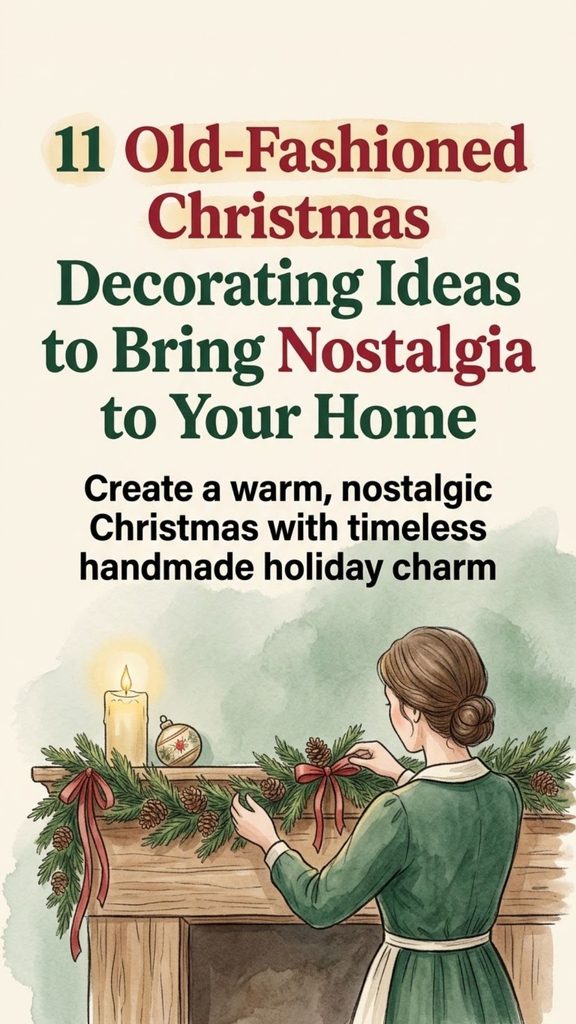
An old-fashioned Christmas rarely looks perfectly coordinated. The charm comes from layers: a tree filled with ornaments collected over many years, greenery draped across the mantel, handwritten cards displayed in the living room, warm lights in the windows, and handmade decorations that may not match but still belong together.
That slightly imperfect, collected-over-time feeling is what makes traditional Christmas decorating so comforting. Instead of replacing everything with a new theme each December, you can build your holiday decor around familiar colors, natural materials, meaningful objects, and simple traditions.
You also do not need a large decorating budget. Some of the most nostalgic Christmas decorations can be made from paper, fabric scraps, dried fruit, evergreen clippings, pinecones, ribbon, and items you already own.
You Might Also Like:
- Loading posts...
Here are 11 ways to create a warm, old-fashioned Christmas atmosphere without making your home feel like a showroom.
1. Start With Christmas Music and a Decorating Tradition
Christmas music may not technically be a decoration, but atmosphere is a large part of what makes holiday decorating memorable.
Instead of treating decorating as another task to finish, turn it into an annual tradition. Put on favorite Christmas songs, make hot chocolate or another seasonal drink, and decorate together.
If you have children, let them hang some of their favorite ornaments even if they do not end up perfectly spaced. If you decorate alone, bring out decorations gradually rather than feeling pressure to transform the entire house in one afternoon.
Old-fashioned Christmas style works especially well when the process itself feels unhurried.
You might even create a simple tradition such as:
- decorating the tree on the same weekend each year
- playing the same Christmas album
- making popcorn or cookies afterward
- opening a box of childhood decorations together
- adding one handmade ornament every December
Years later, these small routines may become more memorable than the decorations themselves.
2. Choose a Real Christmas Tree—or Recreate the Natural Look
Few things create an old-fashioned Christmas atmosphere as quickly as a traditional evergreen tree.
If a real tree works for your household, choosing one can become part of the celebration. Before shopping, measure both the ceiling height and the width of the space where the tree will stand. A tree can look surprisingly small outdoors and enormous once it is inside your living room.
Real trees also require some care. Keep the tree stand supplied with water and position the tree away from fireplaces, heaters, radiators, and other strong heat sources. A drying tree loses needles quickly and becomes more of a fire concern.
A real tree is not essential, though. A good artificial tree can still look traditional when decorated with natural materials, warm lights, ribbon, handmade ornaments, and an intentionally collected mix of decorations.
For an especially nostalgic look, avoid trying to make every branch identical. Let the tree feel personal rather than professionally styled.
3. Use Warm, Gentle Lighting
Lighting changes the entire character of Christmas decorations.
Warm white string lights usually create a softer, more traditional atmosphere than very cool white lights. Wrap them through the tree rather than placing them only on the outer branches so that the glow has more depth.
You can also use warm lights:
- around windows
- along a mantel
- inside glass lanterns
- around a staircase railing
- across a bookshelf
- woven gently through a garland
Candles have long been associated with winter celebrations, but open flames require careful supervision. Never place real candles near evergreen branches, paper decorations, curtains, ribbons, or anything else that can catch fire.
Battery-operated candles are an easy alternative, especially for window ledges, shelves, and mantels. Modern versions with gently flickering lights can create much of the visual warmth without an exposed flame.
The goal is not to make the house brighter. It is to create pockets of soft light that make rooms feel cosy in the evenings.
4. Build Around Traditional Christmas Colors
Red, green, cream, white, gold, and silver are easy foundations for an old-fashioned Christmas palette.
You do not have to use every color. In fact, choosing three or four and repeating them throughout the house usually creates a more natural sense of continuity.
Try combinations such as:
Red, evergreen, and warm gold for a rich traditional look.
Forest green, cream, and brass for something quieter and more understated.
Red, white, and natural wood for a simple country Christmas.
Deep green, burgundy, and antique gold for a more Victorian-inspired feeling.
Instead of buying decorations simply because they match a color scheme, look at what you already have. A slightly faded red ribbon, an old brass candlestick, embroidered white linens, wooden ornaments, or a green glass vase may fit beautifully.
Old-fashioned decorating often looks best when the colors feel collected rather than manufactured as a matching set.
5. Decorate With Evergreen Garlands
Garlands are one of the easiest ways to bring traditional Christmas greenery indoors.
Fresh pine, fir, cedar, or other suitable evergreen cuttings can be used depending on what is available where you live. Artificial garlands are more practical in some homes and can be reused year after year.
Drape garland:
- along a mantel
- over a doorway
- around a staircase
- across the top of a cabinet
- along a dining-room sideboard
- around a large mirror
Then add a few simple details rather than covering every inch.
Pinecones, dried orange slices, berries, bells, ribbon, wooden ornaments, or small clusters of greenery can make a plain garland much more interesting.
If you use fresh greenery indoors, remember that it will gradually dry. Keep it away from open flames and strong heat sources, and remove it once it becomes brittle.
6. Hang a Traditional Wreath
A wreath immediately gives an entrance a festive, old-fashioned character.
Traditional evergreen wreaths can be surprisingly simple. A base of greenery tied with a large velvet, plaid, or satin ribbon may be all you need.
For a more rustic version, add:
- pinecones
- dried oranges
- cinnamon sticks
- small bells
- dried seed heads
- berries
- twigs
You can hang wreaths on more than the front door. Smaller wreaths look beautiful on kitchen windows, cupboard doors, interior doors, mirrors, or the backs of dining chairs.
Making your own wreath can also reduce the cost if you have safe access to suitable greenery. Even an inexpensive artificial wreath can look far more traditional after removing overly shiny decorations and replacing them with natural-looking ribbon and pinecones.
7. Collect Handmade and Heirloom-Style Ornaments
A nostalgic Christmas tree should tell a story.
Instead of buying a large box of identical ornaments every few years, slowly collect decorations you genuinely enjoy. Keep ornaments made by children, gifts from relatives, pieces brought home from trips, and decorations associated with special memories.
Traditional materials include:
- glass
- wood
- fabric
- felt
- paper
- metal
- ceramic
Handmade ornaments add even more personality.
Simple projects might include stitched fabric hearts, felt stars, paper snowflakes, folded paper ornaments, salt-dough decorations, dried citrus ornaments, tied cinnamon bundles, or small wooden shapes.
Popcorn garlands are another classic homemade option. They take patience, but that is partly the point: old-fashioned decorating often involves making something slowly rather than buying an instant finished look.
Do not worry if everything clashes slightly. A tree containing twenty years of family ornaments should not necessarily look coordinated.
8. Give the Dining Table a Traditional Christmas Look
You do not need formal china to create a beautiful Christmas table.
Begin with what you already own and add a few details that make the table feel special.
A linen or cotton tablecloth, simple runner, cloth napkins, candlesticks, greenery, and a bowl of fruit can create a surprisingly traditional setting.
For the centerpiece, consider combining natural elements such as:
- evergreen cuttings
- pinecones
- apples or pears
- oranges
- nuts in their shells
- small ornaments
- candles or battery-operated candles
Vintage dishes and serving pieces can add character, but you do not need an entire matching antique set. One old serving platter or a few patterned plates mixed with plain white dishes may be enough.
Thrift stores, flea markets, and secondhand shops can be excellent places to find embroidered linens, metal candlesticks, serving trays, glassware, and dishes that suit this style.
Just avoid overcrowding the table. Guests still need room to eat comfortably, pass food, and talk to one another.
9. Bring Christmas Fragrance Into the House
Scent is one of the strongest triggers of memory, which is why fragrance can contribute so much to a nostalgic Christmas atmosphere.
A simmer pot is one simple option.
You might combine water with ingredients such as:
- orange slices
- apple pieces
- cinnamon sticks
- whole cloves
- cranberries
Heat the mixture gently so the fragrance spreads through the room.
A simmer pot needs supervision. Keep enough water in the pan so it does not boil dry, and do not leave a stovetop burner unattended.
You can also create seasonal fragrance without simmering anything. Fresh evergreen branches naturally add scent, while dried orange garlands, cinnamon decorations, holiday baking, peppermint treats, and bowls of winter citrus can contribute their own subtle aromas.
Avoid trying to make every room intensely scented. A gentle fragrance usually feels far more inviting.
10. Make Wrapped Gifts Part of the Decoration
Presents can become part of your Christmas decor instead of being hidden until Christmas morning.
For an old-fashioned look, use a mixture of wrapping papers rather than making every package identical.
Good options include:
- brown kraft paper
- traditional red-and-green prints
- striped paper
- botanical designs
- vintage-inspired Christmas illustrations
- simple cream paper
Finish packages with fabric ribbon, baker’s twine, velvet ribbon, or reusable bows.
Natural embellishments can make inexpensive wrapping paper look beautiful. Try slipping a small evergreen sprig, dried orange slice, paper snowflake, cinnamon stick, or gift tag beneath the ribbon.
You can also reuse attractive boxes, fabric gift bags, tins, baskets, and wrapping materials from previous years.
The finished gifts do not need to look professionally wrapped. Slightly uneven bows and handwritten labels often make them feel more personal.
11. Display Christmas Cards, Snow Globes, and Small Collections
Not every Christmas decoration needs to be purchased specifically as decor.
Christmas cards are a perfect example. Instead of stacking them on a table, turn them into a temporary display.
Hang a piece of ribbon or twine across a wall, mantel, doorway, or cabinet and attach the cards with small clips. You can add new cards throughout December as they arrive.
This works especially well with older cards you have saved from relatives and friends. A mixture of handwriting, photographs, illustrations, and different paper styles naturally creates the collected look that suits nostalgic decorating.
Snow globes can serve a similar purpose. Group several on a bookshelf, side table, mantel, or kitchen shelf rather than scattering them everywhere.
The same idea works with other small Christmas collections:
- miniature houses
- bells
- wooden figures
- old ornaments
- Christmas books
- ceramic trees
- vintage tins
- toy trains
Grouping a few related objects together makes them feel intentional and prevents the house from becoming visually cluttered.
How to Make Christmas Decor Feel Collected Rather Than Cluttered
Old-fashioned Christmas decorating tends to be fuller than modern minimalist styles, but there is still a difference between layered and chaotic.
Choose a few areas where decorations can be abundant—the Christmas tree, mantel, dining table, and entryway, for example—and leave some surrounding surfaces quieter.
Repeat a handful of materials throughout the house. If you use velvet ribbon on the tree, repeat a little on the wreath. If dried oranges appear in the garland, add several to wrapped gifts. If brass candlesticks are on the dining table, place another pair on the mantel.
These small repetitions connect rooms without making everything identical.
It also helps to decorate gradually. Put out your favorite pieces first. After living with them for a day or two, decide whether the room genuinely needs anything else.
A Nostalgic Christmas Is Built Over Time
The most convincing old-fashioned Christmas homes are rarely created by purchasing an entire collection in one season.
They grow slowly.
A handmade ornament is added one year. An old serving platter comes from a grandparent. A wreath becomes an annual project. Children bring decorations home. Christmas cards are saved. A favorite ribbon gets reused until its edges begin to fray.
That is what gives this decorating style its warmth.
Start with greenery, gentle lighting, traditional colors, handmade details, and whatever meaningful Christmas pieces you already own. Add something special only when you find it or make it.
A home decorated this way may never look perfectly matched—and that is exactly why it can feel so wonderfully nostalgic.