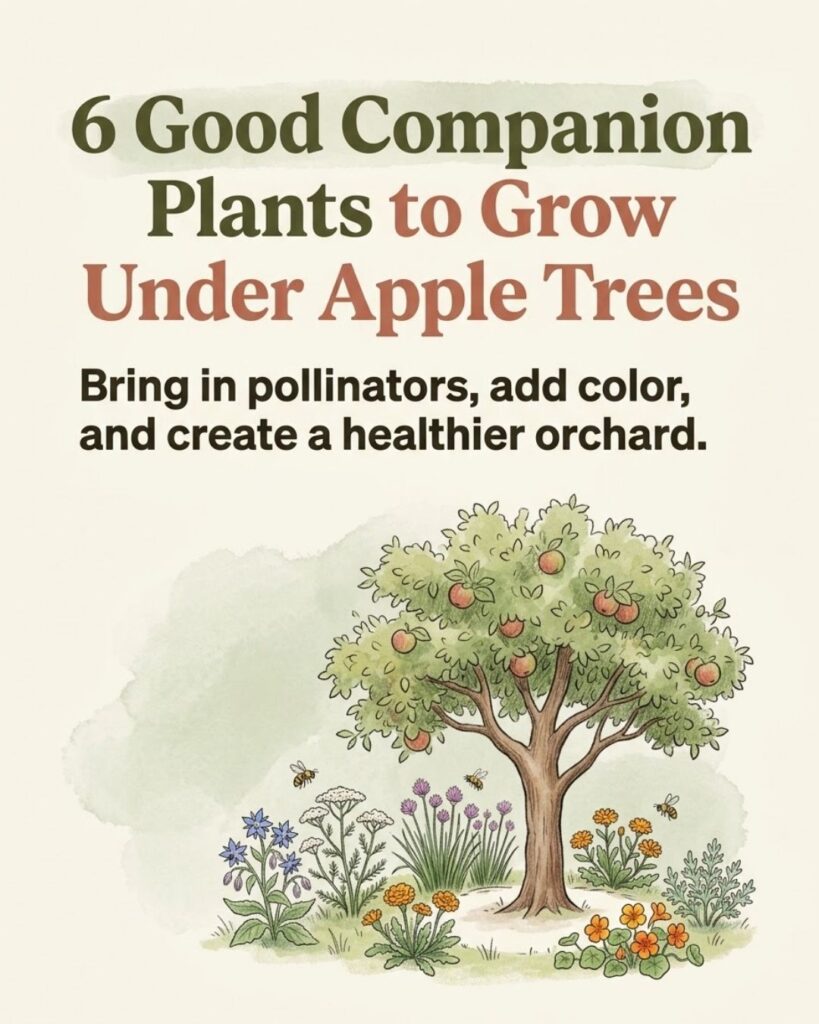
The ground beneath an apple tree does not have to be a circle of struggling grass or bare soil. With thoughtful planting, the area around the tree can become an attractive mix of flowers, herbs, mulch, and useful habitat for pollinating and beneficial insects.
There is one important caution, though: companion planting is often surrounded by claims that go far beyond the evidence. A flower growing beside an apple tree will not magically prevent every pest or make the tree produce more fruit. What diverse planting can do is provide additional flowers for insects, reduce the amount of turf competing near the tree, add seasonal color, and create a more varied garden environment.
Grass can compete with young trees for water and nutrients, which is one reason Extension guidance commonly recommends maintaining a turf-free, mulched area around newly planted trees. Organic mulch can also reduce evaporation and weed growth, but it should be kept away from the trunk rather than piled against the bark.
You Might Also Like:
- Loading posts...
Once those basics are handled, flowers and herbs can be added thoughtfully around the outer part of the tree’s growing area.
Start With the Apple Tree, Not the Companion Plants
Before choosing flowers, think about what the apple tree itself needs.
Apple trees need adequate sunlight, water, nutrients, airflow, and healthy soil. Plants growing beneath them share the same soil and therefore compete to some degree for moisture and nutrients.
That does not mean nothing can grow nearby. It simply means the goal should not be to pack every available inch with plants.
Young apple trees deserve particular care because they are still developing their root systems. Maintaining a relatively open, mulched area around a newly planted tree can reduce competition from grass and weeds. Research-based tree-care guidance also recommends leaving the root flare and trunk free of mulch.
Established trees usually give gardeners more flexibility, although conditions beneath the canopy may still vary from sunny and dry to increasingly shaded as the tree grows.
Why Replace Grass Around an Apple Tree?
A perfectly maintained lawn beneath fruit trees may look tidy, but grass is not necessarily the best neighbor for a young tree.
Turf has its own root system and uses water and nutrients from the same general soil area. Oregon State University Extension notes that young trees planted in lawns can establish and grow faster when a mulched space is maintained around them, in part because the mulch reduces competition from turf.
Removing grass also eliminates another common problem: damage from lawn equipment.
Repeated contact with a mower or string trimmer can injure bark around the base of a tree. A mulch ring creates a physical buffer that makes it much easier to maintain the area without working machinery right against the trunk.
Instead of replacing the grass with dense vegetation immediately, a practical arrangement is to keep mulch around the tree and establish flowers and herbs farther outward.
1. Borage
Borage is an annual herb with striking blue, star-shaped flowers that are attractive to visiting bees.
Its broad leaves and relatively substantial growth give it more visual presence than many small herbs, which can make it useful when you want the planting around an apple tree to look lush rather than sparse.
Because borage can become fairly large, avoid planting it immediately beside a young trunk. Give both the tree and the herb room.
It can also self-seed readily in favorable conditions, so gardeners who want a highly controlled planting may need to remove unwanted seedlings.
The strongest reason to include borage is simple: flowers increase the variety of floral resources available to insects in the garden. It should not be treated as a guaranteed pest-control treatment for apple trees.
2. Yarrow
Yarrow is another good candidate where conditions suit it.
Its clusters of small flowers provide accessible feeding sites for a variety of insects, and adding flowering plants to orchards can support pollinators and other beneficial insects. Orchard pest-management guidance recognizes the value of conserving beneficial insects rather than relying solely on pest-control products.
Yarrow is also a perennial in many climates, so you may not need to replant it every year.
That permanence is both an advantage and something to plan for. Give established perennial plants enough space that they do not crowd the trunk or make it difficult to inspect the base of the tree.
Yarrow is especially useful near the outer edge of an apple-tree planting, where it can receive sufficient light without interfering with routine tree maintenance.
3. Chives
Chives are one of the easiest culinary herbs to incorporate into an orchard-style planting.
They form compact clumps rather than sprawling extensively across the soil, and their purple flower heads are attractive to bees when allowed to bloom.
They are also perennial in many growing regions, meaning an established patch can return year after year.
For gardeners who want the area around a fruit tree to be productive as well as ornamental, chives have another obvious advantage: the leaves are useful in the kitchen.
There are many traditional companion-planting claims about members of the onion family repelling specific pests. Those claims should not be relied upon as a substitute for proper apple pest management. Think of chives primarily as a useful herb and flowering plant rather than as a pesticide growing in the ground.
4. Marigolds
Marigolds are inexpensive, familiar annual flowers that can add a strong band of color around the outer edge of an apple-tree bed.
Their biggest practical advantage is flexibility.
You can start them from seed or use nursery transplants, move them from year to year, and experiment with different spacing without permanently committing that area of the garden.
Marigolds are often described as universal pest repellents, but those claims are frequently exaggerated. Some companion-planting strategies involving marigolds may be useful in specific cropping situations, but that does not mean planting marigolds beneath an apple tree creates broad protection from apple pests.
Their value here is more straightforward: they add plant diversity, flowers, and color.
Annuals are also useful around younger trees because the arrangement can easily be changed as the canopy expands.
5. Nasturtiums
Nasturtiums can bring a completely different look to an apple-tree planting.
Their round leaves spread horizontally, and the flowers can range through shades of yellow, orange, red, and cream depending on the variety. Both leaves and flowers are commonly grown as edible garden plants.
Nasturtiums are also frequently recommended as trap plants for aphids.
The idea behind a trap crop is to provide a plant that attracts a pest away from another crop. This is a real pest-management strategy, but it is more deliberate than simply putting one attractive plant nearby and hoping all aphids move onto it.
Apple trees themselves can host aphids, and beneficial insects such as lady beetles, lacewings, and syrphid flies can help suppress apple aphid populations. Utah State University Extension specifically recommends conserving these natural enemies in home orchards.
So nasturtiums can be useful plants, but do not assume they guarantee aphid-free apples.
They can also spread considerably, so place trailing varieties where they will not cover the trunk flare or smother smaller plants.
6. Artemisia
Artemisia is grown largely for its aromatic, often silvery foliage.
Depending on the species or cultivar, it can provide striking contrast against green apple leaves and colorful flowers.
This is one plant that deserves careful selection.
“Artemisia” refers to a large group of plants rather than one uniform garden flower. Their size, growth habit, and tendency to spread can differ substantially. Some can become aggressive in favorable conditions.
If you want to include Artemisia, identify the exact species or cultivar first and learn its mature size before planting.
A restrained, clump-forming type positioned away from the trunk is easier to manage than an aggressive plant allowed to spread throughout the apple tree’s root zone.
Aromatic foliage is sometimes promoted as a natural pest repellent, but it is better not to promise pest control unless there is evidence for the particular plant-pest relationship involved.
Add Flowers for Pollinators—but Understand the Timing
One of the best reasons to diversify an orchard is to provide food and habitat for insects.
Apple flowers depend on insect pollination, particularly bees, for good fruit set. Having a landscape that provides flowers beyond the short apple-blossom period can help support pollinating insects through more of the growing season.
However, planting flowers beneath one apple tree does not guarantee improved pollination.
Apple pollination also depends on factors such as compatible cultivars flowering at the same time, adequate pollinator activity while blossoms are open, weather conditions, and local orchard circumstances.
Think of companion flowers as one component of a pollinator-friendly landscape rather than a replacement for proper apple-tree pollination planning.
Keep Plants and Mulch Away From the Trunk
One of the most valuable details in any under-tree planting plan is also one of the easiest to ignore.
Do not build a mound of mulch, flowers, groundcovers, or dense foliage directly against the apple tree trunk.
The point where the trunk widens into the major roots—the root flare—should remain visible rather than buried.
University of Minnesota Extension recommends keeping mulch away from trunks, with guidance for established trees beginning the mulched area some distance from the base. Mulch piled against the trunk can create undesirable moisture conditions and interfere with proper tree care.
A simple layout works well:
Tree trunk → clear space around trunk → mulch zone → flowers and herbs farther outward.
That arrangement makes it easier to inspect the bark, watch for damage, and keep vegetation from constantly touching the trunk.
Use Mulch as the Foundation
Companion plants do not have to completely cover the soil.
In fact, mulch can do much of the practical work.
A layer of suitable organic mulch can help conserve soil moisture, reduce weed growth, moderate soil temperature, and reduce competition from turf.
Wood chips are particularly useful around trees because they can cover a broad area without demanding additional water or nutrients the way living groundcover does.
Then, instead of planting the entire mulched ring, create pockets of herbs and flowers toward the outside.
This provides the visual effect of an orchard garden without turning the root zone into a crowded perennial border.
Be Careful With Watering
An apple tree and the small plants underneath it may not need water in exactly the same way.
New annual flowers often need frequent watering while their roots establish. A mature fruit tree benefits from deeper watering that reaches farther into the soil.
If every plant is watered only with a quick daily sprinkle, moisture may remain concentrated near the surface.
Pay attention to the soil rather than using one rigid watering schedule for everything.
Mulch can help reduce water loss, but irrigation should still be adjusted according to rainfall, soil type, temperature, tree age, and the plants you choose.
Avoid Creating a Pest Hiding Place
A diverse orchard floor can support useful insects, but excessively dense growth can also make maintenance harder.
Keep enough open space to:
- inspect the trunk
- pick up fallen fruit
- monitor for pests
- prune low branches when necessary
- water effectively
- move around the tree during harvest
Fallen or damaged apples should not simply disappear beneath dense groundcover where they become difficult to find.
Good companion planting should make orchard management better, not prevent you from seeing what is happening around the tree.
Choose Plants for Your Actual Conditions
The area beneath one apple tree may receive very different sunlight from the area beneath another.
A young tree with a small canopy may allow full sun almost all day. An older tree can create significant shade.
Before planting, consider:
- hours of direct sunlight
- mature tree size
- local climate
- winter hardiness
- soil drainage
- irrigation
- mature size of each companion plant
- whether the plant spreads aggressively
- whether deer, rabbits, or other animals commonly browse the area
Do not force a traditional “apple guild” plant list into conditions where those plants will struggle.
A healthy plant suited to your site is usually more useful than a supposedly perfect companion that dislikes the soil or light you have.
A Simple Apple Tree Planting Plan
You do not need dozens of different species to create a useful space.
For one established apple tree, a simple design might include a mulch ring covering most of the root-zone surface, several clumps of chives, a few yarrow plants farther from the trunk, annual borage or marigolds for summer flowers, and nasturtiums trailing around the outer edge.
Keep the immediate trunk area open.
As the tree becomes larger and creates more shade, adjust the planting instead of insisting on keeping the original arrangement forever.
That adaptability is one of the advantages of mixing permanent herbs with annual flowers.
Make the Space Diverse Without Making It Crowded
Planting around an apple tree can turn an ordinary patch of lawn into one of the most interesting parts of the garden.
Borage, yarrow, chives, marigolds, nasturtiums, and carefully selected Artemisia can all contribute something different—flowers, edible leaves, perennial structure, foliage color, or habitat for insects. Flower-rich orchard environments can also support beneficial insects that play useful roles in pest management.
Just keep the expectations realistic. Companion plants are not magical pest shields, and more plants are not automatically better.
The strongest foundation is much simpler: reduce grass competition, protect the trunk, maintain appropriate mulch, give the tree adequate water, and leave room for inspection and airflow.
Once the apple tree’s basic needs are covered, flowers and herbs can transform the area around it from plain grass into a colorful, productive, and much more interesting little orchard garden.