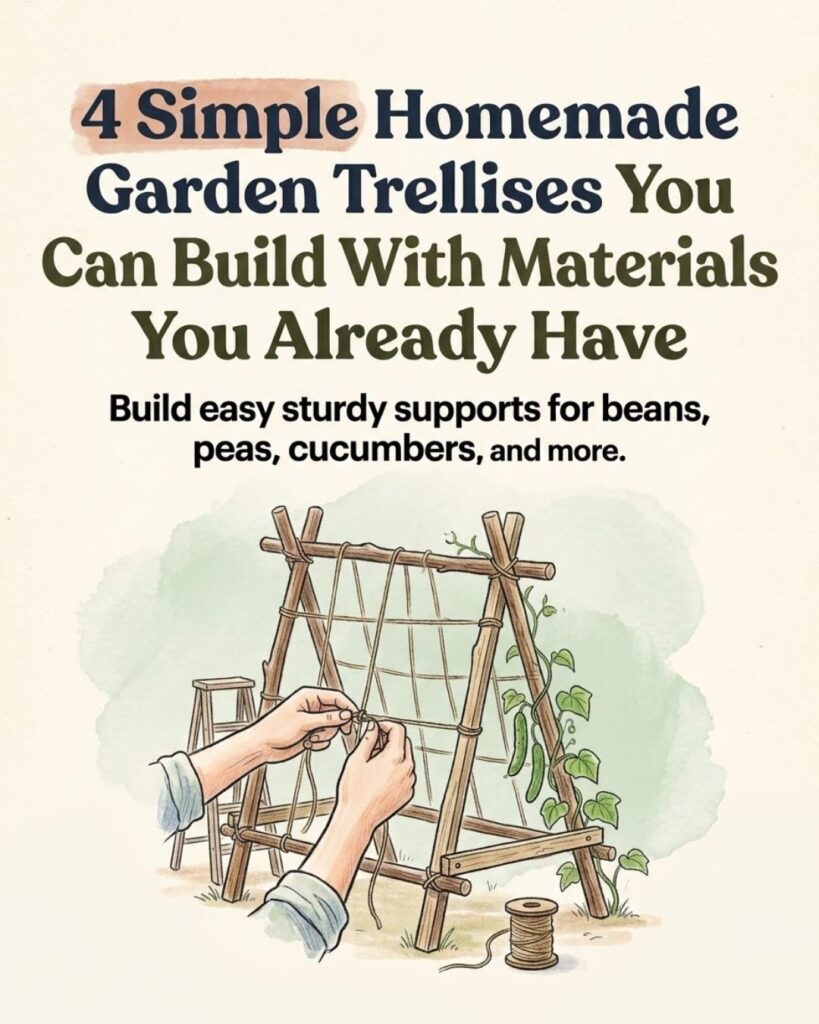
A useful garden trellis does not need to be expensive, decorative, or complicated. For many climbing vegetables, the best support is simply one that is sturdy enough for the crop, tall enough for its growth habit, and installed before the vines become difficult to handle.
That makes homemade trellises especially practical. Scrap lumber, sturdy branches, twine, old garden rods, pallets, and even a small ladder can often be turned into useful vertical supports with very little work.
Growing upward has several advantages. A trellis can keep sprawling vines from taking over pathways, make harvesting easier, and help you use limited garden space more efficiently. It can also make plants easier to inspect because much of the foliage is lifted off the soil.
You Might Also Like:
- Loading posts...
The important part is matching the structure to the plant. Peas can manage with relatively light support, while vigorous pole beans, cucumbers, indeterminate tomatoes, and heavier vines need something much stronger.
Here are four simple homemade trellis designs that can be adapted to raised beds, traditional garden rows, or small backyard growing spaces.
1. Post-and-String Trellis for Rows of Climbing Vegetables
A post-and-string trellis is one of the simplest ways to support a straight row of climbing plants.
The basic design uses two strong vertical posts with a horizontal piece across the top. Wire, durable cord, or strong garden twine can then be stretched across the frame, with individual strings hanging downward toward each plant.
The result is a simple curtain of vertical supports.
What You Need
Depending on the size of the trellis, you can use:
- Two sturdy wooden or metal posts
- One strong crosspiece
- Exterior-grade screws or appropriate fasteners
- Strong garden twine, cord, or wire
- Stakes or other anchors if additional stability is needed
Set the upright posts deeply enough that the frame cannot easily rock from side to side. The taller and wider the trellis becomes, the more important good anchoring is.
Attach the top crosspiece securely.
Then run a strong horizontal line along the top or use the crosspiece itself as the attachment point for vertical strings. Drop one string toward each plant and fasten its lower end near the soil.
Do not pull delicate stems tightly against the string. The plant should have room to grow naturally.
Best Crops for This Trellis
This design can work well for:
- Pole beans
- Peas
- Vining cucumbers
- Other lightweight twining or tendril-producing crops
Pole beans are particularly well suited because their stems naturally wrap around narrow supports.
Peas climb differently. They use tendrils, so they may perform better when they have several nearby strings or a finer network to grab rather than one isolated vertical line.
Cucumbers can also be trained onto string, although vigorous plants may need occasional guidance while they are young.
Why It Is Useful
One advantage of a string trellis is that cleanup can be simple. Instead of trying to untangle dead vines from permanent wire mesh, you can often cut away the string and plant material together at the end of the season.
If you plan to compost the vines, use natural twine that is appropriate for your composting system, or separate synthetic string before adding plant material to the pile.
2. Build a Rustic Triangle Trellis From Pruned Branches
Garden branches do not always need to become firewood or yard waste. Straight, reasonably strong branches can be turned into a rustic support for climbing vegetables.
A triangle or A-frame-style trellis is especially useful because the shape naturally provides stability.
Start by making two triangular end supports. Long branches form the sides, and a horizontal ridge pole connects the triangles at the top.
Additional sticks, twine, or cord can then run from the upper pole toward the ground to create climbing paths.
Choosing the Right Branches
Use branches that are:
- Strong rather than brittle
- Long enough for the intended crop
- Free from sharp projections that could injure plants
- Thick enough to hold the expected weight
Freshly cut or well-preserved branches generally provide better structural support than old, rotten wood.
Remove small side twigs where they would interfere with construction, but the finished frame does not have to be perfectly smooth.
How to Assemble It
Place two long branches so their upper ends meet, creating an inverted V. Tie or fasten them together securely.
Create a second matching pair a short distance away.
Lay a long branch across the top to connect the two frames and secure it at both ends.
From there, add thinner branches vertically or diagonally. Alternatively, tie strings from the top ridge down to the soil.
The finished structure should feel stable before you plant anything beneath it.
Why Gardeners Like This Style
A branch trellis blends easily into an informal garden and requires very few purchased materials.
It also provides many possible attachment points for tendrils and twining stems.
Peas, pole beans, and small vining cucumbers are reasonable candidates.
A branch frame can also support lightweight flowering climbers, making it useful in vegetable gardens and mixed ornamental beds.
The main limitation is durability. Natural branches eventually weather and decay, so inspect the structure before reusing it in another season.
3. Make a Simple Hoop or Arch Trellis
A hoop trellis creates a curved growing structure rather than a flat wall.
The concept is straightforward: flexible rods or poles are pushed securely into the soil on opposite sides of a bed and bent toward one another to create arches. Several arches can then be connected together for additional strength.
Suitable material depends on what you have available and how permanent you want the structure to be.
Flexible garden rods, appropriately sized metal supports, or other strong bendable materials may work. Avoid anything that becomes dangerously brittle, has sharp exposed edges, or cannot safely handle the tension created by bending.
How to Build the Basic Shape
Place the first end of a flexible support deeply into the soil.
Bend it carefully over the bed and secure the opposite end into the ground.
Repeat the process at regular intervals.
If necessary, attach the arches together along the top with a ridge support or strong ties. This helps reduce side-to-side movement.
You can also add string or netting between the arches if the plants need more places to grab.
What Can Grow on an Arch Trellis?
Lightweight climbing crops are the easiest choices, including:
- Peas
- Pole beans
- Smaller vining cucumbers
- Lightweight annual vines
The structure must become much stronger if you plan to support heavier vegetables.
One useful feature of an arch is the space underneath it. Depending on the trellis orientation, season, and amount of shade created by the vines, you may be able to grow lower-growing plants beneath or beside it.
Greens can sometimes benefit from some protection from intense summer sun, but do not assume every crop will thrive under a trellis. Consider each plant’s light requirements and your local climate.
Give the Arch Enough Strength
An arch may feel sturdy while empty but behave very differently once covered with foliage.
Leaves catch wind. Wet plants become heavier after rain. Fruiting vines add additional weight.
For that reason, the supports should be inserted deeply and tied together securely before the vines grow over them.
Trying to reinforce a collapsing arch underneath mature plants is much harder than building it correctly at the beginning.
4. Turn a Ladder, Pallet, or Scrap-Wood Frame Into a Leaning Trellis
One of the easiest trellises may already be sitting behind your shed.
A small wooden ladder, sturdy pallet, or simple scrap-lumber frame can become a climbing structure by leaning it securely at an angle.
The angle gives plants an easy surface to follow upward and can make produce more visible beneath the foliage.
Using an Old Ladder
A small wooden ladder provides ready-made horizontal rungs.
Position it where it cannot fall backward or slide forward. Depending on the design, the feet can be set slightly into the soil or braced securely.
Do not use an unstable ladder with rotten wood, loose rungs, sharp hardware, or peeling materials that you would not want around an edible garden.
The ladder is no longer serving its original purpose as climbing equipment, but it still needs to be structurally sound enough to carry plants.
Using a Pallet
A pallet can create a broad climbing surface with almost no construction.
Lean it against a strong fence or another secure support and anchor it so wind or plant weight cannot shift it.
Pallets vary widely in condition and previous use. Avoid visibly contaminated, oily, chemically stained, or questionable pallets around edible crops. If you cannot determine whether a pallet is suitable for your garden, using clean untreated lumber is the safer option.
You may need to add twine between the boards if the openings are too wide for smaller tendrils.
Building a Simple Leaning Wood Frame
If you have several pieces of scrap lumber, you can make your own version.
Construct a rectangular frame and add horizontal slats, wire, or strong cord.
Lean it at a moderate angle and secure both the top and bottom.
This gives you more control over the size than using a ladder or pallet.
Match the Trellis Strength to the Crop
This is the most important rule in homemade trellis building.
A structure that works perfectly for peas may fail under a mature squash vine.
Lightweight Climbers
Peas and many ornamental vines can often use:
- Twine
- Thin branches
- Lightweight mesh
- Narrow rods
They still need a stable supporting frame, but the individual climbing surfaces do not have to carry enormous loads.
Medium-Weight Vines
Pole beans and cucumbers generally need stronger overall support.
A healthy plant can create a surprisingly large mass of foliage over the course of the season. Cucumbers also add the weight of developing fruit.
Use solid posts, dependable connections, and enough climbing surface to spread the plants out.
Tomatoes Need a Different Approach
Tomatoes are often described as climbing plants, but they do not climb a trellis naturally in the same way that peas or pole beans do.
Indeterminate tomato plants produce long stems and can be trained vertically, but they usually need to be tied, clipped, woven, or otherwise supported as they grow.
If you adapt one of these trellises for tomatoes, make sure it is strong enough to support mature plants and fruit. Use soft ties that do not cut into the stems.
Large tomato plants can become much heavier than a simple string or flimsy branch structure can safely handle.
Be Careful With Heavy Squash and Melons
Some small vining squash can be trained vertically, but the support needs to be substantially stronger.
Large squash, pumpkins, and melons can place significant weight on a trellis. Certain fruits may also require individual slings or support as they develop.
Do not put a heavy crop onto a lightweight homemade structure simply because the vines are capable of climbing it.
Build the Trellis Before Your Plants Need It
One of the most common timing mistakes is waiting until the garden looks crowded before adding support.
Young vines are easy to redirect.
Mature vines are not.
Once beans, peas, or cucumbers have wrapped around neighboring plants and grabbed onto one another, separating them can damage stems and tendrils.
Installing the trellis at planting time or shortly afterward gives you a chance to anchor everything properly without working around a mass of foliage.
As the plants begin growing, check them regularly.
Guide wandering stems toward the support, add loose ties where necessary, and correct problems before vines become firmly attached in the wrong direction.
Small Details Make Homemade Trellises Work Better
A few extra precautions can make a simple structure much more reliable.
Use outdoor-rated fasteners where possible, especially if you want the frame to last more than one season.
Cover or remove exposed nails, wires, screws, and sharp branch ends.
Check knots and connections periodically because weather and plant movement can loosen them.
Keep the base stable. A top-heavy trellis should never depend entirely on loose garden soil to remain upright.
Consider wind direction as well. A vine-covered trellis creates far more wind resistance than an empty one.
Finally, leave enough room to harvest. A beautiful wall of vegetation is less useful if you cannot reach the cucumbers or beans hiding in the middle.
Simple Materials Can Make Excellent Garden Supports
A productive trellis is really just a structure that gives the right plant a secure path upward.
Two posts and string may be all you need for a row of pole beans. A few sturdy branches can become an attractive A-frame for peas. Flexible rods can create an arch over a raised bed, while an unused ladder or suitable pallet can become a climbing wall with almost no construction.
The best design depends less on how polished it looks and more on what you plan to grow.
Build light supports for light vines. Reinforce structures intended for heavier plants. Anchor everything before wind, foliage, and fruit begin adding stress. Most of all, put the trellis in place while the plants are still small.
That little bit of early preparation can turn a pile of leftover garden materials into one of the most useful structures in the bed.