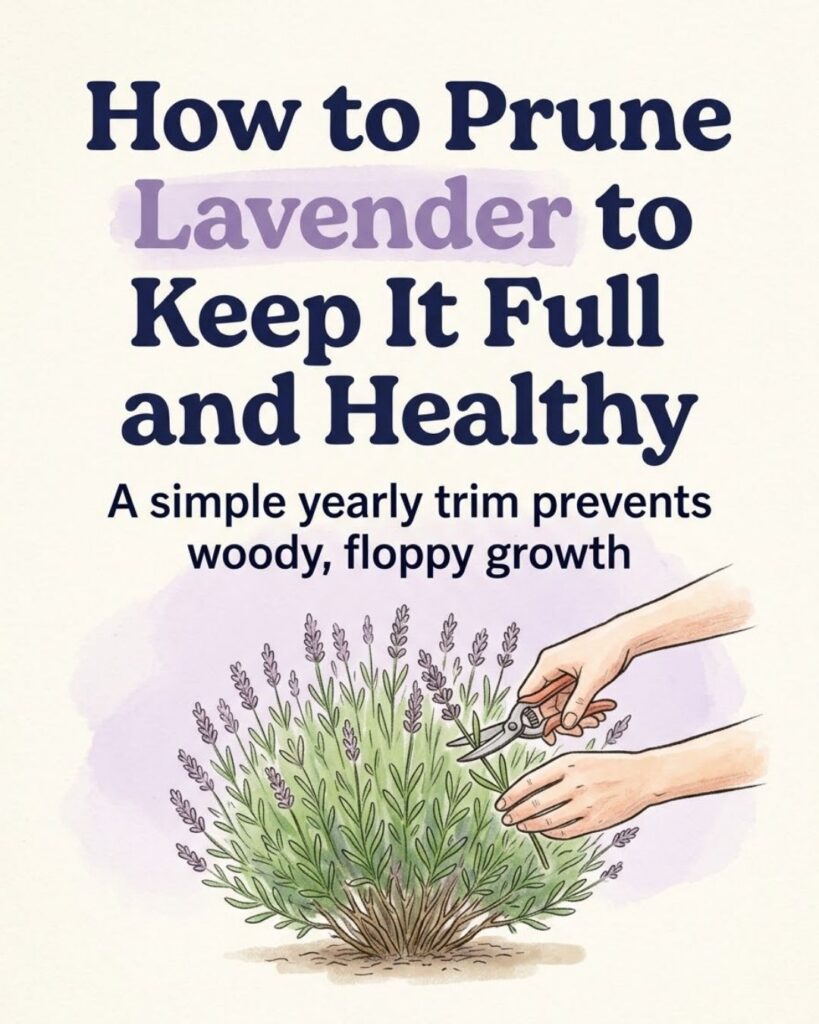
Lavender can look beautifully compact for a few seasons and then suddenly become loose, woody, and uneven. The change often happens gradually. Stems lengthen, the center opens up, flowers sit farther from the base, and the plant begins to flop outward instead of holding a neat mound.
Regular pruning is one of the best ways to slow that process.
The goal is not to cut lavender back aggressively. In fact, hard pruning into old bare wood can permanently damage many lavender plants. A better approach is to trim lightly and consistently while the plant still has plenty of healthy green growth.
You Might Also Like:
- Loading posts...
A small amount of shaping each year is usually much easier than trying to rescue a neglected lavender plant after several seasons.
Why Lavender Becomes Woody
Lavender is a woody perennial shrub rather than a soft herbaceous plant that disappears completely each winter.
As stems age, their lower portions become harder and more woody. New leafy growth continues higher up the stems, while the older base becomes increasingly bare.
That is normal.
The problem develops when too much unpruned growth builds up year after year. Long stems become heavier, plants open in the middle, and the leafy portion moves farther away from the crown.
Eventually the lavender may look leggy even while it is healthy.
Pruning does not stop lavender from developing woody stems altogether, but it helps keep new growth closer to the base and encourages a denser, more rounded plant.
The Most Important Rule: Do Not Cut Deep Into Bare Wood
This is the mistake gardeners need to be most careful about.
Lavender does not reliably produce new shoots from old, leafless wood. If you cut a mature stem back below all visible green growth, that section may remain bare rather than filling in again.
Before making each cut, look closely at the stem.
You should generally be able to see healthy leaves or green shoots below the point where you are cutting.
Think of the woody base as the framework of the plant. You want to shorten and shape the leafy growth above it, not remove the framework itself.
This is also why annual pruning works better than waiting several years. Once all the leafy growth has moved far away from the base, your safe pruning options become much more limited.
When to Prune Lavender
The best timing depends partly on climate and the type of lavender you are growing, but two periods are commonly useful.
Early Spring
Spring is a good time to inspect the plant after winter.
Wait until you can clearly see fresh green growth beginning. This makes it easier to distinguish living stems from sections that may have been damaged by cold weather.
You can remove obvious dead material and lightly shape the plant.
Avoid cutting very early simply because the calendar says spring has arrived. In colder climates, late freezes may still occur, and new growth can be more vulnerable after heavy pruning.
After the Main Flowering Flush
Another useful time to prune is after the first major display of flowers begins to fade.
Removing spent flower stalks improves the plant’s appearance immediately and gives you an opportunity to shape the remaining foliage.
Depending on the lavender variety and climate, trimming after flowering may also encourage additional flowering later in the season, although the amount of repeat bloom varies.
The purpose of this pruning is mainly plant structure, not forcing another round of flowers.
Why Hard Fall Pruning Can Be Risky
Late fall is usually not the best time for aggressive pruning in areas with cold winters.
A hard cut can encourage tender new shoots that may not have enough time to mature before freezing temperatures arrive.
Leaving some established growth also gives the plant a little more protection going into winter.
If your climate is mild, pruning schedules may be more flexible. In colder regions, however, it is generally safer to reserve substantial shaping for spring or earlier in the growing season.
You can still remove obviously spent flowers or damaged material, but avoid dramatically reducing the plant just before winter.
How to Prune Lavender Step by Step
You do not need special equipment beyond a clean, sharp pair of hand pruners or garden shears.
The process is simple once you understand where to cut.
1. Remove the Faded Flower Stems
Start with the flower stalks.
Follow each faded stem down toward the leafy portion of the plant and cut it back rather than leaving long dry stalks standing above the foliage.
If you are working on a large lavender plant, you can often gather several flower stems loosely in one hand and trim them together.
This immediately makes the plant easier to see and helps reveal its natural shape.
2. Look at the Plant Before Cutting More
After the flowers are removed, stop for a moment and inspect the entire shrub.
Look for:
- long stems sticking outside the main shape
- sections flopping toward the ground
- an open center
- damaged or dead stems
- healthy green shoots near the woody base
Do not start cutting randomly.
Lavender usually looks best when shaped into a low, rounded mound rather than a flat-topped box.
3. Shorten the Green Growth
A common general guideline is to remove roughly one-third of the current green growth during routine pruning.
That is not a rigid measurement. The exact amount depends on the plant, how much leafy growth it has, and how recently it was pruned.
The safer rule is this:
Always leave healthy green growth below your cuts.
If one-third would take you into bare woody stems, cut less.
Young, vigorous plants may tolerate more shaping than old plants with only a thin layer of foliage.
4. Shape the Plant Into a Rounded Mound
Work gradually around the plant instead of finishing one side completely before touching the other.
Trim the longest stems first and then step back to check the shape.
A soft dome allows light to reach much of the plant and produces a more natural appearance than cutting everything to exactly the same height.
Do not worry about mathematical perfection.
The goal is simply to prevent a few long stems from dominating the plant and pulling it apart.
5. Leave Plenty of Leaves on Every Living Stem
Before cutting a woody stem, check that foliage remains below your cut.
If the stem has green shoots lower down, you can usually shorten it to just above that living growth.
If the entire lower section is bare wood, be conservative.
It is better to leave a slightly awkward branch than cut it too far and risk losing that portion of the plant.
What About Dead Stems?
Dead wood is different from healthy old wood.
If a stem is clearly dead, dry, brittle, and shows no signs of green growth, it can usually be removed.
Before cutting, scratch a tiny section of bark with a fingernail or clean blade. Living tissue often shows green beneath the surface, while dead wood tends to remain brown and dry.
If you are uncertain, wait until the plant is actively growing in spring. Living branches usually become much easier to identify then.
Why Annual Pruning Works Better
Lavender responds best to consistency.
Imagine a plant that puts on several inches of new growth every year but is never shortened. The leaves gradually become concentrated at the ends of longer woody stems.
After several seasons, you may have a large plant with plenty of flowers but a bare, unattractive center.
At that stage, you cannot safely cut everything back to the original compact size because most of the lower framework no longer has leaves.
Regular pruning prevents the problem from becoming so severe.
Each year, you shorten some of the new growth while keeping foliage lower on the plant. The lavender remains closer to its original size and keeps a fuller outline.
Pruning Young Lavender Plants
Young lavender plants benefit from early shaping.
It can feel strange to trim a plant that is still relatively small, but encouraging branching early helps establish a compact structure.
Do not prune tiny newly planted seedlings severely. Give them time to become established.
Once the plant is actively growing, however, lightly pinching or trimming long shoots can encourage branching rather than allowing a few stems to stretch far beyond the rest.
Early attention is much easier than correcting a mature, woody plant later.
Can You Rescue Old, Woody Lavender?
Sometimes, but expectations should be realistic.
If an older plant still has green growth relatively low on many stems, you may be able to improve its shape gradually over more than one pruning season.
Avoid cutting the entire shrub back to bare wood in one attempt.
Instead, remove dead sections, shorten the healthiest leafy stems conservatively, and see how the plant responds.
If the lavender has become extremely woody, split open in the center, and has almost no low green growth, replacement may eventually be more practical than severe rejuvenation pruning.
Many gardeners try to save old plants by chopping them nearly to ground level. This can work with shrubs that readily sprout from old wood, but lavender is much less dependable in that respect.
Pruning Is Only Part of Keeping Lavender Compact
A floppy lavender plant is not always caused entirely by lack of pruning.
Growing conditions matter too.
Lavender generally performs best in strong sunlight and well-drained soil. Excessively rich soil, heavy feeding, shade, and overly wet conditions can encourage softer growth or weaken the plant.
Avoid trying to compensate for poor growing conditions by pruning more aggressively.
If the plant repeatedly produces weak, floppy stems, check whether it is receiving enough light and whether water drains freely around the roots.
Use Clean, Sharp Tools
Dull blades crush stems instead of cutting them cleanly.
Use sharp hand pruners for thicker stems and clean garden shears for lighter shaping.
Cleaning your tools before moving between plants is also a sensible garden habit, particularly if you have been cutting diseased or damaged material elsewhere.
You do not need to sterilize your shears obsessively after every cut, but keeping tools reasonably clean reduces the chance of carrying problems from one plant to another.
Common Lavender Pruning Mistakes
Most pruning problems come from either cutting too much or waiting too long.
The most common mistakes include cutting below all green growth, pruning severely just before winter, allowing the plant to go untrimmed for years, and trying to force an old woody shrub back into the size of a young plant.
Another mistake is removing only the flower stalks while never shaping the leafy growth underneath.
Deadheading alone improves appearance, but it does not do much to prevent the shrub itself from becoming increasingly woody and loose.
A better routine combines flower removal with light shaping.
A Little Pruning Goes a Long Way
Lavender does not need constant attention.
What it benefits from is a modest amount of pruning at the right time each year.
Remove faded flowers, shorten the fresh leafy growth, shape the plant into a gentle mound, and make sure every cut leaves healthy foliage behind. Avoid digging deeply into the bare woody base, and be cautious about hard pruning late in the year where winters are cold.
That simple routine can keep lavender compact and attractive for much longer.
The biggest advantage of regular pruning is not that it transforms a damaged plant overnight. It is that it prevents the plant from becoming difficult to correct in the first place. A few careful cuts each season are far more effective than trying to rebuild a woody, sprawling lavender shrub years later.