
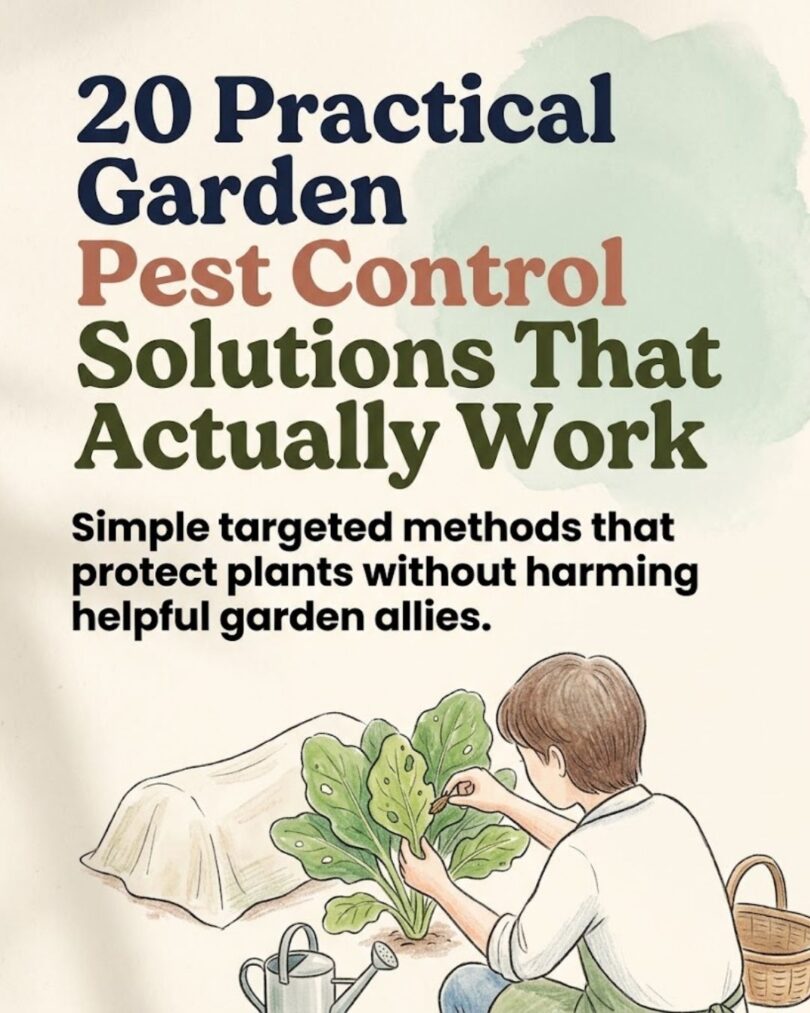
Garden pests are part of growing food. Aphids appear on tender shoots, caterpillars chew holes in brassicas, beetles arrive seemingly overnight, and birds or rabbits may discover ripe produce before you do. A few damaged leaves do not mean a garden is failing, and the answer is rarely to spray everything in sight.
A better approach is integrated pest management, or IPM: identify the problem, prevent damage where possible, monitor pest numbers, use physical and biological controls first, and reach for pesticides only when they are genuinely needed.
This matters because a garden contains far more than pests. Bees, hoverflies, lacewings, predatory beetles, spiders and parasitoid wasps can all play useful roles. Broad-spectrum insecticides may kill those allies along with the insect you were trying to control.
You Might Also Like:
- Loading posts...
The following 20 strategies create a practical pest-control toolkit for vegetable beds, fruit gardens and home landscapes. You will not need every method for every problem. The real skill is matching the solution to the pest.
Start With Prevention and Early Detection
1. Inspect Your Plants Regularly
The most valuable pest-control tool does not come in a bottle. It is a habit: walking through the garden and looking closely.
Check plants at least regularly during active growth, paying particular attention to:
- the undersides of leaves
- tender new growth
- stems near soil level
- flower buds
- developing fruits
- plants that suddenly wilt or stop growing
Do not look only for insects. Look for the evidence they leave behind: holes, stippling, curled leaves, eggs, sticky honeydew, chewed stems, frass or unusual wilting.
Monitoring matters because many pests are far easier to manage while their populations are small. For example, University of Minnesota Extension recommends scouting vegetable crops such as flea-beetle hosts soon after seedlings emerge rather than waiting until damage becomes severe.
Just as important, identify the organism before treating it. A caterpillar on a plant may be a pest, but another insect nearby may be feeding on that caterpillar.
2. Use Floating Row Covers
Floating row covers are among the most reliable ways to prevent insect damage without applying anything to the plant.
These lightweight fabrics allow light, air and moisture through while blocking insects from reaching crops. They can be particularly useful against pests such as flea beetles, cabbage maggot flies and certain moths that lay eggs on vegetables.
Install the cover before the pest arrives and secure every edge. A cover with gaps around the sides provides surprisingly little protection.
There is one important limitation: crops that rely on insects for pollination may need the cover removed once flowering begins. Squash, for example, needs pollinator access unless you are hand-pollinating.
Row covers can also provide some protection from cool weather, making them useful beyond pest control.
3. Protect Young Transplants With Collars
Cutworms can sever seedlings near ground level, sometimes destroying a transplant in a single night.
A simple cardboard or aluminum-foil collar placed around the stem creates a physical obstacle. University of Minnesota Extension recommends pushing the bottom of the collar several inches into the soil while leaving several inches above ground.
This is especially worthwhile for a small garden where losing six young transplants may represent a large portion of the crop.
The advantage is simplicity: no spray, no residue and no need to treat the whole bed for a pest that attacks at soil level.
4. Use Fencing and Hardware Cloth Against Larger Animals
Not every garden pest has six legs.
Rabbits, voles and other small mammals can chew seedlings, roots, bark and stems. In those situations, exclusion is usually more dependable than homemade odor repellents.
Hardware cloth can be used around vulnerable plants or incorporated into certain garden structures. Guards around young trees should leave enough room for trunk growth and may need to extend below the soil to discourage animals from going underneath. Larger animals such as deer require appropriately sized fencing.
For raised beds where burrowing animals are a recurring problem, planning the barrier during construction is much easier than trying to retrofit protection later.
Remove Pests Without Reaching for a Spray
5. Handpick Large Insects
For a backyard garden, hand removal can be remarkably effective.
Tomato hornworms, Japanese beetles, Colorado potato beetles, squash bugs and many caterpillars are large enough to remove manually. Egg masses can often be removed before they hatch as well.
Drop unwanted insects into a container of soapy water if killing them is appropriate. University of Minnesota Extension recommends hand removal for pests including Japanese beetles and Colorado potato beetles in smaller gardens.
Morning and evening can make certain insects easier to catch because cooler temperatures reduce their activity.
One caution: learn what beneficial insects and parasitized pests look like. A hornworm covered in parasitoid wasp cocoons, for instance, is already supporting natural biological control and may be worth leaving alone.
6. Knock Aphids Off With Water
Aphids often look alarming because they gather in dense colonies, but a minor outbreak does not always require an insecticide.
A firm stream of water can dislodge aphids from sturdy plants. Once knocked off, many have difficulty returning to their feeding location, and repeated spraying with plain water may keep a small infestation manageable.
Focus especially on tender shoots and leaf undersides.
This method is best for robust plants that will not be damaged by the water pressure. It is not ideal for fragile seedlings, delicate flowers or plants already suffering from disease problems that are encouraged by prolonged leaf wetness.
7. Trap and Handpick Slugs
Slugs are easiest to find when conditions are cool and damp. Check beneath boards, stones, dense foliage and garden debris.
One useful method is to place flat boards or damp materials in areas where slugs are active. They hide beneath them, allowing you to collect them the following morning.
Fermenting-liquid traps can also catch slugs. University of Minnesota Extension describes traps using beer or a yeast-and-water mixture, but several traps may be necessary when slug pressure is heavy.
These traps should not be viewed as a magic solution for an entire property. They are more useful as one part of a broader slug-control strategy.
8. Use Copper Barriers in Small Areas
Copper can deter slugs, making copper bands or foil useful around containers, small raised beds or especially valuable plants.
The barrier needs to be wide enough that a slug cannot simply stretch across it, and leaves, mulch or soil should not create a bridge over the copper.
Extension guidance notes that copper barriers are most practical for containers and relatively small garden spaces. Some products may also have sharp edges, so installation requires additional care where children play.
Copper is not necessarily practical for enclosing a large vegetable garden, but it can solve a very specific problem well.
Make the Garden Less Favorable to Pests
9. Remove Diseased Plants, Fallen Fruit and Crop Debris
Garden sanitation is easy to underestimate.
Overripe fruit, damaged produce, weeds and dead plant material can provide food, shelter or overwintering sites for certain pests and pathogens.
Remove severely infested material when appropriate, harvest ripe fruit promptly and pick up fruit that has fallen onto the ground. For spotted wing drosophila, for example, Extension guidance specifically recommends frequent harvesting and removing old or fallen fruit.
At the end of the growing season, clean up crop residues associated with recurring pest problems rather than automatically leaving everything in place.
That does not mean a garden must be sterile. Some plant material can provide valuable habitat for beneficial wildlife. The goal is targeted sanitation where you know debris is supporting a particular pest or disease.
10. Manage Pest-Hosting Weeds
Weeds do more than compete with vegetables for space, water and nutrients. Some also provide alternative food or shelter for pests.
For example, nightshade-family weeds can serve as food sources for Colorado potato beetles, while weeds around beds can provide habitat for flea beetles and other insects.
Focus weed control around vulnerable crops instead of assuming every wild plant on the property is harmful.
Flowering plants outside vegetable rows may actually support beneficial insects, so the objective is thoughtful management rather than removing all non-crop vegetation.
11. Rotate Crop Families
Crop rotation is useful because related plants often share pests and diseases.
Instead of thinking only in terms of individual crops, rotate plant families. Tomatoes, peppers, eggplants and potatoes, for example, are closely related and should not be treated as four unrelated crops in a rotation plan.
University of Minnesota Extension notes that crops in the same family frequently share pest and disease problems and recommends rotating by plant family.
Rotation works best against problems that remain relatively localized in soil or crop residues. It will not stop highly mobile insects from flying into the garden, so it should be viewed as one preventive tool rather than a universal cure.
12. Use Companion Planting Selectively
Companion planting has some value, but many popular online charts promise far more than research supports.
Simply planting a marigold beside a vegetable does not create an invisible pest shield.
Research summarized by University of Minnesota Extension has found useful relationships in specific situations. Nasturtiums and marigolds, for example, have reduced damage from some pests in squash research, while basil and marigolds have shown benefits against certain tomato pests. Other widely repeated plant combinations have little supporting evidence.
A more dependable version of companion planting involves increasing plant diversity, attracting natural enemies or using trap crops—plants deliberately chosen because a pest prefers them over your main crop.
Choose companion plants because there is a reason for them to be there, not because an internet chart says two vegetables are “friends.”
13. Encourage Beneficial Insects
A garden already contains predators and parasitoids that can reduce pest populations for free.
Lady beetles, lacewings, hoverfly larvae, predatory bugs and many small wasps feed on or parasitize common garden pests. Penn State Extension identifies numerous beneficial groups that attack aphids and other damaging insects.
To make the garden more welcoming to them:
- grow a variety of flowering plants
- provide blooms across as much of the season as possible
- tolerate minor pest populations
- avoid unnecessary broad-spectrum insecticides
- provide habitat rather than keeping every corner bare
Buying containers of beneficial insects can work in specialized environments, but outdoor releases may simply disperse. Creating habitat for naturally occurring beneficial species is often a better long-term strategy.
Monitor Flying Pests Before They Become a Major Problem
14. Use Sticky Cards as Monitoring Tools
Yellow or blue sticky cards can catch flying insects such as whiteflies, thrips, fungus gnats and winged aphids.
Their greatest value is often detection, not control.
Placed near the plant canopy, sticky cards let you notice a population increase before severe plant damage appears. Extension guidance for protected growing environments specifically recommends sticky cards as part of scouting programs.
Avoid covering an outdoor garden with excessive numbers of sticky traps. Non-target insects can become trapped too.
Use the cards to answer the question, “What is showing up in my garden?” Then choose a targeted management method.
Use Lower-Impact Treatments Correctly
15. Choose Commercial Insecticidal Soap for Soft-Bodied Pests
Insecticidal soap is useful against pests such as aphids, spider mites, mealybugs and some other soft-bodied insects.
It works only when the spray contacts the pest, and it has little or no residual effect after drying. That means good coverage—especially beneath leaves—is far more important than spraying the general area.
Use a product specifically labeled as insecticidal soap rather than assuming any dish detergent is equivalent. Household soaps and detergents can damage plant tissue because their ingredients and concentrations were not designed for plant use.
Follow the product label and test sensitive plants before treating them broadly.
16. Use Neem or Horticultural Oil Only as Labeled
Neem-based pesticides and horticultural oils can be useful against selected insects and mites, but “natural” does not mean harmless or suitable for unrestricted use.
Neem products vary in concentration and formulation, so there is no universal homemade dilution that should be applied to every vegetable.
Use the label to determine:
- which pests the product controls
- which crops may be treated
- the correct concentration
- how often it may be applied
- precautions for pollinators
- harvest restrictions, if any
Oil sprays can also injure certain plants, particularly under stressful environmental conditions. Colorado State University Extension cautions that plant sensitivity and drought stress can increase the risk of injury from horticultural oils.
Avoid spraying open flowers or pollinators directly.
17. Use Bt for the Caterpillars It Actually Controls
Bacillus thuringiensis, commonly shortened to Bt, is a microbial pesticide. Different strains target different organisms, so buying “Bt” without reading the label is not enough.
Bt var. kurstaki, or Btk, is commonly used against young moth and butterfly caterpillars. The caterpillar needs to eat treated plant material, which is why coverage and application while larvae are still small matter.
Bt is highly targeted compared with many broad-spectrum insecticides, but that selectivity also means it will not control every worm-like larva. Sawfly larvae, for example, are not controlled by Btk.
Correct identification comes first.
18. Use Iron Phosphate Bait for Persistent Slugs
If handpicking, habitat management and barriers are not enough, an iron-phosphate slug bait can be a useful targeted option.
University of Minnesota Extension lists iron phosphate among lower-toxicity slug-control choices and distinguishes it from metaldehyde, which can present serious risks to dogs and other animals.
Even lower-risk products must still be used according to their labels. Apply only where needed and store the package where children and animals cannot access it.
This is a good example of why “chemical-free” should not be the only goal. A carefully selected, narrowly targeted product may sometimes be more sensible than repeated applications of untested homemade mixtures.
Protect the Harvest From Birds and Animals
19. Install Bird Netting Properly
Berries and ripening fruit can disappear quickly once birds discover them.
Netting can be effective, but installation matters. Rather than loosely draping mesh over plants, support it on a frame where possible and secure the edges so animals cannot become trapped underneath.
Also remember that netting over flowering crops can exclude bees and other pollinators. Fine netting is best used at the stage when protection is actually needed, such as after flowering and fruit set on crops that rely on insect pollination. Extension guidance similarly cautions against covering blooming plants that require pollinators.
Check netting periodically for gaps, tears and wildlife entanglement.
20. Build Pest Control Around Correct Identification, Not a Shelf Full of Products
The most reliable gardens do not necessarily contain twenty pesticide bottles. They contain gardeners who know when not to treat.
A plant can often tolerate some insect feeding without losing meaningful production. Beneficial insects may already be controlling the pest. Sometimes the damage is old and the culprit has disappeared. A disease, nutrient problem or environmental stress can also resemble insect injury.
Before treating anything, ask:
- What organism is causing the damage?
- Is the damage serious enough to require action?
- Can I physically exclude or remove the pest?
- Is there a biological or cultural solution?
- If a pesticide is necessary, what is the most targeted labeled product?
- How can I avoid exposing pollinators and other non-target organisms?
This sequence prevents one of the most common gardening mistakes: treating first and diagnosing later.
Pest-Control Ideas That Deserve More Caution
Several popular home remedies sound attractive because they are cheap and familiar, but familiar ingredients are not automatically safe for plants.
Diatomaceous earth is often promoted as a perfect slug barrier. In reality, University of Minnesota Extension reports that it loses effectiveness when wet and is generally not a particularly effective slug deterrent. Fine dust should also be handled carefully to avoid inhalation.
Homemade dish-soap sprays are not the same as formulated insecticidal soaps. Detergents may injure leaves, especially if the concentration is guessed.
Essential-oil sprays can also damage foliage at inappropriate concentrations, and their effectiveness varies greatly by pest and formulation.
Garlic mixtures may have repellent effects in some circumstances, but they should not replace a pest-specific management plan.
Likewise, baking soda sprays are primarily discussed as possible disease-management treatments rather than insect control, and homemade concentrations can injure plants. Pest insects and fungal diseases are different problems and should not be treated as though they require the same solution.
The safest rule for any pesticide—even one marketed as organic—is to read and follow the label. Organic pesticides can still injure plants, pollinators, aquatic organisms, pets or people when misused.
A Better Way to Think About Garden Pest Control
A productive garden does not need to be insect-free.
A few holes in cabbage leaves, several aphids on a pepper plant or an occasional beetle are often tolerable. Trying to eliminate every organism can create a larger problem by removing the predators that would otherwise help keep pests under control.
Start with prevention. Cover vulnerable crops before pests arrive. Rotate plant families where it makes sense. Remove problem debris. Protect seedlings with barriers. Grow flowers that support beneficial insects.
Then monitor.
If a pest appears, begin with the least disruptive option that is likely to work: handpicking, a water spray, exclusion or another physical control. Move to insecticidal soaps, oils, Bt or other labeled products only when the pest and level of damage justify them.
That layered approach is less dramatic than searching for a miracle spray, but it is far more dependable. The goal is not a garden where nothing ever chews a leaf. It is a garden where pest damage stays manageable, useful insects remain welcome, and most of the harvest ends up where it belongs—on your table.



Leave a Comment