
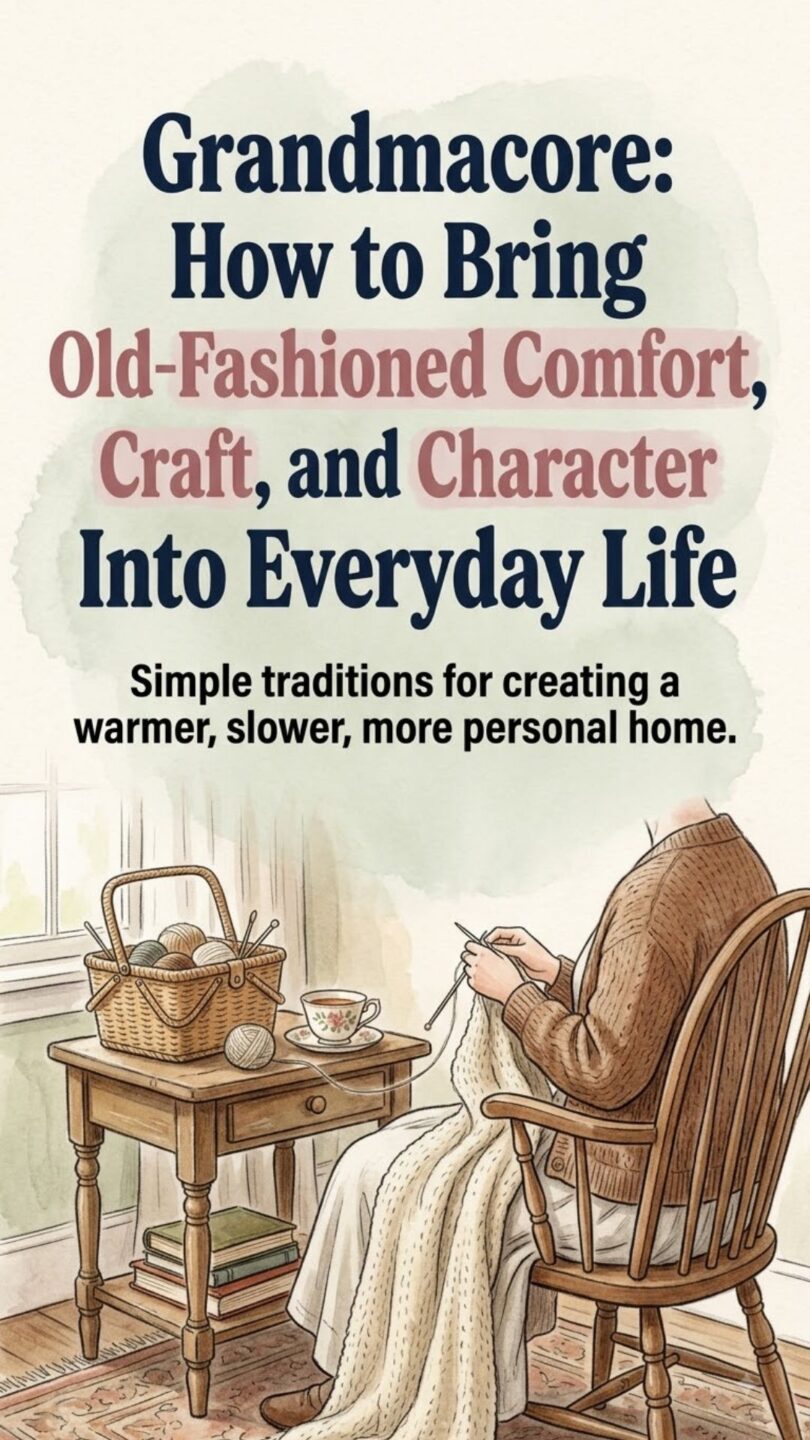
Grandmacore is less about recreating a grandmother’s house exactly and more about recovering the qualities that made those homes feel memorable: comfort, usefulness, handmade details, familiar routines, and objects with a story behind them.
A grandmacore home does not need to look like a carefully staged vintage museum. In fact, the style works best when it feels lived in. A worn wooden table, a stack of well-read books, embroidered linens, a basket of knitting supplies, mismatched dishes, and something baking in the kitchen can create more of the feeling than a room filled with expensive antiques.
The lifestyle side matters just as much as the decorating. Baking, gardening, sewing, mending, preserving food, writing letters, reading, and spending unhurried time with family all fit naturally into grandmacore because they emphasize participation rather than constant consumption.
You Might Also Like:
- Loading posts...
At its best, grandmacore is an invitation to make everyday life warmer, slower, and more personal.
What Does Grandmacore Really Mean?
Grandmacore is a nostalgic aesthetic inspired by the clothing, homes, hobbies, and domestic traditions commonly associated with older generations, especially grandmothers.
Visually, it often includes floral fabrics, vintage furniture, crocheted blankets, patterned dishes, lace, quilts, baskets, books, old lamps, framed photographs, houseplants, and traditional kitchenware.
But reducing grandmacore to decoration misses much of its appeal.
There is also a practical side to the aesthetic. Older household traditions often centered on repairing possessions, making things by hand, cooking at home, using what was available, caring for a garden, and keeping useful objects for years.
You do not need to romanticize every part of the past to appreciate those habits. Life in previous generations was not automatically simpler or easier. Household work could be physically demanding, and many people had fewer conveniences and choices than we do today.
Grandmacore is better understood as selecting worthwhile traditions from the past and adapting them to modern life.
You can use a washing machine and still embroider your own table linens. You can own a smartphone and spend Sunday afternoon making bread. You can live in an apartment and grow herbs in pots on a windowsill.
The goal is not historical accuracy. It is intentional living with a nostalgic touch.
Creating a Grandmacore Home Without Making It Feel Cluttered
A convincing grandmacore interior develops gradually. It should look collected rather than purchased all at once.
Instead of searching for an entire matching furniture set, look for individual pieces with character. A wooden side table, vintage-style lamp, secondhand armchair, framed botanical print, ceramic pitcher, or floral cushion can shift the feeling of a room without requiring a major makeover.
Start With Comfort
Grandmacore rooms are meant to be used.
Choose seating that invites people to stay. Add blankets within reach. Keep a lamp beside the chair where you actually read. Place a small table somewhere convenient for a cup of tea.
A beautiful room that feels too precious to touch misses the point.
Comfortable furniture does not have to be genuinely antique. Older furniture can be wonderful, but sturdy modern pieces can work just as well when combined with softer textiles and collected accessories.
Mix Patterns Carefully
Floral prints are strongly associated with grandmacore, but they are not the only option.
Try combining:
- Small florals with narrow stripes
- Gingham with plain linen
- Botanical prints with muted checks
- Embroidery with solid cotton
- Quilted fabrics with simple neutral upholstery
The easiest way to prevent the room from becoming visually overwhelming is to repeat a few colors throughout the space.
A floral curtain containing sage green, cream, and faded rose, for example, could be paired with a cream sofa, green cushions, and a rose-colored throw.
The patterns can differ while the colors hold everything together.
Use Objects That Have a Purpose
One of the most appealing characteristics of old-fashioned homes is the combination of beauty and usefulness.
A ceramic jug can hold flowers. A basket can store yarn. A decorative tin can keep sewing supplies together. Pretty plates can be displayed and still used for Sunday lunch.
This approach also helps prevent grandmacore from turning into uncontrolled clutter.
Before bringing something home, consider whether you will use it, display it meaningfully, or genuinely enjoy seeing it.
A few treasured objects usually create more character than shelves packed with random vintage-looking decorations.
Add Textiles for Warmth
Textiles can transform a plain room more quickly than almost anything else.
Consider using:
- Crocheted or knitted throws
- Quilts
- Linen tablecloths
- Lace-edged runners
- Floral curtains
- Embroidered cushions
- Cloth napkins
- Cotton or linen tea towels
Handmade textiles are especially appropriate because small imperfections often make them more charming.
If you sew, knit, crochet, quilt, or embroider, your own projects can become part of the room rather than being hidden away when finished.
Even beginners can start simply. A hand-sewn cushion cover or embroidered tea towel can contribute just as much personality as a complicated quilt.
Display Collections With Intention
Grandmacore often includes collections, but thoughtful arrangement makes the difference between charming and chaotic.
Vintage teacups, old books, postcards, plates, baskets, recipe books, ceramic figures, or glass jars can all work.
Try grouping related pieces together instead of scattering them throughout the house.
Three decorative plates on one wall can look deliberate. Twenty unrelated objects squeezed onto every available surface can make cleaning difficult and overwhelm the room.
Collections also feel more meaningful when they develop slowly. Items inherited from relatives, found while traveling, discovered in secondhand shops, or received as gifts naturally accumulate stories.
Those stories are part of what gives grandmacore its warmth.
Old-Fashioned Hobbies That Fit the Grandmacore Lifestyle
You do not need a vintage wardrobe or antique kitchen to practice grandmacore. Spending time on traditional skills may bring you closer to the spirit of the lifestyle than decorating ever could.
Baking and Home Cooking
Simple baking is one of the easiest places to begin.
Banana bread, fruit crumble, biscuits, pies, cookies, bread, and simple cakes all fit naturally into an old-fashioned kitchen atmosphere.
The point is not to prepare complicated recipes every day. Even making one familiar recipe on a quiet weekend can become a comforting household ritual.
Keeping handwritten family recipes can also preserve useful information that might otherwise disappear.
If you inherit a recipe card, consider writing down additional details while someone in the family still remembers them. Older recipes sometimes assume the cook already knows important steps that were never written down.
Knitting and Crochet
Knitting and crochet are practical crafts because the finished projects can actually be used.
Scarves, blankets, hats, dishcloths, shawls, and simple sweaters can become everyday household items or thoughtful gifts.
Beginners do not need to begin with an elaborate project. A small square dishcloth is often more manageable than attempting a full cardigan immediately.
Sewing and Mending
Sewing does not have to mean making an entire wardrobe.
Learning how to sew on a button, repair a small seam, shorten a hem, or patch a worn area can extend the life of clothing and household textiles.
Once those basic skills feel comfortable, projects such as aprons, cushion covers, tote bags, simple skirts, or curtains become much more approachable.
Embroidery and Quilting
Embroidery allows plain fabric to become decorative without requiring expensive equipment. Small floral motifs can be added to napkins, pillowcases, tea towels, aprons, and tablecloths.
Quilting requires more planning, but the same principle applies: useful household textiles can also be creative projects.
Traditional quilts were often connected with reuse because fabric scraps could be incorporated into new pieces. Modern quilters may use both scraps and purpose-bought fabric, depending on the project.
Gardening
Gardening fits grandmacore particularly well because it combines routine, patience, observation, and practical reward.
You do not need a large cottage garden.
A few pots containing herbs, strawberries, flowers, or salad greens can bring the same feeling to a balcony or patio.
If you have more space, combining flowers with vegetables and herbs can create the informal, productive atmosphere often associated with traditional cottage gardens.
Food Preservation: Traditional but Not Casual
Homemade jam, pickles, chutneys, and preserved produce are often associated with old-fashioned homemaking, but food preservation deserves more care than many other nostalgic hobbies.
Recipes for shelf-stable canning should come from reliable, tested preservation guidance because acidity, temperature, processing method, jar size, and processing time can affect safety.
A handwritten family recipe may be emotionally valuable without necessarily meeting modern preservation recommendations.
That does not mean traditional recipes must disappear. Some can be prepared for immediate refrigeration or freezing rather than long-term room-temperature storage.
Grandmacore can respect tradition while still using modern food-safety knowledge.
Grandmacore Fashion: Comfortable, Practical, and Timeless
The clothing associated with grandmacore tends to favor softness, layering, traditional patterns, and pieces that feel familiar rather than trendy.
Common choices include floral dresses, long skirts, knitted cardigans, button-up blouses, high-waisted trousers, wool sweaters, simple cotton shirts, loafers, scarves, quilted jackets, and practical hats.
Natural fibers such as wool, linen, and cotton often suit the look beautifully, but they are not automatically maintenance-free or more durable in every situation. Fabric quality, construction, care, and how the garment is used matter just as much as fiber type.
You also do not need an entirely new wardrobe.
Try starting with what you own.
A plain dress can be paired with a cardigan and loafers. A simple blouse can work with high-waisted trousers. A scarf tied around the neck, hair, or handbag can give an ordinary outfit a more nostalgic character.
Secondhand shopping can be especially useful because older cuts, unusual prints, wool knitwear, leather bags, and classic accessories are often easier to find there than in trend-driven stores.
Grandmacore and Cottagecore Are Similar, but Not Identical
Grandmacore and cottagecore overlap so much that the boundary between them can become blurry.
Both may feature gardening, baking, handmade crafts, flowers, traditional clothing, vintage objects, and slower household routines.
The difference is mostly one of emphasis.
Cottagecore usually romanticizes pastoral or rural domestic life. Its visual language often includes cottages, wildflowers, gardens, countryside landscapes, homemade food, flowing clothing, and an idealized closeness to nature.
Grandmacore focuses more strongly on nostalgic domesticity and the familiar atmosphere associated with an older relative’s home. Think crocheted blankets, recipe boxes, patterned wallpaper, sewing baskets, old books, porcelain dishes, comfortable chairs, homemade cake, and treasured collections.
Cottagecore may make you imagine living in a small cottage surrounded by gardens.
Grandmacore may make you imagine visiting a warm kitchen where someone has saved every useful jar, knows exactly where the sewing kit is kept, and insists that you have something to eat before leaving.
Neither lifestyle requires complete self-sufficiency, and neither has a strict rulebook.
You can easily combine them.
Books That Capture the Grandmacore Mood
Certain classic novels pair naturally with the grandmacore atmosphere because they emphasize home, family, gardens, imagination, domestic life, and close relationships.
Little Women by Louisa May Alcott follows the March sisters as they grow up, face hardships, form ambitions, and negotiate family responsibilities and relationships.
Anne of Green Gables by L. M. Montgomery centers on Anne Shirley, an imaginative orphan who unexpectedly finds a home with siblings Marilla and Matthew Cuthbert on Prince Edward Island.
The Secret Garden by Frances Hodgson Burnett follows Mary Lennox and the transformation that takes place after she discovers a neglected garden. Nature, friendship, responsibility, and emotional change are central to the story.
Reading does not need to be limited to classics, of course. Old cookbooks, gardening manuals, craft books, family memoirs, local histories, and secondhand novels can all become part of a slower reading habit.
How to Practice Grandmacore Without Buying More Stuff
One of the easiest mistakes to make with any aesthetic is turning it into a shopping project.
Grandmacore can actually work in the opposite direction.
Before buying another decorative object, try doing something with what you already have.
Mend a shirt.
Bake something from pantry ingredients.
Wash and use the tablecloth that has been sitting in a cupboard.
Put fresh herbs in an old jar.
Call a relative and ask about a family recipe.
Learn one embroidery stitch.
Repair a loose button.
Borrow a novel from the library.
Grow parsley on a windowsill.
Invite someone over for tea without worrying about whether the house looks perfect.
These small activities create the feeling people are often trying to purchase through decor.
A Home With Memory, Not Just a Vintage Look
Grandmacore is most satisfying when it becomes personal.
A room full of mass-produced objects designed to look old may create the right color palette, but it cannot automatically create the warmth associated with a home that has developed over time.
That character comes from use.
It comes from the blanket you keep reaching for, the cake recipe everyone requests, the chair positioned beside the best reading lamp, the chipped bowl you still love, the herbs growing outside the kitchen door, and the sewing basket that actually contains ongoing projects.
You do not need to reject modern life to enjoy old-fashioned domestic traditions.
Keep the conveniences that make life easier. Choose the older habits that make life richer.
Cook something slowly. Repair instead of replacing when it makes sense. Make something with your hands. Care for the possessions worth keeping. Read more often. Grow what your space allows. Spend time with people without turning every gathering into an event.
That is where grandmacore becomes more than an aesthetic.
It becomes a way of building a home that feels comfortable, useful, welcoming, and unmistakably yours.

Leave a Comment